My Cart
Your Cart 0

    Your cart is empty.

  • Total (Amount) ₹0.00
NCERT · Class 10 · Science

Chapter 11: Electricity

Practice each question, then open the answer or worked solution.

In text 12.6.2

Textbook page 216 · 5 questions
Q1Written answer

Judge the equivalent resistance when the following are connected in parallel – (a) 1 Ω and 106 Ω, (b) 1 Ω, 103 Ω, and 106 Ω.

Show solutionHide solution
Worked solution

(a) When 1 Ω and 106 are connected in parallel, the equivalent resistance is given by
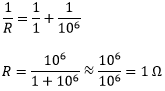
NCERT Solutions for Class 10 Chapter 12 Image 5

Therefore, the equivalent resistance is 1 Ω.

(b) When 1 Ω, 103 Ω, and 106 Ω are connected in parallel, the equivalent resistance is given by
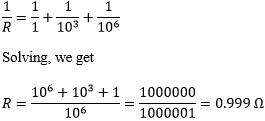
NCERT Solutions for Class 10 Chapter 12 Image 6

Therefore, the equivalent resistance is 0.999 Ω.
Q2Written answer

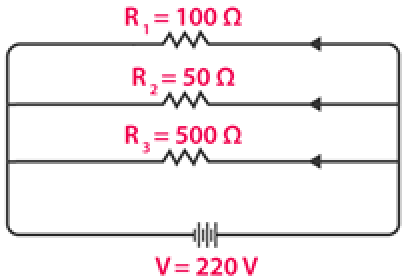
An electric lamp of 100 Ω, a toaster of resistance 50 Ω, and a water filter of resistance 500 Ω are connected in parallel to a 220 V source. What is the resistance of an electric iron connected to the same source that takes as much current as all three appliances, and what is the current through it?

Show solutionHide solution
Worked solution

The electric lamp, the toaster and the water filter connected in parallel to a 220 V source can be shown as using a circuit diagram as follows:

NCERT Solutions for Class 10 Chapter 12 Image 7

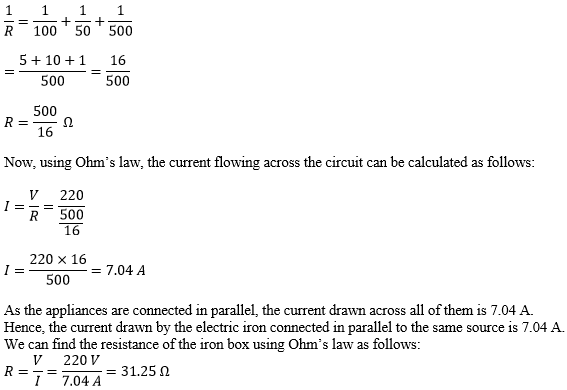
The equivalent resistance of the resistors can be calculated as follows:

NCERT Solutions for Class 10 Chapter 12 Image 8

The resistance of the electric iron box is 31.25 Ω.

Q3Written answer

What are the advantages of connecting electrical devices in parallel with the battery instead of connecting them in series?

Show solutionHide solution
Worked solution

When the electrical devices are connected in parallel there is no division of voltage among the appliances. The potential difference across the devices is equal to supply voltage. Parallel connection of devices also reduces the effective resistance of the circuit.

Q4Written answer

How can three resistors of resistances 2 Ω, 3 Ω, and 6 Ω be connected to give a total resistance of (a) 4 Ω, (b) 1 Ω?

Show solutionHide solution
Worked solution

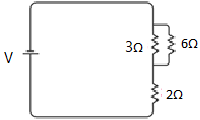
(a) The circuit diagram below shows the connection of three resistors

NCERT Solutions for Class 10 Chapter 12 Image 9

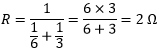
From the circuit above, it is understood that 3 Ω and 6 Ω are connected in parallel. Hence, their equivalent resistance is given by

NCERT Solutions for Class 10 Chapter 12 Image 10

NCERT Solutions for Class 10 Chapter 12 Image 11

The equivalent resistor 2 Ω is in series with the 2 Ω resistor. Now the equivalent resistance can be calculated as follows:

Req= 2 Ω +2 Ω = 4 Ω

Hence, the total resistance of the circuit is 4 Ω.

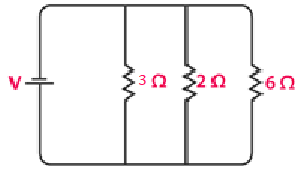
(b) The circuit diagram below, shows the connection of three resistors.

NCERT Solutions for Class 10 Chapter 12 Image 12

From the circuit, it is understood that all the resistors are connected in parallel. Therefore, their equivalent resistance can be calculated as follows:

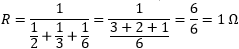
NCERT Solutions for Class 10 Chapter 12 Image 13

The total resistance of the circuit is 1 Ω.

Q5Written answer

What is (a) the highest, (b) the lowest total resistance that can be secured by combinations of four coils of resistance 4 Ω, 8 Ω, 12 Ω, 24 Ω?

Show solutionHide solution
Worked solution

(a) If the four resistors are connected in series, their total resistance will be the sum of their individual resistances and it will be the highest. The total equivalent resistance of the resistors connected in series will be 4 Ω + 8 Ω + 12 Ω + 24 Ω = 48 Ω.

(b) If the resistors are connected in parallel, then their equivalent resistances will be the lowest.

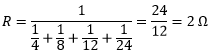
Their equivalent resistance connected in parallel is

NCERT Solutions for Class 10 Chapter 12 Image 14

Hence, the lowest total resistance is 2 Ω.