My Cart
Your Cart 0

    Your cart is empty.

  • Total (Amount) ₹0.00
NCERT · Class 10 · Science

Chapter 11: Electricity

Practice each question, then open the answer or worked solution.

In text 12.6

Textbook page 213 · 2 questions
Q1Written answer

Draw a schematic diagram of a circuit consisting of a battery of three cells of 2 V each, a 5 Ω resistor, an 8 Ω resistor, and a 12 Ω resistor, and a plug key, all connected in series.

Show solutionHide solution
Worked solution

A battery of three cells of 2 V each equals to battery of potential 6 V. The circuit diagram below shows three resistors of resistance 12 Ω, 8 Ω and 5 Ω connected in series along with a battery of potential 6 V.
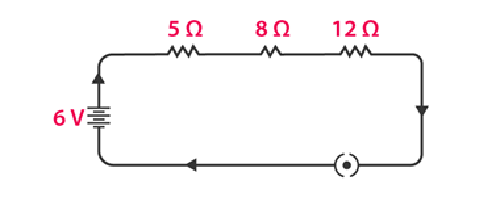
NCERT Solutions for Class 10 Chapter 12 Image 3

Q2Written answer

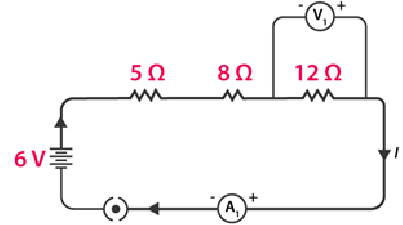
Redraw the circuit of Question 1, putting in an ammeter to measure the current through the resistors and a voltmeter to measure the potential difference across the 12 Ω resistor. What would be the readings in the ammeter and the voltmeter?

Show solutionHide solution
Worked solution

An ammeter should always be connected in series with resistors while the voltmeter should be connected in parallel to the resistor to measure the potential difference as shown in the figure below.

NCERT Solutions for Class 10 Chapter 12 Image 4

Using Ohm’s Law, we can obtain the reading of the ammeter and the voltmeter.

The total resistance of the circuit is 5 Ω + 8 Ω +12 Ω = 25 Ω.

We know that the potential difference of the circuit is 6 V, hence the current flowing through the circuit or the resistors can be calculated as follows:

I = V/R = 6/25 = 0.24A

Let the potential difference across the 12 Ω resistor be V1.

From the obtained current V1 can be calculated as follows:

V1 = 0.24A × 12 Ω = 2.88 V

Therefore, the ammeter reading will be 0.24 A and the voltmeter reading be 2.88 V.