My Cart
Your Cart 0

    Your cart is empty.

  • Total (Amount) ₹0.00
NCERT · Class 10 · Science

Chapter 11: Electricity

Practice each question, then open the answer or worked solution.

In text 12.5

Textbook page 209 · 5 questions
Q1Written answer

On what factors does the resistance of a conductor depend?

Show solutionHide solution
Worked solution

The resistance of the conductor depends on the following factors:

a. Temperature of the conductor

b. Cross-sectional area of the conductor

c. Length of the conductor

d. Nature of the material of the conductor
Q2Written answer

Will current flow more easily through a thick wire or a thin wire of the same material, when connected to the same source? Why?

Show solutionHide solution
Worked solution

Resistance is given by the equation,

R = ρ l/A

where,

ρ is the resistivity of the material of the wire,

l is the length of the wire

A is the area of the cross-section of the wire.

From the equation, it is evident that the area of the cross-section of wire is inversely proportional to the resistance. Therefore, the thinner the wire, the more the resistance and vice versa. Hence, current flows more easily through a thick wire than a thin wire.

Q3Written answer

Let the resistance of an electrical component remain constant while the potential difference across the two ends of the component decreases to half of its former value. What change will occur in the current through it?

Show solutionHide solution
Worked solution

The change in the current flowing through the electrical component can be determined by Ohm’s Law.

According to Ohm’s Law, the current is given by

I = V/R

Now, the potential difference is reduced to half keeping the resistance constant,

Let the new voltage be V’ = V/2

Let the new resistance be R’ = R and the new amount of current be I’.

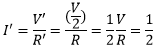
The change in the current can be determined using Ohm’s law as follows:

NCERT Solutions for Class 10 Chapter 12 Image 2

Therefore, the current flowing the electrical component is reduced by half.

Q4Written answer

Why are coils of electric toasters and electric irons made of an alloy rather than a pure metal?

Show solutionHide solution
Worked solution

The melting point of an alloy is much higher than a pure metal because of its high resistivity. At high temperatures, alloys do not melt readily. Therefore, alloys are used in heating appliances such as electric toasters and electric irons.

Q5Written answer

Use the data in the table given below and answer the following questions.

Material Resistivity
Conductors Silver 1.60 × 10⁻⁸
Copper 1.62 × 10⁻⁸
Aluminium 2.63 × 10⁻⁸
Tungsten 5.20 × 10⁻⁸
Nickel 6.84 × 10⁻⁸
Iron 10.0 × 10⁻⁸
Chromium 12.9 × 10⁻⁸
Mercury 94.0 × 10⁻⁸
Manganese 1.84 × 10⁻⁶
Alloys Constantan 49 × 10–6
Manganin 44 × 10–6
Nichrome 100 × 10–6
Insulators Glass 1010 – 1014
Hard rubber 1013 – 1016
Ebonite 1015 – 1017
Diamond 1012 – 1013
Paper (dry) 1012

a. Which among iron and mercury is a better conductor?

b. Which material is the best conductor?

Show solutionHide solution
Worked solution

a. Iron is a better conductor than mercury because the resistivity of mercury is more than the resistivity of iron.

b. Among all the materials listed in the table, silver is the best conductor because the resistivity of silver is lowest among all, i.e., 1.60 × 10⁻⁸.