Difficulty distribution
How the classified questions are distributed by difficulty.
Your cart is empty.
Practice Semiconductor Devices And Logic Gates - Modern Physics - Physics previous year questions organised from real papers, with year-wise coverage and clear topic navigation.
Every graph below is calculated only from this selection.
Year-wise coverage for Semiconductor Devices And Logic Gates. Each bar uses a separate theme-derived color.
How the classified questions are distributed by difficulty.
MCQ, numerical, multiple-select and other formats found in these papers.
Top subjects by unique question coverage.
Top topics across the included previous year papers.
Top subtopics inside this exact selection.
Question coverage for the most populated papers. Every active PYP paper remains listed below.
Newest papers appear first. Sort by year, question coverage or name.
| Paper | Year / session | Questions in this view | Open |
|---|---|---|---|
| TG EAPCET 2025 ONLINE 2ND MAY EVENING SHIFT | 2025 | 2 | View paper |
| TG EAPCET 2025 ONLINE 2ND MAY MORNING SHIFT | 2025 | 2 | View paper |
| TG EAPCET 2025 ONLINE 3RD MAY EVENING SHIFT | 2025 | 2 | View paper |
| TG EAPCET 2025 ONLINE 3RD MAY MORNING SHIFT | 2025 | 2 | View paper |
| TG EAPCET 2025 ONLINE 4TH MAY EVENING SHIFT | 2025 | 2 | View paper |
| TG EAPCET 2025 ONLINE 4TH MAY MORNING SHIFT | 2025 | 2 | View paper |
| TG EAPCET 2024 (Online) 9th May Morning Shift | 2024 | 2 | View paper |
| TG EAPCET 2024 ONLINE 10TH MAY EVENING SHIFT | 2024 | 2 | View paper |
| TG EAPCET 2024 ONLINE 10TH MAY MORNING SHIFT | 2024 | 2 | View paper |
| TG EAPCET 2024 ONLINE 11TH MAY MORNING SHIFT | 2024 | 2 | View paper |
| TG EAPCET 2024 ONLINE 9TH MAY EVENING SHIFT | 2024 | 2 | View paper |
Practice every matching question in batches of 20, with every available option.
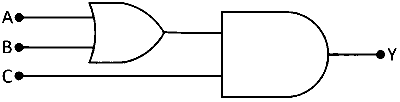
To get output 1 for the following logic circuit, the correct choice of the inputs is 
Match the devices given in List-I with their uses given in List-II.
| List-I | List -II |
| a Transistor | e Filter circuit |
| b Diode | f Voltage regulator |
| c Zener diode | g Rectifier |
| d Capacitor | h Amplifier |
The correct answer is
A zener diode of zener voltage 30 V is connected in circuit as shown in the figure. The maximum current through the zener diode is


An electron in $n$-region of a $p-n$ junction moves towards the junction with a speed of $5 \times 10^5 \mathrm{~ms}^{-1}$. If the barrier potential of the junction is 0.45 V , then the speed with which the electron enters the $p$-region after penetration through the barrier is
(Charge of the electron $=1.6 \times 10^{-19} \mathrm{C}$ and mass of the electron $=9 \times 10^{-31} \mathrm{~kg}$ )
$10^{10}$ electrons enter the emitter of a junction transistor in a time of $0.4 \mu \mathrm{~s}$. If $5 \%$ of the electrons are lost in the base, then the collector current is
The power gain and voltage gain of a transistor connected in common emitter configuration are 1800 and 60 respectively. If the change in the emitter current is 0.62 mA , then the change in the collector current is
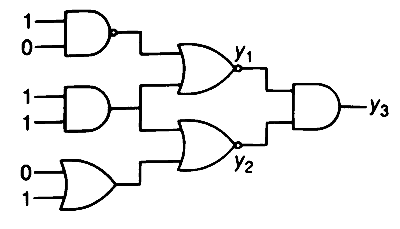
Six logic gates are connected as shown in the figure. The values of $y_1, y_2$ and $y_3$ respectively are

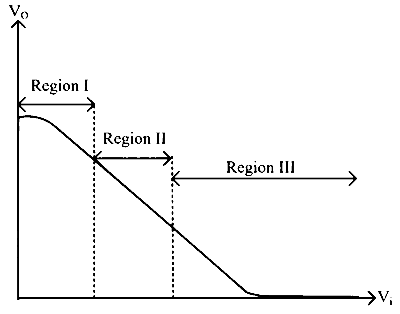
The graph between the input voltage $\left(V_i\right)$ and the output voltage ( $V_o$ ) of a transistor connected in common emitter configuration is shown in the figure. The active, saturation and cutoff regions of the transistor are respectively

Which of the following logic gates is a universal gate?
According to a graph drawn between the input and output voltages of a transistor connected in common emitter configuration, the region in which transistor acts as a switch is
If the energy gap of a semiconductor used for the fabrication of an LED is nearly 1.9 eV , then the color of the light emitted by the LED is
The current amplification factor of a transistor in common emitter configuration is 80 . If the emitter current is 2.43 mA , then the base current is
The negative feedback in an amplifier
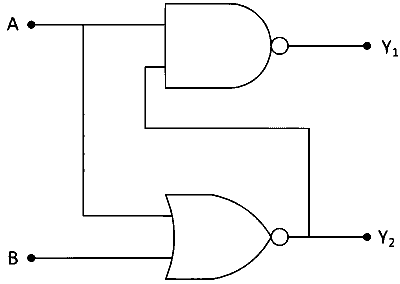
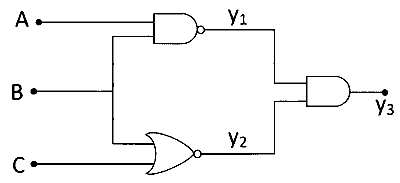
Three logic gates are connected as shown in the figure. If the inputs are $A=1, B=0$ and $C=1$, then the values of $y_1, y_2$ and $y_3$ respectively are

At absolute zero temperature, a semiconductor behaves like
Showing 20 of 22 questions