Exam Details
TG EAPCET 2025 ONLINE 2ND MAY MORNING SHIFT
Review the key details, then start the test when you are ready. You can also open the full package to see related papers.
Questions
160
Duration
180 mins
Package
TG EAPCET- Previous Year Papers
Paper pattern & analysis
Filter this paper by subject, topic or subtopic. Every graph updates from the selected questions.
Topic distribution
Subtopic distribution
Difficulty distribution
160questions
Not classified
120
75%
Medium
21
13.1%
Easy
17
10.6%
Hard
2
1.3%
Question type distribution
160questions
MCQ
159
99.4%
MSQ
1
0.6%
Syllabus
Full Syllabus
Practise paper questions
Choose your answer to check it. Log in to view the explanation. For a timed attempt and result, start the exam.
PYP
TG EAPCET 2025 ONLINE 2ND MAY MORNING SHIFT
A helicopter flying horizontally with a velocity of $288 \mathrm{~km} / \mathrm{h}$ drops a bomb. If the line joining the point of dropping the bomb and the point where bomb hits the ground makes an angle $45^{\circ}$ with the horizontal, then the height at which the bomb was dropped is (Acceleration due to gravity $=10 \mathrm{~ms}^{-2}$ )
PYP
TG EAPCET 2025 ONLINE 2ND MAY MORNING SHIFT
If $A, B$ and $C$ are three different physical quantities with different dimensional formulae, then the combination which can never give a proper physical quantity is
PYP
TG EAPCET 2025 ONLINE 2ND MAY MORNING SHIFT
A particle is acted upon by a force of constant magnitude such that its velocity and acceleration are always perpendicular to each other, then its
PYP
TG EAPCET 2025 ONLINE 2ND MAY MORNING SHIFT
The initial and final velocities of a body projected vertically from the ground are $20 \mathrm{~ms}^{-1}$ and $18 \mathrm{~ms}^{-1}$ respectively. The maximum height reached by the body is (Acceleration due to gravity $=10 \mathrm{~ms}^{-2}$ )
PYP
TG EAPCET 2025 ONLINE 2ND MAY MORNING SHIFT
Two blocks of masses in the ratio $m: n$ are connected by a light inextensible string passing over a frictionless fixed pulley. If the system of the blocks is released from rest, then the acceleration of the centre of mass of the system of the blocks is
( $g=$ acceleration due to gravity)
PYP
TG EAPCET 2025 ONLINE 2ND MAY MORNING SHIFT
If the moment of inertia of a uniform solid cylinder about the axis of the cylinder is $\frac{1}{n}$ times its moment of inertia about an axis passing through its midpoint and perpendicular to its length, then the ratio of the length and radius of the cylinder is
PYP
TG EAPCET 2025 ONLINE 2ND MAY MORNING SHIFT
A man of mass 60 kg is standing in a lift moving up with a retardation of $2.8 \mathrm{~ms}^{-2}$. The apparent weight of the man is
PYP
TG EAPCET 2025 ONLINE 2ND MAY MORNING SHIFT
The driver of a bus moving with a velocity of $72 \mathrm{~km} / \mathrm{h}$ observes a boy walking across the road at a distance of 50 m in front of the bus and decelerates the bus at $5 \mathrm{~ms}^{-2}$ by applying brakes and is just able to avoid an accident. The reaction time of the driver is
PYP
TG EAPCET 2025 ONLINE 2ND MAY MORNING SHIFT
If a brass sphere of radius 36 cm is submerged in a lake at a depth where the pressure is $10^7 \mathrm{~Pa}$, then the change in the radius of the sphere is
(Bulk modulus of brass $=60 \mathrm{GPa}$ )
PYP
TG EAPCET 2025 ONLINE 2ND MAY MORNING SHIFT
The work done in blowing a soap bubble of diameter 3 cm is (surface tension of soap solution $=0.035 \mathrm{Nm}^{-1}$ )
PYP
TG EAPCET 2025 ONLINE 2ND MAY MORNING SHIFT
If a body is projected vertically from the surface of the Earth with a speed of $8000 \mathrm{~ms}^{-1}$, then the maximum height reached by the body is
(Radius of the Earth $=6400 \mathrm{~km}$ and acceleration due to gravity $=10 \mathrm{~ms}^{-2}$ )
PYP
TG EAPCET 2025 ONLINE 2ND MAY MORNING SHIFT
The fundamental frequency of transverse wave of a stretched string subjected to a tension $T_1$ is 300 Hz . If the length of the string is doubled and subjected to a tension of $T_2$, the fundamental frequency of the transverse wave in the string becomes 100 Hz , then $T_2: T_1=$
(Linear density of the string is constant)
PYP
TG EAPCET 2025 ONLINE 2ND MAY MORNING SHIFT
If the terminal velocity of a metal sphere of mass 8 g falling through a liquid is $3 \mathrm{cms}^{-1}$, then the terminal velocity of another sphere of mass 64 g made of the same metal falling through same liquid is
PYP
TG EAPCET 2025 ONLINE 2ND MAY MORNING SHIFT
The amplitude of a particle executing simple harmonic motion is 6 cm . The distance of the point from the mean position at which the ratio of the potential and kinetic energies of the particle becomes $4: 5$ is
PYP
TG EAPCET 2025 ONLINE 2ND MAY MORNING SHIFT
The heat required to convert 8 g of ice at a temperature of $-20^{\circ} \mathrm{C}$ to steam at $100^{\circ} \mathrm{C}$ is [specific heat capacity of ice $=2100 \mathrm{Jkg}^{-1} \mathrm{~K}^{-1}$, specific heat capacity of water $=4200 \mathrm{~J} \mathrm{~kg}^{-1} \mathrm{~K}^{-1}$, latent heat of fusion of ice $=336 \times 10^3 \mathrm{~J} \mathrm{~kg}^{-1}$ and latent heat of steam $\left.=2.268 \times 10^6 \mathrm{Jkg}^{-1}\right]$
PYP
TG EAPCET 2025 ONLINE 2ND MAY MORNING SHIFT
The molar specific heat of a monoatomic gas at constant pressure is
(Universal gas constant $=8.3 \mathrm{~J} \mathrm{~mol}^{-1} \mathrm{~K}^{-1}$ )
PYP
TG EAPCET 2025 ONLINE 2ND MAY MORNING SHIFT
The angle of a prism made of a material of refractive index $\sqrt{2}$ is $90^{\circ}$. The angle of incidence for a light ray on the first face of the prism such that the light ray suffers total internal reflection at the second face is
PYP
TG EAPCET 2025 ONLINE 2ND MAY MORNING SHIFT
Two moles of a gas at a temperature of $327^{\circ} \mathrm{C}$ expands adiabatically such that its volume increases by $700 \%$. If the ratio of the specific heat capacities of the gas is $\frac{4}{3}$, then the work done by the gas is (Universal gas constant $=8.3 \mathrm{~J} \mathrm{~mol}^{-1} \mathrm{~K}^{-1}$ )
PYP
TG EAPCET 2025 ONLINE 2ND MAY MORNING SHIFT
The length of a metal rod is 20 cm and its area of cross-section is $4 \mathrm{~cm}^2$. If one end of the rod is kept at a temperature of $100^{\circ} \mathrm{C}$ and the other end is kept in ice at $0^{\circ} \mathrm{C}$, then the mass of the ice melted in 7 minutes is (Thermal conductivity of the metal $=90 \mathrm{Wm}^{-1} \mathrm{~K}^{-1}$ and latent heat of fusion of ice $=336 \times 10^3 \mathrm{Jkg}^{-1}$ )
PYP
TG EAPCET 2025 ONLINE 2ND MAY MORNING SHIFT
Two sound waves each of intensity $I$ are superimposed. If the phase difference between the waves is $\frac{\pi}{2}$, then the intensity of the resultant wave is
PYP
TG EAPCET 2025 ONLINE 2ND MAY MORNING SHIFT
The total magnification produced by a compound microscope is 24 when the final image is formed at the least distance of distinct vision. If the focal length of the eyepiece is 5 cm , the magnification produced by the objective is
PYP
TG EAPCET 2025 ONLINE 2ND MAY MORNING SHIFT
As shown in the figure, a dielectric of constant $K$ is placed between the plates of a parallel plate capacitor and is charged to a potential $V$ using a battery. If the dielectric is pulled out after disconnecting the battery from the capacitor, the final potential difference across the plates of the capacitor is

PYP
TG EAPCET 2025 ONLINE 2ND MAY MORNING SHIFT
A thin spherical shell of radius $R$ and surface charge density $\sigma$ is placed in a cube of side $5 R$ with their centers coinciding. The electric flux through one face of the cube is $\left(\varepsilon_0=\right.$ Permittivity of free space $)$
PYP
TG EAPCET 2025 ONLINE 2ND MAY MORNING SHIFT
The power of an electric motor is 242 W when connected to a 220 V supply. When the motor is operated at 200 V , the current drawn by it is
PYP
TG EAPCET 2025 ONLINE 2ND MAY MORNING SHIFT
For any fixed distance, the electromagnetic force between two protons is $10^n$ times of the gravitational force between them. Then, $n=$
PYP
TG EAPCET 2025 ONLINE 2ND MAY MORNING SHIFT
In Young's double slit experiment with light of wavelength $\lambda$, the intensity of light at a point on the screen where the path difference becomes $\frac{\lambda}{3}$ is ( $I$ is intensity of the central bright fringe)
PYP
TG EAPCET 2025 ONLINE 2ND MAY MORNING SHIFT
A proton and an alpha particle moving with equal speeds enter normally into a uniform magnetic field. The ratio of times taken by the proton and the alpha particle to make one complete revolution in the magnetic field is
PYP
TG EAPCET 2025 ONLINE 2ND MAY MORNING SHIFT
The drift speed of electrons in a material is found to be $0.3 \mathrm{~ms}^{-1}$ when an electric field of $2 \mathrm{Vm}^{-1}$ is applied across it. The electron mobility (in $\mathrm{m}^2 \mathrm{~V}^{-1} \mathrm{~s}^{-1}$ ) in the material is
PYP
TG EAPCET 2025 ONLINE 2ND MAY MORNING SHIFT
The frequency of an alternating voltage is 50 Hz . The time taken for instantaneous voltage to increase from zero to half of its peak voltage is
PYP
TG EAPCET 2025 ONLINE 2ND MAY MORNING SHIFT
A solenoid of length 50 cm and radius 10 cm has two closely wound layers of windings 100 turns each. If a current of 2.5 A is passing through the windings, the magnetic field (in $10^{-4} \mathrm{~T}$ ) at a point 5 cm from the axis is
PYP
TG EAPCET 2025 ONLINE 2ND MAY MORNING SHIFT
The plane of a circular coil of resistance $7.5 \Omega$ is placed perpendicular to a uniform magnetic field. The flux $\phi$ (in weber) through the coil varies with time $t$ (in second) as $\phi=2 t^2+3 t-2$. The induced power in the coil at time $t=3 \mathrm{~s}$ is
PYP
TG EAPCET 2025 ONLINE 2ND MAY MORNING SHIFT
If the magnetic susceptibility of a substance is 0.6 , then the ratio of permeability of the substance and permeability of free space is
PYP
TG EAPCET 2025 ONLINE 2ND MAY MORNING SHIFT
The power gain and voltage gain of a transistor connected in common emitter configuration are 1800 and 60 respectively. If the change in the emitter current is 0.62 mA , then the change in the collector current is
PYP
TG EAPCET 2025 ONLINE 2ND MAY MORNING SHIFT
If $96.875 \%$ of a radioactive substance decays in 10 days, then the half life of the substance is (in days)
PYP
TG EAPCET 2025 ONLINE 2ND MAY MORNING SHIFT
If the difference in the frequencies of the first and second lines of Lyman series of hydrogen atom is $f$, then the difference in frequencies of the first and second lines of Balmer series of hydrogen atom is
PYP
TG EAPCET 2025 ONLINE 2ND MAY MORNING SHIFT
The dielectric constant of a medium is 8 and its relative permeability is 200 . If an electromagnetic wave of frequency 100 MHz travels in this medium, then its wavelength is
PYP
TG EAPCET 2025 ONLINE 2ND MAY MORNING SHIFT
Photons of energy 4.5 eV are incident on a photosensitive material of work function 3 eV . The de-Broglie wavelength associated with the photoelectrons emitted with maximum kinetic energy is nearly
PYP
TG EAPCET 2025 ONLINE 2ND MAY MORNING SHIFT
The average energy of a neutron produced in the fission of ${ }_{92}^{235} \mathrm{U}$ is
PYP
TG EAPCET 2025 ONLINE 2ND MAY MORNING SHIFT
When electromagnetic radiation of wavelength 310 nm falls on the surface of a metal having work function 3.55 eV , the velocity of photoelectrons emitted is $x \times 10^5 \mathrm{~ms}^{-1}$. The value of $x$ is (Nearest integer) $\left(m_e=9 \times 10^{-31} \mathrm{~kg}\right)$
PYP
TG EAPCET 2025 ONLINE 2ND MAY MORNING SHIFT
At 298 K , the enthalpy change ( in kJ ) for the reaction given below is
$$ \mathrm{CH}_4(g)+\mathrm{O}_2(g) \longrightarrow \mathrm{C}(s)+2 \mathrm{H}_2 \mathrm{O}(l) $$
$$ \begin{aligned} Given:\mathrm{H}_2(g)+\frac{1}{2} \mathrm{O}_2(g) & \longrightarrow \mathrm{H}_2 \mathrm{O}(l) ; \Delta H^{\ominus}=-286 \mathrm{~kJ} \\ \mathrm{C}(s)+\mathrm{O}_2(g) & \longrightarrow \mathrm{CO}_2(g) ; \Delta H^{\ominus}=-394 \mathrm{~kJ} \\ \mathrm{CH}_4(g)+2 \mathrm{O}_2(g) & \longrightarrow \mathrm{CO}_2(g)+2 \mathrm{H}_2 \mathrm{O}(l) \Delta H^{\ominus}=-890 \mathrm{~kJ}\end{aligned} $$
PYP
TG EAPCET 2025 ONLINE 2ND MAY MORNING SHIFT
The radius of stationary state $(n=2)$ of hydrogen atom is $x \mathrm{pm}$. The radius of stationary state $(n=3)$ of $\mathrm{He}^{+}$ion (in pm) is
PYP
TG EAPCET 2025 ONLINE 2ND MAY MORNING SHIFT
The RMS velocity of dihydrogen is $\sqrt{7}$ times more than that of dinitrogen. If $T_{\mathrm{H}_2}$ and $T_{\mathrm{N}_2}$ are the temperatures of dihydrogen and dinitrogen, then the correct relationship between them is
PYP
TG EAPCET 2025 ONLINE 2ND MAY MORNING SHIFT
For commercial telephonic communication, the frequency range adequate for speech signals is
PYP
TG EAPCET 2025 ONLINE 2ND MAY MORNING SHIFT
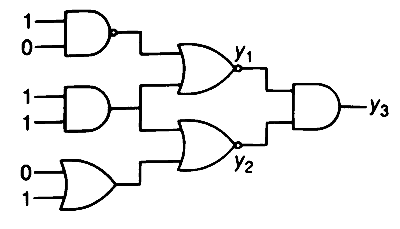
Six logic gates are connected as shown in the figure. The values of $y_1, y_2$ and $y_3$ respectively are
PYP
TG EAPCET 2025 ONLINE 2ND MAY MORNING SHIFT
For the reaction $\mathrm{N}_2 \mathrm{O}_4(g) \rightleftharpoons 2 \mathrm{NO}_2(g)$, the correct relation between degree of dissociation $(\alpha)$ of $\mathrm{N}_2 \mathrm{O}_4(g)$ and equilibrium constant, $K_p$ is ( $p=$ total pressure of mixture)
PYP
TG EAPCET 2025 ONLINE 2ND MAY MORNING SHIFT
At 298 K , if emf of the cell corresponding to the reaction $\mathrm{Zn}(s)+2 \mathrm{H}^{+}(a q) \longrightarrow \mathrm{Zn}^{2+}(0.01 \mathrm{M})+\mathrm{H}_2(g) (1 \mathrm{~atm})$ is 0.28 V , then the pH of the solution at the hydrogen electrode is $\left(\frac{2.303 R T}{F}=0.06 \mathrm{~V}\right)$, $\left(E_{\mathrm{Zn}^{2+} / \mathrm{Zn}}^{\circ}=-0.76 \mathrm{~V}\right)$
PYP
TG EAPCET 2025 ONLINE 2ND MAY MORNING SHIFT
Which of the following solution has highest amount of solute?
PYP
TG EAPCET 2025 ONLINE 2ND MAY MORNING SHIFT
Observe the following statements
Statement I : The boiling point of 0.1 M urea solution is less than that of 0.1 M KCl solution.
Statement II : Elevation of boiling point is inversely proportional to molar mass of solute.
The correct answer is
PYP
TG EAPCET 2025 ONLINE 2ND MAY MORNING SHIFT
A substance has a density of $2 \mathrm{~g} \mathrm{~cm}^{-3}$. It crystallises in the fcc crystal with an edge length of 600 pm . The molar mass of the substance (in $\mathrm{g} \mathrm{mol}^{-1}$ ) is $\left(N_A=6 \times 10^{23} \mathrm{~mol}^{-1}\right)$
PYP
TG EAPCET 2025 ONLINE 2ND MAY MORNING SHIFT
In acidic medium one mole each of $\mathrm{MnO}_4^{-}$and $\mathrm{Cr}_2 \mathrm{O}_7^{2-}$ is reduce by $x$ and $y$ moles of ferrous ions. The sum of $x$ and $y$ is
PYP
TG EAPCET 2025 ONLINE 2ND MAY MORNING SHIFT
Which of the following is not correct about Freundlich adsorption isotherm?
PYP
TG EAPCET 2025 ONLINE 2ND MAY MORNING SHIFT
Identify the pair of molecules in which the hybridisation of the central atom is $s p^2$ with bent geometry.
PYP
TG EAPCET 2025 ONLINE 2ND MAY MORNING SHIFT
For the reaction $R \rightarrow P$, half life is independent of initial concentration of the reactant, $R$. Which one of the following graphs is not correct for the reaction?
PYP
TG EAPCET 2025 ONLINE 2ND MAY MORNING SHIFT
Observe the following oxides. The number of amphoteric oxides from the given list is $\mathrm{CO}, \mathrm{B}_2 \mathrm{O}_3, \mathrm{SnO}_2, \mathrm{PbO}_2, \mathrm{Ga}_2 \mathrm{O}_3, \mathrm{SnO}, \mathrm{PbO}, \mathrm{CO}_2$
PYP
TG EAPCET 2025 ONLINE 2ND MAY MORNING SHIFT
In which of the following options, elements are correctly arranged in the increasing order of their atomic radius?
PYP
TG EAPCET 2025 ONLINE 2ND MAY MORNING SHIFT
The correct order of atomic radii of group 13 elements is
PYP
TG EAPCET 2025 ONLINE 2ND MAY MORNING SHIFT
$A, B C, D$ and $E$ are elements with atomic numbers 13 , $11,9,7$ and 16 respectively. Among these elements, ion of an element $X$ has largest size and ion of an element $Y$ has smallest size. $X$ and $Y$ are respectively.(Assume that all ions have nearest inert gas configuration)
PYP
TG EAPCET 2025 ONLINE 2ND MAY MORNING SHIFT
Oxidation state of hydrogen in compound $X$ is -1 and in compound $Y$ is $+1 . X$ and $Y$ are respectively
PYP
TG EAPCET 2025 ONLINE 2ND MAY MORNING SHIFT
Xenon hexafluoride on partial hydrolysis gives ' $X$ ' and HF . The shape of ' $X$ ' is
PYP
TG EAPCET 2025 ONLINE 2ND MAY MORNING SHIFT
$$ \text { Match the following } $$
| $$ \text { Lis- I (Chemical) } $$ |
$$ \text { List-II (Use) } $$ |
||
|---|---|---|---|
| A. | KOH | I. | Coolant |
| B. | $\mathrm{Na}(l)$ | II. | Antacid |
| C. | Li | III. | Electrochemical cells |
| D. | $\mathrm{Mg}(\mathrm{OH})_2$ | IV | Absorbent for $\mathrm{CO}_2$ |
The correct answer is
PYP
TG EAPCET 2025 ONLINE 2ND MAY MORNING SHIFT
Phosphorus on reaction with sulphuryl chloride gives a compound $X$, which on complete hydrolysis gives $Y$. $X$ and $Y$ are respectively.
PYP
TG EAPCET 2025 ONLINE 2ND MAY MORNING SHIFT
When burnt in excess of oxygen, sodium forms a compound $X$ and potassium forms a compound $Y$. The magnetic natures of $X$ and $Y$ respectively are
PYP
TG EAPCET 2025 ONLINE 2ND MAY MORNING SHIFT
Consider the following statements
I. In the conversion of $\mathrm{O}_2$ to $\mathrm{O}_2^{2+}$ bond order decreases.
II. In the conversion of $\mathrm{O}_2$ to $\mathrm{O}_2^{2+}$ magnetic property is not changed.
III. In the conversion of $\mathrm{O}_2$ to $\mathrm{O}_2^{2+}$ bond length decreases.
IV. $\mathrm{O}_2^{2-}$ and $\mathrm{B}_2$ have same bond order.
Identify the correct statements
PYP
TG EAPCET 2025 ONLINE 2ND MAY MORNING SHIFT
Identify the reaction, which is not related to extraction of copper
PYP
TG EAPCET 2025 ONLINE 2ND MAY MORNING SHIFT
Which one of the following represents hyperconjugation effect?
PYP
TG EAPCET 2025 ONLINE 2ND MAY MORNING SHIFT
Which of the following pairs of oxoacids have basicity as 2?
PYP
TG EAPCET 2025 ONLINE 2ND MAY MORNING SHIFT
Which one of the following is not an ambidenate ligand?
PYP
TG EAPCET 2025 ONLINE 2ND MAY MORNING SHIFT
Among the following compounds, which one is not primarily responsible for depletion of ozone layer in stratosphere?
PYP
TG EAPCET 2025 ONLINE 2ND MAY MORNING SHIFT
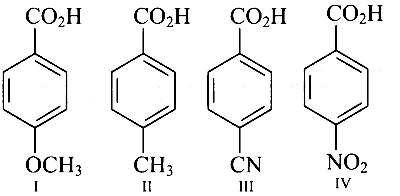
The increasing order of acidic strength of the following in aqueous solution is
PYP
TG EAPCET 2025 ONLINE 2ND MAY MORNING SHIFT
$$ \left(\mathrm{CH}_3\right)_3 \mathrm{CH} \xrightarrow{\mathrm{KMnO}_4} X \xrightarrow[573 \mathrm{~K}]{\mathrm{Cu}} Y $$
The number of $s p^3$ and $s p^2$ carbons in $Y$ are respectively
PYP
TG EAPCET 2025 ONLINE 2ND MAY MORNING SHIFT
The increasing order of boiling points of the following is
$$ \begin{array}{cccc} \mathrm{CH}_3-\mathrm{O}-\mathrm{CH}_3 & \mathrm{CH}_3 \mathrm{CHO} & \mathrm{CH}_3 \mathrm{CH}_2 \mathrm{CH}_3 & \mathrm{CH}_3 \mathrm{CH}_2 \mathrm{OH} \\ \text { I } & \text { II } & \text { III } & \text { IV } \end{array} $$
PYP
TG EAPCET 2025 ONLINE 2ND MAY MORNING SHIFT
Consider the following reaction sequence. $(A)$ and $(C)$ are
$$ \mathrm{CH}_3 \mathrm{CHO} \xrightarrow[\text { (ii) } \mathrm{H}_2 \mathrm{O} / \mathrm{H}^{+}]{\text {(i) } \mathrm{CH}_3 \mathrm{MgBr}}(A) \xrightarrow{\mathrm{H}_5 \mathrm{SO}_4 . \Delta}(B) \xrightarrow[\text { (ii) } \mathrm{H}_2 \mathrm{O}, \mathrm{H}_2 \mathrm{O}_2 / \mathrm{OH}^{-}]{\text {(i) } \mathrm{B}_3 \mathrm{H}_6}(C) $$PYP
TG EAPCET 2025 ONLINE 2ND MAY MORNING SHIFT
Which of the following is the most reactive towards $\mathrm{S}_{\mathrm{N}} 1$ mechanism?
PYP
TG EAPCET 2025 ONLINE 2ND MAY MORNING SHIFT
Consider the following sequence of reaction. In ' $Z$ ' the number of $s p^3$ carbons is ' $a$ ' and $s p^2$ carbons is ' $b$ '. Value of $(a+b)$ is

PYP
TG EAPCET 2025 ONLINE 2ND MAY MORNING SHIFT
For the alkyne with formula $\mathrm{C}_6 \mathrm{H}_{10}$, the number of alkynes with acidic hydrogens is $x$ and number of alkynes with no acidic hydrogens is $y . x$ and $y$ are respectively
PYP
TG EAPCET 2025 ONLINE 2ND MAY MORNING SHIFT
Which of the following hormones is an example of polypeptide?
PYP
TG EAPCET 2025 ONLINE 2ND MAY MORNING SHIFT
The major products $P$ and $Q$ from the following reactions are

PYP
TG EAPCET 2025 ONLINE 2ND MAY MORNING SHIFT
' $X$ ' is a polymer, which is mainly used for making unbreakable cups and laminated sheets. The monomers of ' $X$ ' are
PYP
TG EAPCET 2025 ONLINE 2ND MAY MORNING SHIFT
If $\omega$ is a complex cube root of unity and $x=\omega^2-\omega+2$, then
PYP
TG EAPCET 2025 ONLINE 2ND MAY MORNING SHIFT
The structure of which artificial sweetener contains aspartic acid and phenylalanine parts?
PYP
TG EAPCET 2025 ONLINE 2ND MAY MORNING SHIFT
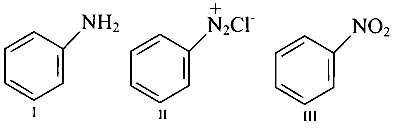
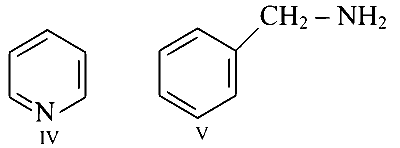
Which of the following compounds will be suitable for estimation of nitrogen by Kjeldahl's method?
PYP
TG EAPCET 2025 ONLINE 2ND MAY MORNING SHIFT
If the sum of two roots of the equation $x^4-2 x^3+x^2+4 x-6=0$ is zero, then the sum of the squares of the other two roots is
PYP
TG EAPCET 2025 ONLINE 2ND MAY MORNING SHIFT
The product of all the values of $(\sqrt{3}-i)^{\frac{3}{7}}$ is
PYP
TG EAPCET 2025 ONLINE 2ND MAY MORNING SHIFT
Let $z=x+i y$ and $P(x, y)$ be a point on the argand plane. If $z$ satisfies the condition $\arg \left(\frac{z-3 i}{z+2 i}\right)=\frac{\pi}{4}$, then the locus of $P$ is
PYP
TG EAPCET 2025 ONLINE 2ND MAY MORNING SHIFT
If $\frac{2+3 i}{i-2}-\frac{4 i-3}{3+4 i}=x+i y$, then $3 x+y=$
PYP
TG EAPCET 2025 ONLINE 2ND MAY MORNING SHIFT
The number of integral values of ' $a$ ' for which the quadratic equation $a x^2+a x+5=0$ cannot have real roots is
PYP
TG EAPCET 2025 ONLINE 2ND MAY MORNING SHIFT
If the roots of the equation $32 x^3-48 x^2+22 x-3=0$ are in arithmetic progression, then the square of the common difference of the roots is
PYP
TG EAPCET 2025 ONLINE 2ND MAY MORNING SHIFT
If three smallest squares are chosen at-random on a chess board, then the probability of getting them in such a way that they are all together in a row or in a column is
PYP
TG EAPCET 2025 ONLINE 2ND MAY MORNING SHIFT
$1+(1+3)+(1+3+5)+(1+3+5+7)+\ldots$ to 10 terms $=$
PYP
TG EAPCET 2025 ONLINE 2ND MAY MORNING SHIFT
Number of triangles whose vertices are the points $(x, y)$ in the $X Y$-plane with integer coordinates satisfying $0 \leq x \leq 4$ and $0 \leq y \leq 4$ is
PYP
TG EAPCET 2025 ONLINE 2ND MAY MORNING SHIFT
A student has to answer a multiple-choice question having 5 alternatives in which two or more than two alternatives are correct. Then, the number of ways in which the student can answer that question is
PYP
TG EAPCET 2025 ONLINE 2ND MAY MORNING SHIFT
Urn A contains 6 white and 2 black balls; run B contains 5 white and 3 black balls and urn C contains 4 white and 4 black balls. if an urn is chosen at random and a ball is drawn at random from it, then the probability that the ball drawn is white is
PYP
TG EAPCET 2025 ONLINE 2ND MAY MORNING SHIFT
If all the letters of the word 'HANDLE' are permuted in all possible ways and the words (with or without meaning) thus formed are arranged in dictionary order, then the rank of the word 'HELAND' is
PYP
TG EAPCET 2025 ONLINE 2ND MAY MORNING SHIFT
If $\mathbf{a}$ and $\mathbf{b}$ are two vectors such that $|\mathbf{a}|=5,|\mathbf{b}|=12$ and $|\mathbf{a}-\mathbf{b}|=13$, then $|2 \mathbf{a}+\mathbf{b}|=$
PYP
TG EAPCET 2025 ONLINE 2ND MAY MORNING SHIFT
If the coefficient of 3rd term from the beginning in the expansion of $\left(a x^2-\frac{8}{b x}\right)^9$ is equal to the coefficient of 3rd term from the end in the expansion of $\left(a x-\frac{2}{b x^2}\right)^9$, then the relation between $a$ and $b$ is
PYP
TG EAPCET 2025 ONLINE 2ND MAY MORNING SHIFT
If three cards are drawn randomly from a pack of 52 playing cards then the probability of getting exactly, one spade card, exactly one king and exactly one card having a prime number is
PYP
TG EAPCET 2025 ONLINE 2ND MAY MORNING SHIFT
If $X \sim B(7, P)$ is a binomial variate and $P(X=3)=P(X=5)$, then $P=$
PYP
TG EAPCET 2025 ONLINE 2ND MAY MORNING SHIFT
The position vectors of two points $A$ and $B$ are $\hat{\mathbf{i}}+2 \hat{\mathbf{j}}+3 \hat{\mathbf{k}}$ and $7 \hat{\mathbf{i}}-\hat{\mathbf{k}}$ respectively. The point $P$ with position vector $-2 \hat{\mathbf{i}}+3 \hat{\mathbf{j}}+5 \hat{\mathbf{k}}$ is on the line $A B$. If the point $Q$ is the harmonic conjugate of $P$, then the sum of the scalar components of the position vector of $Q$ is
PYP
TG EAPCET 2025 ONLINE 2ND MAY MORNING SHIFT
If the expression $5^{2 n}-48 n+k$ is divisible by 24 for all $n \in N$, then the least positive integral value of $k$ is
PYP
TG EAPCET 2025 ONLINE 2ND MAY MORNING SHIFT
If $A(0,3,4), B(1,5,6), C(-2,0,-2)$ are the vertices of a $\triangle A B C$ and the bisector of angle $A$ meets the side $B C$ at $D$, then $A D=$
PYP
TG EAPCET 2025 ONLINE 2ND MAY MORNING SHIFT
If the equation of the plane passing through the points $(2,1,2),(1,2,1)$ and perpendicular to the plane $2 x-y+2 z=1$ is $a x+b y+c z+d=0$, then $\frac{a+b}{c+d}=$
PYP
TG EAPCET 2025 ONLINE 2ND MAY MORNING SHIFT
If $\mathbf{a}=\hat{\mathbf{i}}-2 \hat{\mathbf{j}}-2 \hat{\mathbf{k}}$ and $\mathbf{b}=2 \hat{\mathbf{i}}+\hat{\mathbf{j}}+2 \hat{\mathbf{k}}$ are two vectors, then $(\mathbf{a}+2 \mathbf{b}) \times(3 \mathbf{a}-\mathbf{b})$
PYP
TG EAPCET 2025 ONLINE 2ND MAY MORNING SHIFT
The point of intersection of the line joining the points $\hat{\mathbf{i}}+2 \hat{\mathbf{j}}+\hat{\mathbf{k}}, 2 \hat{\mathbf{i}}-\hat{\mathbf{j}}-\hat{\mathbf{k}}$ and the plane passing through the points $\hat{\mathbf{i}}, 2 \hat{\mathbf{j}}, 3 \hat{\mathbf{k}}$ is
PYP
TG EAPCET 2025 ONLINE 2ND MAY MORNING SHIFT
The shortest distance between the lines
$$ \begin{aligned} & \mathbf{r}=(3 \hat{\mathbf{i}}-5 \hat{\mathbf{j}}+2 \hat{\mathbf{k}})+t(4 \hat{\mathbf{i}}+3 \hat{\mathbf{j}}-\hat{\mathbf{k}}) \text { and } \\ & \mathbf{r}=(\hat{\mathbf{i}}+2 \hat{\mathbf{j}}-4 \hat{\mathbf{k}})+s(6 \hat{\mathbf{i}}+3 \hat{\mathbf{j}}-2 \hat{\mathbf{k}}) \text { is } \end{aligned} $$
PYP
TG EAPCET 2025 ONLINE 2ND MAY MORNING SHIFT
If the direction cosines of two lines satisfy the equation $2 l+m-n=0, l^2-2 m^2+n^2=0$ and $\theta$ is the angle between the lines, then $\cos \theta=$
PYP
TG EAPCET 2025 ONLINE 2ND MAY MORNING SHIFT
$\alpha, \beta$ are the roots of the equation $\sin ^2 x+b \sin x+c=0$. If $\alpha+\beta=\frac{\pi}{2}$, then $b^2-1=$
PYP
TG EAPCET 2025 ONLINE 2ND MAY MORNING SHIFT
If three dice are thrown, then the mean of the sum of the numbers appearing on them is
PYP
TG EAPCET 2025 ONLINE 2ND MAY MORNING SHIFT
The general solution of the equation $\sqrt{6-5 \cos x+7 \sin ^2 x}-\cos x=0$ also satisfies the equation
PYP
TG EAPCET 2025 ONLINE 2ND MAY MORNING SHIFT
If $2 \tanh ^{-1} x=\sinh ^{-1}\left(\frac{4}{3}\right)$, then $\cosh ^{-1}\left(\frac{1}{x}\right)=$
PYP
TG EAPCET 2025 ONLINE 2ND MAY MORNING SHIFT
The mean deviation from the median for the following data is
$$ \begin{array}{cllllll} x_i & 2 & 9 & 8 & 3 & 5 & 7 \\ \hline f_i & 5 & 3 & 1 & 6 & 6 & 1 \\ \hline \end{array} $$
PYP
TG EAPCET 2025 ONLINE 2ND MAY MORNING SHIFT
If the augmented matrix corresponding to the system of equations $x+y-z=1,2 x+4 y-z=0$ and $3 x+4 y+5 z=18$ is transformed to $\left[\begin{array}{cccc}1 & a & 0 & -1 \\ 0 & 2 & 1 & b \\ 0 & 0 & c & 32\end{array}\right]$ then $\sqrt{a+b+c}=$
PYP
TG EAPCET 2025 ONLINE 2ND MAY MORNING SHIFT
The range of the real value function $f(x)=\sin ^{-1}\left(\sqrt{x^2+x+1}\right)$ is
PYP
TG EAPCET 2025 ONLINE 2ND MAY MORNING SHIFT
The period of the function $f(x)=\frac{2 \sin \left(\frac{\pi x}{3}\right) \cos \left(\frac{2 \pi x}{5}\right)}{3 \tan \left(\frac{7 \pi x}{2}\right)-5 \sec \left(\frac{5 \pi x}{3}\right)}$ is
PYP
TG EAPCET 2025 ONLINE 2ND MAY MORNING SHIFT
If $\sin A=-\frac{60}{61}, \cot B=-\frac{40}{9}$ and neither $A$ and $B$ is in 4th quadrant, then $6 \cot A+4 \sec B=$
PYP
TG EAPCET 2025 ONLINE 2ND MAY MORNING SHIFT
If $f(x)=\sqrt{\cos ^{-1} \sqrt{1-x^2}}$, then $f^{\prime}\left(\frac{1}{2}\right)=$
PYP
TG EAPCET 2025 ONLINE 2ND MAY MORNING SHIFT
If $A+B+C=4 S$, then $\sin (2 S-A)$
$$ +\sin (2 S-B)+\sin (2 S-C)-\sin 2 S= $$
PYP
TG EAPCET 2025 ONLINE 2ND MAY MORNING SHIFT
$$ \tan ^{-1} \frac{3}{5}+\tan ^{-1} \frac{6}{41}+\tan ^{-1} \frac{9}{191}= $$
PYP
TG EAPCET 2025 ONLINE 2ND MAY MORNING SHIFT
If $p_1, p_2, p_3$ are the altitudes and $a=4, b=5, c=6$ are the sides of a $\triangle A B C$, then $\frac{1}{p_1^2}+\frac{1}{p_2^2}+\frac{1}{p_3^2}=$
PYP
TG EAPCET 2025 ONLINE 2ND MAY MORNING SHIFT
If $1^{\circ}=0.0175$ radians, then the approximate value of $\sec 58^{\circ}$ is
PYP
TG EAPCET 2025 ONLINE 2ND MAY MORNING SHIFT
If $\left(x^2-3 x+2\right)^{\frac{y}{x^{2-1}}}=x+2$, then $\left(\frac{d y}{d x}\right)_{x=0}=$
PYP
TG EAPCET 2025 ONLINE 2ND MAY MORNING SHIFT
If $x=\frac{t^2}{1+t^5}, y=\frac{2 t^3}{1+t^5}$ and $t \neq-1$ is a perimeter, then $\frac{d y}{d x}=$
PYP
TG EAPCET 2025 ONLINE 2ND MAY MORNING SHIFT
Let the angles $A, B, C$ of a $\triangle A B C$ be in arithmetic progression. If the exradii $r_1, r_2, r_3$ of $\triangle A B C$ satisfy the condition $r_3^2=r_1 r_2+r_2 r_3+r_3 r_1$, then $b=$
PYP
TG EAPCET 2025 ONLINE 2ND MAY MORNING SHIFT
If $y=f(\cosh x)$ and $f^{\prime}(x)=\log \left(x+\sqrt{x^2-1}\right)$, then $\frac{d^2 y}{d x^2}=$
PYP
TG EAPCET 2025 ONLINE 2ND MAY MORNING SHIFT
If $\cos x \frac{d y}{d x}=y \sin x-1, x \neq(2 n+1) \frac{\pi}{2}, n \in Z$ is the differential equation corresponding to the curve $y=f(x)$ and $f(0)=1$, then $f(x)$
PYP
TG EAPCET 2025 ONLINE 2ND MAY MORNING SHIFT
If $[x]$ is the greatest integer function, then
$$ \mathop {\lim }\limits_{x \to 3} \frac{(3-|x|+\sin |3-x|) \cos [9-3 x]}{|3-x|[3 x-9]} $$
PYP
TG EAPCET 2025 ONLINE 2ND MAY MORNING SHIFT
$$ \int_0^{\pi / 4} x^2 \sin 2 x d x $$
PYP
TG EAPCET 2025 ONLINE 2ND MAY MORNING SHIFT
The general solution of the differential equation $2 d x+d y=(6 x y+4 x-3 y) d x$ is
PYP
TG EAPCET 2025 ONLINE 2ND MAY MORNING SHIFT
Let ' $a$ ' be a positive real number. If a real valued function
$f(x)=\left\{\begin{array}{cl}\frac{6^x-3^x-2^x+1}{1-\cos \left(\frac{x}{a}\right)} & \text { if } x \neq 0 \\ \log 3 \log 4 & \text { if } x=0\end{array}\right.$ is continuous at $x=0$, then $a=$
PYP
TG EAPCET 2025 ONLINE 2ND MAY MORNING SHIFT
$$ \int_{-2 \pi}^{2 \pi} \sin ^4 x \cos ^6 x d x= $$
PYP
TG EAPCET 2025 ONLINE 2ND MAY MORNING SHIFT
$$ \int\left(\frac{1-\log x}{1+(\log x)^2}\right)^2 d x= $$
PYP
TG EAPCET 2025 ONLINE 2ND MAY MORNING SHIFT
If the rate of change of the slope of the tangent drawn to the curve $y=x^3-2 x^2+3 x-2$ at the point $(2,4)$ is $k$ times the rate of change of its abscissa, then $k=$
PYP
TG EAPCET 2025 ONLINE 2ND MAY MORNING SHIFT
The acute angle between the curves $y=3 x^2-2 x-1$ and $y=x^3-1$ at their point of intersection which lies in the first quadrant is
PYP
TG EAPCET 2025 ONLINE 2ND MAY MORNING SHIFT
If $f(x)=x+\log \left(\frac{x-1}{x+1}\right)$ is a well-defined real valued function, then $f$ is
PYP
TG EAPCET 2025 ONLINE 2ND MAY MORNING SHIFT
$$ \int \frac{2 \sin x-3 \cos x}{4 \cos x-3 \sin x} d x= $$
PYP
TG EAPCET 2025 ONLINE 2ND MAY MORNING SHIFT
A real valued function $f(x)=\left|x^2-3 x+2\right|+2 x-3$ is defined on $[-2,1]$. If $m$ and $M$ are absolute minimum and absolute maximum values of $f$ respectively, then $M-4 m=$
PYP
TG EAPCET 2025 ONLINE 2ND MAY MORNING SHIFT
If the equation of the circle passing through the points $(-1,0),(-1,1),(1,1)$ is $a x^2+a y^2+2 g x+2 f y-2=0$, then $a=$
PYP
TG EAPCET 2025 ONLINE 2ND MAY MORNING SHIFT
If the angle between the circles $x^2+y^2-2 x+k y+1=0$ and $x^2+y^2-k x-2 y+1=0$ is $\cos ^{-1}\left(\frac{1}{4}\right)$ and $k<0$, then the point which lies on the radical axis of the given circle is
PYP
TG EAPCET 2025 ONLINE 2ND MAY MORNING SHIFT
$$ \int e^{4 x}(\sin 3 x-\cos 3 x) d x= $$
PYP
TG EAPCET 2025 ONLINE 2ND MAY MORNING SHIFT
For the circle $x-2=5 \cos \theta, y+1=5 \sin \theta$, where $\theta$ is the perimeter, the line $x=1+\frac{r}{2}, y=-2+\frac{\sqrt{3}}{2} r$ where $r$ is the perimeter, is a
PYP
TG EAPCET 2025 ONLINE 2ND MAY MORNING SHIFT
If $A, B$ are the points of contact of the tangents drawn from the point $(-3,1)$ to the circle $x^2+y^2-4 x+2 y-4=0$, then the equation of the circumcircle of the $\triangle P A B$ is
PYP
TG EAPCET 2025 ONLINE 2ND MAY MORNING SHIFT
If $x-2 y=0$ is a tangent drawn at a point $P$ on the circle $x^2+y^2-6 x+2 y+c=0$, then the distance of the point $(6,3)$ from $P$ is
PYP
TG EAPCET 2025 ONLINE 2ND MAY MORNING SHIFT
If the points $A(2,3), B(3,2)$ form a triangle with a variable point $p\left(t, t^2\right)$, where $t$ is a parameter, then the equation of the locus of the centroid of $\triangle A B C$ is
PYP
TG EAPCET 2025 ONLINE 2ND MAY MORNING SHIFT
If $(h, k)$ is the new origin to be chosen to eliminate first degree terms from the equation $S \equiv 2 x^2-x y-y^2-3 x+3 y=0$ by translation and if $\theta$ is the angle with which the axes are to be rotated about the origin in anti-clockwise direction to eliminate $x y$-term from $S=0$, then $\tan 2 \theta=$
PYP
TG EAPCET 2025 ONLINE 2ND MAY MORNING SHIFT
The focal distance of a point $(5,5)$ on the parabola $x^2-2 x-4 y+5=0$ is
PYP
TG EAPCET 2025 ONLINE 2ND MAY MORNING SHIFT
If the product of the perpendicular distances from any point on the hyperbola $\frac{x^2}{a^2}-\frac{y^2}{b^2}=1$ to its asymptotes is $\frac{36}{13}$ and its eccentricity is $\frac{\sqrt{13}}{3}$, then $a-b=$
PYP
TG EAPCET 2025 ONLINE 2ND MAY MORNING SHIFT
A circle $C$ passing through the point $(1,1)$ bisects the circumference of the circle $x^2+y^2-2 x=0$. If $C$ is orthogonal to the circle $x^2+y^2+2 y-3=0$, then the centre of the circle $C$ is
PYP
TG EAPCET 2025 ONLINE 2ND MAY MORNING SHIFT
If the normal drawn at $P(8,16)$ to the parabola $y^2=32 x$ meets the parabola again at $Q$, then the equation of the tangent drawn at $Q$ to the parabola is
PYP
TG EAPCET 2025 ONLINE 2ND MAY MORNING SHIFT
A line $L$ perpendicular to the line $5 x-12 y+6=0$ makes positive intercept on the $Y$-axis. If the distance from the origin to the line $L$ is 2 units and the angle made by the perpendicular drawn from the origin to the line $L$ with positive $X$-axis is $\theta$, then $\tan \theta+\cot \theta=$
PYP
TG EAPCET 2025 ONLINE 2ND MAY MORNING SHIFT
One of the foci of an ellipse is $(2,-3)$ and its corresponding directrix is $2 x+y=5$. If the eccentricity of the ellipse is $\frac{\sqrt{5}}{3}$, then the coordinates of the other focus are
PYP
TG EAPCET 2025 ONLINE 2ND MAY MORNING SHIFT
If $4 x^2+12 x y+9 y^2+2 g x+2 f y-1=0$ represent a pair of parallel lines, then
PYP
TG EAPCET 2025 ONLINE 2ND MAY MORNING SHIFT
A variable straight-line $L$ with negative slope passes through the point $(4,9)$ and cuts the positive coordinate axes in $A$ and $B$. If $O$ is the origin, then the minimum value of $O A+O B$ is
PYP
TG EAPCET 2025 ONLINE 2ND MAY MORNING SHIFT
If $S$ and $S^{\prime}$ are the foci of an ellipse $\frac{x^2}{169}+\frac{y^2}{144}=1$ and the point $B$ lying on positive $Y$-axis is one end of its minor axis, then the incentre of the $\triangle S B S^{\prime}$ is
PYP
TG EAPCET 2025 ONLINE 2ND MAY MORNING SHIFT
If a line $L$ passing through a point $A(2,3)$ intersects another line $4 x-3 y-19=0$ at the point $B$ such that $A B=4$, then the angle made by the line $L$ with positive $X$-axis in anti-clockwise direction is
PYP
TG EAPCET 2025 ONLINE 2ND MAY MORNING SHIFT
If $\left|\begin{array}{ccc}9 & 25 & 16 \\ 16 & 36 & 25 \\ 25 & 49 & 36\end{array}\right|=K$, then $K, K+1$ are the roots of the equation
PYP
TG EAPCET 2025 ONLINE 2ND MAY MORNING SHIFT
$A=\left[\begin{array}{ccc}1 & -3 & -5 \\ -2 & 4 & -6 \\ 7 & -11 & 13\end{array}\right]$, then $\sqrt{|\operatorname{adj} A|}=$
PYP
TG EAPCET 2025 ONLINE 2ND MAY MORNING SHIFT
If $\Delta_r=\left|\begin{array}{cc}\frac{1}{3 r-2} & \frac{2}{3 r-5} \\ 0 & \frac{3}{3 r+1}\end{array}\right|$ then $\sum\limits_{r=1}^{33} \Delta_r=$
PYP
TG EAPCET 2025 ONLINE 2ND MAY MORNING SHIFT
$$ \int_0^2 \sqrt{(x+3)(2-x)} d x= $$
PYP
TG EAPCET 2025 ONLINE 2ND MAY MORNING SHIFT
If $f(x)=\tan \left(\frac{\pi}{\sqrt{x+1}+4}\right)$ is a real valued function, then the range of $f$ is
PYP
TG EAPCET 2025 ONLINE 2ND MAY MORNING SHIFT
If $\frac{x^3+3}{(x-3)^3}=a+\frac{b}{x-3}+\frac{c}{(x-3)^2}+\frac{d}{(x-3)^3}$, then $(a+d)-(b+c)=$
PYP
TG EAPCET 2025 ONLINE 2ND MAY MORNING SHIFT
If $\int(x+2) \sqrt{x^2-x+2} d x=\frac{1}{3} f(x)+\frac{5}{8} g(x)+\frac{35}{16} h(x)+C$ then $f(-1)+g(-1)+h\left(\frac{1}{2}\right)=$
Showing 5 of 160 questions