Exam Details
TG EAPCET 2025 ONLINE 2ND MAY EVENING SHIFT
Review the key details, then start the test when you are ready. You can also open the full package to see related papers.
Questions
160
Duration
180 mins
Package
TG EAPCET- Previous Year Papers
Paper pattern & analysis
Filter this paper by subject, topic or subtopic. Every graph updates from the selected questions.
Topic distribution
Subtopic distribution
Difficulty distribution
160questions
Not classified
120
75%
Medium
22
13.8%
Easy
15
9.4%
Hard
3
1.9%
Question type distribution
160questions
MCQ
160
100%
Syllabus
Full Syllabus
Practise paper questions
Choose your answer to check it. Log in to view the explanation. For a timed attempt and result, start the exam.
PYP
TG EAPCET 2025 ONLINE 2ND MAY EVENING SHIFT
The locus of the centre of the circle touching the $X$-axis and passing through the point $(-1,1)$ is
PYP
TG EAPCET 2025 ONLINE 2ND MAY EVENING SHIFT
Two bodies are projected from the same point with the same initial velocity ' $u$ ' making angles ' $\theta^{\prime}$ and $\left(90^{\circ}-\theta\right)$ with the horizontal in opposite directions. The horizontal distance between their positions when the bodies are at their maximum heights is
PYP
TG EAPCET 2025 ONLINE 2ND MAY EVENING SHIFT
The ratio of times taken by a freely falling body to travel first 5 m , second 5 m , third 5 m distances is
PYP
TG EAPCET 2025 ONLINE 2ND MAY EVENING SHIFT
If $L$ and $C$ are inductance and capacitance respectively, then the dimensional formula of $(\mathrm{LC})^{-\frac{1}{2}}$ is
PYP
TG EAPCET 2025 ONLINE 2ND MAY EVENING SHIFT
A body projected vertically up with an initial speed of $10 \mathrm{~ms}^{-1}$ reaches the point of projection after sometime with a speed of $8 \mathrm{~ms}^{-1}$. The maximum height reached by the body is
(Acceleration due to gravity $=10 \mathrm{~ms}^{-2}$ )
PYP
TG EAPCET 2025 ONLINE 2ND MAY EVENING SHIFT
The ratio of the time periods of a simple pendulum at heights $2 R_E$ and $3 R_E$ from the surface of the Earth is ( $R_E$ is radius of the Earth)
PYP
TG EAPCET 2025 ONLINE 2ND MAY EVENING SHIFT
If the component of the vector $\mathbf{A}$ along the vector $\mathbf{B}$ is twice the component of $\mathbf{B}$ along $\mathbf{A}$, then the ratio of magnitudes of vectors $\mathbf{A}$ and $\mathbf{B}$ is
PYP
TG EAPCET 2025 ONLINE 2ND MAY EVENING SHIFT
Due to global warming, if the ice in the polar region melts and some of this water flows to the equatorial region, then
PYP
TG EAPCET 2025 ONLINE 2ND MAY EVENING SHIFT
If the moment of inertia of a thin circular ring about an axis passing through its edge and perpendicular to its plane is $I$, then the moment of inertia of the ring about its diameter is
PYP
TG EAPCET 2025 ONLINE 2ND MAY EVENING SHIFT
A particle is executing simple harmonic motion. If the force acting on the particle at a position is $86.6 \%$ of the maximum force on it, then the ratio of its velocity at that point and its maximum velocity is
PYP
TG EAPCET 2025 ONLINE 2ND MAY EVENING SHIFT
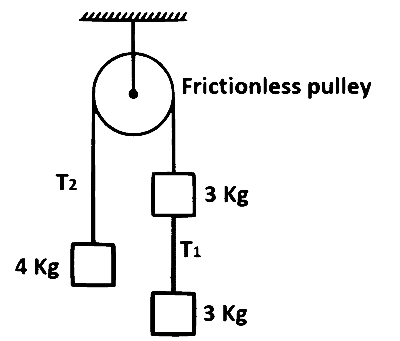
If the system of blocks shown in the figure is released from rest, the ratio of the tensions $T_1$ and $T_2$ is (Neglect the mass of the string shown in the figure)
PYP
TG EAPCET 2025 ONLINE 2ND MAY EVENING SHIFT
Two wires $A$ and $B$ made of same material and areas of cross-section in the ratio $1: 2$ are stretched by same force. If the masses of the wires $A$ and $B$ are in the ratio $2: 3$, then the ratio of the elongations of the wires $A$ and $B$ is
PYP
TG EAPCET 2025 ONLINE 2ND MAY EVENING SHIFT
If the lengths of the open and closed pipes are in the ratio of $2: 3$, then the ratio of the frequencies of the third harmonic of the open pipe and the fifth harmonic of the closed pipe is
PYP
TG EAPCET 2025 ONLINE 2ND MAY EVENING SHIFT
For which of the following Reynold's number, a flow is streamlined?
PYP
TG EAPCET 2025 ONLINE 2ND MAY EVENING SHIFT
The equation of a transverse wave propagating on a stretched string is given by $y=3 \sin (4 x+200 t)$, where $x$ and $y$ are in metre and the time ' $t$ ' is in second. If the tension applied to the string is 500 N , the linear density of the string is
PYP
TG EAPCET 2025 ONLINE 2ND MAY EVENING SHIFT
A body cools from a temperature of $60^{\circ} \mathrm{C}$ to $50^{\circ} \mathrm{C}$ in 10 minutes and $50^{\circ} \mathrm{C}$ to $40^{\circ} \mathrm{C}$ in 15 minutes. The time taken in minutes for the body to cool from $40^{\circ} \mathrm{C}$ to $30^{\circ} \mathrm{C}$ is
PYP
TG EAPCET 2025 ONLINE 2ND MAY EVENING SHIFT
Water is filled in a tank up to a height of 20 cm from the bottom of the tank. Water flows through a hole of area $1 \mathrm{~mm}^2$ at its bottom. The mass of the water coming out from the hole in a time of 0.6 s is
PYP
TG EAPCET 2025 ONLINE 2ND MAY EVENING SHIFT
A gas is suddenly compressed such that its absolute temperature is doubled. If the ratio of the specific heat capacities of the gas is 1.5 , then the percentage decrease in the volume of the gas is
PYP
TG EAPCET 2025 ONLINE 2ND MAY EVENING SHIFT
For an aperture of $5 \times 10^{-3} \mathrm{~m}$ and a monochromatic light of wavelength $\lambda$, the distance for which ray optics becomes a good approximation is 50 m , then $\lambda=$
PYP
TG EAPCET 2025 ONLINE 2ND MAY EVENING SHIFT
The property of light that explains the formation of coloured images due to thick lenses is
PYP
TG EAPCET 2025 ONLINE 2ND MAY EVENING SHIFT
If the heat required to increase the rms speed of 4 moles of a diatomic gas from $v$ to $\sqrt{3} v$ is 83.1 kJ , then the initial temperature of the gas is
(universal gas constant $=8.31 \mathrm{~J} \mathrm{~mol}^{-1} \mathrm{~K}^{-1}$ )
PYP
TG EAPCET 2025 ONLINE 2ND MAY EVENING SHIFT
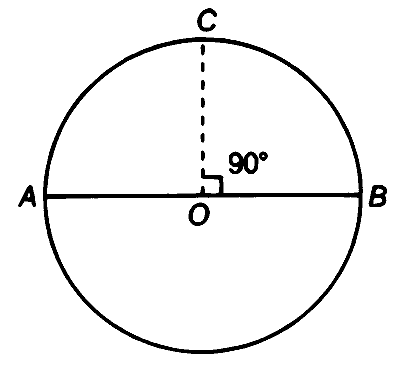
A charge $q$ is placed at the centre ' $O$ ' of a circle of radius $R$ and two other charges $q$ and $q$ are placed at the ends of the diameter $A B$ of the circle. The work done to move the charge at point $B$ along the circumference of the circle to a point $C$ as shown in the figure is
PYP
TG EAPCET 2025 ONLINE 2ND MAY EVENING SHIFT
When the temperature of a gas in a closed vessel is increased by $2.4^{\circ} \mathrm{C}$, its pressure increases by $0.5 \%$. The initial temperature of the gas is
PYP
TG EAPCET 2025 ONLINE 2ND MAY EVENING SHIFT
A current of 4 A is passed through a square loop of side 5 cm made of a uniform manganin wire as shown in the figure. The magnetic field at the centre of the loop is

PYP
TG EAPCET 2025 ONLINE 2ND MAY EVENING SHIFT
Two identical wires, carrying equal currents are bent into circular coils $A$ and $B$ with 2 and 3 turns respectively. The ratio of the magnetic fields at the centres of the coils $A$ and $B$ is
PYP
TG EAPCET 2025 ONLINE 2ND MAY EVENING SHIFT
An electron and a positron enter a uniform electric field $E$ perpendicular to it with equal speeds at the same time. The distance of separation between them in the direction of the field after a time ' $t$ ' is
( $\frac{e}{m}$ is specific charge of electron)
PYP
TG EAPCET 2025 ONLINE 2ND MAY EVENING SHIFT
If $B_V$ and $B_H$ are respectively the vertical and horizontal components of the Earth's magnetic field at a place where the angle of $\operatorname{dip}$ is $60^{\circ}$, then the total magnetic field at that place is
PYP
TG EAPCET 2025 ONLINE 2ND MAY EVENING SHIFT
In a potentiometer experiment, a wire of length 10 m and resistance $5 \Omega$ is connected to a cell of emf 2.2 V . If the potential difference between two points separated by a distance of 660 cm on potentiometer wire is 1.1 V , then the internal resistance of the cell is
PYP
TG EAPCET 2025 ONLINE 2ND MAY EVENING SHIFT
When the right gap of a metre bridge consists of two equal resistors in series, the balancing point is at 50 cm . When one of the resisters in the right gap is removed and is connected in parallel to the resistor in the left gap, the balancing point is at
PYP
TG EAPCET 2025 ONLINE 2ND MAY EVENING SHIFT
An inductor and a resistor are connected in series to an AC supply. If the potential difference across the inductor and the resistor are 180 V and 240 V respectively, then the voltage of the AC supply is
PYP
TG EAPCET 2025 ONLINE 2ND MAY EVENING SHIFT
In $\beta^{-}$decay, a neutron transforms into a proton within the nucleus according to the equation :
neutron $\rightarrow$ proton $+\beta^{-}+x$
In this equation the particle represented by ' $x$ ' is
PYP
TG EAPCET 2025 ONLINE 2ND MAY EVENING SHIFT
A coil of resistance $8 \Omega$, number of turns 250 and area $120 \mathrm{~cm}^2$ is placed in a uniform magnetic field of 2 T such that the plane of the coil makes and angle of $\frac{\pi}{6}$ with the direction of the magnetic field. In a time of 100 ms , the coil is rotated until its plane becomes parallel to the direction of the magnetic field. The current induced in the coil is
PYP
TG EAPCET 2025 ONLINE 2ND MAY EVENING SHIFT
If electromagnetic waves of power 600 W incident on a non-reflecting surface, then the total force acting on the surface is
PYP
TG EAPCET 2025 ONLINE 2ND MAY EVENING SHIFT
The ratio of the kinetic energies of the electrons in the third and fourth excited states of hydrogen atom is
PYP
TG EAPCET 2025 ONLINE 2ND MAY EVENING SHIFT
Bose-Einstein statistics is applicable to particles with
PYP
TG EAPCET 2025 ONLINE 2ND MAY EVENING SHIFT
Two radioactive substances $A$ and $B$ have same number of initial nuclei. If the half lives of $A$ and $B$ are 1.5 days and 4.5 days respectively, then the ratio of the number of nuclei remaining in $A$ and $B$ after 9 days is
PYP
TG EAPCET 2025 ONLINE 2ND MAY EVENING SHIFT
When a photosensitive material is illuminated by photons of energy 3.1 eV , the stopping potential of the photoelectrons is 1.7 V . When the same photosensitive material is illuminated by photons of energy 2.5 eV , the stopping potential of the photoelectrons is
PYP
TG EAPCET 2025 ONLINE 2ND MAY EVENING SHIFT
$10^{10}$ electrons enter the emitter of a junction transistor in a time of $0.4 \mu \mathrm{~s}$. If $5 \%$ of the electrons are lost in the base, then the collector current is
PYP
TG EAPCET 2025 ONLINE 2ND MAY EVENING SHIFT
Coaxial cable, a widely used wire medium offers and approximate frequency bandwidth of
PYP
TG EAPCET 2025 ONLINE 2ND MAY EVENING SHIFT
Identify the incorrect statement from the following?
PYP
TG EAPCET 2025 ONLINE 2ND MAY EVENING SHIFT
An electron in $n$-region of a $p-n$ junction moves towards the junction with a speed of $5 \times 10^5 \mathrm{~ms}^{-1}$. If the barrier potential of the junction is 0.45 V , then the speed with which the electron enters the $p$-region after penetration through the barrier is
(Charge of the electron $=1.6 \times 10^{-19} \mathrm{C}$ and mass of the electron $=9 \times 10^{-31} \mathrm{~kg}$ )
PYP
TG EAPCET 2025 ONLINE 2ND MAY EVENING SHIFT
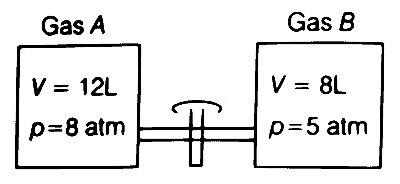
Two vessels are filled with ideal gases $A$ and $B$ and are connected through a pipe of zero volume as shown in figure. The stop cock is opened and the gases are allowed to mix homogeneously and the temperature is
kept constant. The partial pressures of $A$ and $B$ respectively ( in atm ) are
PYP
TG EAPCET 2025 ONLINE 2ND MAY EVENING SHIFT
The osmotic pressure (in atm) of an aqueous solution containing 0.01 mol of NaCl (degree of dissociation 0.94 ) and 0.03 mol of glucose in 500 mL at $27^{\circ} \mathrm{C}$ is $\left(R=0.082 \mathrm{~L} \mathrm{~atm} \mathrm{~K}^{-1} \mathrm{~mol}^{-1}\right)$
PYP
TG EAPCET 2025 ONLINE 2ND MAY EVENING SHIFT
If the number of moles of $\mathrm{Fe}^{2+}$ ions oxidised by one mole of acidified $\mathrm{MnO}_4^{-}$is $x$, the number of moles of $\mathrm{Fe}^{2+}$ ions oxidised by one mole of acidified $\mathrm{Cr}_2 \mathrm{O}_7^{2-}$ is
PYP
TG EAPCET 2025 ONLINE 2ND MAY EVENING SHIFT
At 1000 K , the equilibrium constant for the reaction, $\mathrm{CO}_2(\mathrm{~g})+\mathrm{H}_2(\mathrm{~g}) \rightleftharpoons \mathrm{CO}(\mathrm{g})+\mathrm{H}_2 \mathrm{O}(\mathrm{g})$ is 0.53 . In a one litre vessel, at equilibrium the mixture contains 0.25 mole of $\mathrm{CO}, 0.5$ mole of $\mathrm{CO}_2, 0.6$ mole of $\mathrm{H}_2$ and $x$ moles of $\mathrm{H}_2 \mathrm{O}$. The value of $x$ is
PYP
TG EAPCET 2025 ONLINE 2ND MAY EVENING SHIFT
One mole of an ideal gas at 300 K and 20 atm expands to 2 atm under isothermal and reversible conditions. The work done by the gas is $-x \mathrm{~kJ} \mathrm{~mol}^{-1}$. The value of $x$ is $\left(R=8.3 \mathrm{~J} \mathrm{~K}^{-1} \mathrm{~mol}^{-1}\right)$
PYP
TG EAPCET 2025 ONLINE 2ND MAY EVENING SHIFT
The electron in hydrogen atom undergoes transition from higher orbits to an orbit of radius 476.1 pm . This transition corresponds to which of the following series?
PYP
TG EAPCET 2025 ONLINE 2ND MAY EVENING SHIFT
A solid contains elements $A$ and $B$. Anions of $B$ form ccp lattice. Cations of $A$ occupy 50\% of octahedral voids and 50\% of tetrahedral voids. What is the molecular formula of the solid?
PYP
TG EAPCET 2025 ONLINE 2ND MAY EVENING SHIFT
Electrolysis of aqueous copper (II) sulphate between Pt electrodes gives ' $X^{\prime}$ at anode and ' $Y^{\prime}$ at cathode. $X$ and $Y$ are respectively.
PYP
TG EAPCET 2025 ONLINE 2ND MAY EVENING SHIFT
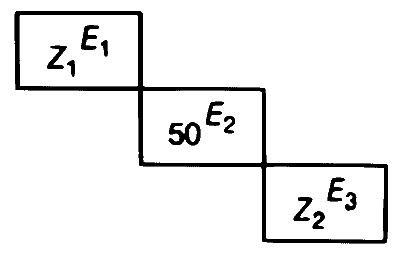
Atomic numbers of three elements $E_1, E_2$ and $E_3$ of periodic table are $Z_1, 50$ and $Z_2$ respectively. From the position of the elements shown in figure, the values of $\left(Z_2-Z_1\right)$ is
PYP
TG EAPCET 2025 ONLINE 2ND MAY EVENING SHIFT
Observe the following list of molecules. Number of polar and non-polar molecules are respectively
$\mathrm{NH}_3, \mathrm{BF}_3, \mathrm{NF}_3, \mathrm{H}_2 \mathrm{~S}_2, \mathrm{CO}_2, \mathrm{CH}_4, \mathrm{CHCl}_3, \mathrm{H}_2 \mathrm{O}$
PYP
TG EAPCET 2025 ONLINE 2ND MAY EVENING SHIFT
Electron gain enthalpy values $\left(\Delta_{\mathrm{cg}} H\right)$ (in $\mathrm{kJ} \mathrm{mol}^{-1}$ ) of elements $X, Y$ and $Z$ are $-349,-200$ and -295 respectively. $X, Y$ and $Z$ are respectively
PYP
TG EAPCET 2025 ONLINE 2ND MAY EVENING SHIFT
The most effective coagulating agent for antimony sulphide sol is
PYP
TG EAPCET 2025 ONLINE 2ND MAY EVENING SHIFT
The molecule ' $X$ ' has see-saw shape with central atom in $s p^3 d$ hybridisation. What is ' $X$ '?
PYP
TG EAPCET 2025 ONLINE 2ND MAY EVENING SHIFT
$$ \text { Match the following. } $$
.tg {border-collapse:collapse;border-spacing:0;}
.tg td{border-color:black;border-style:solid;border-width:1px;font-family:Arial, sans-serif;font-size:14px;
overflow:hidden;padding:10px 5px;word-break:normal;}
.tg th{border-color:black;border-style:solid;border-width:1px;font-family:Arial, sans-serif;font-size:14px;
font-weight:normal;overflow:hidden;padding:10px 5px;word-break:normal;}
.tg .tg-c3ow{border-color:inherit;text-align:center;vertical-align:top}
| $$ \text { List I (Reactions) } $$ |
$$ \text { List II (Methods) } $$ |
||
|---|---|---|---|
| (A) | $$ \begin{aligned} \mathrm{Mg}\left(\mathrm{HCO}_3\right)_2 \longrightarrow \mathrm{Mg}(\mathrm{OH})_2 \downarrow & +2 \mathrm{CO}_2 \uparrow \end{aligned} $$ |
(I) | Clark's method |
| (B) | $$ \begin{array}{r} M^{2+}+\mathrm{Na}_4 \mathrm{P}_6 \mathrm{O}_{18}^{2-} \longrightarrow\left[\mathrm{Na}_2 \mathrm{MP}_6 \mathrm{O}_{18}\right]^{2-} +2 \mathrm{Na}^{+} \end{array} $$ |
(II) | Ion exchange method |
| (C) | $$ \begin{aligned} \mathrm{Ca}\left(\mathrm{HCO}_3\right)_2 & +\mathrm{Ca}(\mathrm{OH})_2 \longrightarrow 2 \mathrm{CaCO}_3+2 \mathrm{H}_2 \mathrm{O} \end{aligned} $$ |
(III) | Boiling |
| (D) | $$ \begin{gathered} 2 \mathrm{NaZ}+\mathrm{Ca}^{2+}(\mathrm{aq}) \longrightarrow 2 \mathrm{Na}^{+}+\mathrm{CaZ} (\mathrm{Z}=\text { Zeolite }) \end{gathered} $$ |
(IV) | Calgon's method |
The correct answer is
PYP
TG EAPCET 2025 ONLINE 2ND MAY EVENING SHIFT
An oxoacid of phosphorus ' $X$ ' reduces silver nitrate solution to metallic silver and gets oxidised to another compound $Y . X$ and $Y$ respectively are
PYP
TG EAPCET 2025 ONLINE 2ND MAY EVENING SHIFT
Zinc on reaction with concentrated nitric acid gives an oxide of nitrogen $(A)$. Zinc with dilute nitric acid gives another oxide of nitrogen $(B)$. Oxidation numbers of nitrogen in $(A)$ and $(B)$ are respectively
PYP
TG EAPCET 2025 ONLINE 2ND MAY EVENING SHIFT
Observe the following statements.
Statement I Both LiF and CsI have low solubility in water.
Statement II Low solubility of LiF in water is due to smaller hydration enthalpy of ions and that of CsI is due to its high lattice enthalpy.
The correct answer is
PYP
TG EAPCET 2025 ONLINE 2ND MAY EVENING SHIFT
In which of the following the $s$-block elements are arranged in the correct order of their melting points?
PYP
TG EAPCET 2025 ONLINE 2ND MAY EVENING SHIFT
The correct statements about the compounds of boron are
I. In borax bead test, the colour of cobalt metaborate is blue.
II. Diborane is prepared by the oxidation of sodium borohydride with iodine.
III. In diborane oxidation state of hydrogen is +1 .
IV. Boric acid is a tribasic acid.
PYP
TG EAPCET 2025 ONLINE 2ND MAY EVENING SHIFT
Metal $X$ obtained from sphalarite ore can be purified by which of the following method?
PYP
TG EAPCET 2025 ONLINE 2ND MAY EVENING SHIFT
Identify the correct statements about lanthanoids
I. $\mathrm{Ce}^{4+}$ and $\mathrm{Tb}^{4+}$ act as oxidising agents.
II. $\mathrm{Eu}^{2+}$ and $\mathrm{Yb}^{2+}$ act as oxidising agents.
III. Misch metal is an alloy of $95 \%$ iron and $5 \%$ lanthanoid metal.
IV. $\mathrm{La}^{3+}$ and $\mathrm{Ce}^{4+}$ are diamagnetic in nature.
PYP
TG EAPCET 2025 ONLINE 2ND MAY EVENING SHIFT
Identify the correct statements from the following
I. Photochemical smog has high concentration of oxidising agents.
II. $\mathrm{NO}_2$ is present in classical smog.
III. Higher concentration of $\mathrm{SO}_2$ in air can cause stiffness of flower buds.
IV. pH of rain water is approximately 7.5 .
PYP
TG EAPCET 2025 ONLINE 2ND MAY EVENING SHIFT
When 100 mL of 0.2 M solution of $\mathrm{CoCl}_3 \cdot x \mathrm{NH}_3$ is treated with excess of $\mathrm{AgNO}_3$ solution, $3.6 \times 10^{22}$ ions are precipitated. The value of $x$ is $\left(N=6 \times 10^{23} \mathrm{~mol}^{-1}\right)$
PYP
TG EAPCET 2025 ONLINE 2ND MAY EVENING SHIFT
Identify the reaction related to Deacon's process
PYP
TG EAPCET 2025 ONLINE 2ND MAY EVENING SHIFT
Which of the following is an example of electrophilic substitution reaction?
PYP
TG EAPCET 2025 ONLINE 2ND MAY EVENING SHIFT
Consider the given sequence of reactions,
$$ \mathrm{C}_2 \mathrm{H}_6+\frac{3}{2} \mathrm{O}_2 \xrightarrow[\Delta]{(\mathrm{CH}, \mathrm{COO})_2 \mathrm{Mn}} X \xrightarrow{\mathrm{Na}} Y $$
Electrolysis of aqueous solution of $Y$ gives gases $P$ and $Q$ at anode. $P$ and $Q$ are respectively
PYP
TG EAPCET 2025 ONLINE 2ND MAY EVENING SHIFT
An alkene $X$ on ozonolysis gives a mixture of simplest ketone $(Y)$ and 3-pentanone. The IUPAC name of the alkene $X$ is
PYP
TG EAPCET 2025 ONLINE 2ND MAY EVENING SHIFT
Dehydration of an organic acid $X$ with concentrated $\mathrm{H}_2 \mathrm{SO}_4$ at 373 K gives $\mathrm{H}_2 \mathrm{O}$ and gas $Y$. The hybridisation of the carbon in $Y$ and nature of $Y$ are respectively.
PYP
TG EAPCET 2025 ONLINE 2ND MAY EVENING SHIFT
The major product in Reimer-Tiemann reaction is $X$. The reactants are $Y$ and $Z, X, Y$ and $Z$ are respectively
PYP
TG EAPCET 2025 ONLINE 2ND MAY EVENING SHIFT
Ethylene on reaction with cold, dilute alkaline $\mathrm{KMnO}_4$ at 273 K gives a compound ' $P$ '. This on polymerisation with which of the following gives dacron?
PYP
TG EAPCET 2025 ONLINE 2ND MAY EVENING SHIFT
$$ \text { Toluene } \xrightarrow[\text { (ii) } \mathrm{H}_3 \mathrm{O}^{+}]{\text {(i) } \mathrm{CrO}_2 \mathrm{Cl}_2 / \mathrm{CS}_2} X \xrightarrow{\text { Conc. } \mathrm{NaOH}} Y+Z $$
The correct statements about $Y$ and $Z$ are
A. $Y$ is a secondary alcohol.
B. $Y$ is the reduction product of $X$.
C. $Z$ on heating with sodalime gives benzene.
D. $Y$ does not give $\mathrm{H}_2$ gas with Na metal.
PYP
TG EAPCET 2025 ONLINE 2ND MAY EVENING SHIFT
$$ \text { The product ' } C \text { ' in the given reaction sequence is } $$

PYP
TG EAPCET 2025 ONLINE 2ND MAY EVENING SHIFT
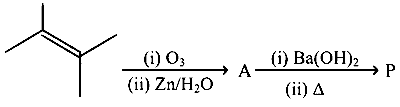
$$ \text { Identify the product ' } P \text { ' in the given reaction sequence. } $$
PYP
TG EAPCET 2025 ONLINE 2ND MAY EVENING SHIFT
A carbohydrate $(A)$, when treated with dilute HCl in alcoholic solution gives two isomers $(B)$ and $(C)$. $B$ on reaction with bromine water gives a monocarboxylic acid ' $Z$ ' and ' $C$ ' is a ketohexose. What is $A$ ?
PYP
TG EAPCET 2025 ONLINE 2ND MAY EVENING SHIFT
The amine/salt of amine which gives positive test with a mixture of chloroform and alcoholic KOH solution is
PYP
TG EAPCET 2025 ONLINE 2ND MAY EVENING SHIFT
The number of chlorine $(\mathrm{Cl})$ atoms in the structure of DDT molecule is
PYP
TG EAPCET 2025 ONLINE 2ND MAY EVENING SHIFT
The incorrect statement about chloramphenicol is
PYP
TG EAPCET 2025 ONLINE 2ND MAY EVENING SHIFT
If $n, K \in N$ such that $n \neq 3 K$, then $(\sqrt{3}+i)^{2 n}+(\sqrt{3}-i)^{2 n}=$
PYP
TG EAPCET 2025 ONLINE 2ND MAY EVENING SHIFT
When sodium fusion extract of an organic compound is boiled with iron (II)sulphate solution followed by addition of concentrated $\mathrm{H}_2 \mathrm{SO}_4$, gives prussian blue colour. This confirms the presence of the element
PYP
TG EAPCET 2025 ONLINE 2ND MAY EVENING SHIFT
$\omega$ is a complex cube root of unity and $Z$ is a complex number satisfying $|Z-1| \leq 2$. The possible values of $r$ such that $|Z-1| \leq 2$ and $\left|\omega Z-1-\omega^2\right|=r$ have no common solution are
PYP
TG EAPCET 2025 ONLINE 2ND MAY EVENING SHIFT
If $|Z|=2, Z_1=\frac{Z}{2} e^{i \alpha}$ and $\theta$ is the $\operatorname{amp}(Z)$, then $\frac{Z_1^n-Z_1^{-n}}{Z_1^n+Z_1^{-n}}=$
PYP
TG EAPCET 2025 ONLINE 2ND MAY EVENING SHIFT
In argand plane, no value of $\sqrt[3]{1-i \sqrt{3}}$ lie in
PYP
TG EAPCET 2025 ONLINE 2ND MAY EVENING SHIFT
If $\alpha, \beta, \gamma$ are the roots of the equation $x^3-P x^2+Q x-R=0$ and $(\alpha-2)^2,(\beta-2)^2,(\gamma-2)^2$ are the roots of the equation $x^3-5 x^2+4 x=0$, then the possible least value of $P+Q+R$ is
PYP
TG EAPCET 2025 ONLINE 2ND MAY EVENING SHIFT
If the equation $x^2-3 a x+a^2-2 a-k=0$ has different real roots for every rational number $a$, then $k$ lies in the interval
PYP
TG EAPCET 2025 ONLINE 2ND MAY EVENING SHIFT
The number of all common roots of the equation $x^4-10 x^3+37 x^2-60 x+36=0$ and the transformed equation of it obtained by increasing any two distinct roots of it by 1 , keeping the other two roots fixed, is
PYP
TG EAPCET 2025 ONLINE 2ND MAY EVENING SHIFT
The value of the greatest positive integer $k$, such that $49^k+1$ is a factor of $48\left(49^{125}+49^{124}+\ldots+49^2+49+1\right)$ is
PYP
TG EAPCET 2025 ONLINE 2ND MAY EVENING SHIFT
If all the letters of the word MOST are permuted and the words (with or without meaning) thus obtained are arranged in the dictionary order, then the rank of the words STOM when counted from the rank of the word MOST, is
PYP
TG EAPCET 2025 ONLINE 2ND MAY EVENING SHIFT
The number of non-negative integral solutions of the equation $x+y+z+t=10$ when $x \geq 2, z \geq 5$ is
PYP
TG EAPCET 2025 ONLINE 2ND MAY EVENING SHIFT
Two persons $A$ and $B$ play a game by throwing two dice. If the sum of the numbers appeared on the two dice is even, A will get $\frac{1}{2}$ point and $B$ will get $\frac{1}{2}$ point.
If the sum is odd, A will get one point and $B$ will get no point. The arithmetic mean of the random variable of the number of points of $A$ is
PYP
TG EAPCET 2025 ONLINE 2ND MAY EVENING SHIFT
A typist claims that he prepares a typed page with typo errors of 1 per 10 pages. In a typing assignment of 40 pages, if the probability that the typo errors are at most 2 is $p$, then $e^2 p=$
PYP
TG EAPCET 2025 ONLINE 2ND MAY EVENING SHIFT
Let $P=\left[\begin{array}{lll}1 & 2 & 3 \\ 4 & 5 & 6 \\ 7 & 8 & 9\end{array}\right]$ be a matrix. Three elements of this matrix $P$ are selected at random. $A$ is the event of having the three elements whose sum is odd. $B$ is the event of selecting the three elements which are in a row or column. Then, $P(A)+P\left(\frac{A}{B}\right)=$
PYP
TG EAPCET 2025 ONLINE 2ND MAY EVENING SHIFT
$A, B_1, B_2, B_3$ are the events in a random experiment. If $P\left(B_1\right)=0.25, P\left(B_2\right)=0.30, P\left(B_3\right)=0.45, P\left(\frac{A}{B_1}\right)=0.05$, $P\left(\frac{A}{B_2}\right)=0.04, P\left(\frac{A}{B_3}\right)=0.03$, then $P\left(\frac{B_2}{A}\right)=$
PYP
TG EAPCET 2025 ONLINE 2ND MAY EVENING SHIFT
The number of integers lying between 1000 and 10000 such that the sum of all the digits in each of those numbers becomes 30 is
PYP
TG EAPCET 2025 ONLINE 2ND MAY EVENING SHIFT
$A, B$ are the events in a random experiment.
If $P(A)=\frac{1}{2}, P(B)=\frac{1}{3}, P(A \cap B)=\frac{1}{4}$, then $P\left(\frac{A^c}{B^c}\right)+P\left(\frac{A}{B}\right)=$
PYP
TG EAPCET 2025 ONLINE 2ND MAY EVENING SHIFT
The four points whose position vectors are given by $2 a+3 b-c, a-2 b+3 c, 3 a+4 b-2 c$ and $a-6 b+6 c$ are
PYP
TG EAPCET 2025 ONLINE 2ND MAY EVENING SHIFT
$O(0,0,0), A(3,1,4), B(1,3,2)$ and $C(0,4,-2)$ are the vertices of a tetrahedron. If $G$ is the centroid of the tetrahedron and $G_1$ is the centroid of its face $A B C$, then the point which divides $G G_1$ in the ratio $1: 2$ is
PYP
TG EAPCET 2025 ONLINE 2ND MAY EVENING SHIFT
If $a=|\mathbf{a}| ; b=|\mathbf{b}|$, then $\left(\frac{\mathbf{a}}{a^2}-\frac{\mathbf{b}}{b^2}\right)^2$
PYP
TG EAPCET 2025 ONLINE 2ND MAY EVENING SHIFT
The constant term in the expansion of $\left(1+\frac{1}{x}\right)^{20}\left(30 x(1+x)^{29}+(1+x)^{30}\right)$ is
PYP
TG EAPCET 2025 ONLINE 2ND MAY EVENING SHIFT
$A, B, C$ and $D$, are any four points. If $E$ and $F$ are mid-points of $A C$ and $B D$ respectively, then $\mathbf{A B}+\mathbf{C B}+\mathbf{C D}+\mathbf{A D}=$
PYP
TG EAPCET 2025 ONLINE 2ND MAY EVENING SHIFT
When $|x|>3$, then coefficient of $\frac{1}{x^n}$ in the expansion of $x^{3 / 2}(3+x)^{1 / 2}$ is
PYP
TG EAPCET 2025 ONLINE 2ND MAY EVENING SHIFT
$\mathbf{a}, \mathbf{b}, \mathbf{c}$ are three unit vectors such that $x \mathbf{a}+y \mathbf{b}+z \mathbf{c}= p(\mathbf{b} \times \mathbf{c})+q(\mathbf{c} \times \mathbf{a})+r(\mathbf{a} \times \mathbf{b})$. If $(\mathbf{a}, \mathbf{b})=(\mathbf{b}, \mathbf{c})=(\mathbf{c}, \mathbf{a})=\frac{\pi}{3}$, $(\mathbf{a}, \mathbf{b} \times \mathbf{c})=\frac{\pi}{6}$ and $\mathbf{a}, \mathbf{b}, \mathbf{c}$ form a right-handed system, then $\frac{x+y+z}{p+q+r}=$
PYP
TG EAPCET 2025 ONLINE 2ND MAY EVENING SHIFT
$A, C$ are $3 \times 3$ matrices $B, D$ are $3 \times 1$ matrices. If $A X=B$ has unique solution and $C X=D$ has infinite number of solutions, then
PYP
TG EAPCET 2025 ONLINE 2ND MAY EVENING SHIFT
If the points $(1,1, \lambda)$ and $(-3,0,1)$ are equidistant from the plane $3 x+4 y-12 z+13=0$, then the values of $\lambda$ are
PYP
TG EAPCET 2025 ONLINE 2ND MAY EVENING SHIFT
Let $A$ be a point having position vector $\hat{\mathbf{i}}-3 \hat{\mathbf{j}}$ and $\mathbf{r}=(\hat{\mathbf{i}}-3 \hat{\mathbf{j}})+t(\hat{\mathbf{j}}-2 \hat{\mathbf{k}})$ be a line. If $P$ is a point on this line and is at a minimum distance from the plane $\mathbf{r} .(2 \hat{\mathbf{i}}+3 \hat{\mathbf{j}}+5 \hat{\mathbf{k}})=0$, then the equation of the plane through $P$ and perpendicular to $A P$, is
PYP
TG EAPCET 2025 ONLINE 2ND MAY EVENING SHIFT
If $\left|\begin{array}{ccc}1 & 2 & 3-\lambda \\ 0 & -1-\lambda & 2 \\ 1-\lambda & 1 & 3\end{array}\right|=A \lambda^3+B \lambda^2+C \lambda+D$, then $D+A=$
PYP
TG EAPCET 2025 ONLINE 2ND MAY EVENING SHIFT
If $L$ is a line common to the planes $3 x+4 y+7 z=1$, $x-y+z=5$, then the direction ratios of the line $L$ are
PYP
TG EAPCET 2025 ONLINE 2ND MAY EVENING SHIFT
$1+\cos x+\cos ^2 x+\cos ^3 x+\ldots$ to $\infty=4+2 \sqrt{3}$, then $x=$
PYP
TG EAPCET 2025 ONLINE 2ND MAY EVENING SHIFT
$A$ and $B$ are two non-square matrices. If $P=A+B, Q=A^T B, R=A B^T$, then the matrices whose order is equal to the order of $A$ are
PYP
TG EAPCET 2025 ONLINE 2ND MAY EVENING SHIFT
Consider the following statements
Assertion (A) : When $x, y, z$ are positive numbers, then
$$ \begin{aligned} & \tan ^{-1}\left(\sqrt{\frac{x(x+y+z)}{y z}}\right)+\tan ^{-1}\left(\sqrt{\frac{y(x+y+z)}{x z}}\right) +\tan ^{-1}\left(\sqrt{\frac{z(x+y+z)}{x y}}\right)=\pi \end{aligned} $$
Reason (R) : $\tan ^{-1} a+\tan ^{-1} b=\tan ^{-1}\left(\frac{a+b}{1-a b}\right)$, if $a>0$ and $b>0$
The correct answer is
PYP
TG EAPCET 2025 ONLINE 2ND MAY EVENING SHIFT
If the variance of the numbers $9,15,21, \ldots,(6 n+3)$ is $P$, then the variance of the first $n$ even numbers is
PYP
TG EAPCET 2025 ONLINE 2ND MAY EVENING SHIFT
If $y=\left(\sin ^{-1} x\right)^2$, then $\left(1-x^2\right) \frac{d^2 y}{d x^2}-x \frac{d y}{d x}=$
PYP
TG EAPCET 2025 ONLINE 2ND MAY EVENING SHIFT
Consider the following statements
Assertion (A) For $x \in R-\{1\}$;
$$ \frac{d}{d x}\left(\tan ^{-1}\left(\frac{1+x}{1-x}\right)\right)=\frac{d}{d x}\left(\tan ^{-1} x\right) $$
Reason (R) For $x<1, \tan ^{-1}\left(\frac{1+x}{1-x}\right)=\frac{\pi}{4}+\tan ^{-1} x$, for
$$ x>1, \tan ^{-1}\left(\frac{1+x}{1-x}\right)=-\frac{3 \pi}{4}+\tan ^{-1} x $$
The correct answer is
PYP
TG EAPCET 2025 ONLINE 2ND MAY EVENING SHIFT
In a $\triangle A B C$, if $r_1=4, r_2=8$ and $r_3=24$, then $a: b: c=$
PYP
TG EAPCET 2025 ONLINE 2ND MAY EVENING SHIFT
If $5 \sin \theta+3 \cos \left(\theta+\frac{\pi}{3}\right)+3$ lies between $\alpha$ and $\beta$ (including $\alpha, \beta$ also), then $(\alpha-\beta)(\alpha+\beta-6)=$
PYP
TG EAPCET 2025 ONLINE 2ND MAY EVENING SHIFT
$$ \frac{\sin 1^{\circ}+\sin 2^{\circ}+\ldots \sin 89^{\circ}}{2\left(\cos 1^{\circ}+\cos 2^{\circ}+\ldots+\cos 44^{\circ}\right)+1}= $$
PYP
TG EAPCET 2025 ONLINE 2ND MAY EVENING SHIFT
If $f(x)=\frac{x\left(a^x-1\right)}{1-\cos x}$ and $g(x)=\frac{x\left(1-a^x\right)}{a^x\left(\sqrt{1-x^2}-\sqrt{1+x^2}\right)}$, then $\lim _{x \rightarrow 0}(f(x)-g(x))=$
PYP
TG EAPCET 2025 ONLINE 2ND MAY EVENING SHIFT
If $3 \sin (\alpha-\beta)=5 \cos (\alpha+\beta)$ and $\alpha+\beta \neq \frac{\pi}{2}$, then $\frac{\tan \left(\frac{\pi}{4}-\alpha\right)}{\tan \left(\frac{\pi}{4}-\beta\right)}=$
PYP
TG EAPCET 2025 ONLINE 2ND MAY EVENING SHIFT
In a $\triangle A B C,\left(r_2+r_3\right) \operatorname{cosec}^2\left(\frac{A}{2}\right)=$
PYP
TG EAPCET 2025 ONLINE 2ND MAY EVENING SHIFT
If $f(x)=\left\{\begin{array}{cc}\frac{a \sin x-b x+c x^2+x^3}{2 \log (1+x)-2 x^3+x^4} & , x \neq 0 \\ 0 & , x=0\end{array}\right.$
is continuous at $x=0$, then
PYP
TG EAPCET 2025 ONLINE 2ND MAY EVENING SHIFT
The area of the region bounded by the curves $y=x^3, y=x^2$ and the lines $x=0$ and $x=2$ is
PYP
TG EAPCET 2025 ONLINE 2ND MAY EVENING SHIFT
Let $m, n, p, q$ be four positive integers. If
$$ \begin{aligned} & \int_0^{2 \pi} \sin ^m x \cos ^n x d x=4 \int_0^{\pi / 2} \sin ^m x \cos ^n x d x \int_0^{2 \pi} \sin ^p x \cos ^n x d x=0 \\ & \int_0^\pi \sin ^p x \cos ^q x d x=0, a=m+n+p \text { and } b=m+n+q, \text { then } \end{aligned} $$
PYP
TG EAPCET 2025 ONLINE 2ND MAY EVENING SHIFT
The substitution required to reduce the differential equation $t^2 d x+\left(x^2-t x+t^2\right) d t=0$ to a differential equation which can be solved by variables separable method is
PYP
TG EAPCET 2025 ONLINE 2ND MAY EVENING SHIFT
$$ \mathop {\lim }\limits_{n \to \infty } \frac{1}{n^2}\left[e^{1 / n}+2 e^{2 / n}+3 e^{3 / n}+\ldots+2 n e^2\right]= $$
PYP
TG EAPCET 2025 ONLINE 2ND MAY EVENING SHIFT
If the function $g(x)=\left\{\begin{array}{cl}K \sqrt{x+1} & , 0 \leq x \leq 3 \\ m x+2 & , 3 < x \leq 5\end{array}\right.$ is differentiable, then $K+m=$
PYP
TG EAPCET 2025 ONLINE 2ND MAY EVENING SHIFT
The radius of a cone of height 9 units is changed from 2 units to 2.12 units. The exact change and approximate change in the volume of the cone are respectively
PYP
TG EAPCET 2025 ONLINE 2ND MAY EVENING SHIFT
$P(5,2)$ is a point on the curve $y=f(x)$ and $\frac{7}{2}$ is the slope of the tangent to the curve at $P$. The area of the triangle (in sq. units) formed by the tangent and the normal to the curve at $P$ with $X$-axis is
PYP
TG EAPCET 2025 ONLINE 2ND MAY EVENING SHIFT
The local maximum value $l$ and local minimum value $m$ of $f(x)=\frac{x^2+2 x+2}{x+1}$ in $R-\{-1\}$ exist at $\alpha, \beta$ respectively, then $\frac{l+m}{\alpha+\beta}=$
PYP
TG EAPCET 2025 ONLINE 2ND MAY EVENING SHIFT
The equation which represents the system of parabolas whose axis is parallel to $Y$-axis satisfies the differential equation.
PYP
TG EAPCET 2025 ONLINE 2ND MAY EVENING SHIFT
If $f:[a, b] \rightarrow[c, d]$ is a continuous and strictly increasing function, then $\frac{d-c}{b-a}$ is
PYP
TG EAPCET 2025 ONLINE 2ND MAY EVENING SHIFT
If a particle is moving in a straight line so that after $t$ seconds its distance $S$ (in cms) from a fixed point on the line is given by $S=f(t)=t^3-5 t^2+8 t$, then the acceleration of the particle at $t=5 \mathrm{sec}$ is (in $\mathrm{cm} / \mathrm{sec}^2$ )
PYP
TG EAPCET 2025 ONLINE 2ND MAY EVENING SHIFT
The slope of a common tangent to the circles $x^2+y^2=16$ and $(x-9)^2+y^2=16$ is
PYP
TG EAPCET 2025 ONLINE 2ND MAY EVENING SHIFT
If $f: R-\{0\} \rightarrow R$ is defined by $3 f(x)+4 f\left(\frac{1}{x}\right)=\frac{2-x}{x}$ then $f(3)=$
PYP
TG EAPCET 2025 ONLINE 2ND MAY EVENING SHIFT
The equation of the circle whose radius is 3 and which touches the circle $x^2+y^2-4 x-6 y-12=0$ internally at $(-1,-1)$ is
PYP
TG EAPCET 2025 ONLINE 2ND MAY EVENING SHIFT
If $\int \frac{d x}{\left(x^2+9\right) \sqrt{x^2+16}}=\frac{1}{3 \sqrt{7}} \tan ^{-1}\left(K \frac{x}{\sqrt{16+x^2}}\right)+c$, then $K=$
PYP
TG EAPCET 2025 ONLINE 2ND MAY EVENING SHIFT
The inverse of the function $y=\frac{10^x-10^{-x}}{10^x+10^{-x}}+1$ is $x=$
PYP
TG EAPCET 2025 ONLINE 2ND MAY EVENING SHIFT
If $I_n=\int \frac{1}{\left(x^2+1\right)^n} d x$, then $2 n I_{n+1}-(2 n-1) I_n=$
PYP
TG EAPCET 2025 ONLINE 2ND MAY EVENING SHIFT
The locus of a point which divides the line segment joining the focus and any point on the parabola $y^2=12 x$ in the ratio $m: n(m+n \neq 0)$ is a parabola.
Then, the length of the latus rectum of that parabola is
PYP
TG EAPCET 2025 ONLINE 2ND MAY EVENING SHIFT
For the parabola $y=x^2-3 x+2$, match the items in List I to that of the items in List II. $S$ is a focus, $Z$ is intersection of axis and directrix, $P$ is one end of latus rectum, $Q$ is the point on the parabola at which tangent is parallel to $X$-axis.
$$ \begin{array}{llll} \hline & \text { List I } & & \text { List II } \\ \hline \text { A. } & P & \text { I. } & (2,0) \\ \hline \text { B. } & Q & \text { II. } & \left(\frac{3}{2},-\frac{1}{4}\right) \\ \hline \text { C. } & S & \text { III. } & \left(\frac{3}{2}, 0\right) \\ \hline \text { D. } & Z & \text { IV. } & \left(\frac{3}{2},-\frac{1}{2}\right) \\ \hline & & \text { V. } & \left(0, \frac{3}{2}\right) \\ \hline \end{array} $$
PYP
TG EAPCET 2025 ONLINE 2ND MAY EVENING SHIFT
Suppose $C_1$ and $C_2$ are two circles having no common points, then
PYP
TG EAPCET 2025 ONLINE 2ND MAY EVENING SHIFT
If $l$ is the maximum value of $-3 x^2+4 x+1$ and $m$ is the minimum value of $3 x^2+4 x+1$, then the equation of the hyperbola having foci at $(l, 0),(7 m, 0)$ and eccentricity as 2 is
PYP
TG EAPCET 2025 ONLINE 2ND MAY EVENING SHIFT
$A$ circle $S$ given by $x^2+y^2-14 x+6 y+33=0$ cuts the $X$-axis at $A$ and $B(O B>O A)$. $C$ is mid-point of $A B . L$ is a line through $C$ and having slope ( -1 ). If $L$ is the diameter of a circle $S^{\prime}$ and also the radical axis of the circles $S$ and $S^{\prime}$, then the equation of the circle $S^{\prime}$ is
PYP
TG EAPCET 2025 ONLINE 2ND MAY EVENING SHIFT
The centres of all circles passing through the points of intersection of the circles $x^2+y^2+2 x-2 y+1=0$ and $x^2+y^2-2 x+2 y-2=0$ and having radius $\sqrt{14}$ lie on the curve
PYP
TG EAPCET 2025 ONLINE 2ND MAY EVENING SHIFT
If the line passing through the point $(4,-3)$ and having negative slope makes an angle of $45^{\circ}$ with the line joining the points $(1,1),(2,3)$, then the sum of intercepts of that line is
PYP
TG EAPCET 2025 ONLINE 2ND MAY EVENING SHIFT
The curve represented by $\frac{x^2}{12-\alpha}+\frac{y^2}{\alpha-10}=1$ is
PYP
TG EAPCET 2025 ONLINE 2ND MAY EVENING SHIFT
Let $x$ be the eccentricity of a hyperbola whose transverse axis is twice its conjugate axis. Let $y$ be the eccentricity of another hyperbola for which the distance between the focii is 3 times the distance between its directrices. Then $y^2-x^2=$
PYP
TG EAPCET 2025 ONLINE 2ND MAY EVENING SHIFT
Every point on the curve $3 x+2 y-3 x y=0$ is the centroid of a triangle formed by the coordinate axes and a line $(L)$ intersecting both the coordinates axes. Then, all such lines $(L)$
PYP
TG EAPCET 2025 ONLINE 2ND MAY EVENING SHIFT
$O(0,0), B(-3,-1)$ and $C(-1,-3)$ are vertices of a $\triangle O B C$. $D$ is a point on $O C$ and $E$ is a point on $O B$. If the equation of $D E$ is $2 x+2 y+\sqrt{2}=0$, then the ratio in which the line $D E$ divides the altitude of the $\triangle O B C$ is
PYP
TG EAPCET 2025 ONLINE 2ND MAY EVENING SHIFT
The point $P(\alpha, \beta)(\alpha>0, \beta>0)$ undergoes the following transformations successively.
(a) Translation to a distance of 3 units in positive direction of $X$-axis.
(b) Reflection about the line $y=-x$.
(c) Rotation of axes through an angle of $\frac{\pi}{4}$ about the origin in the positive direction.
If the final position of that point $P$ is $(-4 \sqrt{2},-2 \sqrt{2})$, then $(\alpha+\beta)=$
PYP
TG EAPCET 2025 ONLINE 2ND MAY EVENING SHIFT
The value of ' $a$ ' for which the equation $\left(a^2-3\right) x^2+16 x y -2 a y^2+4 x-8 y-2=0$ represents a pair of perpendicular lines is
PYP
TG EAPCET 2025 ONLINE 2ND MAY EVENING SHIFT
If any tangent drawn to the ellipse $\frac{x^2}{16}+\frac{y^2}{9}=1$ touches one of the circles $x^2+y^2=\alpha^2$, then the range of $\alpha$ is
PYP
TG EAPCET 2025 ONLINE 2ND MAY EVENING SHIFT
A line segment joining a point $A$ on $X$-axis to a point $B$ on $Y$-axis is such that $A B=15$. If $P$ is a point on $A B$ such that $\frac{A P}{P B}=\frac{2}{3}$, then the locus of $P$ is
PYP
TG EAPCET 2025 ONLINE 2ND MAY EVENING SHIFT
A compound microscope has an objective of focal length 1.25 cm and an eyepiece of focal length 5 cm separated by a distance of 7.5 cm . The total magnification produced by the microscope when the final image forms at infinity is
PYP
TG EAPCET 2025 ONLINE 2ND MAY EVENING SHIFT
Consider a general first order reaction,
$$ A(g) \longrightarrow B(g)+C(g) $$
If the initial pressure is 200 mm and after 20 minutes it is 250 mm , then the half-life period of the reaction (in minutes) is ( $\log 2=0.30, \log 3=0.48, \log 4=0.60$ )
PYP
TG EAPCET 2025 ONLINE 2ND MAY EVENING SHIFT
If $A+2 B=\left[\begin{array}{ccc}1 & 2 & 0 \\ 6 & -3 & 3 \\ -5 & 3 & 1\end{array}\right]$ and $2 A-B=\left[\begin{array}{ccc}2 & -1 & 5 \\ 2 & -1 & 6 \\ 0 & 1 & 2\end{array}\right]$, then $\operatorname{tr}(A)-\operatorname{tr}(B)=$
PYP
TG EAPCET 2025 ONLINE 2ND MAY EVENING SHIFT
If $e^{\left(\sinh ^{-1} 2+\cosh ^{-1} \sqrt{6}\right)}=(a+(b+\sqrt{c}) \sqrt{a}+b \sqrt{c})$, then $a+b+c=$
PYP
TG EAPCET 2025 ONLINE 2ND MAY EVENING SHIFT
If $\frac{d}{d x}\left\{\left(\frac{x-1}{x-\sqrt{x}}\right) e^{2 x+1}\right\}=\frac{x-1}{x-\sqrt{x}} e^{2 x+1} f(x)$, then $f(4)=$
PYP
TG EAPCET 2025 ONLINE 2ND MAY EVENING SHIFT
If $\frac{x^2-3}{(x+2)\left(x^2+1\right)}=\frac{A}{x+2}+\frac{B x+C}{\left(x^2+1\right)}$, then $3 A+2 B-C=$
PYP
TG EAPCET 2025 ONLINE 2ND MAY EVENING SHIFT
$$ \int\left(\frac{1}{x^2}+\frac{\sin ^3 x+\cos ^3 x}{\sin ^2 x \cos ^2 x}\right) d x= $$
PYP
TG EAPCET 2025 ONLINE 2ND MAY EVENING SHIFT
$\int \frac{x^3}{x^4+3 x^2+2} d x=$
Showing 5 of 160 questions