Exam Details
TG EAPCET 2024 (Online) 9th May Morning Shift
Review the key details, then start the test when you are ready. You can also open the full package to see related papers.
Questions
161
Duration
60 mins
Package
TG EAPCET- Previous Year Papers
Paper pattern & analysis
Filter this paper by subject, topic or subtopic. Every graph updates from the selected questions.
Topic distribution
Subtopic distribution
Difficulty distribution
161questions
Not classified
161
100%
Question type distribution
161questions
MCQ
161
100%
Updates & syllabus
View exam information →Practise paper questions
Choose your answer to check it. Log in to view the explanation. For a timed attempt and result, start the exam.
PYP
TG EAPCET 2024 (Online) 9th May Morning Shift
A car is moving on circular track banked at an angle of $45^{\circ}$. If the maximum permissible speed of the car to avoid slipping is twice the optimum speed of the car to avoid the wear and tear of the tyres, then the coefficient of static friction between the wheels of the car and the road is
PYP
TG EAPCET 2024 (Online) 9th May Morning Shift
A block of mass 0.5 kg is at rest on a horizontal table. The coefficient of kinetic friction between the table and the block is 0.2 . If a horizontal force of 5 N is applied on the block, the kinetic energy of the block in a time of 4 s is (Acceleration due to gravity $=10 \mathrm{~ms}^{-2}$ )
PYP
TG EAPCET 2024 (Online) 9th May Morning Shift
The equation of motion of a damped oscillator is given by $m \frac{d^2 x}{d t^2}+b \frac{d x}{d t}+k x=0$. The dimensional formula of $\frac{b}{\sqrt{k m}}$ is
PYP
TG EAPCET 2024 (Online) 9th May Morning Shift
A body is falling freely from the top of a tower of height 125 m . The distance covered by the body during the last second of its motion is $x \%$ of the height of the tower. Then, $x$ is (Acceleration due to gravity $=10 \mathrm{~ms}^{-2}$ )
PYP
TG EAPCET 2024 (Online) 9th May Morning Shift
A body $P$ is projected at an angle of $30^{\circ}$ with the horizontal and another body $Q$ is projected at an angle of $30^{\circ}$ with the vertical. If the ratio of the horizontal ranges of the bodies $P$ and $Q$ is $1: 2$, then the ratio of the maximum heights reached by the bodies $P$ and $Q$ is
PYP
TG EAPCET 2024 (Online) 9th May Morning Shift
The work done in increasing the diameter of a soap bubble from 2 cm to 4 cm is (Surface tension of soap solution $=3.5 \times 10^{-2} \mathrm{Nm}^{-1}$ )
PYP
TG EAPCET 2024 (Online) 9th May Morning Shift
Four identical particles each of mass $m$ are kept at the four corners of a square of side $a$. If one of the particles is removed, the shift in the position of the centre of mass is
PYP
TG EAPCET 2024 (Online) 9th May Morning Shift
A solid sphere rolls down without slipping from the top of an inclined plane of height 28 m and angle of inclination $30^{\circ}$. The velocity of the sphere, when it reaches the bottom of the plane is (Acceleration due to gravity $=10 \mathrm{~ms}^{-2}$ )
PYP
TG EAPCET 2024 (Online) 9th May Morning Shift
The sphere $A$ of mass $m$ moving with a constant velocity hits another sphere $B$ of mass $2 m$ at rest. If the coefficient of restitution is 0.4 the ratio of the velocities of the spheres $A$ and $B$ after collision is
PYP
TG EAPCET 2024 (Online) 9th May Morning Shift
The energy required to take a body from the surface of the earth to a height equal to the radius of the earth is $W$. The energy required to take this body from the surface of the earth to a height equal to twice the radius of the earth is
PYP
TG EAPCET 2024 (Online) 9th May Morning Shift
Regarding fundamental forces in nature, the correct statement is
PYP
TG EAPCET 2024 (Online) 9th May Morning Shift
In a time $t$ amplitude of vibrations of a damped oscillator becomes half of its initial value, then the mechanical energy of the oscillator decreases by
PYP
TG EAPCET 2024 (Online) 9th May Morning Shift
The efficiency of a reversible heat engine working between two temperatures is $50 \%$. The coefficient of performance of a refrigerator working between the same two temperatures but in reverse direction is
PYP
TG EAPCET 2024 (Online) 9th May Morning Shift
A car travelling at a speed of 54 kmph towards a wall sounds horn of frequency 400 Hz . The difference in the frequencies of two sounds, one received directly from the car and other reflected from the wall noticed by a person standing between the car and the wall is (speed of sound in air is $335 \mathrm{~m} / \mathrm{s}$ )
PYP
TG EAPCET 2024 (Online) 9th May Morning Shift
The speed of a transverse wave in a stretched string $A$ is $v$. Another string $B$ of same length and same radius is subjected to same tension. If the density of the material of the string $B$ is $2 \%$ more than that of $A$ then the speed of the transverse wave in string $B$ is
PYP
TG EAPCET 2024 (Online) 9th May Morning Shift
The height of water level in a tank of uniform cross-section is 5 m . The volume of the water leaked in 5 s through a hole of area $2.4 \mathrm{~mm}^2$ miade at the bottom of the tank is (Assume the level of the water in the tank remains constant and acceleration due to gravity $=10 \mathrm{~ms}^{-2}$ )
PYP
TG EAPCET 2024 (Online) 9th May Morning Shift
A steel wire of length 3 m and a copper wire of length 2.2 m are connected end to end. When the combination is stretched by a force, the net elongation is 1.05 mm . If the area of cross-section of each wire is $6 \mathrm{~mm}^2$, then the load applied is (Young's moduli of steel and copper are respectively $2 \times 10^{11} \mathrm{Nm}^{-2}$ and $1.1 \times 10^{11} \mathrm{Nm}^{-2}$ )
PYP
TG EAPCET 2024 (Online) 9th May Morning Shift
The temperature on a fahrenheit temperature scale that is twice the temperature on a celsius temperature scale is
PYP
TG EAPCET 2024 (Online) 9th May Morning Shift
For a combination of two convex lenses of focal lengths $f_1$ and $f_2$ to act as a glass slab, the distance of separation between them is
PYP
TG EAPCET 2024 (Online) 9th May Morning Shift
Two positive point charges are separated by a distance of 4 m in air. If the sum of the two charges is $36 \mu \mathrm{C}$ and the electrostatic force between them is 0.18 N , then the bigger charge is
PYP
TG EAPCET 2024 (Online) 9th May Morning Shift
The temperatures of equal masses of three different liquids $A, B$ and $C$ are $15^{\circ} \mathrm{C}, 24^{\circ} \mathrm{C}$ and $30^{\circ} \mathrm{C}$, respectively. The resultant temperature when liquids $A$ and $B$ are mixed is $20^{\circ} \mathrm{C}$ and when liquids $B$ and $C$ are mixed is $26^{\circ} \mathrm{C}$. Then, the ratio of specific heat capacities of the liquids $A, B$ and $C$ is
PYP
TG EAPCET 2024 (Online) 9th May Morning Shift
Young's double slit experiment is performed with monochromatic light of wavelength $6000 \mathring{A}$. If the intensity of light at a point on the screen, where path difference of $2000 \mathring{A}$ is $I_1$ and the intensity of light at a I point on the screen, where the path difference is $1000 \mathring{A}$ is $I_2$, then $I_1: I_2=$
PYP
TG EAPCET 2024 (Online) 9th May Morning Shift
The total internal energy of 4 moles of a diatomic gas at a temperature of $27^{\circ} \mathrm{C}$ is (gas constant $=831$ $\mathrm{J} \mathrm{mol}^{-1} \mathrm{~K}^{-1}$ )
PYP
TG EAPCET 2024 (Online) 9th May Morning Shift
If a ray of light passes through an equilateral prism such that the angle of incidence and the angle of emergence are both equal to $70 \%$ of the angle of the prism, then the angle of minimum deviation is
PYP
TG EAPCET 2024 (Online) 9th May Morning Shift
The most exotic diamagnetic materials are
PYP
TG EAPCET 2024 (Online) 9th May Morning Shift
A rectangular coil of 400 turns and $10^{-2} \mathrm{~m}^2$ area, carrying a current of 0.5 A is placed in a uniform magnetic field of IT such that the plane of the coil makes an angle of $60^{\circ}$ with the direction of the magnetic field. The initial moment of force acting on the coil in $\mathrm{N}-\mathrm{m}$ is
PYP
TG EAPCET 2024 (Online) 9th May Morning Shift
When the temperature of a wire is increased from 303 K to 356 K , the resistance of the wire increases by $10 \%$. The temperature coefficient of resistance of the material of the wire is
PYP
TG EAPCET 2024 (Online) 9th May Morning Shift
A particle of charge 2 C is moving with a velocity of $(3 \hat{\mathbf{i}}+4 \hat{\mathrm{j}}) \mathrm{ms}^{-1}$ in the presence of magnetic and electric fields. If the magnetic field is $(\hat{\mathbf{i}}+2 \hat{\mathbf{j}}+3 \hat{\mathbf{k}}) \mathrm{T}$ and the electric field is $(-2 \hat{\mathbf{k}}) \mathrm{NC}^{-1}$, then the Lorentz force on the particle is
PYP
TG EAPCET 2024 (Online) 9th May Morning Shift
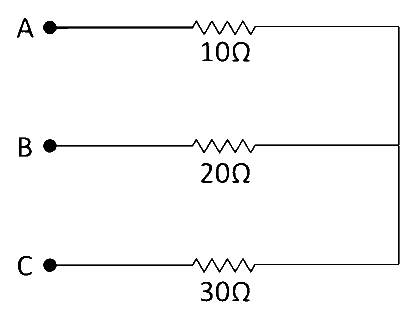
Three resistors of resistances $10 \Omega, 20 \Omega$ and $30 \Omega$ are connected as shown in the figure. If the points $A, B$ and $C$ are at potentials $10 \mathrm{~V}, 6 \mathrm{~V}$ and 5 V respectively, then the ratio of the magnitudes of the currents through $10 \Omega$ and $30 \Omega$ resistors is
PYP
TG EAPCET 2024 (Online) 9th May Morning Shift
Three capacitors of capacitances $10 \mu \mathrm{~F}, 5 \mu \mathrm{~F}$ and $20 \mu \mathrm{~F}$ are connected in series with a 14 V DC supply. The charge on $5 \mu \mathrm{~F}$ capacitor is
PYP
TG EAPCET 2024 (Online) 9th May Morning Shift
At room temperature, gaseous hydrogen is bombarded with a beam of electrons of 13.6 eV energy. The series to which the emitted spectral line belongs to
PYP
TG EAPCET 2024 (Online) 9th May Morning Shift
An element consists of a mixture of three isotopes $A, B$ and $C$ of masses $m_1, m_2$ and $m_3$, respectively. If the relative abundances of the three isotopes $A, B$ and $C$ are in the ratio $2: 3: 5$, the average mass of the element is
PYP
TG EAPCET 2024 (Online) 9th May Morning Shift
In a series $L-C-R$ circuit, if the current leads the source voltage, then
PYP
TG EAPCET 2024 (Online) 9th May Morning Shift
The half-life of a radioactive substance is 12 min . The time gap between $28 \%$ decay and $82 \%$ decay of the radioactive substance is
PYP
TG EAPCET 2024 (Online) 9th May Morning Shift
Two circular coils of radii $r_1$ and $r_2\left(r_1 \ll r_2\right)$ are placed coaxially with their centres coinciding. The mutual inductance of the arrangement is
PYP
TG EAPCET 2024 (Online) 9th May Morning Shift
If the amplitude of the magnetic field part of a harmonic electromagnetic wave in vacuum is 270 nT , the amplitude of the electric field part of the wave is
PYP
TG EAPCET 2024 (Online) 9th May Morning Shift
The heights of the transmitting and receiving antennas are 33.8 m and 64.8 m respectively. The maximum distance between the antennas for satisfactory communication in line of sight mode is (radius of the earth $=6400 \mathrm{~km}$ )
PYP
TG EAPCET 2024 (Online) 9th May Morning Shift
Identify the pair of species having same energy from the following. (The number given in the bracket corresponds to principal quantum number ( $n$ ) in which the electron is present.)
PYP
TG EAPCET 2024 (Online) 9th May Morning Shift
The concentration of electrons in an intrinsic semiconductor is $6 \times 10^{15} \mathrm{~m}^{-3}$. On doping with an impurity, the electron concentration increases to $4 \times 10^{22} \mathrm{~m}^{-3}$. In thermal equilibrium, the concentration of the holes in the doped semiconductor is
PYP
TG EAPCET 2024 (Online) 9th May Morning Shift
If Planck's constant is $6.63 \times 10^{-34} \mathrm{Js}$, then the slope of a graph drawn between cut-off voltage and frequency of incident light in a photoelectric experiment is
PYP
TG EAPCET 2024 (Online) 9th May Morning Shift
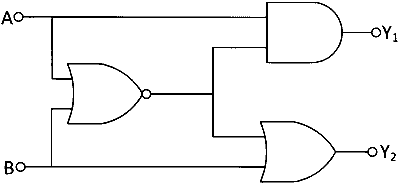
Three logic gates are connected as shown in the figure. If the inputs are $A=1$ and $B=1$, then the values of $Y_1$ and $Y_2$ respectively are
PYP
TG EAPCET 2024 (Online) 9th May Morning Shift
Which one of the following corresponds to the wavelength of line spectrum of H atom in its Balmer series ? ( $R=$ Rydberg constant)
PYP
TG EAPCET 2024 (Online) 9th May Morning Shift
An open vessel containing air was heated from $27^{\circ} \mathrm{C}$ to $727^{\circ} \mathrm{C}$. Some air was expelled. What is the fraction of air remaining in the vessel ? (Assume air as an ideal gas.)
PYP
TG EAPCET 2024 (Online) 9th May Morning Shift
The molecular formula of a compound is $A B_2 \mathrm{O}_4$. Atoms of $O$ form ccp lattice. Atoms of $A$ (cation) occupy $\frac{1}{8}$ th of tetrahedral voids. Atoms of $B$ (cation) occupy a fraction of octahedral voids. What is the fraction of vacant octahedral voids?
PYP
TG EAPCET 2024 (Online) 9th May Morning Shift
Adsorption of a gas ( $A$ ) on an adsorbent follows Freundlich adsorption isotherm. The slope and intercept (on $Y$-axis) of the isotherm are $0: 5$ and 1.0 respectively. What is the value of $\frac{x}{m}$, when the pressure of the gas $(A)$ is 100 atm ?
PYP
TG EAPCET 2024 (Online) 9th May Morning Shift
Distilled water boils at 373.15 K and freezes at 273.15 K . A solution of glucose in distilled water boils at 373.202 K . What is the freezing point (in K ) of the same solution? (For water, $K_b=0.52 \mathrm{~K} \mathrm{~kg} \mathrm{~mol}^{-1}$,
$K_f=1.86 \mathrm{~K} \mathrm{~kg} \mathrm{~mol}^{-1}$ )
PYP
TG EAPCET 2024 (Online) 9th May Morning Shift
The standard enthalpy of formation $\left(\Delta_f H^{\varphi}\right)$ of ammonia is $-46.2 \mathrm{~kJ} \mathrm{~mol}^{-1}$, What is the $\Delta_{,} H^{\ominus}$ of the following reaction? $$
\mathrm{N}_2(g)+3 \mathrm{H}_2(g) \longrightarrow 2 \mathrm{NH}_3(g)
$$
PYP
TG EAPCET 2024 (Online) 9th May Morning Shift
At $T(\mathrm{~K}), K_c$ for the reaction, $A O_2(g)+B \mathrm{O}_2(g) \rightleftharpoons A \mathrm{O}_3(g)+B \mathrm{O}(g)$ is 16 . One mole each of reactants and products are taken in a IL flask and heated to $T(\mathrm{~K})$, and equilibrium is established. What is the equilibrium concentration of $B O$ ( in $\mathrm{mol} \mathrm{L}^{-1}$ )?
PYP
TG EAPCET 2024 (Online) 9th May Morning Shift
According to Fajan's rules, which of the following is not correct about covalent character?
PYP
TG EAPCET 2024 (Online) 9th May Morning Shift
Which of the following has the least electron gain enthalpy?
PYP
TG EAPCET 2024 (Online) 9th May Morning Shift
Identify the pair of element in which the number of $s$-electrons to $p$-electrons ratio is $2: 3$
PYP
TG EAPCET 2024 (Online) 9th May Morning Shift
Identify the correct statements from the following
(A) At 298 K , the potential of hydrogen electrotle placed in a solution of $\mathrm{pH}=10$, is -0.59 V
(B) The limiting molar conductivity of $\mathrm{Ca}^{2+}$ and $\mathrm{Cl}^{-}$is 119 and $76 \mathrm{~S} \mathrm{~cm}^2 \mathrm{~mol}^{-1}$ respectively. The limiting molar conductivity of $\mathrm{CaCl}_2$ is $195 \mathrm{Scm}^2 \mathrm{~mol}^{-1}$
(C) The correct relationship between $K_C$ and $E_{\text {cell }}^{\ominus}$ is $$ E_{\text {cell }}^\theta=\frac{2303 R T}{n F} \log K_C $$
PYP
TG EAPCET 2024 (Online) 9th May Morning Shift
Consider the following pairs.
$$ \begin{array}{l|l|l} \hline & \text { Order } & \text { Property } \\ \hline \text { (A) } & \mathrm{NO}_2>\mathrm{O}_3>\mathrm{H}_2 \mathrm{O} & \text { Bond angle } \\ \hline \text { (B) } & \mathrm{HF}>\mathrm{H}_2 \mathrm{O}>\mathrm{NH}_3 & \text { Dipole moment } \\ \hline \text { (C) } & \mathrm{I}_2>\mathrm{F}_2>\mathrm{N}_2 & \text { Bond length } \\ \hline \end{array} $$
Which of the above pairs are correctly matched?
PYP
TG EAPCET 2024 (Online) 9th May Morning Shift
For a first order reaction, a plot of $\ln k\left(Y\right.$-axis) and $\frac{1}{T}$ $(X$-axis) gave the straight line with slope equal to $-10^3 \mathrm{~K}$ and intercept equal to 2.303 ( on $Y$-axis). What is the activation energy ( $E_a$ in $\mathrm{kJ} \mathrm{mol}^{-1}$ ) of the reaction? (Given, $R=8314 \mathrm{JK}^{-1} \mathrm{~mol}^{-1}$ )
PYP
TG EAPCET 2024 (Online) 9th May Morning Shift
What is the correct stability order of $\mathrm{KO}_2, \mathrm{RbO}_2, \mathrm{CsO}_2$ ?
PYP
TG EAPCET 2024 (Online) 9th May Morning Shift
Assertion (A) $\mathrm{MgO}, \mathrm{CaO}, \mathrm{SrO}$ and BaO are insoluble in water.
Reason ( R ) In aqueous medium the basic strength of $\mathrm{MgO}, \mathrm{CaO}, \mathrm{SrO}$ and BaO increases with increase in the atomic number of metal.
The correct option among the following is
PYP
TG EAPCET 2024 (Online) 9th May Morning Shift
Which of the following when subjected to thermal decomposition will liberate dinitrogen ?
(i) Sodium nitrate
(ii) Ammonium dichromate
(iii) Barium azide
PYP
TG EAPCET 2024 (Online) 9th May Morning Shift
Observe the oxides $\mathrm{CO}, \mathrm{B}_2 \mathrm{O}_3, \mathrm{SiO}_2, \mathrm{CO}_2, \mathrm{Al}_2 \mathrm{O}_3$. $\mathrm{PbO}_2, \mathrm{Tl}_2 \mathrm{O}_3$. The number of acidic oxides in the list is
PYP
TG EAPCET 2024 (Online) 9th May Morning Shift
Identify the set which is not correctly matched in the following.
PYP
TG EAPCET 2024 (Online) 9th May Morning Shift
Identify the element for which +1 oxidation state is more stable than +3 oxidation state.
PYP
TG EAPCET 2024 (Online) 9th May Morning Shift
"Observe the following reaction. This reaction represents
$$ 4 \mathrm{HCl}+\mathrm{O}_2 \xrightarrow[723 \mathrm{~K}]{\mathrm{CuCl}_2} 2 \mathrm{Cl}_2+2 \mathrm{H}_2 \mathrm{O} $$"
PYP
TG EAPCET 2024 (Online) 9th May Morning Shift
The common components of photochemical smog are
PYP
TG EAPCET 2024 (Online) 9th May Morning Shift
The molecular formula of a coordinate complex is $\mathrm{CoH}_{12} \mathrm{O}_6 \mathrm{Cl}_3$. When one mole of this aqueous solution of complex is reacted with excess of aqueous $\mathrm{AgNO}_3$ solution, three moles of AgCl was formed. What is the correct formula of the complex ?
PYP
TG EAPCET 2024 (Online) 9th May Morning Shift
Identify the correct statements from the following.
(i) Ti (IV) is more stable than Ti (III) and Ti (II).
(ii) Among $3 d$-series elements (From $Z=22$ to 29). Only copper has positive reduction potential $\left(M^{2+} / M\right)$.
(iii) Both Sc and Zn exhibit +1 oxidation state.
PYP
TG EAPCET 2024 (Online) 9th May Morning Shift
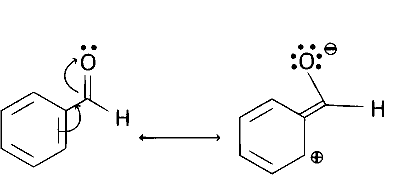
The electron displacement effect observed in the given structures is known as
PYP
TG EAPCET 2024 (Online) 9th May Morning Shift
A low boiling point metal contains high boiling point metal as impurity. The correct refining method is
PYP
TG EAPCET 2024 (Online) 9th May Morning Shift
The number of activating and deactivating groups of the following are respectively
$$ \begin{aligned} & -\mathrm{OCH}_2 \mathrm{CH}_3,-\mathrm{COCH}_3,-\mathrm{NHCOCH}_3, \\ & -\mathrm{COOCH}_3, \mathrm{SO}_3 \mathrm{H} \end{aligned} $$
$$ \begin{aligned} & -\mathrm{OCH}_2 \mathrm{CH}_3,-\mathrm{COCH}_3,-\mathrm{NHCOCH}_3, \\ & -\mathrm{COOCH}_3, \mathrm{SO}_3 \mathrm{H} \end{aligned} $$
PYP
TG EAPCET 2024 (Online) 9th May Morning Shift
Assertion (A) : Chlorobenzene is not formed in the reaction of phenol with thionyl chloride.
Reason (R) : In phenol, carbon - oxygen bond has partial double bond character.
The correct answer is :
PYP
TG EAPCET 2024 (Online) 9th May Morning Shift
An alkene $X\left(\mathrm{C}_4 \mathrm{H}_8\right)$ exhibits geometrical isomerism. Oxidation of $A$ with $\mathrm{KMnO}_4 / \mathrm{H}^{+}$gave $Y$. On heating sodium salt of $Y$ with a mixture of NaOH and CaO gave $Z$. What is $Z$ ?
PYP
TG EAPCET 2024 (Online) 9th May Morning Shift
A halogen compound $X\left(\mathrm{C}_4 \mathrm{H}_9 \mathrm{Br}\right)$ on hydrolysis gave alcohol $Y$. The alcohol $Y$ undergoes dehydration with $20 \% \mathrm{H}_3 \mathrm{PO}_4$ at 358 K . What is $X$ ?
PYP
TG EAPCET 2024 (Online) 9th May Morning Shift
An alcohol $X\left(\mathrm{C}_3 \mathrm{H}_{12} \mathrm{O}\right)$ when reacted with conc. HCl and anhydrous $\mathrm{ZnCl}_2$ produces turbidity instantly. The alcohol $X$ can be prepared from which of the following reactions?
PYP
TG EAPCET 2024 (Online) 9th May Morning Shift
$X$ and $Z$ respectively in the following reaction sequence are $\mathrm{C}_3 \mathrm{H}_6 \xrightarrow{X} Y \xrightarrow[\mathrm{AlCl}_3]{\mathrm{C}_6 \mathrm{H}_6} Z$ (Major projuct)
PYP
TG EAPCET 2024 (Online) 9th May Morning Shift
The correct statement(s) of the following is/are (A) Aniline forms a stable benzene diazonium chloride at 285 K . (B) N - phenylethanamide is less reactive towards nitration than aniline. (C) $p-\mathrm{CH}_3 \mathrm{C}_6 \mathrm{H}_4 \mathrm{COCl}$ is Hinsberg reagent.
PYP
TG EAPCET 2024 (Online) 9th May Morning Shift
The functional groups involved in the conversion of glucose to gluconic acid and gluconic acid to saccharic acid respectively are
PYP
TG EAPCET 2024 (Online) 9th May Morning Shift
Among the following the incorrect statement about chloramphenicol is
PYP
TG EAPCET 2024 (Online) 9th May Morning Shift
The reagents/ chemicals $X$ and $Y$ that convert cyanobenzene to Schiff's base are
PYP
TG EAPCET 2024 (Online) 9th May Morning Shift
If $\sqrt{5}-i \sqrt{15} \doteqdot r(\cos \theta+i \sin \theta),-\pi<\theta<\pi$, then $r^2\left(\sec \theta+3 \operatorname{cosec}^2 \theta\right)=$
PYP
TG EAPCET 2024 (Online) 9th May Morning Shift
The $\mathrm{p} K_{\mathrm{a}}$ values of $X, Y, Z$ respectively are $8.3,7.1,10.2$. What are $X, Y, Z$ ?
PYP
TG EAPCET 2024 (Online) 9th May Morning Shift
The equations $2 x^2+a x-2=0$ and $x^2+x+2 a=0$ have exactly one common root. If $a \neq 0$, then one of the roots of the equation $a x^2-4 x-2 a=0$ is
PYP
TG EAPCET 2024 (Online) 9th May Morning Shift
$x$ and $y$ are two complex numbers such that $|x|=|y|=1$.
If $\arg (x)=2 \alpha, \arg (y)=3 \beta$ and $\alpha+\beta=\frac{\pi}{36}$, then $x^6 y^4+\frac{1}{x^6 y^4}=$
PYP
TG EAPCET 2024 (Online) 9th May Morning Shift
One of the roots of the equation $x^{14}+x^9-x^5-1=0$ is
PYP
TG EAPCET 2024 (Online) 9th May Morning Shift
If the quadratic equation $3 x^2+(2 k+1) x-5 k=0$ has real and equal roots, then the value of $k$ such that
$\frac{1}{2}$ < $k$ < 0 is
PYP
TG EAPCET 2024 (Online) 9th May Morning Shift
The point $P$ denotes the complex number $z=x+i y$ in the argand plane. If $\frac{2 z-i}{z-2}$ is a purely real number, then the equation of the locus of $P$ is
PYP
TG EAPCET 2024 (Online) 9th May Morning Shift
If $\alpha, \beta$ and $\gamma$ are the roots of the equation $2 x^3-3 x^2+5 x-7=0$, then $\sum \alpha^2 \beta^2=$
PYP
TG EAPCET 2024 (Online) 9th May Morning Shift
The sum of all the 4 -digit numbers formed by taking all the digits from $2,3,5,7$ without repetition, is
PYP
TG EAPCET 2024 (Online) 9th May Morning Shift
If ${ }^n c_r=c_r$ and $2 \frac{c_1}{c_0}+4 \frac{c_2}{c_1}+6 \frac{c_3}{c_2}+\ldots .+2 n \frac{c_n}{c_{n-1}}=650$, then
${ }^n C_2=$ $\qquad$
PYP
TG EAPCET 2024 (Online) 9th May Morning Shift
The number of ways in which 15 identical gold coins can be distributed among 3 persons such that each one gets atleast 3 gold coins, is
PYP
TG EAPCET 2024 (Online) 9th May Morning Shift
When $|x|<2$, then coefficient of $x^2$ in the power series expansion of $\frac{x}{(x-2)(x-3)}$, is
PYP
TG EAPCET 2024 (Online) 9th May Morning Shift
The sum of two roots of the equation $x^4-x^3-16 x^2+4 x+48=0$ is zero. If $\alpha, \beta, \gamma$ and $\delta$ are the roots of this equation, then $\alpha^4+\beta^4+\gamma^4+\delta^4=$
PYP
TG EAPCET 2024 (Online) 9th May Morning Shift
The number of all possible combinations of 4 letters which are taken from the letters of the word 'ACCOMMODATION', is
PYP
TG EAPCET 2024 (Online) 9th May Morning Shift
When 2 dice are thrown, it is observed that the sum of the numbers appeared on the top faces of both the dice is a prime number. Then, the probability of having a multiple of 3 among the pair of numbers thus obtained is
PYP
TG EAPCET 2024 (Online) 9th May Morning Shift
A dealer gets refrigerators from 3 different manufacturing companies $C_1, C_2$ and $C_3 .25 \%$ of his stock is from $C_1, 35 \%$ from $C_2$ and $40 \%$ from $C_3$. The percentages of receiving defective refrigerators from $C_1, C_2$ and $C_3$ are $3 \% 2 \%, 1 \%$ respectively. If a refrigerator sold at random is found to be defective by a customer, then the probability that it is from $\mathrm{C}_2$ is
PYP
TG EAPCET 2024 (Online) 9th May Morning Shift
If the probability that a student selected at random from a particular college is good at mathematics is 0.6 , then the probability of having two students who are good at Mathematics in a group of 8 students of that college standing in front of the college, is
PYP
TG EAPCET 2024 (Online) 9th May Morning Shift
For $n \in N$ the largest positive integer that divides $81^n+20 n-1$ is $k$. If $S$ is the sum of all positive divisors of $k$, then $S-k=$
PYP
TG EAPCET 2024 (Online) 9th May Morning Shift
If on an average 4 customers visit a shop in an hour, then the probability that more than 2 customers visit the shop in a specific hour is
PYP
TG EAPCET 2024 (Online) 9th May Morning Shift
If 2 cards are drawn at random from a well shuffled pack of 52 playing cards from the same suit, then the probability of getting a face card and a card having a prime number is
PYP
TG EAPCET 2024 (Online) 9th May Morning Shift
A plane $\pi$ passes through the points $(5,1,2),(3,-4,6)$ and $(7,0,-1)$. If $p$ is the perpendicular distance from the origin to the plane $\pi$ and $l, m$ and $n$ are the direction cosines of a normal to the plane $\pi$, the $|3 l+2 m+5 n|=$
PYP
TG EAPCET 2024 (Online) 9th May Morning Shift
A vector of magnitude $\sqrt{2}$ units along the internal bisector of the angle between the vectors $2 \hat{\mathbf{i}}-2 \hat{\mathbf{j}}+\hat{\mathbf{k}}$ and $\hat{\mathbf{i}}+2 \hat{\mathbf{j}}+2 \hat{\mathbf{k}}$ is
PYP
TG EAPCET 2024 (Online) 9th May Morning Shift
If $\mathbf{a}, \mathbf{b}$ and $\mathbf{c}$ are non-coplanar vectors and the points $\lambda \mathbf{a}+3 \mathbf{b}-\mathbf{c}, \mathbf{a}-\lambda \mathbf{b}+3 \mathbf{c}, 3 \mathbf{a}+4 \mathbf{b}-\lambda \mathbf{c}$ and $\mathbf{a}-6 b+6 \mathbf{c}$ are coplanar, then one of the values of $\lambda$ is
PYP
TG EAPCET 2024 (Online) 9th May Morning Shift
If $\theta$ is the angle between the vectors $4 \hat{\mathbf{i}}-\hat{\mathbf{j}}+2 \hat{\mathbf{k}}$ and $\hat{\mathbf{i}}+3 \hat{\mathbf{j}}-2 \hat{\mathbf{k}}$, then $\sin 2 \theta=$
PYP
TG EAPCET 2024 (Online) 9th May Morning Shift
$\mathbf{a}, \mathbf{b}$ and $\mathbf{c}$ are three vectors such that $|a|=3,|b|=2 \sqrt{2},|c|=5$ and $\mathbf{c}$ is perpendicular to the plane of $\mathbf{a}$ and $\mathbf{b}$. If the angle between the vectors a and $\mathbf{b}$ is $\frac{\pi}{4}$, then $|\mathbf{a}+\mathbf{b}+\mathbf{c}|=$
PYP
TG EAPCET 2024 (Online) 9th May Morning Shift
If the ratio of the perpendicular distances of a variable point $P(x, y, z)$ from the $X$-axis and from the $Y Z$ - plane is $2: 3$, then the equation of the locus of $P$ is
PYP
TG EAPCET 2024 (Online) 9th May Morning Shift
If $A$ is square matrix and $A^2+I=2 A$, then $A^9=$
PYP
TG EAPCET 2024 (Online) 9th May Morning Shift
$\operatorname{det}\left[\begin{array}{ccc}\frac{a^2+b^2}{c} & c & c \\\\ a & \frac{b^2+c^2}{a} & a \\\ b & b & \frac{c^2+a^2}{b}\end{array}\right]=$
PYP
TG EAPCET 2024 (Online) 9th May Morning Shift
The system of simultaneous linear equations
$$ \begin{aligned} & x-2 y+3 z=4,3 x+y-2 z=7 \\ & 2 x+3 y+z=6 \text { has } \end{aligned} $$
PYP
TG EAPCET 2024 (Online) 9th May Morning Shift
The direction cosines of two lines are connected by the relations $l-m+n=0$ and $2 l m-3 m n+n l=0$. If $\theta$ is the angle between these two lines, then $\cos \theta=$
PYP
TG EAPCET 2024 (Online) 9th May Morning Shift
The mean deviation about the mean for the following data is
\begin{array}{c|l|l|l|l|l}
\hline \text { Class interval } & 0-2 & 2-4 & 4-6 & 6-8 & 8-10 \\\\
\hline \text { Frequency } & 1 & 3 & 5 & 3 & 1 \\\\
\hline
\end{array}
PYP
TG EAPCET 2024 (Online) 9th May Morning Shift
$A, B, C$ and $D$ are square matrices such that $A+B$ is symmetric, $A-B$ is skew-symmetric and $D$ is the transpose of $C$.
If $A=\left[\begin{array}{ccc}-1 & 2 & 3 \\\\ 4 & 3 & -2 \\\\ 3 & -4 & 5\end{array}\right]$ and
$C=\left[\begin{array}{ccc}0 & 1 & -2 \\\\ 2 & -1 & 0 \\\\ 0 & 2 & 1\end{array}\right]$, then the matrix $B+D=$
PYP
TG EAPCET 2024 (Online) 9th May Morning Shift
If $\cosh ^{-1}\left(\frac{5}{3}\right)+\sinh ^{-1}\left(\frac{3}{4}\right)=k$, then $e^k=$
PYP
TG EAPCET 2024 (Online) 9th May Morning Shift
$\cos ^{-1} \frac{3}{5}+\sin ^{-1} \frac{5}{13}+\tan ^{-1} \frac{16}{63}=$
PYP
TG EAPCET 2024 (Online) 9th May Morning Shift
If $\tan A<0$ and $\tan 2 A=-\frac{4}{3}$, then $\cos 6 A=$
PYP
TG EAPCET 2024 (Online) 9th May Morning Shift
If the period of the function
$f(x)=2 \cos (3 x+4)-3 \tan (2 x-3)+5 \sin (5 x)-7$ is $k$, then
PYP
TG EAPCET 2024 (Online) 9th May Morning Shift
If $m \cos (\alpha+\beta)-n \cos (\alpha-\beta)$ $=m \cos (\alpha-\beta)+n \cos (\alpha+\beta)$, then $\tan \alpha \tan \beta=$
PYP
TG EAPCET 2024 (Online) 9th May Morning Shift
The number of solutions of the equation $\sin 7 \theta-\sin 3 \theta=\sin 4 \theta$ that lie in the interval $(0, \pi)$, is
PYP
TG EAPCET 2024 (Online) 9th May Morning Shift
In a $\triangle A B C$, if $r_1 r_2+r_3=35, r_2 r_3+r_1=63$ and $r_3 r_1+r_2=45$, then $2 s=$
PYP
TG EAPCET 2024 (Online) 9th May Morning Shift
A particle moving from a fixed point on a straight line travels a distance $S$ metres in $t \mathrm{sec}$. If $S=t^3-t^2-t+3$, then the distance (in mts) travelled by the particle when it comes to rest, is
PYP
TG EAPCET 2024 (Online) 9th May Morning Shift
If $2 x^2-3 x y+4 y^2+2 x-3 y+4=0$, then $\left(\frac{d y}{d x}\right)_{(3,2)}=$
PYP
TG EAPCET 2024 (Online) 9th May Morning Shift
If $y=\sin a x+\cos b x$, then $y^{\prime \prime}+b^2 y=$
PYP
TG EAPCET 2024 (Online) 9th May Morning Shift
If $x=\frac{9 t^2}{1+t^4}$ and $y=\frac{16 t^2}{1-t^4}$ then $\frac{d y}{d x}=$
PYP
TG EAPCET 2024 (Online) 9th May Morning Shift
In a $\triangle A B C$, if $(a-b)^2 \cos ^2 \frac{C}{2}+(a+b)^2 \sin ^2 \frac{C}{2}=a^2+b^2$, then $\cos A=$
PYP
TG EAPCET 2024 (Online) 9th May Morning Shift
$\lim _{x \rightarrow 0} \frac{3^{\sin x}-2^{\tan x}}{\sin x}=$
PYP
TG EAPCET 2024 (Online) 9th May Morning Shift
If $f(x)=\int \frac{\sin 2 x+2 \cos x}{4 \sin ^2 x+5 \sin x+1} d x$ and $f(0)=0$, then $f(\pi / 6)=$
PYP
TG EAPCET 2024 (Online) 9th May Morning Shift
If $ f(x)=\left\{\begin{array}{ll}\frac{8}{x^{3}}-6 x & \text {, if } 0 < x \leq 1 \\\\ \frac{x-1}{\sqrt{x}-1} & \text {,if } x > 1\end{array}\right. $ is a real valued function, then at $ x=1, f $ is
PYP
TG EAPCET 2024 (Online) 9th May Morning Shift
$\int_{-2}^2 x^4\left(4-x^2\right)^{\frac{7}{2}} d x=$
PYP
TG EAPCET 2024 (Online) 9th May Morning Shift
$\lim \limits_{n \rightarrow \infty}\left[\left(1+\frac{1}{n^2}\right)\left(1+\frac{4}{n^2}\right)\left(1+\frac{9}{n^2}\right) \ldots .(2)\right]^{1 / n}=$
PYP
TG EAPCET 2024 (Online) 9th May Morning Shift
If the function
$$ f(x)=\left\{\begin{array}{cc} \frac{\cos a x-\cos 9 x}{x^2} & \text {, if } x \neq 0 \\ 16 & \text {, if } x=0 \end{array}\right. $$
is continuous at $x=0$, then $a=$
PYP
TG EAPCET 2024 (Online) 9th May Morning Shift
Area of the region enclosed between the curves $y^2=4(x+7)$ and $y^2=5(2-x)$ is
PYP
TG EAPCET 2024 (Online) 9th May Morning Shift
The curve $y=x^3-2 x^2+3 x-4$ intersects the horizontal line $y=-2$ at the point $P(h, k)$. If the tangent drawn to this curve at $P$ meets the $X$-axis at $\left(x_1, y_1\right)$, then $x_1=$
PYP
TG EAPCET 2024 (Online) 9th May Morning Shift
If $f(x)=(2 x-1)(3 x+2)(4 x-3)$ is a real valued function defined on $\left[\frac{1}{2}, \frac{3}{4}\right]$, then the value(s) of $c$ as defined in the statement of Rolle's theorem
PYP
TG EAPCET 2024 (Online) 9th May Morning Shift
The radius of a sphere is 7 cm . If an error of 0.08 sq cm is made in measuring it, then the approximate error (in cubic cm ) found in its volume is
PYP
TG EAPCET 2024 (Online) 9th May Morning Shift
The general solution of the differential equation $\left(3 x^2-2 x y\right) d y+\left(y^2-2 x y\right) d x=0$ is
PYP
TG EAPCET 2024 (Online) 9th May Morning Shift
If the interval in which the real valued function $f(x)=\log \left(\frac{1+x}{1-x}\right)-2 x-\frac{x^3}{1-x^2}$ is decreasing in $(a, b)$, where $|b-a|$ is maximum, then $\frac{a}{b}=$
PYP
TG EAPCET 2024 (Online) 9th May Morning Shift
$\int \frac{\left(1-4 \sin ^2 x\right) \cos x}{\cos (3 x+2)} d x=$
PYP
TG EAPCET 2024 (Online) 9th May Morning Shift
If the slope of the tangent drawn at any point $(x, y)$ on the curve $y=f(x)$ is $\left(6 x^2+10 x-9\right)$ and $f(2)=0$, then $f(-2)=$
PYP
TG EAPCET 2024 (Online) 9th May Morning Shift
$\int(\sqrt{1-\sin x}+\sqrt{1+\sin x}) d x=f(x)+c$, where $c$ is the constant of integration. If $\frac{5 \pi}{2}$<$x<\frac{7 \pi}{2}$ and $$ f\left(\frac{8 \pi}{3}\right)=-2, \text { then } f^{\prime}\left(\frac{8 \pi}{3}\right)= $$
PYP
TG EAPCET 2024 (Online) 9th May Morning Shift
If $f(x)=\frac{2 x-3}{3 x-2}$ and $f_n(x)=($ fofofo .......n times) $(x)$, then $f_{32}(x)=$
PYP
TG EAPCET 2024 (Online) 9th May Morning Shift
The domain of the real valued function $f(x)=\sqrt{\cos (\sin x)}+\cos ^{-1}\left(\frac{1+x^2}{2 x}\right)$ is
PYP
TG EAPCET 2024 (Online) 9th May Morning Shift
$\int \frac{\left(1-4 \sin ^2 x\right) \cos x}{\cos (3 x+2)} d x=$
PYP
TG EAPCET 2024 (Online) 9th May Morning Shift
If $(1,1),(-2,2)$ and $(2,-2)$ are 3 points on a circle $S$, then the perpendicular distance from the centre of the circle $S$ to the line $3 x-4 y+1=0$ is
PYP
TG EAPCET 2024 (Online) 9th May Morning Shift
If the equation of the transverse common tangent of the circles $x^2+y^2-4 x+6 y+4=0$ and $x^2+y^2+2 x-2 y-2=0$ is $a x+b y+c=0$, then $\frac{a}{c}=$
PYP
TG EAPCET 2024 (Online) 9th May Morning Shift
$\int \frac{1}{x^{m \sqrt[m]{m}} x^{m}+1} d x=$
PYP
TG EAPCET 2024 (Online) 9th May Morning Shift
If the inverse point of the point $P(3,3)$ with respect to the circle $x^2+y^2-4 x+4 y+4=0$ is $Q(a, b)$, then $a+5 b=$
PYP
TG EAPCET 2024 (Online) 9th May Morning Shift
The centroid of a variable $\triangle A B C$ is at the distance of 5 units from the origin. If $A=(2,3)$ and $B=(3,2)$, then the locus of $C$ is
PYP
TG EAPCET 2024 (Online) 9th May Morning Shift
If the line $4 x-3 y+p=0(p+3>0)$ touches the circle $x^2+y^2-4 x+6 y+4=0$ at the point $(h, k)$, then $h-2 k=$
PYP
TG EAPCET 2024 (Online) 9th May Morning Shift
A circle $S \equiv x^2+y^2+2 g x+2 f y+6=0$ cuts another circle $x^2+y^2-6 x-6 y-6=0$ orthogonally. If the angle between the circles $S=0$ and $x^2+y^2+6 x+6 y+2=0$ is $60^{\circ}$, then the radius of the circle $S=0$ is
PYP
TG EAPCET 2024 (Online) 9th May Morning Shift
If $(2,3)$ is the focus and $x-y+3=0$ is the directrix of a parabola, then the equation of the tangent drawn at the vertex of the parabola is
PYP
TG EAPCET 2024 (Online) 9th May Morning Shift
Consider the parabola $25\left[(x-2)^2+(y+5)^2\right]=(3 x+4 y-1)^2$, match the characteristic of this parabola given in List I with its corresponding item in List II.
$$ \begin{array}{lll} \hline & \text { List I } & \text { List II } \\\\ \hline \text { I } & \text { Vertex } & \text { (A) } 8 \\\\ \hline \text { II } & \text { length of latus rectum } & \text { (B) }\left(\frac{29}{10}, \frac{-38}{10}\right) \\\\ \hline \text { III } & \text { Directrix } & \text { (C) } 3 x+4 y-1=0 \\\\ \hline \text { IV } & \begin{array}{l} \text { One end of the latus } \\\\ \text { rectum } \end{array} & \text { (D) }\left(\frac{-2}{5}, \frac{-16}{5}\right) \\\\ \hline \end{array} $$
The correct answer is
PYP
TG EAPCET 2024 (Online) 9th May Morning Shift
The point of intersection of two tangents drawn to the hyperbola $\frac{x^2}{a^2}-\frac{y^2}{4}=1$ lie on the circle $x^2+y^2=5$. If these tangents are perpendicular to each other, then $a=$
PYP
TG EAPCET 2024 (Online) 9th May Morning Shift
If $m_1$ and $m_2$ are the slopes of the direct common tangents drawn to the circles $x^2+y^2-2 x-8 y+8=0$ and $x^2+y^2-8 x+15=0$, then $m_1+m_2=$
PYP
TG EAPCET 2024 (Online) 9th May Morning Shift
The equation of the common tangent to the parabola $y^2=8 x$ and the circle $x^2+y^2=2$ is $a x+b y+2=0$. If $-\frac{a}{b}>0$, then $3 a^2+2 b+1=$
PYP
TG EAPCET 2024 (Online) 9th May Morning Shift
Area of the triangle bounded by the lines given by the equations $12 x^2-20 x y+7 y^2=0$ and $x+y-1=0$ is
PYP
TG EAPCET 2024 (Online) 9th May Morning Shift
When the origin is shifted to the point $(2, b)$ by translation of axes, the coordinates of the point $(a, 4)$ have changed to $(6,8)$. When the origin is shifted to $(a, b)$ by translation of axes, if the transformed equation of $x^2+4 x y+y^2=0$ is $X^2+2 H X Y+Y^2+2 G X+2 F Y+C=0$, then $2 H(G+F)=$
PYP
TG EAPCET 2024 (Online) 9th May Morning Shift
The slope of a line $L$ passing through the point $(-2,-3)$ is not defined. If the angle between the lines $L$ and $a x-2 y+3=0(a>0)$ is $45^{\circ}$, then the angle made by the line $x+a y-4 \doteq 0$ with positive $X$-axis in the anti-clockwise direction is
PYP
TG EAPCET 2024 (Online) 9th May Morning Shift
If $6 x-5 y-20=0$ is a normal to the ellipse $x^2+3 y^2=K$, then $K=$
PYP
TG EAPCET 2024 (Online) 9th May Morning Shift
If $(4,3)$ and $(1,-2)$ are the end points of a diagonal of a square, then the equation of one of its sides is
PYP
TG EAPCET 2024 (Online) 9th May Morning Shift
$(a, b)$ is the point of concurrency of the lines $x-3 y+3=0, k x+y+k=0$ and $2 x+y-8=0$. If the perpendicular distance from the origin to the line $L=a x-b y+2 k=0$ is $p$, then the perpendicular distance from the point $(2,3)$ to $L=0$ is
PYP
TG EAPCET 2024 (Online) 9th May Morning Shift
Observe the following reactions.
$$ \begin{aligned} & \text { I. } \mathrm{H}_2 \mathrm{O}(l)+2 \mathrm{Na}(s) \longrightarrow 2 \mathrm{NaOH}(a q)+\mathrm{H}_2(g) \\\\ & \text { II. } 2 \mathrm{H}_2 \mathrm{O}(l)+2 \mathrm{~F}_2(g) \longrightarrow 4 \mathrm{H}^{+}(a q)+4 \mathrm{~F}^{-}(a q)+\mathrm{O}_2(g) \end{aligned} $$
PYP
TG EAPCET 2024 (Online) 9th May Morning Shift
12 g of an element reacts with 32 g of oxygen. What is the equivalent weight of the element ?
PYP
TG EAPCET 2024 (Online) 9th May Morning Shift
Match the following.
| List-I (Monomer/s) | List-II (Name of polymer) |
| A. CF₂$=$CF₂ | I. Neoprene |
| B. NH₂(CH₂)₆NH₂, HO₂C(CH₂)₄CO₂H | II. Bakelite |
| C. C₆H₅OH₃ HCHO | III. Teflon |
| D. CH₂$=$CH(Cl)—CH$=$CH₂ | IV. Nylon 6,6 |
The correct answer is
PYP
TG EAPCET 2024 (Online) 9th May Morning Shift
$\hat{\mathbf{i}}-2 \hat{\mathbf{j}}+\hat{\mathbf{k}}, 2 \hat{\mathbf{i}}+\hat{\mathbf{j}}-\hat{\mathbf{k}}$ and $\hat{\mathbf{i}}-\hat{\mathbf{j}}-2 \hat{\mathbf{k}}$ are the position vectors of the vertices $A, B$ and $C$ of a $\triangle A B C$ respectively. If $D$ and $E$ are the mid points of $B C$ and $C A$ respectively, then the unit vector along DE is
PYP
TG EAPCET 2024 (Online) 9th May Morning Shift
If $\frac{x^4}{\left(x^2+1\right)(x-2)}=f(x)+\frac{A x+B}{x^2+1}+\frac{C}{x-2}$, then $f(14)+2 A-B=$
Showing 5 of 161 questions