Difficulty distribution
How the classified questions are distributed by difficulty.
11questions
Not classified
11
100%
Your cart is empty.
Practice States Of Matter - Physical Chemistry - Chemistry previous year questions organised from real papers, with year-wise coverage and clear topic navigation.
Every graph below is calculated only from this selection.
Year-wise coverage for States Of Matter. Each bar uses a separate theme-derived color.
How the classified questions are distributed by difficulty.
MCQ, numerical, multiple-select and other formats found in these papers.
Top subjects by unique question coverage.
Top topics across the included previous year papers.
Top subtopics inside this exact selection.
Question coverage for the most populated papers. Every active PYP paper remains listed below.
Newest papers appear first. Sort by year, question coverage or name.
| Paper | Year / session | Questions in this view | Open |
|---|---|---|---|
| TG EAPCET 2025 ONLINE 2ND MAY EVENING SHIFT | 2025 | 1 | View paper |
| TG EAPCET 2025 ONLINE 2ND MAY MORNING SHIFT | 2025 | 1 | View paper |
| TG EAPCET 2025 ONLINE 3RD MAY EVENING SHIFT | 2025 | 1 | View paper |
| TG EAPCET 2025 ONLINE 3RD MAY MORNING SHIFT | 2025 | 1 | View paper |
| TG EAPCET 2025 ONLINE 4TH MAY EVENING SHIFT | 2025 | 1 | View paper |
| TG EAPCET 2025 ONLINE 4TH MAY MORNING SHIFT | 2025 | 1 | View paper |
| TG EAPCET 2024 (Online) 9th May Morning Shift | 2024 | 1 | View paper |
| TG EAPCET 2024 ONLINE 10TH MAY EVENING SHIFT | 2024 | 1 | View paper |
| TG EAPCET 2024 ONLINE 10TH MAY MORNING SHIFT | 2024 | 1 | View paper |
| TG EAPCET 2024 ONLINE 11TH MAY MORNING SHIFT | 2024 | 1 | View paper |
| TG EAPCET 2024 ONLINE 9TH MAY EVENING SHIFT | 2024 | 1 | View paper |
Practice every matching question in batches of 20, with every available option.
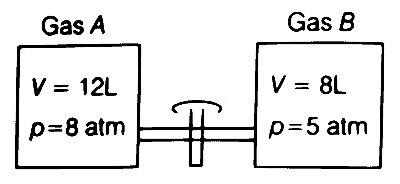
Two vessels are filled with ideal gases $A$ and $B$ and are connected through a pipe of zero volume as shown in figure. The stop cock is opened and the gases are allowed to mix homogeneously and the temperature is
kept constant. The partial pressures of $A$ and $B$ respectively ( in atm ) are
The RMS velocity of dihydrogen is $\sqrt{7}$ times more than that of dinitrogen. If $T_{\mathrm{H}_2}$ and $T_{\mathrm{N}_2}$ are the temperatures of dihydrogen and dinitrogen, then the correct relationship between them is
At 298 K , a flask ' $A$ ' of unknown volume $(V)$ contains oxygen at 5 atm . Another flask ' $B$ ' of volume 2 L contains helium at 3 atm . Two flasks are connected together by a small tube of zero volume. After the two gases are completely mixed, if the resulting mixture is found to have the mole fraction of oxygen as 0.2 , the volume of flask ' $A$ ' (in L ) is
(Assume oxygen and helium as ideal gases)
At $T(\mathrm{~K})$ root mean square (rms) velocity of argon (molar mass $40 \mathrm{~g} \mathrm{~mol}^{-1}$ ) is $20 \mathrm{~ms}^{-1}$. The average kinetic energy of the same gas at $T(\mathrm{~K})$ (in $\mathrm{J} \mathrm{mol}^{-1}$ ) is
The isobars of one mole of an ideal gas were obtained at three different pressure ( $p_1, p_2$ and $p_3$ ). The slopes of these isobars are $m_1, m_2$ and $m_3$ respectively. If $p_1 < p_2 < p_3$, then the correct relation of the slopes is
The force $(F)$ required to maintain the flow of layers of a liquid is equal to
( $A=$ area of contact of layers
$d z=$ distance between the layers
$d u=$ change in velocity
$\eta=$ coefficient of viscosity)