Difficulty distribution
How the classified questions are distributed by difficulty.
22questions
Not classified
22
100%
Your cart is empty.
Practice Periodic Table And Periodicity - Inorganic Chemistry - Chemistry previous year questions organised from real papers, with year-wise coverage and clear topic navigation.
Every graph below is calculated only from this selection.
Year-wise coverage for Periodic Table And Periodicity. Each bar uses a separate theme-derived color.
How the classified questions are distributed by difficulty.
MCQ, numerical, multiple-select and other formats found in these papers.
Top subjects by unique question coverage.
Top topics across the included previous year papers.
Top subtopics inside this exact selection.
Question coverage for the most populated papers. Every active PYP paper remains listed below.
Newest papers appear first. Sort by year, question coverage or name.
| Paper | Year / session | Questions in this view | Open |
|---|---|---|---|
| TG EAPCET 2025 ONLINE 2ND MAY EVENING SHIFT | 2025 | 2 | View paper |
| TG EAPCET 2025 ONLINE 2ND MAY MORNING SHIFT | 2025 | 4 | View paper |
| TG EAPCET 2025 ONLINE 3RD MAY EVENING SHIFT | 2025 | 1 | View paper |
| TG EAPCET 2025 ONLINE 3RD MAY MORNING SHIFT | 2025 | 2 | View paper |
| TG EAPCET 2025 ONLINE 4TH MAY EVENING SHIFT | 2025 | 2 | View paper |
| TG EAPCET 2025 ONLINE 4TH MAY MORNING SHIFT | 2025 | 2 | View paper |
| TG EAPCET 2024 (Online) 9th May Morning Shift | 2024 | 2 | View paper |
| TG EAPCET 2024 ONLINE 10TH MAY EVENING SHIFT | 2024 | 2 | View paper |
| TG EAPCET 2024 ONLINE 10TH MAY MORNING SHIFT | 2024 | 1 | View paper |
| TG EAPCET 2024 ONLINE 11TH MAY MORNING SHIFT | 2024 | 1 | View paper |
| TG EAPCET 2024 ONLINE 9TH MAY EVENING SHIFT | 2024 | 3 | View paper |
Practice every matching question in batches of 20, with every available option.
Assertion (A) : The ionic radii of $\mathrm{Na}^{+}$and $\mathrm{F}^{-}$are same.
Reason (R) : Both $\mathrm{Na}^{+}$and $\mathrm{F}^{-}$are isoelectronic species.
The correct answer is
| List I (Element) | List II (Block) |
| A Ra | I p - block |
| B Uuq | II s- block |
| C Ds | III f - block |
| D Fm | IV d - block |
Electron gain enthalpy values $\left(\Delta_{\mathrm{cg}} H\right)$ (in $\mathrm{kJ} \mathrm{mol}^{-1}$ ) of elements $X, Y$ and $Z$ are $-349,-200$ and -295 respectively. $X, Y$ and $Z$ are respectively
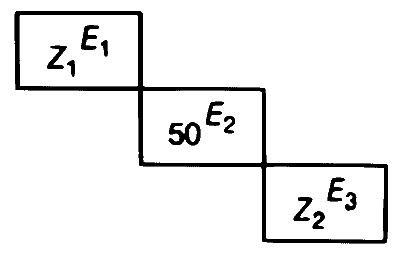
Atomic numbers of three elements $E_1, E_2$ and $E_3$ of periodic table are $Z_1, 50$ and $Z_2$ respectively. From the position of the elements shown in figure, the values of $\left(Z_2-Z_1\right)$ is
In which of the following options, elements are correctly arranged in the increasing order of their atomic radius?
Observe the following oxides. The number of amphoteric oxides from the given list is $\mathrm{CO}, \mathrm{B}_2 \mathrm{O}_3, \mathrm{SnO}_2, \mathrm{PbO}_2, \mathrm{Ga}_2 \mathrm{O}_3, \mathrm{SnO}, \mathrm{PbO}, \mathrm{CO}_2$
The correct order of atomic radii of group 13 elements is
$A, B C, D$ and $E$ are elements with atomic numbers 13 , $11,9,7$ and 16 respectively. Among these elements, ion of an element $X$ has largest size and ion of an element $Y$ has smallest size. $X$ and $Y$ are respectively.(Assume that all ions have nearest inert gas configuration)
In second period of the modern periodic table, two elements $X$ and $Y$ have higher first ionisation enthalpy values than the preceding and succeeding elements. $X$ and $Y$ are respectively
Observe the following data ( $\Delta_t H_1, \Delta_t H_2$ and $\Delta_{\mathrm{eg}} H$ represent the first, second ionisation enthalpies and electron gain enthalpy respectively)
| $$ \[\text { Element }\] $$ |
$$ \[\Delta_l H_1\left(\mathrm{kJmol}^{-1}\right)\] $$ |
$$ \[\Delta_1 H_2\left(\mathrm{kJmol}^{-1}\right)\] $$ |
$$ \[\Delta_{\mathrm{eg}} H\left(\mathrm{kJmol}^{-1}\right)\] $$ |
|---|---|---|---|
| I | 520 | 7300 | -60 |
| II | 490 | 3051 | -48 |
| III | 1681 | 3374 | -328 |
| IV | 2372 | 5251 | +48 |
Using the data identify the most reactive metal.
$$\text { Match the following. }$$
| $$ \[\text { List-I (Element) }\] $$ |
$$ \[\text { List-II }\left(\Delta_{\mathrm{e}g} H\right) \text { (in } \mathrm{kJmol}^{-1} \text { ) }\] $$ |
||
|---|---|---|---|
| A. | O | I. | -200 |
| B. | F | II. | -349 |
| C. | Cl | III. | -141 |
| D. | S | IV. | -328 |
| V. | +48 | ||
The correct answer is
Identify the correct orders regarding atomic radii
(i) $\mathrm{Cl}>\mathrm{F}>\mathrm{Li}$
(ii) $\mathrm{P}>\mathrm{C}>\mathrm{N}$
(iii) $\mathrm{Tm}>\mathrm{Sm}>\mathrm{Eu}$
(iv) $\mathrm{Sr}>\mathrm{Ca}>\mathrm{Mg}$
$$\text { Match the following }$$
$$\begin{array}{cccc} \hline & \text { List-I (Elements) } & & \text { List-II (Group) } \\ \hline \text { A } & \mathrm{Mn}, \mathrm{Tc}, \mathrm{Re} & \text { I } & 12 \\ \hline \text { B } & \mathrm{Zn}, \mathrm{Cd}, \mathrm{Hg} & \text { II } & 4 \\ \hline \text { C } & \mathrm{Ti}, \mathrm{Zr}, \mathrm{Hf} & \text { III } & 17 \\ \hline \text { D } & \mathrm{Ga}, \mathrm{In}, \mathrm{Tl} & \text { IV } & 7 \\ \hline & & \text { V } & 13 \\ \hline \end{array}$$
The correct answer is
In long form of periodic table an element ' $E$ ' has atomic number 78 . The period and group number of the element are $x$ and $y$ respectively. $(x+y)$ is equal to
Match the following
$$\begin{array}{llll} \hline & \text { List-I (Element) } & & \text { List-II (Block) } \\ \hline \text { (A) } & \mathrm{Cd} & \text { I } & f \text {-block } \\ \hline \text { (B) } & \mathrm{Eu} & \text { II } & s \text {-block } \\ \hline \text { (C) } & \mathrm{Se} & \text { III } & d \text {-block } \\ \hline \text { (D) } & \mathrm{Ba} & \text { IV } & p \text {-block } \\ \hline \end{array}$$The correct answer is
Showing 20 of 22 questions