Difficulty distribution
How the classified questions are distributed by difficulty.
Your cart is empty.
Practice Heat And Thermodynamics - Mechanics - Physics previous year questions organised from real papers, with year-wise coverage and clear topic navigation.
Every graph below is calculated only from this selection.
Year-wise coverage for Heat And Thermodynamics. Each bar uses a separate theme-derived color.
How the classified questions are distributed by difficulty.
MCQ, numerical, multiple-select and other formats found in these papers.
Top subjects by unique question coverage.
Top topics across the included previous year papers.
Top subtopics inside this exact selection.
Question coverage for the most populated papers. Every active PYP paper remains listed below.
Newest papers appear first. Sort by year, question coverage or name.
| Paper | Year / session | Questions in this view | Open |
|---|---|---|---|
| JEE Advanced 2026 Paper 1 Online | 2026 | 3 | View paper |
| JEE Advanced 2026 Paper 1 Online | 2026 | 3 | View paper |
| JEE Advanced 2026 Paper 1 Online | 2026 | 3 | View paper |
| JEE Advanced 2026 Paper 2 Online | 2026 | 1 | View paper |
| JEE ADVANCED 2025 PAPER 1 ONLINE | 2025 | 1 | View paper |
| JEE ADVANCED 2025 PAPER 2 ONLINE | 2025 | 3 | View paper |
| JEE ADVANCED 2024 PAPER 1 ONLINE | 2024 | 2 | View paper |
| JEE ADVANCED 2024 PAPER 2 ONLINE | 2024 | 1 | View paper |
| JEE ADVANCED 2023 PAPER 1 ONLINE | 2023 | 3 | View paper |
| JEE ADVANCED 2023 PAPER 2 ONLINE | 2023 | 4 | View paper |
| JEE ADVANCED 2022 PAPER 1 ONLINE | 2022 | 1 | View paper |
| JEE ADVANCED 2022 PAPER 2 ONLINE | 2022 | 1 | View paper |
| JEE ADVANCED 2021 PAPER 1 ONLINE | 2021 | 2 | View paper |
| JEE ADVANCED 2021 PAPER 2 ONLINE | 2021 | 4 | View paper |
| JEE ADVANCED 2020 PAPER 1 OFFLINE | 2020 | 2 | View paper |
| JEE ADVANCED 2020 PAPER 2 OFFLINE | 2020 | 3 | View paper |
| JEE ADVANCED 2019 PAPER 1 OFFLINE | 2019 | 1 | View paper |
| JEE ADVANCED 2019 PAPER 2 OFFLINE | 2019 | 3 | View paper |
| JEE ADVANCED 2018 PAPER 1 OFFLINE | 2018 | 1 | View paper |
| JEE ADVANCED 2018 PAPER 2 OFFLINE | 2018 | 2 | View paper |
| JEE ADVANCED 2017 PAPER 1 OFFLINE | 2017 | 3 | View paper |
| JEE ADVANCED 2016 PAPER 1 OFFLINE | 2016 | 2 | View paper |
| JEE ADVANCED 2016 PAPER 2 OFFLINE | 2016 | 2 | View paper |
| JEE ADVANCED 2015 PAPER 1 OFFLINE | 2015 | 2 | View paper |
| JEE ADVANCED 2015 PAPER 2 OFFLINE | 2015 | 1 | View paper |
| JEE ADVANCED 2014 PAPER 1 OFFLINE | 2014 | 1 | View paper |
| JEE ADVANCED 2014 PAPER 2 OFFLINE | 2014 | 3 | View paper |
| JEE ADVANCED 2013 PAPER 1 OFFLINE | 2013 | 2 | View paper |
| JEE ADVANCED 2013 PAPER 2 OFFLINE | 2013 | 2 | View paper |
| IIT JEE 2012 PAPER 1 OFFLINE | 2012 | 2 | View paper |
| IIT JEE 2012 PAPER 2 OFFLINE | 2012 | 1 | View paper |
| IIT JEE 2011 PAPER 1 OFFLINE | 2011 | 2 | View paper |
| IIT JEE 2011 PAPER 2 OFFLINE | 2011 | 1 | View paper |
| IIT JEE 2010 PAPER 1 OFFLINE | 2010 | 4 | View paper |
| IIT JEE 2010 PAPER 2 OFFLINE | 2010 | 1 | View paper |
| IIT JEE 2009 PAPER 1 OFFLINE | 2009 | 1 | View paper |
| IIT JEE 2009 PAPER 2 OFFLINE | 2009 | 3 | View paper |
| IIT JEE 2008 PAPER 1 OFFLINE | 2008 | 1 | View paper |
| IIT JEE 2008 PAPER 2 OFFLINE | 2008 | 1 | View paper |
| IIT JEE 2007 PAPER 1 OFFLINE | 2007 | 2 | View paper |
| IIT JEE 2007 PAPER 2 OFFLINE | 2007 | 1 | View paper |
| IIT JEE 2006 | 2006 | 3 | View paper |
| IIT JEE 2005 MAINS | 2005 | 1 | View paper |
Practice every matching question in batches of 20, with every available option.
A cylinder of mass \(1 \mathrm{~kg}\) is given heat of \(20000 \mathrm{~J}\) at atmospheric pressure. If initially temperature of cylinder is \(20^{\circ} \mathrm{C}\), find
(A) The final temperature of the cylinder;
(B) The work done by the cylinder;
(C) The change in internal energy of the cylinder.
Given :
The specific heat of cylinder
$$=400 \mathrm{~J} \mathrm{~kg}^{-1 \circ} \mathrm{C}^{-1}$$
Coefficient of volume expansion
$$=9 \times 10^{-5}{ }^{\circ} \mathrm{C}^{-1} \text {; }$$
Atmospheric pressure \(=10^{5} \mathrm{~N} / \mathrm{m}^{2}\) Density of cylinder \(=9000 \mathrm{~kg} / \mathrm{m}^{3}\) )
In an insulated vessel, 0.05 kg steam at 373 K and 0.45 kg of ice at 253 K are mixed. Then, find the final temperature of the mixture.
In a dark room with ambient temperature $\mathrm{T}_0$, a black body is kept at a temperature T . Keeping the temperature of the black body constant (at T), sunrays are allowed to fall on the black body through a hole in the roof of the dark room. Assuming that there is no change in the ambient temperature of the room, which of the following statement(s) is/are correct?
Heat given to the processes is positive. Match Column I with Column II:
| Column I | Column II | ||
|---|---|---|---|
| (A) | JK | (P) | $$ \Delta W>0 $$ |
| (B) | KL | (Q) | $$ \[\Delta \mathrm{Q}<0\] $$ |
| (C) | LM | (R) | $$ \[\Delta \mathrm{W}<0\] $$ |
| (D) | MJ | (S) | $$ \Delta Q>0 $$ |
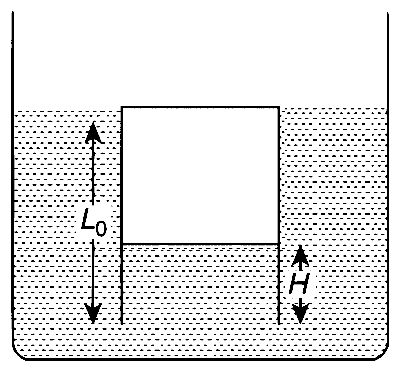
The piston is now pulled out slowly and held at a distance 2L from the top. The pressure in the cylinder between its top and the piston will then be
The piston is taken completely out of the cylinder. The hole at the top is sealed. A water tank is brought below the cylinder and put in a position so that the water surface in the tank is at the same level as the top of the cylinder as shown in the figure. The density of the water is \(\rho\). In equilibrium, the height H of the water column in the cylinder satisfies

STATEMENT 1
The total translational kinetic energy of all the molecules of a given mass of an ideal gas is 1.5 times the product of its pressure and its volume.
Because
STATEMENT 2
The molecules of a gas collide with each other and the velocities of the molecules change due to the collision.
An ideal gas is expanding such that PT\(^2\) = constant. The coefficient of volume expansion of the gas is
Column I contains a list of processes involving expansion of an ideal gas. Match this with Column II describing the thermodynamic change during this process. Indicate your answer by darkening the appropriate bubbles of the 4 \(\times\) 4 matrix given in the ORS.
| Column I | Column II | ||
|---|---|---|---|
| (A) | An insulated container has two chambers separated by a valve. Chamber I contains an ideal gas and the Chamber II has vacuum. The valve is opened. |
(P) | The temperature of the gas decreases |
| (B) | An ideal monatomic gas expands to twice its original volume such that its pressure P \(\propto\) \(\frac{1}{\mathrm{V}^2}\), where V is the volume of the gas | (Q) | The temperature of the gas increase or remains constant. |
| (C) | An ideal monoatomic gas expands to twice its original volume such that its pressure P \(\propto\) \(\frac{1}{\mathrm{V}^{4/3}}\), where V is its volume | (R) | The gas loses heat |
| (D) | An ideal monoatomic gas expands such that its pressure P and volume V follows the behaviour shown in the graph |
(S) | The gas gains heat |
\(C_V\) and \(C_P\) denote the molar specific heat capacities of a gas at constant volume and constant pressure, respectively. Then
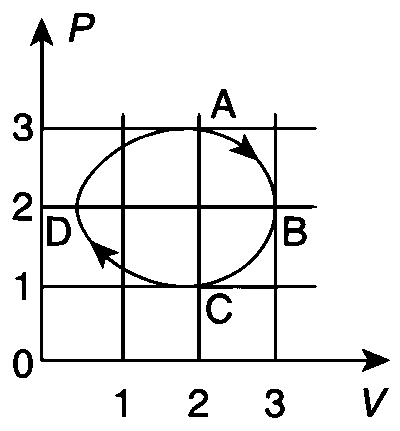
The figure shows the PV plot of an ideal gas taken through a cycle ABCDA. The part ABC is a semicircle and CDA is half of an ellipse. Then,

Column II gives certain systems undergoing a process. Column I suggests changes in some of the parameters related to the system. Match the statements in Column I to the appropriate process(es) from Column II:
| Column I | Column II | ||
|---|---|---|---|
| (A) | The energy of the system is increased. | (P) | System : A capacitor, initially uncharged. Process : It is connected to a battery. |
| (B) | Mechanical energy is provided to the system, which is converted into energy of random motion of its parts. | (Q) | System : A gas in an adiabatic container filled with an adiabatic piston. Process : The gas is compressed by pushing the piston. |
| (C) | Internal energy of the system is converted into its mechanical energy. | (R) | System : A gas in a rigid container. Process : The gas gets cooled due to colder atmosphere surrounding it. |
| (D) | Mass of the system is decreased. | (S) | System : A heavy nucleus, initially at rest. Process : The nucleus fissions into two fragments of nearly equal masses and some neutrons are emitted. |
| (T) | System : A resistive wire loop. Process : The loop is placed in a time varying magnetic field perpendicular to its plane. |
A metal rod AB of length 10x has its one end A in ice at 0\(^\circ\)C and the other end B in water at 100\(^\circ\)C. If a point P on the rod is maintained at 400\(^\circ\)C, then it is found that equal amounts of water and ice evaporate and melt per unit time. The latent heat of evaporation of water is 540 cal/g and latent heat of melting of ice is 80 cal/g. If the point P is at a distance of \(\lambda x\) from the ice end A, find the value of \(\lambda\). (Neglect any heat loss to the surrounding.)
One mole of an ideal gas in initial state A undergoes a cyclic process ABCA, as shown in the figure. Its pressure at A is P0. Choose the correct option(s) from the following:

Showing 20 of 80 questions