Exam Details
JEE Advanced 2026 Paper 1 Online
Review the key details, then start the test when you are ready. You can also open the full package to see related papers.
Questions
46
Duration
60 mins
Package
IIT-JEE Advance - Previous Year Papers
Paper pattern & analysis
Filter this paper by subject, topic or subtopic. Every graph updates from the selected questions.
Topic distribution
Subtopic distribution
Difficulty distribution
46questions
Hard
20
43.5%
Medium
18
39.1%
Easy
8
17.4%
Question type distribution
46questions
MCQ
22
47.8%
Numerical Answer Type (NAT)
12
26.1%
MSQ
12
26.1%
Updates & syllabus
View exam information →Practise paper questions
Choose your answer to check it. Log in to view the explanation. For a timed attempt and result, start the exam.
PYP
JEE Advanced 2026 Paper 1 Online
List-I shows four planar structures made of uniform solid rods each of mass $m$ and length $l$. In the List-II the possible moment of inertia of these structures about an axis $OCO'$, which lies in the plane of the structures, are given.
Choose the option that describes the correct match between the entries in List-I to those in List-II.
| List-I | List-II |
|---|---|
|
(P) |
(1) $$\frac{5}{4}ml^2$$ |
|
(Q) |
(2) $$\frac{1}{6}ml^2$$ |
|
(R) |
(3) $$\frac{1}{12}ml^2$$ |
|
(S) |
(4) $$\frac{2}{3}ml^2$$ |
| (5) $$\frac{1}{3}ml^2$$ |
PYP
JEE Advanced 2026 Paper 1 Online
As shown in the figure, an insulated container is fitted with a thermally conducting but immovable partition ($P_1$) and a freely movable but thermally insulated piston ($P_2$). The partition $P_1$ with thermal conductivity $K$, cross sectional area $A$ and width $x$ divides the container into two sections, $S_1$ and $S_2$, each containing one mole of a monoatomic gas. The piston $P_2$ moves freely such that the gas in $S_2$ is always at the atmospheric pressure. Initially, the difference between the temperatures of $S_1$ and $S_2$ is $\Delta T_0$. The time it takes for the temperature difference to become $\frac{\Delta T_0}{2}$ is $nxR/KA$, where $R$ is the universal gas constant. The value of $n$ is:
[ Given: $ln 2 \approx 0.7$ ]
PYP
JEE Advanced 2026 Paper 1 Online
As shown in the figure, five Carnot engines, each with efficiency $\eta$ and same number of cycles per unit time, are operating between six heat reservoirs. The amount of heat released per cycle by one engine is completely absorbed by the next engine. Consider $Q_0$ to be the amount of heat absorbed per cycle by the first engine and $W$ as the amount of total work done by all the engines per cycle, then the net efficiency of the system is found to be
$$\eta_{\mathrm{net}} = \frac{W}{Q_0} = \frac{211}{243}.$$
The value of $\eta$ is:
PYP
JEE Advanced 2026 Paper 1 Online
A quasi-static cycle of a monoatomic ideal gas contains an isothermal process $(ab)$, followed by an isochoric process $(bc)$ and an adiabatic process $(ca)$ as shown in the figure. The volumes of the gas are $V_1$ and $V_2$ at $a$ and $b$, respectively. If the cycle has heat input $Q_{\mathrm{in}}$ and output $Q_{\mathrm{out}}$, then the efficiency of the cycle is defined as $$\eta = \frac{Q_{\mathrm{in}} - Q_{\mathrm{out}}}{Q_{\mathrm{in}}}.$$ The correct statement(s) is/are:
[Given: $\ln 2 \approx 0.7$]
PYP
JEE Advanced 2026 Paper 1 Online
A tank contains two immiscible liquids of densities $6\rho$ and $2\rho$. The higher density liquid is filled up to a height $L/2$ from the bottom. A thin rod of density $\rho$ and length $L$ is fully immersed and hinged at the bottom so that it can oscillate freely, as shown in the figure. If the rod is slightly disturbed from its equilibrium, the time period of small oscillations is $$\frac{2\pi}{n}\sqrt{\frac{L}{g}},$$ where $g$ is the acceleration due to gravity. The value of $n$ is:
PYP
JEE Advanced 2026 Paper 1 Online
List-I shows four configurations made of straight and semi-circular narrow tubes containing air. A sound wave of wavelength $\lambda = 0.29\ \mathrm{m}$ enters these structures at the point $S$ and a sound detector is placed at $D$.
Between the points $S$ and $D$, the sound travels only through the tubes. List-II contains the possible smallest values of $l$ (refer to the figures) for which the detector $D$ records maximum amplitude. Ignore effects of sharp corners. [Given $\cos(15^\circ) = 0.97$]
Choose the option that best describes the match between the entries in List-I to those in List-II.
| List-I | List-II |
|---|---|
|
(P) |
(1) $1.32 \text{ m}$ |
|
(Q) |
(2) $1.19 \text{ m}$ |
|
(R) |
(3) $0.51 \text{ m}$ |
|
(S) |
(4) $0.29 \text{ m}$ |
| (5) $0.13 \text{ m}$ |
PYP
JEE Advanced 2026 Paper 1 Online
A particle is thrown with a speed v from a point O at an angle θ with the horizontal plane such that it passes through the point P at a height of 1 m and horizontal distance of 5 m from O, as shown in the figure. If acceleration due to gravity is g $\text{ms}^{-2}$, then the correct statement(s) is/are:
PYP
JEE Advanced 2026 Paper 1 Online
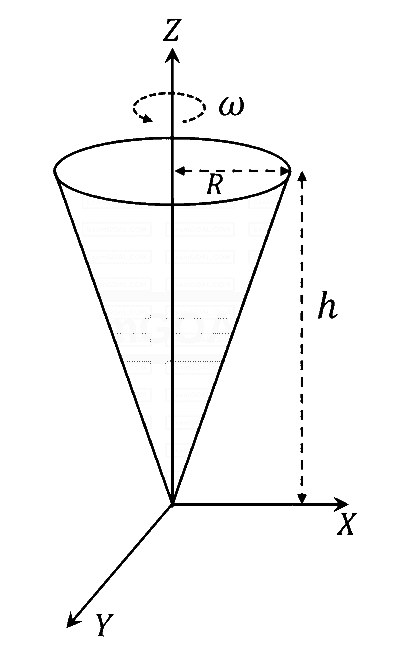
A hollow, right circular cone of base radius $R$ and height $h$, with its tip at the origin is rotating about the $Z$-axis with an angular velocity $\omega$, as shown in the figure. The cone carries a total charge $Q$ uniformly distributed on its curved surface. The magnitude of magnetic field at a point $(0,0,z)$, where $z \gg R$ and $z \gg h$, is $$\frac{n\mu_0}{4\pi}\frac{Q R^2 \omega}{z^3}.$$ The value of $n$ is:
PYP
JEE Advanced 2026 Paper 1 Online
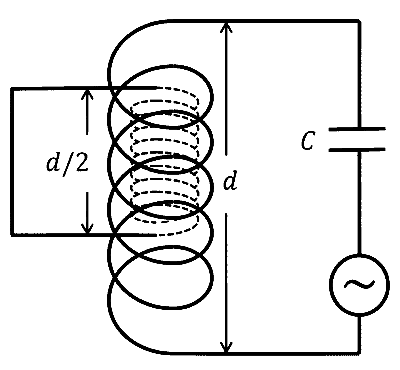
Consider a circuit consisting of a capacitor of capacitance C and a coil with N turns per unit length, cross sectional area S and length d, where $d^2 \gg S$. There is another coil of length $d/2$, cross sectional area $S/2$ and $2N$ turns per unit length completely inside the larger coil, as shown in the figure. The ends of this smaller coil are connected with each other by an insulated conducting wire. The self-inductance of the larger coil is L. Neglecting edge effects and all the Ohmic resistances, the resonant frequency of the circuit is:
PYP
JEE Advanced 2026 Paper 1 Online
List-I contains four conducting loops lying in the $XY$ plane, as shown in the figures. The loops are rotating about $Z$ axis passing through the point $O$ with time period $T$ in clockwise direction.
The region $x>0$ contains a uniform magnetic field $B$ in the $+z$ direction. List-II contains the qualitative variation of the induced current $i(t)$ for each of these loops. Choose the option which describes the correct match between the entries in List-I to those in List-II.
| List-I | List-II |
|---|---|
(P)
|
(1)
|
(Q)
|
(2)
|
(R)
|
(3)
|
(S)
|
(4) 
|
(5) 
|
PYP
JEE Advanced 2026 Paper 1 Online
A double convex lens made of glass of refractive index 1.5 and radii of curvature of the curved surfaces 20 cm each is immersed in a liquid of refractive index nL. The correct plot showing the variation of the power, in the units of diopter (D), as a function of nL is :
PYP
JEE Advanced 2026 Paper 1 Online
The electric field associated with an electromagnetic wave travelling in vacuum is given by
$E_0 \sin(3y + 4z + \omega t) \hat{i}$, where $\\omega$ is the angular frequency. All quantities are in SI units. The correct statement(s) about this wave is/are:
[Given: speed of light in vacuum $c = 3 \times 10^8\ \mathrm{m\,s^{-1}}$.]
PYP
JEE Advanced 2026 Paper 1 Online
In the List-I, four optical effects are mentioned. The physical phenomena of light which are essential to describe these optical effects are given in List-II. Choose the option which describes the correct match between the entries in List-I to those in List-II.
| List-I | List-II |
|---|---|
| (P) Colorful sky in north polar region (Aurora Borealis) | (1) Dispersion and reflection |
| (Q) Partially polarized sun light | (2) Total internal reflection |
| (R) Rainbow | (3) Diffraction |
| (S) Dark and bright fringes | (4) Scattering of light by molecules in the atmosphere |
| (5) Emission of radiation from oxygen and nitrogen atoms excited by charged particles |
PYP
JEE Advanced 2026 Paper 1 Online
Consider a hydrogen atom with $v_k, r_k,$ and $K_k$ denoting the velocity, orbital radius and kinetic energy of the electron in the $k^{{th}}$ orbit, respectively. The electron undergoes a transition from the $n^{{th}}$ orbit, emitting radiation corresponding to the Lyman series. Considering $h$ to be the Planck’s constant and $ ho_0$ the permittivity of the free space, the correct statement(s) is/are:
PYP
JEE Advanced 2026 Paper 1 Online
The 2s and the 2p orbital energies of hydrogen atom are $E_{2s}({H})$ and $E_{2p}({H})$, respectively. The 2s and the 2p orbital energies of lithium atom are $E_{2s}({Li})$ and $E_{2p}({Li})$, respectively. The correct option(s) about the orbital energies is(are)
PYP
JEE Advanced 2026 Paper 1 Online
Reaction of PtF6 with oxygen (O2) gas results in the formation of an ionic compound, X+Y-.
Correct statement(s) is(are)
PYP
JEE Advanced 2026 Paper 1 Online
Two cylinders, both fitted with frictionless pistons, are filled with mixtures of He and Ar gases. In the first cylinder, the masses of He and Ar are $m_1$ and $m_2$, respectively. In the second cylinder, the masses of He and Ar are $m_2$ and $m_1$, respectively. The molar mass of Ar is 10 times the molar mass of He. The external pressure applied by the piston on the first cylinder needs to be 5 times that on the second cylinder so that the volume of the gas mixtures in both the cylinders are equal at the same temperature. Assuming He and Ar behave like ideal gases, the value of $(m_1/m_2)$ is _______.
PYP
JEE Advanced 2026 Paper 1 Online
An ideal gas (0.5 mol), initially at 2 bar pressure, is compressed at a constant temperature of 600 K in two steps: first, against a constant external pressure of P bar (2 < P < 8), and then against constant external pressure of 8 bar. At each step, the compression is stopped only when the pressure of the gas becomes equal to the external pressure. The total work done on the gas in these steps is W. Considering all possible values of P (2 < P < 8) and taking the gas constant as R (in J K−1 mol−1), the minimum value of |W| (in J) is
PYP
JEE Advanced 2026 Paper 1 Online
List-I contains various physical/chemical processes, and List-II contains combinations of changes in enthalpy ($\Delta H$) and entropy ($\Delta S$). Match each entry in List-I to the appropriate entry in List-II, and choose the correct option.
| List-I | List-II |
|---|---|
| (P) Physisorption | (1) $$\Delta H > 0 \text{ and } \Delta S > 0$$ |
| (Q) Diamond $\rightarrow$ Graphite | (2) $$\Delta H < 0 \text{ and } \Delta S < 0$$ |
| (R) Denaturation of protein | (3) $$\Delta H < 0 \text{ and } \Delta S = 0$$ |
| (S) Propene $\rightarrow$ Cyclopropane | (4) $$\Delta H > 0 \text{ and } \Delta S < 0$$ |
| (5) $$\Delta H < 0 \text{ and } \Delta S > 0$$ |
PYP
JEE Advanced 2026 Paper 1 Online
For a reversible reaction $R \rightleftharpoons P$, at constant temperature, both the forward and the backward reactions are first order elementary reactions with rate constants $k_{{f}}$ and $k_{{b}}$, respectively. At time zero, the concentration of $R$ is $[R]_0$ and the concentration of $P$ is zero. At any given time, $[R]$ and $[P]$ are the concentrations of $R$ and $P$, respectively. If $k_{{b}} = 4k_{{f}}$, the correct graphical representation of the reaction is
PYP
JEE Advanced 2026 Paper 1 Online
The correct order of dipole moments for the given species is
PYP
JEE Advanced 2026 Paper 1 Online
Consider the following species:
SOCl$_2$, XeOF$_4$, ClF$_3$, ClF$_5$, XeF$_5^+$, SO$_3^{2-}$, XeF$_3^+$, SF$_4$
List-I contains different molecular shapes and List-II contains total number of species with the same molecular shapes from the given species. Match each entry in List-I with the appropriate entry in List-II and choose the correct option.
| List-I | List-II |
|---|---|
| (P) See-saw | (1) one |
| (Q) T-Shaped | (2) two |
| (R) Trigonal Planar | (3) three |
| (S) Square Pyramidal | (4) four |
| (5) zero |
PYP
JEE Advanced 2026 Paper 1 Online
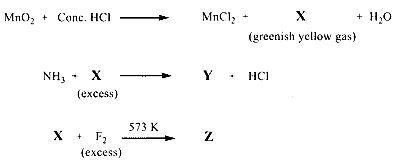
Correct statement(s) about the compounds X, Y and Z is (are)
PYP
JEE Advanced 2026 Paper 1 Online
The total number of all possible isomers for the square planar complex with formula
$\mathrm{K[M(NCS)(NO_2)(gly)]}$ is ______.
($\mathrm{M} = \text{metal ion and } \mathrm{gly} = \mathrm{NH_2CH_2COO^-}$)
PYP
JEE Advanced 2026 Paper 1 Online
Treatment of buta-1,3-diyne with NaNH2 (2 equivalents), followed by reaction with excess of trans-CH3-CH=CH-CH2-Br gives X as the major product. The maximum number of carbon atoms that are collinear (in a straight line) in X is _____.
PYP
JEE Advanced 2026 Paper 1 Online
In the following reaction sequence, Q, R, S and T are the major products.
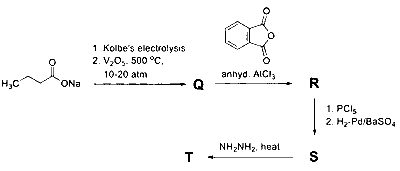
The correct statement(s) about Q, R, S and T is(are) :
PYP
JEE Advanced 2026 Paper 1 Online
The List-II contains products obtained from the reaction of compounds in List-I with $O_3$/Zn-$H_2O$ followed by cyclization (via more stable enolate) in the presence of aqueous NaOH. Match each entry in List-I with appropriate entry in List-II and choose the correct option.
| List-I | List-II |
|---|---|
(P)
|
(1)
|
(Q)
|
(2)
|
(R)
|
(3)
|
(S)
|
(4)
|
(5)
|
PYP
JEE Advanced 2026 Paper 1 Online
Considering LiBH4 reduces an ester group to the corresponding alcohol and does not reduce a carboxylic acid group, the correct statement about the major products P, Q, R and S is:
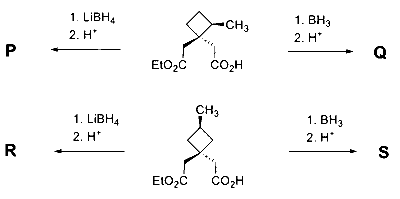
PYP
JEE Advanced 2026 Paper 1 Online
The sum of total number of carbonyl groups ($> {C}= {O}$) present in the major products X and Y in the following reactions is _____.
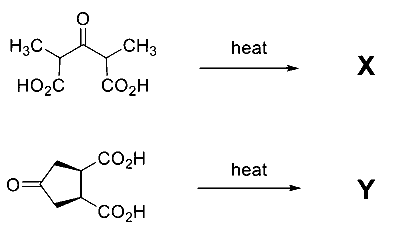
PYP
JEE Advanced 2026 Paper 1 Online
Match the major products obtained in the reactions given in List-I with the corresponding structures in List-II and choose the correct option.
| List-I | List-II |
|---|---|
(P)
|
(1)
|
(Q)
|
(2)
|
(R)
|
(3)
|
(S)
|
(4)
|
(5)
|
PYP
JEE Advanced 2026 Paper 1 Online
Which one of the following matrices can be obtained by performing elementary row transformations on the $3 \times 3$ identity matrix?
PYP
JEE Advanced 2026 Paper 1 Online
Consider the matrix
$$ M = \begin{bmatrix} 2 & -1 \\ 1 & 0 \end{bmatrix}. $$
Let $p, q, r, s, a, b, c$ and $d$ be integers such that
$$ M^{26} = \begin{bmatrix} p & q \\ r & s \end{bmatrix} \quad \text{and} \quad \sum\limits_{k=1}^{26} M^k = \begin{bmatrix} a & b \\ c & d \end{bmatrix}. $$
Then which of the following statements is (are) TRUE?
PYP
JEE Advanced 2026 Paper 1 Online
The number of ways to distribute 10 identical red pens and 14 identical blue pens among four persons such that each person gets 6 pens, is ______________.
PYP
JEE Advanced 2026 Paper 1 Online
Let $S = \{1, 2, 3, \ldots, 10\}$. Consider the set
$X = \{R : R \text{ is an equivalence relation on the set } S \text{ such that } R \text{ has exactly 42 elements}\}$.
Then the number of elements in $X$ is ____________.
PYP
JEE Advanced 2026 Paper 1 Online
Suppose that Box I contains 6 red balls and 9 green balls, and Box II contains 8 red balls and 12 green balls. All the balls of Box I and Box II are mixed together and a ball is chosen at random from them. Let $E_1$ be the event that the ball chosen belonged to Box I and let $E_2$ be the event that the ball chosen belonged to Box II. Let $F_1$ be the event that the ball chosen is red and let $F_2$ be the event that the ball chosen is green.
Then which of the following statements is (are) TRUE?
PYP
JEE Advanced 2026 Paper 1 Online
For real numbers $\alpha$, $\beta$, $\gamma$, $\delta$ and $\mu$, consider the matrix
$$ M = \begin{bmatrix} \alpha & \frac{1}{\sqrt{2}} & -\frac{1}{\sqrt{2}} \\ \frac{1}{\sqrt{3}} & \beta & \frac{1}{\sqrt{3}} \\ \gamma & \delta & \mu \end{bmatrix}. $$
Suppose that $MM^{T} = I$, where $M^{T}$ is the transpose of the matrix $M$, and $I$ is the $3 \times 3$ identity matrix. Let
$$ \vec{u} = \alpha\,\hat{i} + \frac{1}{\sqrt{3}}\hat{j} + \gamma\,\hat{k}, \qquad \vec{v} = \frac{1}{\sqrt{2}}\hat{i} + \beta\hat{j} + \delta\hat{k} \qquad \text{and} \qquad \vec{w} = -\frac{1}{\sqrt{2}}\hat{i} + \frac{1}{\sqrt{3}}\hat{j} + \mu\hat{k}. $$
Match each entry in List-I to the correct entry in List-II and choose the correct option.
| List-I | List-II |
|---|---|
| (P) The value of $$\gamma^2 + \delta^2$$ is | (1) 0 |
| (Q) If $$x\vec{u} + y\vec{v} + z\vec{w} = \hat{j}$$ for some real numbers $x$, $y$ and $z$, then the value of $x$ is | (2) 1 |
| (R) The value of $$\left|\vec{u} \cdot (\vec{v} \times \vec{w})\right|$$ is | (3) $$\frac{1}{\sqrt{2}}$$ |
| (S) The value of $$\left|\vec{u} \times (\vec{v} \times \vec{w})\right|$$ is | (4) $$\frac{1}{\sqrt{3}}$$ |
| (5) $$\frac{5}{6}$$ |
PYP
JEE Advanced 2026 Paper 1 Online
Let P be the plane such that it contains the straight line $\frac{x-1}{2}=\frac{y-3}{3}=\frac{z+2}{1}$ and is perpendicular to the plane $x+2y+3z=4$. Let $P_1$ be the plane which passes through the point $(4,2,2)$ and is parallel to P.
Then which of the following statements is (are) TRUE?
PYP
JEE Advanced 2026 Paper 1 Online
Let
$$ \alpha = \left( 1 - 2\cos\left(\frac{\pi}{11}\right) \right) \left( 1 - 2\cos\left(\frac{3\pi}{11}\right) \right) \left( 1 - 2\cos\left(\frac{9\pi}{11}\right) \right) \left( 1 - 2\cos\left(\frac{27\pi}{11}\right) \right) \left( 1 - 2\cos\left(\frac{81\pi}{11}\right) \right). $$
Then the value of $5 - \alpha^2$ is ______________.
PYP
JEE Advanced 2026 Paper 1 Online
Match each entry in List-I to the correct entry in List-II and choose the correct option.
| List-I | List-II |
|---|---|
| (P) If $\alpha$ and $\beta$ are the distinct roots of the equation $x^2 + x + 1 = 0$, then the quadratic equation with roots $\frac{1}{(\alpha+1)^{2026}}$ and $\frac{1}{(\beta+1)^{2026}}$ is | (1) $x^2 + x + 1 = 0$ |
| (Q) If $\alpha$ and $\beta$ are the distinct roots of the equation $x^2 + x + 1 = 0$, then the quadratic equation with roots $\frac{1}{(\alpha+1)^{2027}}$ and $\frac{1}{(\beta+1)^{2027}}$ is | (2) $x^2 - x + 1 = 0$ |
| (R) If $\gamma$ and $\delta$ are the distinct roots of the equation $x^2 - x + 1 = 0$, then the value of $\frac{1}{(\gamma-1)^{2026}} + \frac{1}{(\delta-1)^{2026}}$ is | (3) $x^2 + x - 1 = 0$ |
| (S) If $p$ and $r$ are the distinct roots of the equation $x^2 + x - 1 = 0$, then the value of $\frac{1}{(p+1)^3} + \frac{1}{(r+1)^3}$ is | (4) $-1$ |
| (5) $-4$ |
PYP
JEE Advanced 2026 Paper 1 Online
Match each entry in List-I to the correct entry in List-II and choose the correct option.
| List-I | List-II |
|---|---|
|
(P) The number of elements in the set $$\left\{x \in [-\pi,\pi] : \sin^6 x + \cos^4 x = 1 \right\}$$ |
(1) is 1 |
|
(Q) The number of elements in the set $$\left\{x \in \left[-\frac{\pi}{2}, \frac{\pi}{2}\right] : \sin^2 x + \cos^6 x = 1 \right\}$$ |
(2) is 2 |
|
(R) The number of elements in the set $$\left\{x \in [-\pi,\pi] : \cos^2\left(\frac{x}{2}\right) - \sin^2 x = \frac{1}{2} \right\}$$ |
(3) is 3 |
|
(S) The number of elements in the set $$\left\{x \in [-2\pi,2\pi] : 6\sin^2\left(\frac{x}{2}\right) - \cos 3x = 3 \right\}$$ |
(4) is 4 (5) is 5 |
PYP
JEE Advanced 2026 Paper 1 Online
Considering only the principal values of the inverse trigonometric functions, the value of
$$\cot^{-1}(\cot(-11)) + 10 \sin\left(2 \cos^{-1}\left(\frac{1}{\sqrt{2}}\right)\right) + 10\sin(2 \tan^{-1}(2))$$
is
PYP
JEE Advanced 2026 Paper 1 Online
Let $P$ be the point on the parabola $y = x^2$ such that the slope of the tangent to the parabola at the point $P$ is $4$. Let $Q$ be the point in the first quadrant lying on the circle $x^2 + y^2 = 2$ such that the slope of the tangent to the circle at the point $Q$ is $-1$. Let $R$ be the point in the first quadrant lying on the ellipse $x^2 + 4y^2 = 8$ such that the slope of the tangent to the ellipse at the point $R$ is $-\frac{1}{2}$. Then the radius of the circle passing through the points $P, Q$ and $R$ is
PYP
JEE Advanced 2026 Paper 1 Online
Match each entry in List-I to the correct entry in List-II and choose the correct option.
| List-I | List-II |
|---|---|
| (P) The circle with centre $(1,2)$ and touching the straight line $$3x + 4y = 1$$ passes through | (1) the point $(1,1)$ |
| (Q) The common tangent to the circle $$x^2 + y^2 = 2$$ and the parabola $$y^2 = 8x$$ with positive slope, passes through | (2) the point $(7,9)$ |
| (R) Let $M$ be the end point of the latus rectum of the ellipse $$3x^2 + 4y^2 = 48$$ such that $M$ lies in the first quadrant. Then the normal to the ellipse drawn at $M$ passes through | (3) the point $(3,2)$ |
|
(S) Let $H$ be the hyperbola whose centre is at the origin, one of the foci is at $(5,0)$, and one directrix is
$$5x + 16 = 0$$
Then $H$ passes through |
(4) the point $(2,5)$ |
| (5) the point $(8, 3\sqrt{3})$ |
PYP
JEE Advanced 2026 Paper 1 Online
Let $\mathbb{R}$ denote the set of all real numbers. Let $f : \mathbb{R} \to \mathbb{R}$ be an arbitrary function and let $g : \mathbb{R} \to \mathbb{R}$ be the function defined by
$$g(x) = x f(x), \quad \text{for all } x \in \mathbb{R}.$$
Then which of the following statements is (are) TRUE?
PYP
JEE Advanced 2026 Paper 1 Online
Consider the function $f:\left(-\frac{\pi}{2},\frac{\pi}{2}\right) \to (-\infty, \infty)$ defined by
$$f(x) = (|x| + |x-1|) \sin x + \left[ x \sin x \right],$$
where $\left[ x \sin x \right]$ is the greatest integer less than or equal to $x \sin x$.
Let $\alpha$ be the total number of points in the interval $\left(-\frac{\pi}{2}, \frac{\pi}{2}\right)$ at which $f$ is NOT continuous, and let $\beta$ be the total number of points in the interval $\left(-\frac{\pi}{2}, \frac{\pi}{2}\right)$ at which $f$ is NOT differentiable.
Then the value of $\alpha + \beta$ is ____________.
PYP
JEE Advanced 2026 Paper 1 Online
Consider the function $f : (0, \infty) \to (-\infty, \infty)$ given by
$f(x) = \sqrt{x} \log_e(x) - x + 1$.
Then which one of the following statements is TRUE?
Showing 5 of 46 questions