Exam Details
JEE ADVANCED 2015 PAPER 2 OFFLINE
Review the key details, then start the test when you are ready. You can also open the full package to see related papers.
Questions
60
Duration
180 mins
Package
IIT-JEE Advance - Previous Year Papers
Paper pattern & analysis
Filter this paper by subject, topic or subtopic. Every graph updates from the selected questions.
Topic distribution
Subtopic distribution
Difficulty distribution
60questions
Medium
43
71.7%
Hard
10
16.7%
Easy
7
11.7%
Question type distribution
60questions
Multiple Choices
36
60%
Numerical Answer Type (NAT)
24
40%
Syllabus
Full Syllabus
Sample questions from this paper
Questions are selected across the paper subjects wherever the paper contains that variety.
2015 · Mathematics · Algebra · Sequences And Series
JEE ADVANCED 2015 PAPER 2 OFFLINE
Suppose that all the terms of an arithmetic progression (A.P) are natural numbers. If the ratio of the sum of the first seven terms to the sum of the first eleven terms is 6 : 11 and the seventh term lies in between 130 and 140, then the common difference of this A.P. is
Enter a numerical response
2015 · Physics · Mechanics · Properties Of Matter
JEE ADVANCED 2015 PAPER 2 OFFLINE
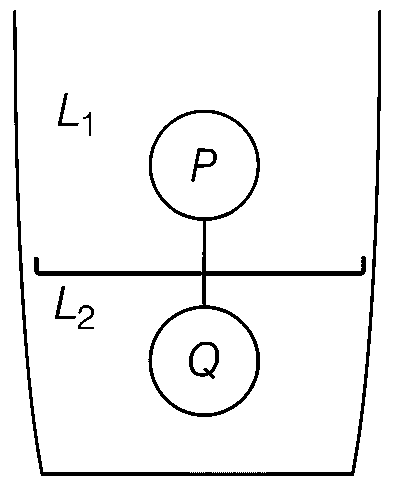
Two spheres P and Q for equal radii have densities \(\rho\)1 and \(\rho\)2, respectively. The spheres are connected by a massless string and placed in liquids L1 and L2 of densities \(\sigma\)1 and \(\sigma\)2 and viscosities \({\eta _1}\) and \({\eta _2}\), respectively. They float in equilibrium with the sphere P in L1 and sphere Q in L2 and the string being taut (see figure) If sphere P along in L2 has terminal velocity vP and Q alone in L1 ha terminal velocity vQ, then
2015 · Chemistry · Physical Chemistry · Ionic Equilibrium
JEE ADVANCED 2015 PAPER 2 OFFLINE
Paragraph
When 100 mL of 1.0 M HCl was mixed with 100 mL of 1.0 M NaOH in an insulated beaker at constant pressure, a temperature increase of 5.7o C was measured for the beaker and its contents (Expt. 1). Because the enthalpy of neutralization of a strong acid with a strong base is constant (-57.0 kJ/mol), this experiment could be used to measure the calorimeter constant. In a second experiment (Expt. 2) 100 mL of 2.0 M acetic acid (Ka = 2.0 \(\times\) 10-5) was mixed with 100 mL of 1.0 M NaOH (under identical conditions to Expt. 1) where a temperature rise of 5.6o C was measured. (Consider heat capacity of all solutions as 4.2 J/gK and density of all solutions as 1.0 g m/L)
Question
Enthalpy of dissociation (in kJ/mol) of acetic acid obtained from the Expt. 2 is
When 100 mL of 1.0 M HCl was mixed with 100 mL of 1.0 M NaOH in an insulated beaker at constant pressure, a temperature increase of 5.7o C was measured for the beaker and its contents (Expt. 1). Because the enthalpy of neutralization of a strong acid with a strong base is constant (-57.0 kJ/mol), this experiment could be used to measure the calorimeter constant. In a second experiment (Expt. 2) 100 mL of 2.0 M acetic acid (Ka = 2.0 \(\times\) 10-5) was mixed with 100 mL of 1.0 M NaOH (under identical conditions to Expt. 1) where a temperature rise of 5.6o C was measured. (Consider heat capacity of all solutions as 4.2 J/gK and density of all solutions as 1.0 g m/L)
Question
Enthalpy of dissociation (in kJ/mol) of acetic acid obtained from the Expt. 2 is
2015 · Mathematics · Coordinate Geometry · Parabola
JEE ADVANCED 2015 PAPER 2 OFFLINE
Suppose that the foci of the ellipse \({{{x^2}} \over 9} + {{{y^2}} \over 5} = 1\) are \(\left( {{f_1},0} \right)\) and \(\left( {{f_2},0} \right)\) where \({{f_1} > 0}\) and \({{f_2} < 0}\). Let \({P_1}\) and \({P_2}\) be two parabolas with a common vertex at \((0,0)\) and with foci at \(\left( {{f_1},0} \right)\) and \(\left( 2{{f_2},0} \right)\), respectively. Let \({T_1}\) be a tangent to \({P_1}\) which passes through \(\left( 2{{f_2},0} \right)\) and \({T_2}\) be a tangent to \({P_2}\) which passes through \(\left( {{f_1},0} \right)\). If \({m_1}\) is the slope of \({T_1}\) and \({m_2}\) is the slope of \({T_2}\), then the value of \(\left( {{1 \over {m_1^2}} + m_2^2} \right)\) is
Enter a numerical response
2015 · Physics · Mechanics · Rotational Motion
JEE ADVANCED 2015 PAPER 2 OFFLINE
The densities of two solid spheres A and B of the same radii R vary with radial distance r as \({\rho _A}(r) = k\left( {{r \over R}} \right)\) and \({\rho _B}(r) = k{\left( {{r \over R}} \right)^5}\), , respectively, where k is a constant. The moments of inertia of the individual spheres about axes passing through their centres are \({I_A}\) and \({I_B}\), respectively. If, \({{{I_B}} \over {{I_A}}} = {n \over {10}}\), the value of n is
Enter a numerical response
2015 · Chemistry · Physical Chemistry · Ionic Equilibrium
JEE ADVANCED 2015 PAPER 2 OFFLINE
Paragraph
When 100 mL of 1.0 M KCl was mixed with 100 mL of 1.0 M NaOH in an insulated beaker at constant pressure, a temperature increase of 5.7o C was measured for the beaker and its contents (Expt. 1). Because the enthalpy of neutralization of a strong acid with a strong base is constant (-57.0 kJ/mol), this experiment could be used to measure the calorimeter constant. In a second experiment (Expt. 2) 100 mL of 2.0 M acetic acid (Ka = 2.0 \(\times\) 10-5) was mixed with 100 mL of 1.0 M NaOH (under identical conditions to Expt. 1) where a temperature rise of 5.6o C was measured. (Consider heat capacity of all solutions as 4.2 J/gK and density of all solutions as 1.0 g m/L)
Question
The pH of the solution after Expt. 2 is
When 100 mL of 1.0 M KCl was mixed with 100 mL of 1.0 M NaOH in an insulated beaker at constant pressure, a temperature increase of 5.7o C was measured for the beaker and its contents (Expt. 1). Because the enthalpy of neutralization of a strong acid with a strong base is constant (-57.0 kJ/mol), this experiment could be used to measure the calorimeter constant. In a second experiment (Expt. 2) 100 mL of 2.0 M acetic acid (Ka = 2.0 \(\times\) 10-5) was mixed with 100 mL of 1.0 M NaOH (under identical conditions to Expt. 1) where a temperature rise of 5.6o C was measured. (Consider heat capacity of all solutions as 4.2 J/gK and density of all solutions as 1.0 g m/L)
Question
The pH of the solution after Expt. 2 is