Exam Details
JEE ADVANCED 2024 PAPER 2 ONLINE
Review the key details, then start the test when you are ready. You can also open the full package to see related papers.
Questions
51
Duration
180 mins
Package
IIT-JEE Advance - Previous Year Papers
Paper pattern & analysis
Filter this paper by subject, topic or subtopic. Every graph updates from the selected questions.
Topic distribution
Subtopic distribution
Difficulty distribution
51questions
Hard
28
54.9%
Medium
18
35.3%
Easy
5
9.8%
Question type distribution
51questions
Numerical Answer Type (NAT)
30
58.8%
Multiple Choices
21
41.2%
Syllabus
Full Syllabus
Sample questions from this paper
Questions are selected across the paper subjects wherever the paper contains that variety.
2024 · Chemistry · Organic Chemistry · Aldehydes Ketones And Carboxylic Acids
JEE ADVANCED 2024 PAPER 2 ONLINE
The molecular weight of $\mathbf{U}$ is ______ .
Enter a numerical response
2024 · Physics · Optics · Wave Optics
JEE ADVANCED 2024 PAPER 2 ONLINE
The $8^{\text {th }}$ bright fringe above the point $\mathrm{O}$ oscillates with time between two extreme positions. The separation between these two extreme positions, in micrometer $(\mu \mathrm{m})$, is _________ .
Enter a numerical response
2024 · Mathematics · Algebra · Permutations And Combinations
JEE ADVANCED 2024 PAPER 2 ONLINE
If $n(X)={ }^m C_6$, then the value of $m$ is _____
Enter a numerical response
2024 · Chemistry · Organic Chemistry · Aldehydes Ketones And Carboxylic Acids
JEE ADVANCED 2024 PAPER 2 ONLINE
Sum of number of oxygen atoms in $\mathbf{S}$ and $\mathbf{T}$ is _______.
Enter a numerical response
2024 · Physics · Optics · Geometrical Optics
JEE ADVANCED 2024 PAPER 2 ONLINE
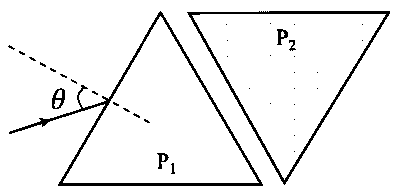
Two equilateral-triangular prisms $\mathrm{P}_1$ and $\mathrm{P}_2$ are kept with their sides parallel to each other, in vacuum, as shown in the figure. A light ray enters prism $\mathrm{P}_1$ at an angle of incidence $\theta$ such that the outgoing ray undergoes minimum deviation in prism $\mathrm{P}_2$. If the respective refractive indices of $\mathrm{P}_1$ and $\mathrm{P}_2$ are $\sqrt{\frac{3}{2}}$ and $\sqrt{3}$, then $\theta=\sin ^{-1}\left[\sqrt{\frac{3}{2}} \sin \left(\frac{\pi}{\beta}\right)\right]$, where the value of $\beta$ is ____.
Enter a numerical response
2024 · Mathematics · Algebra · Vector Algebra
JEE ADVANCED 2024 PAPER 2 ONLINE
Let $\vec{p}=2 \hat{i}+\hat{j}+3 \hat{k}$ and $\vec{q}=\hat{i}-\hat{j}+\hat{k}$. If for some real numbers $\alpha, \beta$, and $\gamma$, we have
$$15 \hat{i}+10 \hat{j}+6 \hat{k}=\alpha(2 \vec{p}+\vec{q})+\beta(\vec{p}-2 \vec{q})+\gamma(\vec{p} \times \vec{q}),$$
then the value of $\gamma$ is ________.
Enter a numerical response