Difficulty distribution
How the classified questions are distributed by difficulty.
Your cart is empty.
Practice Magnetism - Electricity - Physics previous year questions organised from real papers, with year-wise coverage and clear topic navigation.
Every graph below is calculated only from this selection.
Year-wise coverage for Magnetism. Each bar uses a separate theme-derived color.
How the classified questions are distributed by difficulty.
MCQ, numerical, multiple-select and other formats found in these papers.
Top subjects by unique question coverage.
Top topics across the included previous year papers.
Top subtopics inside this exact selection.
Question coverage for the most populated papers. Every active PYP paper remains listed below.
Newest papers appear first. Sort by year, question coverage or name.
| Paper | Year / session | Questions in this view | Open |
|---|---|---|---|
| JEE Advanced 2026 Paper 1 Online | 2026 | 1 | View paper |
| JEE Advanced 2026 Paper 1 Online | 2026 | 1 | View paper |
| JEE Advanced 2026 Paper 1 Online | 2026 | 1 | View paper |
| JEE Advanced 2026 Paper 2 Online | 2026 | 1 | View paper |
| JEE ADVANCED 2025 PAPER 2 ONLINE | 2025 | 1 | View paper |
| JEE ADVANCED 2024 PAPER 1 ONLINE | 2024 | 1 | View paper |
| JEE ADVANCED 2024 PAPER 2 ONLINE | 2024 | 2 | View paper |
| JEE ADVANCED 2023 PAPER 2 ONLINE | 2023 | 1 | View paper |
| JEE ADVANCED 2022 PAPER 1 ONLINE | 2022 | 1 | View paper |
| JEE ADVANCED 2022 PAPER 2 ONLINE | 2022 | 1 | View paper |
| JEE ADVANCED 2021 PAPER 1 ONLINE | 2021 | 2 | View paper |
| JEE ADVANCED 2021 PAPER 2 ONLINE | 2021 | 3 | View paper |
| JEE ADVANCED 2020 PAPER 1 OFFLINE | 2020 | 2 | View paper |
| JEE ADVANCED 2018 PAPER 1 OFFLINE | 2018 | 2 | View paper |
| JEE ADVANCED 2018 PAPER 2 OFFLINE | 2018 | 1 | View paper |
| JEE ADVANCED 2017 PAPER 1 OFFLINE | 2017 | 3 | View paper |
| JEE ADVANCED 2017 PAPER 2 OFFLINE | 2017 | 2 | View paper |
| JEE ADVANCED 2015 PAPER 1 OFFLINE | 2015 | 1 | View paper |
| JEE ADVANCED 2015 PAPER 2 OFFLINE | 2015 | 2 | View paper |
| JEE ADVANCED 2014 PAPER 1 OFFLINE | 2014 | 1 | View paper |
| JEE ADVANCED 2014 PAPER 2 OFFLINE | 2014 | 2 | View paper |
| JEE ADVANCED 2013 PAPER 1 OFFLINE | 2013 | 1 | View paper |
| JEE ADVANCED 2013 PAPER 2 OFFLINE | 2013 | 3 | View paper |
| IIT JEE 2012 PAPER 1 OFFLINE | 2012 | 2 | View paper |
| IIT JEE 2012 PAPER 2 OFFLINE | 2012 | 2 | View paper |
| IIT JEE 2011 PAPER 1 OFFLINE | 2011 | 3 | View paper |
| IIT JEE 2011 PAPER 2 OFFLINE | 2011 | 1 | View paper |
| IIT JEE 2010 PAPER 1 OFFLINE | 2010 | 3 | View paper |
| IIT JEE 2009 PAPER 2 OFFLINE | 2009 | 1 | View paper |
| IIT JEE 2008 PAPER 1 OFFLINE | 2008 | 1 | View paper |
| IIT JEE 2008 PAPER 2 OFFLINE | 2008 | 1 | View paper |
| IIT JEE 2007 PAPER 2 OFFLINE | 2007 | 2 | View paper |
| IIT JEE 2006 | 2006 | 2 | View paper |
| IIT JEE 2005 MAINS | 2005 | 1 | View paper |
Practice every matching question in batches of 20, with every available option.
In a moving coil galvanometer, torque on the coil can be expressed as \(\tau=k i\), where \(i\) is current through the wire and \(k\) is constant. The rectangular coil of the galvanometer having numbers of turns \(\mathrm{N}\), area \(\mathrm{A}\) and moment of inertia I is placed in magnetic field B. Find
(A) \(k\) in terms of given parameters \(\mathrm{N}, \mathrm{I}, \mathrm{A}\) and B;
(B) The torsional constant of the spring, if a current \(i_{0}\) produces a deflection of \(\frac{\pi}{2}\) in the coil;
(C) The maximum angle through which coil is deflected, if charge \(\mathrm{Q}\) is passed through the coil almost instantaneously. (Ignore the damping in mechanical oscillations.)
An infinite current-carrying wire passes through point O and in perpendicular to the plane containing a current-carrying loop ABCD as shown in the figure. Choose the correct option(s):

$$\text { Match the following Columns. }$$
| Column I | Column II | ||
|---|---|---|---|
| (A) | Dielectric ring uniformly charged. | (P) | Time independent electrostatic field out of system. |
| (B) | Dielectric ring uniformly charged rotating with angular velocity $\omega$. | (Q) | Magnetic field. |
| (C) | Constant current in ring io | (R) | Induced electric field. |
| (D) | $$ \[i=i_o \cos \omega \mathrm{t}\] $$ |
(S) | Magnetic moment. |
A magnetic field \(\overrightarrow{\mathrm{B}}=\mathrm{B}_{0} \hat{j}\) exists in the region \(a < x < 2 a\) and \(\overrightarrow{\mathrm{B}}=-\mathrm{B}_{0} \hat{j}\), in the region \(2 a < x < 3 a\), where \(\mathrm{B}_{0}\) is a positive constant. A positive point charge moving with a velocity \(\vec{v}=v_{0} \hat{i}\), where \(v_{0}\) is a positive constant, enters the magnetic field at \(x=a\). The trajectory of the charge in this region can be like,

Two wires each carrying a steady current I are shown in four configurations in Column I. Some of the resulting effects are described in Column II. Match the statements in Column I with the statements in Column II and indicate your answer by darkening appropriate bubbles in the \(4 \times 4\) matrix given in the ORS.
| Column I | Column II | ||
|---|---|---|---|
| (A) | Point P is situated midway between the wires.![]() |
(P) | The magnetic fields (B) at P due to the currents in the wire are in same direction. |
| (B) | Point P is situated at the mid-point of the line joining the centers of the circular wires, which have same radii.![]() |
(Q) | The magnetic fields (B) at P due to the currents in the wires are in opposite directions. |
| (C) | Point P is situated at the mid-point of the line joining the centers of the circular wires, which have same radii.![]() |
(R) | There is no magnetic field at P. |
| (D) | Point P is situated at the common center of the wires.![]() |
(S) | The wires repel each other. |
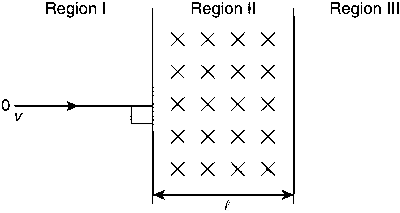
A particle of mass m and charge q, moving with velocity v enters Region II normal to the boundary as shown in the figure. Region II has a uniform magnetic field B perpendicular to the plane of the paper. The length of the Region II is \(l\). Choose the correct choice (s).

STATEMENT 1 : The sensitivity of a moving coil galvanometer is increased by placing a suitable magnetic material as a core inside the coil.
and
STATEMENT 2 : Soft iron has a high magnetic permeability and cannot be easily magnetized or demagnetized.
A steady current I goes through a wire loop PQR having shape of a right angle triangle with PQ = 3x, PR = 4x and QR = 5x. If the magnitude of the magnetic field at P due to this loop is \(k\left( {{{{\mu _0}I} \over {48\pi x}}} \right)\), find the value of \(k\).
A superconductor has Tc(0) = 100 K. When a magnetic field of 7.5 T is applied, its Tc decreases to 75 K. For this material, one can definitely say that when
A thin flexible wire of length L is connected to two adjacent fixed points and carries a current I in the clockwise direction, as shown in the figure. When the system is put in a uniform magnetic field of strength B going into the plane of the paper, the wire takes the shape of a circle. The tension in the wire is

In the graph below, the resistance R of a superconductor is shown as a friction of its temperature T for two different magnetic fields B1 (solid line) and B2 (dashed line). If B2 is larger than B1 which of the following graphs shows the correct variation of R with T in these fields?
A long circular tube of length 10 m and radius 0.3 m carries a current I along its curved surface as shown. A wire-loop of resistance 0.005 \(\Omega\) and of radius 0.1 m is placed inside the tube with its axis coinciding with the axis of the tube. The current varies as \(I = {I_0}\cos (300t)\), where I0 is constant. If the magnetic moment of the loop is \(N{\mu _0}{I_0}\sin (300t)\), then N is ___________.

Estimate the wavelength at which plasma reflection will occur for a metal having the density of electrons N \(\approx\) 4 \(\times\) 1027 m-3. Taking \({{\varepsilon _0}}\) = 10- 11 and m \(\approx\) 10- 30, where these quantities are in proper SI units.
An electron and a proton are moving on straight parallel paths with same velocity. They enter a semi-infinite region of uniform magnetic field perpendicular to the velocity. Which of the following statement(s) is/are true?
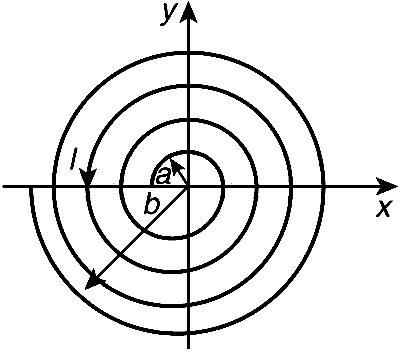
A long insulated copper wire is closely wound as a spiral of N turns. The spiral has inner radius a and outer radius b. The spiral lies in the xy-plane and a steady current I flows through the wire. The z-component of the magnetic field at the centre of the spiral is

A cylinder cavity of diameter a exists inside a cylinder of diameter 2a as shown in the figure. Both the cylinder and the cavity are infinitely long. A uniform current density J flows along the length. If the magnitude of the magnetic field at the point P is given by \({N \over {12}}{\mu _0}aJ\), then the value of N is ______________.

Consider the motion of a positive point charge in a region, there are simultaneous uniform electric and magnetic fields \(\overrightarrow E = {E_0}\widehat j\) and \(\overrightarrow B = {B_0}\widehat j\). At time t = 0, this charge has velocity \(\overrightarrow v\) in the xy-plane, making an angle \(\theta\) with the x-axis. Which of the following option(s) is(are) correct for time t > 0 ?
A loop carrying current \(l\) lies in the xy-plane as shown in the figure. The unit vector \(\widehat k\) is coming out of the plane of the paper. The magnetic moment of the current loop is

An infinite long hollow conducting cylinder with inner radius R/2 and outer radius R carries a uniform current density along its length. The magnitude of the magnetic field, \(\left| {\overrightarrow B } \right|\) as a function of the radial distance r from the axis is best represented by
A particle of mass M and positive charge Q, moving with a constant velocity \({\overrightarrow u _1} = 4\widehat i\) ms\(-\)1 enters a region of uniform static magnetic field, normal to the xy plane. The region of the magnetic field extends from x = 0 to x = L for all values of y. After passing through this region, the particle emerges on the other side after 10 ms with a velocity \({\overrightarrow u _2} = 2\left( {\sqrt 3 \widehat i + \widehat j} \right)\) ms\(-\)1. The correct statement(s) is(are)
Showing 20 of 53 questions