Difficulty distribution
How the classified questions are distributed by difficulty.
3questions
Not classified
3
100%
Your cart is empty.
Practice Capacitor - Electromagnetism - Physics previous year questions organised from real papers, with year-wise coverage and clear topic navigation.
Every graph below is calculated only from this selection.
Year-wise coverage for Capacitor. Each bar uses a separate theme-derived color.
How the classified questions are distributed by difficulty.
MCQ, numerical, multiple-select and other formats found in these papers.
Top subjects by unique question coverage.
Top topics across the included previous year papers.
Top subtopics inside this exact selection.
Question coverage for the most populated papers. Every active PYP paper remains listed below.
Newest papers appear first. Sort by year, question coverage or name.
| Paper | Year / session | Questions in this view | Open |
|---|---|---|---|
| IAT IISER 2025 | 2025 | 1 | View paper |
| IAT IISER 2024 | 2024 | 1 | View paper |
| IAT IISER 2022 | 2022 | 1 | View paper |
Practice every matching question in batches of 20, with every available option.
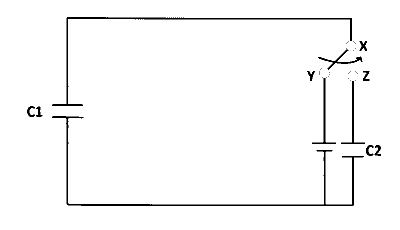
Consider the shown circuit. The capacitors $C_1$ and $C_2$ have capacitances $2 \mu \mathrm{~F}$ and $8 \mu \mathrm{~F}$, respectively. The switch can connect point $X$ to either $Y$ or $Z$. Initially $X Y$ is connected until the capacitor is fully charged by the battery. Then the switch connects $X$ and $Z$, and the final charges on Cl and C 2 are $Q_1$ and $Q_2$, respectively. What is the value of the ratio $\frac{Q_2}{Q_1+Q_2}$ ?
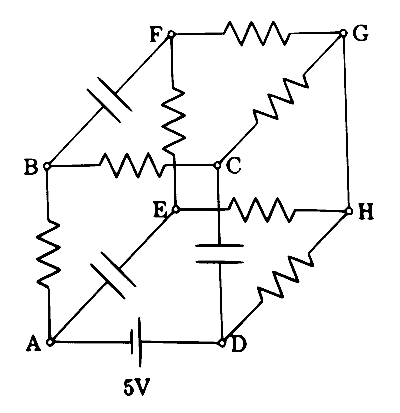
What is the potential difference between the points $P$ and $Q$ in the circuit shown below, once the capacitors are fully charged?
