Exam Details
IAT IISER 2024
Review the key details, then start the test when you are ready. You can also open the full package to see related papers.
Questions
60
Duration
180 mins
Package
IAT IISER- Previous Year Papers
Paper pattern & analysis
Filter this paper by subject, topic or subtopic. Every graph updates from the selected questions.
Topic distribution
Subtopic distribution
Difficulty distribution
60questions
Not classified
60
100%
Question type distribution
60questions
MCQ
60
100%
Syllabus
Full Syllabus
Practise paper questions
Choose your answer to check it. Log in to view the explanation. For a timed attempt and result, start the exam.
PYP
IAT IISER 2024
A ship sets off on a voyage with three engines, labelled $A, B$, and $C$, which work independently. The ship can complete the voyage only if at least two of these engines keep working. The probability that engine $A$ breaks down is $1 / 4$, that engine $B$ breaks down is $1 / 4$, and that engine $C$ breaks down is $1 / 2$. What is the probability that the ship can complete the voyage?
PYP
IAT IISER 2024
An inextensible cord of negligible mass passes over the rim of a solid disc of mass $M$ and radius $R$. The disc is free to rotate about an axis passing through the centre perpendicular to the plane of the screen, as shown in the figure. Two blocks of masses $M$ and $\widetilde{M} / 2$ are attached to the two free ends of the cord. Assume that there is no slipping of the cord on the disc. The acceleration due to gravity is $g$. What is the value of the angular acceleration of the disc?

PYP
IAT IISER 2024
On a circular track, two cyclists, Abhijit and Vani, start moving in opposite directions from a point. Abhijit moves with a constant speed. Vani starts with a constant acceleration from rest. They meet again on the track with the same speed. Which of the following is correct?
PYP
IAT IISER 2024
Consider a simple pendulum undergoing simple harmonic motion with a time period $T$, and a fixed amplitude $\theta_0$ of angular oscillation. Its angular momentum about the point of suspension exhibits an oscillatory behaviour with an amplitude $A$. Which of the following relations between $A$ and $T$ is correct?
PYP
IAT IISER 2024
Which of the following complexes exhibit(s) magnetic moment close to 2 BM ?
$$
\left[\mathrm{Fe}\left(\mathrm{H}_2 \mathrm{O}\right)_6\right]\left(\mathrm{NO}_3\right)_2, \mathrm{~K}_2\left[\mathrm{MnCl}_4\right], \mathrm{K}_4\left[\mathrm{Mn}(\mathrm{CN})_6\right] \text {, and }\left[\mathrm{Ni}(\mathrm{CO})_4\right]
$$
PYP
IAT IISER 2024
Consider the motion of a particle along the $x$-axis. The position of the particle varies with time as $x(t)=\sin ^2(\omega t) \cos ^3(\omega t)$, where $\omega$ is a constant. What is the time period of the motion?
PYP
IAT IISER 2024
Consider two point charges $+q$ and $+2 q$ fixed on the $x-y$ plane at $(-\ell / 2,0)$ and $(+\ell / 2,0)$ respectively. Another point charge $-q$ having mass $m$ is released from rest at $(0,(\sqrt{3} / 2) \ell)$ on the $x y$ plane, as shown in the figure The permittivity of free space is $\epsilon_0$. What is the acceleration of the charge $-q$ at the time of release?

PYP
IAT IISER 2024
Two identical boxes contain the same ideal gas. Let $\left(n_1, \lambda_1, T_1\right)$ and $\left(n_2, \lambda_2, T_2\right)$ be the number density, mean free path and temperature of the gas in the first and the second box, respectively. One of the boxes is empty into the other one. What will be the mean free path? $\lambda$ and temperature $T$ of the gas now?
PYP
IAT IISER 2024
The refractive indices $(n)$ of two transparent slabs are 2 and $2 / \sqrt{3}$. They are attached together and placed in a third transparent medium of refractive index $\sqrt{2}$, as shown in the figure. The thickness of the upper slab is $I \mathrm{~cm}$. A monochromatic light ray is incident on the upper slab at $45^{\circ}$. What would be the thickness in cm of the lower slab such that the lateral shift of the ray after passing through both the slabs is zero?

PYP
IAT IISER 2024
One mole of an ideal gas of volume $V$ and temperature $T$ is allowed to expand adiabatically to volume $2 V$ while doing no external work. The universal gas constant is $R$. What is the pressure of the gas after expansion?
PYP
IAT IISER 2024
Consider a solid sphere of radius $R$ floating in a pond with half of the sphere submerged. The sphere is pushed vertically downwards at the topmost point and released, such that it executes a simple harmonic motion. Acceleration due to gravity is $g$. What is the time period of oscillation?
PYP
IAT IISER 2024
A solid bob of a material having density twice that of water is suspended with a massless and inextensible string of length $L$. The whole set-up is placed inside a water-filled tank. The bob is imparted a horizontal velocity $V_0$ at the lowest point A , while the other end of the string is fixed, such that the bob completes a semi-circular trajectory in the vertical plane. The string becomes slack only when the bob reaches the topmost point C. Assume that the effects of viscosity and water currents are negligible. The acceleration due to gravity is $g$. What is the expression for $V_0$ ?

PYP
IAT IISER 2024
The minimum energy needed to remove an electron from a metal corresponds to a wavelength of 500 nm . What is the total kinetic energy of all the photoelectrons ejected per second when the entire radiation from a 100 Watt bulb with a wavelength of 300 nm falls on the surface of the metal? [Planck's constant $=6.6 \times 10^{34} \mathrm{Js}$; speed of light $=3 \times 10^8 \mathrm{~ms}^{-1}$ ]
PYP
IAT IISER 2024
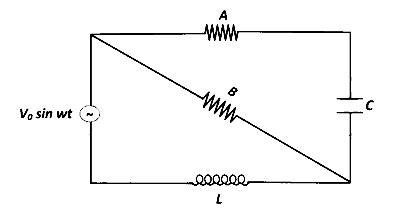
Consider the circuit diagram as shown in the figure. The source has a voltage $V=V_0 \sin \omega t$. Both the resistors $A$ and $B$ have the same resistance. The capacitor and the inductor have capacitance $C$ and inductance $L$, respectively. For some frequency $\omega$, and certain initial charge in the capacitor, the current through the resistor $A$ is in phase with the source. What is the value of $\omega$ ?
PYP
IAT IISER 2024
Two monochromatic sources emit light at wavelengths $\lambda$ and $\lambda / 2$. The stopping potentials for a photosensitive material using these two sources are found to be 1 V and 3 V , respectively. What is the work function of the material?
PYP
IAT IISER 2024
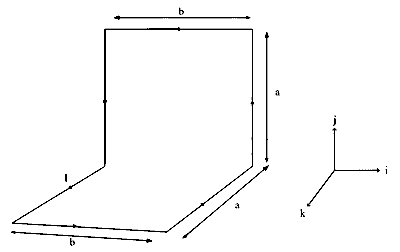
A conducting wire carrying a steady current $I$ is shaped as shown in the figure below. All connected graight segments meet at right angles. What is the magnetic moment of the current loop?
PYP
IAT IISER 2024
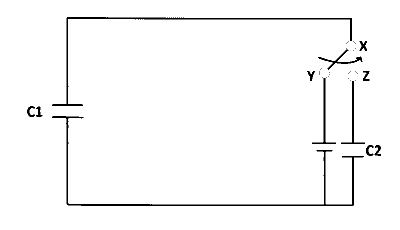
Consider the shown circuit. The capacitors $C_1$ and $C_2$ have capacitances $2 \mu \mathrm{~F}$ and $8 \mu \mathrm{~F}$, respectively. The switch can connect point $X$ to either $Y$ or $Z$. Initially $X Y$ is connected until the capacitor is fully charged by the battery. Then the switch connects $X$ and $Z$, and the final charges on Cl and C 2 are $Q_1$ and $Q_2$, respectively. What is the value of the ratio $\frac{Q_2}{Q_1+Q_2}$ ?
PYP
IAT IISER 2024
Atomic masses of two oxygen isotopes ${ }_8^{16} \mathrm{O}$ and ${ }_8^{18} \mathrm{O}$ are 15.99491 u and 17.99916 u , respectively, where $u$ is the atomic mass unit. Masses of protom and neutron are given by 1.00727 u and I .00866 u , respectively. The speed of light is c . What is the difference between the binding energies of ${ }_8^{18} \mathrm{O}{ }_8^{16} \mathrm{O}$ nuclei in units of $u c^2$ ?
PYP
IAT IISER 2024
Consider an exothermic reaction: $2 \mathrm{~A}(\mathrm{~s}) \rightarrow \mathrm{B}(\mathrm{s})+\mathrm{C}(\mathrm{g})+\mathrm{D}(\mathrm{g})$. The correct statement about the reaction is
PYP
IAT IISER 2024
For a reaction $R \rightarrow P$ with a rate constant of $3 \times 10^{-3} \mathrm{~mol} \mathrm{~L}^{-1} \mathrm{~s}^{-1}$, which one of the following plots is correct? (Given [R] $]_0$ is the initial concentration of $R$ and $[R]$ is the concentration of $R$ at time t)
PYP
IAT IISER 2024
According to the VSEPR theory, what are the most stable shapes of $X_4 F_4$ and $\mathrm{SF}_4$, respectively?
PYP
IAT IISER 2024
Which one of these plots correctly describes the variation of osmotic pressure ( $\Pi$ ) of a fixed amount of a solute against the volume $(\mathrm{V})$ of the solution at a fixed temperature?
PYP
IAT IISER 2024
If an element with $Z=120$ is discovered, then which group of elements will it belong to?
PYP
IAT IISER 2024
Consider the following data for KCl solution at a particular temperature. What is the value of the limiting molar conductivity?
$$ \begin{array}{|c|c|} \hline \text { Concentration }\left(\mathrm{mol} \mathrm{~L}^{-1}\right) & \text { Molar Conductivity }\left(\mathrm{S} \mathrm{~cm}^2 \mathrm{~mol}^{-1}\right) \\ \hline 1 \times 10^{-4} & 149.1 \\ \hline 9 \times 10^{-4} & 147.1 \\ \hline \end{array} $$
PYP
IAT IISER 2024
Which one of the following statements is correct about $\mathrm{N}_2, \mathrm{CO}$, and $\mathrm{NO}^{+}$?
PYP
IAT IISER 2024
$$ \text { What are } X \text { and } Z \text { in the following sequence of reactions? } $$

PYP
IAT IISER 2024
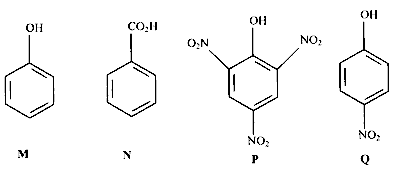
$$
\text { What is the correct order of acidity for the following compounds? }
$$
PYP
IAT IISER 2024
The following complex ions absorb in the ultraviolet-visible region of light. Which one of these shows violet colour?
$$ \left[\mathrm{CoCl}\left(\mathrm{NH}_3\right)_5\right]^{2+},\left[\mathrm{Co}\left(\mathrm{H}_2 \mathrm{O}\right)\left(\mathrm{NH}_3\right)_5\right]^{3+},\left[\mathrm{Co}\left(\mathrm{NH}_3\right)_6\right]^{3+}, \text { and }\left[\mathrm{Co}(\mathrm{CN})_6\right]^{3-} $$
PYP
IAT IISER 2024
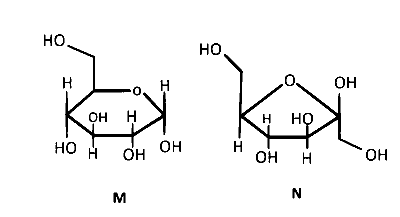
$$ \text { What are the correct structural descriptions for } M \text { and } N \text { ? } $$
PYP
IAT IISER 2024
$$ \text { What is the relationship between the structures depicted below? } $$

PYP
IAT IISER 2024
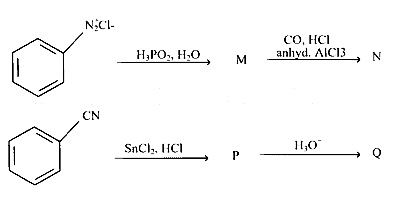
$$ \text { What are the products } \mathrm{N} \text { and } \mathrm{Q} \text { in the following reaction sequences? } $$
PYP
IAT IISER 2024
Consider the following subset of the $X Y$-plane.
$$ S=\left\{\left(|z-\mathrm{i} z|,|z|^2\right): \quad z \text { is a complex number }\right\} $$
Which one of the following statements is correct?
PYP
IAT IISER 2024
Let $M$ be the set of all $3 \times 3$ matrices with real entries. Consider the relation $R$ on $M$ given by $R=\{(A, B) \in M \times M: \operatorname{det}(A-B)$ is an integer $\}$. Which one of the following statements is Correct?
PYP
IAT IISER 2024
Consider the lines $L_1$ and $L_2$ given below:
$$ \begin{gathered} L 1: x=2+\lambda, y=3+2 \lambda, z=4+3 \lambda \\ L 2: x=4+\lambda, y=4, z=4+\lambda \end{gathered} $$
If $(2,3,4)$ is the point of $L_1$ that is closest to $L_2$, then which point of $L_2$ is closest to $L_1$ ?
PYP
IAT IISER 2024
What is the value of ${ }^{23} C_0+{ }^{23} C_2+{ }^{23} C_4+\cdots+{ }^{23} C_{22}$ ?
PYP
IAT IISER 2024
Let $a_1, a_2, a_3, \ldots$ be a sequence of real numbers. Let $s_n=a_1+a_2+\cdots+a_n$. If $2 s_n=$ $n\left(c+a_n\right)$ for some real number. for some real number $c$ and for all $n=1,2,3, \ldots$, then which one of the following statements is Correct?
PYP
IAT IISER 2024
Let $f, g: R \rightarrow R$ be functions. If $g$ is continuous, then which one of the following cases implies that $f$ is continuous?
PYP
IAT IISER 2024
Let $I=\int_{e^{-\pi / 2}}^{e^{\pi / 2}}\left(\sin ^2(\log (x))+\sin \left(\log \left(x^2\right)\right)\right) d x$. What is the value of $I$ ?
PYP
IAT IISER 2024
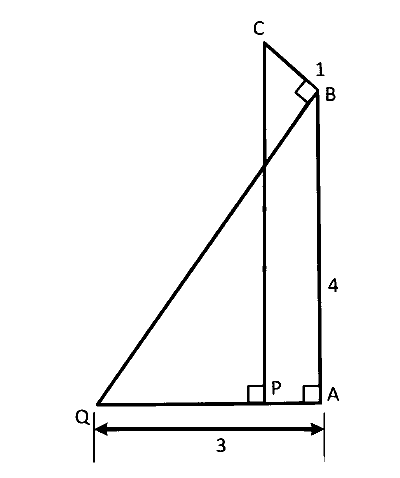
In the given figure, the angles $\angle B A Q=\angle C P Q=\angle C B Q=\frac{\pi}{2}$; and the lengths $Q A=3$ units, $A B=$ 4 units, and $B C=1$ unit. What is the length of $P Q$ ?
PYP
IAT IISER 2024
What is the largest area of a rectangle, whose sides are parallel to the coordinate axes, that can be inscribed under the graph of the curve $y=1-x^2$ and above the $x$-axis?
PYP
IAT IISER 2024
Let $f: \mathbf{R} \rightarrow \mathbf{R}$ be a strictly decreasing function with $|f(t)|<\pi / 2$ for all $t \in \mathbf{R}$. Let $g:[0, \pi] \rightarrow$ R be a function defined by $g(t)=\sin (f(t))$. Which one of the following statements is Correct?
PYP
IAT IISER 2024
Let $f: Q \rightarrow Q$ be a function such that $f(x+y)=f(x)+f(y)$ for all $x, y \in \mathbf{Q}$, and $f(1)=$ 10. Which one of the following statements is Correct?
PYP
IAT IISER 2024
Consider the differential equation $\cos (y) \frac{d y}{d x}+\frac{1}{x} \sin (y)=x, \quad(x>0)$; given that, $y=\frac{\pi}{2}$ at $x=\sqrt{3}$. Which one of the following is the value of $y$ at $x=\sqrt{\frac{3}{2}}$ ?
PYP
IAT IISER 2024
Polymerase chain reaction (PCR) is used to amplify a gene of interest (GOI). If, after 30 cycles of PCR, 1 billion copies of GOI are produced, approximately how many copies of GOI were present at the end of the $20^{\text {th }}$ cycle?
PYP
IAT IISER 2024
Consider the following lines in the $X Y$-plane:
$$ L_1: 5 x-2 y=1 $$
$L_2$ : The line passing through $(0,1)$ and $(100,101)$,
$L_3$ : The line passing through $(1,11)$ and parallel to the vector $-\hat{\imath}+2 \hat{\jmath}$.
Let $A=\left(L_1 \cap L_2\right) \cup\left(L_2 \cap L_3\right) \cup\left(L_3 \cap L_1\right)$. What is the total number of elements of $A$ ?
PYP
IAT IISER 2024
Which of the following plasmid vectors can be used for cloning of a gene, with restriction enzymes BamHI and EcoRI, and ampicillin-containing nutrient agar for selection? [Ori - origin of replication; $\mathrm{Amp}^R$ - gene for ampicillin resistance]
PYP
IAT IISER 2024
Let $A$ be the set of points in the $X Y$-plane which are equidistant from $P(-1,0)$ and $Q(1,0)$. Let $B$ be the set of points in the $X Y$-plane which are equidistant from $A$ and $Q$. If $(5, y)$ is a point in $B$, then what is the value of $y^2$ ?
PYP
IAT IISER 2024
Two species of a flowering plant, $P(2 n=20$ chromosomes) and $Q$ ( $2 n=30$ chromosomes) are reciprocally crossed with each other as male or female as shown below to produce F1 seeds. Which of the following seed tissues from both the F1 seeds ( $R$ and $S$ ) will have the same chromosome numbers?

PYP
IAT IISER 2024
Which of the following graphs represents the correct relationship between light intensity (Xaxis) and the rate of photosynthesis ( $Y$-axis)?
PYP
IAT IISER 2024
$$ \text { Match the enzymes in Column I with the cellular compartments in Column II. } $$
| Column I | Column II | ||
| P | Succinate dehydrogenase | i | Cytoplasm |
| Q | Pyruvate dehydrogenase | ii | Inner mitochondrial membrane |
| R | Lactate dehydrogenase | iii | Mitochondrial matrix |
| S | ATP synthase | iv | Thylakoid membrane |
| v | Inner chloroplast membrane |
PYP
IAT IISER 2024
$$ \text { Match the list of conditions with the list of affected physiological processes. } $$
| Column I | Column II | ||
|---|---|---|---|
| P | Allergy | i | Excess secretion of growth hormone |
| Q | Uremia | ii | Exaggerated immune response to environmental substances |
| R | Myasthenia gravis | iii | Autoimmune disorder affecting the neuromuscular junction |
| S | Acromegaly | iv | Malfunctioning of kidneys which can lead to urea accumulation in the blood |
Which of the following combinations is correct?
PYP
IAT IISER 2024
What will be the sequence of RNA synthesized using the following DNA template strand?
$5^{\prime}$-GTCTAGGCTTCTC- $3^{\prime}$
PYP
IAT IISER 2024
Which of the following proteins plays a direct role in muscle contraction?
PYP
IAT IISER 2024
Which one of the following statements is correct?
PYP
IAT IISER 2024
Which of the following statements about meiosis in sexually reproducing plants is INCORRECT?
PYP
IAT IISER 2024
Which of the following is routinely performed to detect typhoid?
PYP
IAT IISER 2024
Which of the following is NOT derived from the epidermal cell layer in plants?
PYP
IAT IISER 2024
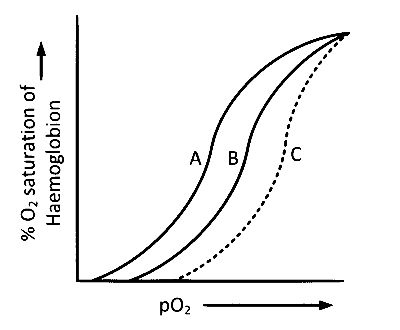
Which of the following statements is correct about the oxygen $\left(\mathrm{O}_2\right)$ dissociation curves A and C relative to curve B ?
PYP
IAT IISER 2024
The following pedigree diagram shows the inheritance of a rare genetic disorder (filled shapes depict affected individuals).
 Which of the following is the most likely pattern of inheritance of the disorder?
Which of the following is the most likely pattern of inheritance of the disorder?PYP
IAT IISER 2024
A population with $N=400$ in asymptote at $K=500$ individuals, $K$ being the carrying capacity. Assuming the intrinsic rate of natural increase $(r)$ to be 0.01 , what would be the population browth rate ( $\mathrm{dN} / \mathrm{dt}$ )?
Showing 5 of 60 questions