Difficulty distribution
How the classified questions are distributed by difficulty.
75questions
Not classified
75
100%
Your cart is empty.
Practice Physics previous year questions organised from real papers, with year-wise coverage and clear topic navigation.
Every graph below is calculated only from this selection.
Year-wise coverage for Physics. Each bar uses a separate theme-derived color.
How the classified questions are distributed by difficulty.
MCQ, numerical, multiple-select and other formats found in these papers.
Top subjects by unique question coverage.
Top topics across the included previous year papers.
Top subtopics inside this exact selection.
Question coverage for the most populated papers. Every active PYP paper remains listed below.
Open a focused page built from the same verified paper data.
Explore previous-paper coverage, trends and focused practice for Mechanics.
Explore previous-paper coverage, trends and focused practice for Electromagnetism.
Explore previous-paper coverage, trends and focused practice for Modern Physics.
Explore previous-paper coverage, trends and focused practice for Optics.
Newest papers appear first. Sort by year, question coverage or name.
| Paper | Year / session | Questions in this view | Open |
|---|---|---|---|
| IAT IISER 2025 | 2025 | 15 | View paper |
| IAT IISER 2024 | 2024 | 15 | View paper |
| IAT IISER 2023 | 2023 | 15 | View paper |
| IAT IISER 2022 | 2022 | 15 | View paper |
| IAT IISER 2020 | 2020 | 15 | View paper |
A varied preview from the papers represented in this selection, with every available option.
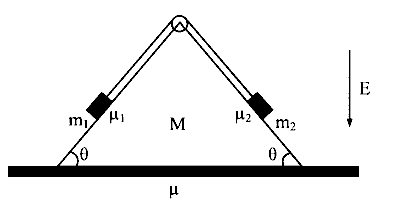
Consider a mass-pulley system as shown in the figure. There is a wedge of mass $M$ and equal wedge angles $\theta$ lying on a rigid horizontal table. The coefficient of friction between the wedge and the table is $\mu$. There are two blocks of mass $m_1$ and $m_2$ lying on the incline of the wedge. The coefficients of friction between the blocks and wedge are $\mu_1$ and $\mu_2$ as shown in the figure. Consider $m_1>m_2$ and the coefficients of friction ( $\mu, \mu_1$ and $\mu_2$ ) to be less than $\tan \theta$. Gravity is acting downwards with acceleration due to gravity $g$. What should be the value of $\frac{m_1}{m_2}$ so that the system is in equilibrium?

Consider two waves, which are given by $y_1(x, t)=A \sin (k x-\omega t)$ and $y_2(x, t)=\sqrt{3} A \cos (k x-\omega t)$, where $k$ is the wave number and $\omega$ is the angular frequency. The amplitude of the resultant waveform obtained by the superposition of the two waves is $A_s$ and its phase difference with $y_1$ is $\phi_s$. What are $A_s$ and $\phi_s$ ?
The potential energy of a point particle of mass $m$ undergoing rectilinear motion along the $x$-axis is given by
$$V(x)=A x+B x^2$$
What is the maximum speed attained by the particle if it starts from rest at $x=\frac{A}{B}$ ?