Exam Details
IAT IISER 2025
Review the key details, then start the test when you are ready. You can also open the full package to see related papers.
Questions
60
Duration
180 mins
Package
IAT IISER- Previous Year Papers
Paper pattern & analysis
Filter this paper by subject, topic or subtopic. Every graph updates from the selected questions.
Topic distribution
Subtopic distribution
Difficulty distribution
60questions
Not classified
60
100%
Question type distribution
60questions
MCQ
60
100%
Syllabus
Full Syllabus
Practise paper questions
Choose your answer to check it. Log in to view the explanation. For a timed attempt and result, start the exam.
PYP
IAT IISER 2025
A block of mass $M$ lies at rest connected to a massless spring of spring constant $k$ on a frictionless surface. A bullet of mass $m$ hits the block horizontally with speed $v$ as shown in the figure and is completely stuck to the block. What is the maximum compression in the spring resulting from this impact (assuming that at this point the spring is still not fully compressed)?

PYP
IAT IISER 2025
Consider two waves, which are given by $y_1(x, t)=A \sin (k x-\omega t)$ and $y_2(x, t)=\sqrt{3} A \cos (k x-\omega t)$, where $k$ is the wave number and $\omega$ is the angular frequency. The amplitude of the resultant waveform obtained by the superposition of the two waves is $A_s$ and its phase difference with $y_1$ is $\phi_s$. What are $A_s$ and $\phi_s$ ?
PYP
IAT IISER 2025
Consider an elastic collision between two particles $A$ and $B$ of same mass, moving in the same direction. Particle $A$ is moving at speed $v_A$ and particle $B$ is moving at speed $v_B$. In the figures shown, the solid lines represent the motion before the collision and the dotted lines represent the motion after the collision. Which of the following describes the motion of these two particles most accurately?
PYP
IAT IISER 2025
A cart of mass $M$ is released from $A$, the highest point of a frictionless track, as shown in the figure. The cart travels along the track and enters the semicircular arc $D B C$ of radius $R$. The heights of the points $A$ and $B$ are $h_1$ and $h_2$ from the ground, respectively. Which of the following quantities does not play any role in ensuring that the cart does not leave the track?

PYP
IAT IISER 2025
A circular disk of mass $M$ and radius $R$ is rotating clockwise with a uniform angular velocity $\omega$ about an axis passing through the centre, normal to the disk. At time $t=0$, a torque $T$ is applied along the same axis to oppose the rotation of the disk. What is the angular displacement $\theta$ (measured from $t=0$ in the clockwise direction) that the disk attains before it starts rotating counterclockwise?
PYP
IAT IISER 2025
Consider two pipes $A$ and $B$ of identical length. $A$ has one end closed and one end open. $B$ has both ends open. Each tube is immersed in a closed chamber of ideal gas having volume $V$. The chamber containing tube $A$ is at temperature $T_A$ and the chamber containing tube $B$ is at temperature $T_B$. The sound frequencies corresponding to the $n_A$-th harmonic in tube $A$ and the $n_B$-th harmonic in tube $B$ are the same. What is the relation between the temperatures $T_A$ and $T_B$ ?
PYP
IAT IISER 2025
What is the potential difference between the points $P$ and $Q$ in the circuit shown below, once the capacitors are fully charged?

PYP
IAT IISER 2025
A particle of charge $q=1 e$ and mass $m$ with kinetic energy $K$ enters an electric field set up by two parallel plates of length $l$ as illustrated in the figure. The potential difference between the two plates is 1 V and their separation is $d$. What is the minimum value of $K$ (in eV ) for which the particle will not hit either of the plates? [ $e$ is the charge of the electron.]

PYP
IAT IISER 2025
A source produces a light beam of intensity $I_0$ polarized along the $x$-direction. The beam is sent along the $z$-direction. It enters a polaroid $P 1$ with its polaroid axis aligned along the $y$-direction so that no light exits the polaroid. When another polaroid $P 2$ is placed in between the source and $P 1$, the intensity measured after $P 1$ is $3 I_0 / 16$. Which among the following is a possible value of $\theta$, the angle of the polaroid axis measured from the $x$-axis?

PYP
IAT IISER 2025
A charged particle is moving in a circular orbit with radius $r$ and orbital angular frequency $\omega$ in the presence of a magnetic field. The orbit is enclosed within a larger circular metallic frame. The frame is concentric and coplanar with the orbit. The radius of the frame is now gradually decreased. Assuming that the particle remains within the frame at all times, what changes to the trajectory of the particle will occur as the frame is being shrunk?
PYP
IAT IISER 2025
A particle of mass $m$ and charge $q$ moving with a velocity $\vec{v}=v_0(\hat{i}+\hat{j}-\hat{k})$ is placed in a uniform magnetic field $\vec{B}=B_0(\hat{i}+\hat{j}+\hat{k})$. It executes a helical trajectory of radius $r$ and pitch $p$. Which of the following options is correct?
PYP
IAT IISER 2025
Consider an equilateral prism of refractive index 1.5 and a parallelepiped block of refractive index 2.0 arranged as shown in the figure such that their adjacent faces are parallel. A light ray enters the prism from air at an angle of incidence such that the ray travels through the prism parallel to its base. What is the angle of emergence $\theta$ ?

PYP
IAT IISER 2025
What is the value of $E^{\circ}\left(\mathrm{Fe}^{3+} / \mathrm{Fe}^0\right)$ ?
[The standard reduction potential values are $E^{\circ}\left(\mathrm{Fe}^{3+} / \mathrm{Fe}^{2+}\right)=0.77 \mathrm{~V}$, and $\left.E^{\circ}\left(\mathrm{Fe}^{2+} / \mathrm{Fe}^0\right)=-0.44 \mathrm{~V}\right]$
PYP
IAT IISER 2025
The work done when one mole of an ideal gas expands at constant temperature $T$ from volume $V$ to $2 V$ (in two equal steps of volume in a linear fashion) is $\frac{7}{12} R T$. How much more work would be done by the gas if it expands in three equal steps?
[ $R$ is the universal gas constant]
PYP
IAT IISER 2025
An electron in the ground state (with energy $E_1$ ) of a hydrogen atom, absorbs a photon of energy $E_a$, and gets excited to a higher energy level of principal quantum number $n$. What is the value of $n$ ?
PYP
IAT IISER 2025
During the charging and discharging of a lead-acid battery (a Pb anode, a grid of Pb packed with $\mathrm{PbO}_2$ as cathode, and an aqueous solution of $\mathrm{H}_2 \mathrm{SO}_4$ as an electrolyte), which of the following redox reactions does NOT occur?
PYP
IAT IISER 2025
What is the time period of revolution of an electron in the fourth Bohr orbit of $\mathrm{He}^{+}$?
[Bohr radius $=52.9$ picometers, mass of an electron $=9.11 \times 10^{-31} \mathrm{~kg}$, Planck's constant $=6.626 \times 10^{-34} \mathrm{Js}$ ]
PYP
IAT IISER 2025
At a particular temperature, the magnitude of the rate constant of a reaction is $5 \times 10^{-5}$ and the unit of the pre-exponential factor of the Arrhenius equation for this reaction is $\mathrm{mol} \mathrm{L}^{-1} \mathrm{~min}^{-1}$. Which of the following plots is correct for this reaction?
$\left[\right.$ Note: $[\mathrm{R}]_0$ is the initial concentration and $t_{1 / 2}$ is the half-life of the reaction $]$
PYP
IAT IISER 2025
Which among the following processes is/are associated with increasing bond order but no change in diamagnetic/paramagnetic behaviour?
(i) $\mathrm{N}_2 \rightarrow \mathrm{~N}_2^{+}+\mathrm{e}^{-}$
(ii) $\mathrm{O}_2 \rightarrow \mathrm{O}_2^{+}+\mathrm{e}^{-}$
(iii) $\mathrm{O}_2+\mathrm{e}^{-} \rightarrow \mathrm{O}_2^{-}$
PYP
IAT IISER 2025
Which one of the following statements best describes the acidic/basic/amphoteric nature of ZnO and CaO ?
PYP
IAT IISER 2025
$$ \text { Consider the following reaction scheme: } $$
 $$ \text { Which among the following statements is correct? } $$
PYP
IAT IISER 2025
The dipole moments of three $\mathrm{AB}_3$-type molecules $\mathbf{I}, \mathbf{I I}$, and $\mathbf{I I I}$ are measured to be $0.0 \mathrm{D}, 0.2 \mathrm{D}$, and 1.5 D , respectively. Which one of the following options is correct regarding the identity of $\mathbf{I}, \mathbf{I I}$, and $\mathbf{I I I}$ ?
PYP
IAT IISER 2025
$$ \text { What are the correct orders of stability for the following compounds? } $$
PYP
IAT IISER 2025
$$ \text { How many } \beta \text {-hydrogen is/are present in 2-methyl-3-phenyl-pentan-1-al? } $$
PYP
IAT IISER 2025
$$ \text { Which of the following reactions do NOT provide an aldehyde as a product? } $$
PYP
IAT IISER 2025
$$ \text { What are the major products formed in the following reaction sequence? } $$
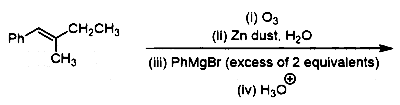
PYP
IAT IISER 2025
$$ \text { What is the major product in the reaction sequence given below? } $$
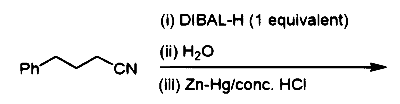
PYP
IAT IISER 2025
Let
$$ A=\left\{x \in \mathbf{R} \left\lvert\,-31<\operatorname{det}\left[\begin{array}{cc} 3 x-1 & 2 \\ -2 & 5 \end{array}\right] \leq 29\right.\right\} $$
Which one of the following statements is TRUE?
PYP
IAT IISER 2025
Let $n=\sum\limits_{r=0}^{10}(-1)^r{ }^{10} C_r\left(\frac{2}{3}\right)^{2 r} 3^{20}$. Which one of the following statements is TRUE?
PYP
IAT IISER 2025
Let $A$ be a $3 \times 3$ matrix with real entries such that
$$ A=\left[\begin{array}{ccc} 4 & -1 & \cos x \\ -1 & 5 x & 25 \\ x^2+1 & 25 & 7 \end{array}\right] $$
For how many values of $x$, the matrix $A$ is symmetric?
PYP
IAT IISER 2025
Five fair coins are tossed independently. What is the probability that at least two heads appear?
PYP
IAT IISER 2025
Let $f: \mathbf{R} \rightarrow \mathbf{R}$ be the function defined by
$$ f(x)= \begin{cases}x^2-4 x-5 & \text { if } x \geq 1, \\ 2 x & \text { if } x<1 .\end{cases} $$
Which one of the following statements is TRUE?
PYP
IAT IISER 2025
Let $\vec{a}$ and $\vec{b}$ be two vectors such that $|\vec{a}+\vec{b}|=15$ and
$$ \vec{a} \times(3 \hat{i}-4 \hat{j}+5 \hat{k})=(3 \hat{i}-4 \hat{j}+5 \hat{k}) \times \vec{b} $$
What is the value of $|(\vec{a}+\vec{b}) \cdot(2 \hat{i}+3 \hat{j}+\hat{k})|$ ?
PYP
IAT IISER 2025
How many three digit numbers divisible by 5 are there in which no digits are repeated?
PYP
IAT IISER 2025
Let $z_1, z_2$, and $z_3$ be complex numbers satisfying the following conditions
$$ 2=\left|2 z_1\right|=\left|z_2-1\right|=\left|z_3+1\right|=\left|\frac{1}{z_1}+\frac{1}{z_2-1}+\frac{1}{z_3+1}\right| . $$
What is the value of $\left|4 z_1+z_2+z_3\right|$ ?
PYP
IAT IISER 2025
Let $S_n$ denote the sum of the first $n$ terms of a sequence $a_1, a_2, a_3, \ldots$. If $S_{n+3}-S_n=13 n+7$ for all $n$, what is the value of $a_{13}-a_{10}$ ?
PYP
IAT IISER 2025
What is the value of $\int_0^\pi x|\cos x| \sin x d x$ ?
PYP
IAT IISER 2025
Which one of the following is the solution of the differential equation
$$ x^2 \frac{d y}{d x}+9 x y=x^4(\text { for } x>0) $$
given that $y=0$ when $x=1$ ?
PYP
IAT IISER 2025
Let $f: \mathbf{R} \rightarrow \mathbf{R}$ be defined as $f(x)=\left|x^3-3 x\right|[x]$, where $[x]$ denotes the greatest integer less than or equal to $x$. Which one of the following statements is TRUE?
PYP
IAT IISER 2025
What is the derivative of $\log \left(\sin ^2 x\right)$ with respect to $\sin x$ ?
PYP
IAT IISER 2025
Let $f: \mathbf{R} \rightarrow \mathbf{R}$ be the function given by $f(x)=\cos \left(\tan ^{-1} x\right)$. Which one of the following statements is TRUE?
PYP
IAT IISER 2025
Let $\ell$ be the tangent line to the ellipse $x^2+16 y^2=4$ at $\left(1, \frac{\sqrt{3}}{4}\right)$. What is the equation of the line perpendicular to $\ell$ passing through $(2,0)$ ?
PYP
IAT IISER 2025
Chromosomes are classified as metacentric, sub-metacentric, acrocentric and telocentric. This classification is based on the position of which one of the following structures?
PYP
IAT IISER 2025
Which one of the following statements about a plant carotenoid is FALSE?
PYP
IAT IISER 2025
Two double heterozygous plants ( PpQq ), derived from two different pairs of true-breeding parents of unknown genotype, produce gametes in the proportions as given below.
 Which one of the following options correctly represents the genotype of the parents?
PYP
IAT IISER 2025
Which one of the following options describes a triglyceride?
PYP
IAT IISER 2025
Honey bee males are haploid and females are diploid. Which one of the following statements is INCORRECT about honey bees?
PYP
IAT IISER 2025
A metallic cube initially kept at a temperature $T$ is emitting black body radiation with a power $P$ (energy emitted per unit time). If $T$ is increased by $1 \%$, the power being radiated increases by $4.5 \%$. What is the approximate percentage increase in the volume of the cube in this process?
PYP
IAT IISER 2025
What are retroviruses?
PYP
IAT IISER 2025
Which one of the following organisms produces the female gamete by mitosis of haploid cells?
PYP
IAT IISER 2025
Which one of the following autoregulatory mechanisms is employed by the kidney when glomerular filtration rate is reduced?
PYP
IAT IISER 2025
Which one of the following statements is FALSE?
PYP
IAT IISER 2025
Which one of the following statements is correct?
PYP
IAT IISER 2025
Which one of the following conditions will favour maximum dissociation of oxygen from the oxyhaemoglobin in the tissues?
PYP
IAT IISER 2025
The given picture was obtained from an agarose gel electrophoresis of a plasmid after digestion with restriction enzymes either $\mathrm{X}, \mathrm{Y}$ or both X and Y.
 Which one of the following diagrams correctly represents the position of the restriction enzyme sites $(\mathrm{X}, \mathrm{Y})$ on the 10,000 bp plasmid?
PYP
IAT IISER 2025
$$ \text { Match the entries in column I and column II. } $$
| Column I | Column II | ||
|---|---|---|---|
| P. | Notochord and hollow nerve cord present | i. | Cyclostomata |
| Q. | Ectoparasite with 6-15 pairs of gills and closed circulation | ii. | Chondrichthyes |
| R. | Marine animals with persistent notochord and placoid scales | iii. | Hemichordata |
| S. | Animals with open circulatory systems, and stomochord | iv. | Chordata |
PYP
IAT IISER 2025
Which amino acid will be charged on the tRNA with anticodon $5^{\prime}$-GUU- $3^{\prime}$ ?
PYP
IAT IISER 2025
A cell suspension of actively respiring mitochondria is treated with either chemical X (experiment 1) or chemical Y (experiment 2), or left untreated (experiment 3 ).
Chemical X selectively inhibits electron transport from Complex I to ubiquinone, while chemical Y selectively inhibits electron transport from Complex III to cytochrome C.
Which one of the following options represents the correct order of relative number of ATP synthesised in mitochondria?
PYP
IAT IISER 2025
A particle of mass $m$ and charge $q$ is accelerated through a distance $d_1$ by an electric field $\vec{E}$. Another particle of mass $M$ and charge $q$ is accelerated by the same electric field through a distance $d_2$. Both the particles emerge with the same de Broglie wavelength $\lambda_B$. What is the ratio of the distances $d_2 / d_1$ ?
PYP
IAT IISER 2025
Compound $\mathbf{I}$ undergoes hydroboration-oxidation reaction with $\left(\mathrm{BH}_3\right)_2$ followed by treatment with $\mathrm{H}_2 \mathrm{O}_2$ and aqueous NaOH to produce another compound II, which upon oxidation with $\mathrm{CrO}_3$ gives 2,3-dimethyl-cyclohexanone as the product. What is the structure of $\mathbf{I}$ ?
Showing 5 of 60 questions