My Cart
Your Cart 0

    Your cart is empty.

  • Total (Amount) ₹0.00
Previous year question hub

LTI systems - Networks, Signals and Systems - Electronics & Communication Engineering Previous Year Questions

Practice LTI systems - Networks, Signals and Systems - Electronics & Communication Engineering previous year questions organised from real papers, with year-wise coverage and clear topic navigation.

23Papers
16Years
59Questions
1Topics

LTI systems question pattern

Every graph below is calculated only from this selection.

Questions by year

Compare question counts across years.

Difficulty distribution

How the classified questions are distributed by difficulty.

Easy 35 59.3%
Medium 22 37.3%
Hard 2 3.4%
Question type distribution

MCQ, numerical, multiple-select and other formats found in these papers.

MCQ 51 86.4%
Numerical Answer Type (NAT) 5 8.5%
Fill in the blanks 2 3.4%
MSQ 1 1.7%

Subject weightage

Top subjects by unique question coverage.

Electronics & Communication Engineering
59 Qs

Most asked topics

Top topics across the included previous year papers.

Networks, Signals and Systems
59 Qs

Subtopic coverage

Top subtopics inside this exact selection.

LTI systems
59 Qs

Paper coverage

Question coverage for the most populated papers. Every active PYP paper remains listed below.

Electronics and Communication Engineering (EC) 2026
1 Qs
Electronics & Communication Engineering (EC) 2025
1 Qs
Electronics & Communication Engineering (EC) 2024
1 Qs
Electronics & Communication Engineering (EC) 2023
3 Qs
Electronics & Communication Engineering (EC) 2022
3 Qs
Electronics & Communication Engineering (EC) 2019
1 Qs
Electronics & Communication Engineering (EC) 2018
1 Qs
Electronics & Communication Engineering (EC) 2017
3 Qs
Electronics & Communication Engineering (EC) 2017 [Session 2]
3 Qs
Electronics & Communication Engineering (EC) 2017 [Session 1]
1 Qs
Electronics & Communication Engineering (EC) 2016 [Session 3]
2 Qs
Electronics & Communication Engineering (EC) 2014 [Session 4]
4 Qs
Electronics & Communication Engineering (EC) 2014 [Session 2]
2 Qs
Electronics & Communication Engineering (EC) 2014 [Session 3]
1 Qs
Electronics & Communication Engineering (EC) 2013 [Session 1]
7 Qs
Electronics & Communication Engineering (EC) 2013 [Session 3]
7 Qs
Electronics & Communication Engineering (EC) 2013 [Session 4]
7 Qs
Electronics & Communication Engineering (EC) 2013 [Session 2]
5 Qs
Electronics & Communication Engineering (EC) 2012
1 Qs
Electronics & Communication Engineering (EC) 2011
1 Qs
Electronics & Communication Engineering (EC) 2009
1 Qs
Electronics & Communication Engineering (EC) 2008
2 Qs
Electronics & Communication Engineering (EC) 2007
1 Qs

Included previous year papers

Newest papers appear first. Search these papers or sort by year and name.

Paper nameYearPDFAttempt
Electronics and Communication Engineering (EC) 20262026
1 questions in this view
2026
Electronics & Communication Engineering (EC) 20252025
1 questions in this view
2025
Electronics & Communication Engineering (EC) 20242024
1 questions in this view
2024
Electronics & Communication Engineering (EC) 20232023
3 questions in this view
2023
Electronics & Communication Engineering (EC) 20222022
3 questions in this view
2022
Electronics & Communication Engineering (EC) 20192019
1 questions in this view
2019
Electronics & Communication Engineering (EC) 20182018
1 questions in this view
2018
Electronics & Communication Engineering (EC) 20172017
3 questions in this view
2017
Electronics & Communication Engineering (EC) 2017 [Session 1]2017
1 questions in this view
2017
Electronics & Communication Engineering (EC) 2017 [Session 2]2017
3 questions in this view
2017
Electronics & Communication Engineering (EC) 2016 [Session 3]2016
2 questions in this view
2016
Electronics & Communication Engineering (EC) 2014 [Session 2]2014
2 questions in this view
2014
Electronics & Communication Engineering (EC) 2014 [Session 3]2014
1 questions in this view
2014
Electronics & Communication Engineering (EC) 2014 [Session 4]2014
4 questions in this view
2014
Electronics & Communication Engineering (EC) 2013 [Session 1]2013
7 questions in this view
2013
Electronics & Communication Engineering (EC) 2013 [Session 2]2013
5 questions in this view
2013
Electronics & Communication Engineering (EC) 2013 [Session 3]2013
7 questions in this view
2013
Electronics & Communication Engineering (EC) 2013 [Session 4]2013
7 questions in this view
2013
Electronics & Communication Engineering (EC) 20122012
1 questions in this view
2012
Electronics & Communication Engineering (EC) 20112011
1 questions in this view
2011
Electronics & Communication Engineering (EC) 20092009
1 questions in this view
2009
Electronics & Communication Engineering (EC) 20082008
2 questions in this view
2008
Electronics & Communication Engineering (EC) 20072007
1 questions in this view
2007

All LTI systems previous year questions

Practice every matching question in batches of 20, with every available option.

1
2007 · Electronics & Communication Engineering · Networks, Signals and Systems · LTI systems
Electronics & Communication Engineering (EC) 2007

A Hilbert transformer is a

Open complete paper
2
2008 · Electronics & Communication Engineering · Networks, Signals and Systems · LTI systems
Electronics & Communication Engineering (EC) 2008
The input and output of a continuous time system are respectively denoted by \(x(t)\) and \(y(t)\). Which of the following descriptions corresponds to a causal system?
Open complete paper
3
2008 · Electronics & Communication Engineering · Networks, Signals and Systems · LTI systems
Electronics & Communication Engineering (EC) 2008
The impulse response \(h(t)\) of a linear time-invariant continuous time system is described by \(h(t) = \exp(\alpha t)u(t) + \exp(\beta t)u(-t)\), where \(u(t)\) denotes the unit step function, and \(\alpha\) and \(\beta\) are real constants. This system is stable if
Open complete paper
4
2009 · Electronics & Communication Engineering · Networks, Signals and Systems · LTI systems
Electronics & Communication Engineering (EC) 2009
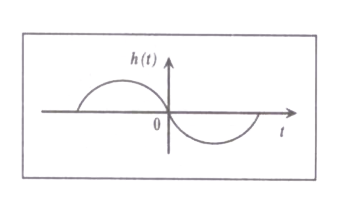
Consider a system whose input \(x\) and output \(y\) are related by the equation \[y(t) = \int_{-\infty}^{t} x(t-\tau)h(2\tau)d\tau ,\] where \(h(t)\) is shown in the graph. Which of the following four properties are possessed by the system ? BIBO: Bounded input gives a bounded output. Causal: The system is causal. LP: The system is low pass. LTI: The system is linear and time-invariant.

Question diagram

Open complete paper
5
2011 · Electronics & Communication Engineering · Networks, Signals and Systems · LTI systems
Electronics & Communication Engineering (EC) 2011
An input $x(t) = \exp(-2t)u(t) + \delta(t-6)$ is applied to an LTI system with impulse response $h(t) = u(t)$. The output is
Open complete paper
6
2012 · Electronics & Communication Engineering · Networks, Signals and Systems · LTI systems
Electronics & Communication Engineering (EC) 2012
The input \( x(t) \) and output \( y(t) \) of a system are related as \( y(t) = \int_{-\infty}^{t} x(\tau) \cos(3\tau) d\tau \). The system is
Open complete paper
7
2013 · Electronics & Communication Engineering · Networks, Signals and Systems · LTI systems
Electronics & Communication Engineering (EC) 2013 [Session 1]
Two systems with impulse responses \(h_1(t)\) and \(h_2(t)\) are connected in cascade. Then the overall impulse response of the cascaded system is given by
Open complete paper
8
2013 · Electronics & Communication Engineering · Networks, Signals and Systems · LTI systems
Electronics & Communication Engineering (EC) 2013 [Session 1]
The impulse response of a system is \( h(t) = t u(t) \). For an input \( u(t-1) \), the output is
Open complete paper
9
2013 · Electronics & Communication Engineering · Networks, Signals and Systems · LTI systems
Electronics & Communication Engineering (EC) 2013 [Session 1]

Which one of the following statements is NOT TRUE for a continuous time causal and stable LTI system?

Open complete paper
10
2013 · Electronics & Communication Engineering · Networks, Signals and Systems · LTI systems
Electronics & Communication Engineering (EC) 2013 [Session 1]
Assuming zero initial condition, the response \( y(t) \) of the system given below to a unit step input \( u(t) \) is

Question diagram

Open complete paper
11
2013 · Electronics & Communication Engineering · Networks, Signals and Systems · LTI systems
Electronics & Communication Engineering (EC) 2013 [Session 1]
Let \( g(t) = e^{-\pi t^2} \), and \( h(t) \) is a filter matched to \( g(t) \). If \( g(t) \) is applied as input to \( h(t) \), then the Fourier transform of the output is
Open complete paper
12
2013 · Electronics & Communication Engineering · Networks, Signals and Systems · LTI systems
Electronics & Communication Engineering (EC) 2013 [Session 1]
The impulse response of a continuous time system is given by \( h(t) = \delta(t-1) + \delta(t-3) \). The value of the step response at \( t = 2 \) is
Open complete paper
13
2013 · Electronics & Communication Engineering · Networks, Signals and Systems · LTI systems
Electronics & Communication Engineering (EC) 2013 [Session 1]
A system described by a linear, constant coefficient, ordinary, first order differential equation has an exact solution given by y(t) for t > 0, when the forcing function is x(t) and the initial condition is y(0). If one wishes to modify the system so that the solution becomes -2y(t) for t > 0, we need to
Open complete paper
14
2013 · Electronics & Communication Engineering · Networks, Signals and Systems · LTI systems
Electronics & Communication Engineering (EC) 2013 [Session 2]
The impulse response of a system is $h(t) = t u(t)$. For an input $u(t-1)$, the output is
Open complete paper
15
2013 · Electronics & Communication Engineering · Networks, Signals and Systems · LTI systems
Electronics & Communication Engineering (EC) 2013 [Session 2]
A system described by a linear, constant coefficient, ordinary, first order differential equation has an exact solution given by \(y(t)\) for \(t > 0\), when the forcing function is \(x(t)\) and the initial condition is \(y(0)\). If one wishes to modify the system so that the solution becomes \(-2y(t)\) for \(t > 0\), we need to
Open complete paper
16
2013 · Electronics & Communication Engineering · Networks, Signals and Systems · LTI systems
Electronics & Communication Engineering (EC) 2013 [Session 2]
The impulse response of a continuous time system is given by \(h(t) = \delta(t-1) + \delta(t-3)\). The value of the step response at \(t = 2\) is
Open complete paper
17
2013 · Electronics & Communication Engineering · Networks, Signals and Systems · LTI systems
Electronics & Communication Engineering (EC) 2013 [Session 3]
Two systems with impulse responses \( h_1(t) \) and \( h_2(t) \) are connected in cascade. Then the overall impulse response of the cascaded system is given by
Open complete paper
18
2013 · Electronics & Communication Engineering · Networks, Signals and Systems · LTI systems
Electronics & Communication Engineering (EC) 2013 [Session 3]
Assuming zero initial condition, the response \(y(t)\) of the system given below to a unit step input \(u(t)\) is

Question diagram

Open complete paper
19
2013 · Electronics & Communication Engineering · Networks, Signals and Systems · LTI systems
Electronics & Communication Engineering (EC) 2013 [Session 3]
The impulse response of a continuous time system is given by \(h(t)=\delta(t-1)+\delta(t-3)\). The value of the step response at \(t=2\) is
Open complete paper
20
2013 · Electronics & Communication Engineering · Networks, Signals and Systems · LTI systems
Electronics & Communication Engineering (EC) 2013 [Session 4]
The impulse response of a system is \(h(t) = t u(t)\). For an input \(u(t-1)\), the output is
Open complete paper

Showing 20 of 49 questions