My Cart
Your Cart 0

    Your cart is empty.

  • Total (Amount) ₹0.00
Previous year question hub

Op-amp Circuits - Analog Circuits - Electronics & Communication Engineering Previous Year Questions

Practice Op-amp Circuits - Analog Circuits - Electronics & Communication Engineering previous year questions organised from real papers, with year-wise coverage and clear topic navigation.

26Papers
18Years
77Questions
1Topics

Op-amp Circuits question pattern

Every graph below is calculated only from this selection.

Questions by year

Compare question counts across years.

Difficulty distribution

How the classified questions are distributed by difficulty.

Medium 66 85.7%
Easy 8 10.4%
Hard 3 3.9%

Question type distribution

MCQ, numerical, multiple-select and other formats found in these papers.

MCQ 54 70.1%
Numerical Answer Type (NAT) 19 24.7%
Fill in the blanks 2 2.6%
MSQ 2 2.6%

Subject weightage

Top subjects by unique question coverage.

Electronics & Communication Engineering
77 Qs

Most asked topics

Top topics across the included previous year papers.

Analog Circuits
77 Qs

Subtopic coverage

Top subtopics inside this exact selection.

Op-amp Circuits
77 Qs

Paper coverage

Question coverage for the most populated papers. Every active PYP paper remains listed below.

Electronics and Communication Engineering (EC) 2026
5 Qs
Electronics & Communication Engineering (EC) 2025
3 Qs
Electronics & Communication Engineering (EC) 2024
3 Qs
Electronics & Communication Engineering (EC) 2023
2 Qs
Electronics & Communication Engineering (EC) 2022
5 Qs
Electronics & Communication Engineering (EC) 2021
4 Qs
Electronics & Communication Engineering (EC) 2020
6 Qs
Electronics & Communication Engineering (EC) 2018
3 Qs
Electronics & Communication Engineering (EC) 2017 [Session 1]
3 Qs
Electronics & Communication Engineering (EC) 2017
1 Qs
Electronics & Communication Engineering (EC) 2016 [Session 1]
5 Qs
Electronics & Communication Engineering (EC) 2016 [Session 2]
2 Qs
Electronics & Communication Engineering (EC) 2016 [Session 3]
2 Qs
Electronics & Communication Engineering (EC) 2014 [Session 3]
2 Qs
Electronics & Communication Engineering (EC) 2014 [Session 4]
2 Qs
Electronics & Communication Engineering (EC) 2014 [Session 1]
1 Qs
Electronics & Communication Engineering (EC) 2013 [Session 2]
4 Qs
Electronics & Communication Engineering (EC) 2013 [Session 3]
3 Qs
Electronics & Communication Engineering (EC) 2013 [Session 1]
2 Qs
Electronics & Communication Engineering (EC) 2013 [Session 4]
2 Qs
Electronics & Communication Engineering (EC) 2012
1 Qs
Electronics & Communication Engineering (EC) 2011
2 Qs
Electronics & Communication Engineering (EC) 2010
3 Qs
Electronics & Communication Engineering (EC) 2009
2 Qs
Electronics & Communication Engineering (EC) 2008
5 Qs
Electronics & Communication Engineering (EC) 2007
4 Qs

Included previous year papers

Newest papers appear first. Search these papers or sort by year and name.

Paper nameYearPDFAttempt
Electronics and Communication Engineering (EC) 20262026
5 questions in this view
2026
Electronics & Communication Engineering (EC) 20252025
3 questions in this view
2025
Electronics & Communication Engineering (EC) 20242024
3 questions in this view
2024
Electronics & Communication Engineering (EC) 20232023
2 questions in this view
2023
Electronics & Communication Engineering (EC) 20222022
5 questions in this view
2022
Electronics & Communication Engineering (EC) 20212021
4 questions in this view
2021
Electronics & Communication Engineering (EC) 20202020
6 questions in this view
2020
Electronics & Communication Engineering (EC) 20182018
3 questions in this view
2018
Electronics & Communication Engineering (EC) 20172017
1 questions in this view
2017
Electronics & Communication Engineering (EC) 2017 [Session 1]2017
3 questions in this view
2017
Electronics & Communication Engineering (EC) 2016 [Session 1]2016
5 questions in this view
2016
Electronics & Communication Engineering (EC) 2016 [Session 2]2016
2 questions in this view
2016
Electronics & Communication Engineering (EC) 2016 [Session 3]2016
2 questions in this view
2016
Electronics & Communication Engineering (EC) 2014 [Session 1]2014
1 questions in this view
2014
Electronics & Communication Engineering (EC) 2014 [Session 3]2014
2 questions in this view
2014
Electronics & Communication Engineering (EC) 2014 [Session 4]2014
2 questions in this view
2014
Electronics & Communication Engineering (EC) 2013 [Session 1]2013
2 questions in this view
2013
Electronics & Communication Engineering (EC) 2013 [Session 2]2013
4 questions in this view
2013
Electronics & Communication Engineering (EC) 2013 [Session 3]2013
3 questions in this view
2013
Electronics & Communication Engineering (EC) 2013 [Session 4]2013
2 questions in this view
2013
Electronics & Communication Engineering (EC) 20122012
1 questions in this view
2012
Electronics & Communication Engineering (EC) 20112011
2 questions in this view
2011
Electronics & Communication Engineering (EC) 20102010
3 questions in this view
2010
Electronics & Communication Engineering (EC) 20092009
2 questions in this view
2009
Electronics & Communication Engineering (EC) 20082008
5 questions in this view
2008
Electronics & Communication Engineering (EC) 20072007
4 questions in this view
2007

All Op-amp Circuits previous year questions

Practice every matching question in batches of 20, with every available option.

1
2007 · Electronics & Communication Engineering · Analog Circuits · Op-amp Circuits
Electronics & Communication Engineering (EC) 2007
For the Op-Amp circuit shown in the figure, V₀ is

Question diagram

Open complete paper
2
2007 · Electronics & Communication Engineering · Analog Circuits · Op-amp Circuits
Electronics & Communication Engineering (EC) 2007
In the Op-Amp circuit shown, assume that the diode current follows the equation \(I = I_s \exp(V / V_T)\). For \(V_i = 2\text{ V}, V_a = V_{a1}\), and for \(V_i = 4\text{ V}, V_a = V_{a2}\). The relationship between \(V_{a1}\) and \(V_{a2}\) is
Open complete paper
3
2007 · Electronics & Communication Engineering · Analog Circuits · Op-amp Circuits
Electronics & Communication Engineering (EC) 2007
The transfer function Vo(s)/Vi(s) is

Question diagram

Open complete paper
4
2007 · Electronics & Communication Engineering · Analog Circuits · Op-amp Circuits
Electronics & Communication Engineering (EC) 2007
The voltage V_o is
Open complete paper
5
2008 · Electronics & Communication Engineering · Analog Circuits · Op-amp Circuits
Electronics & Communication Engineering (EC) 2008
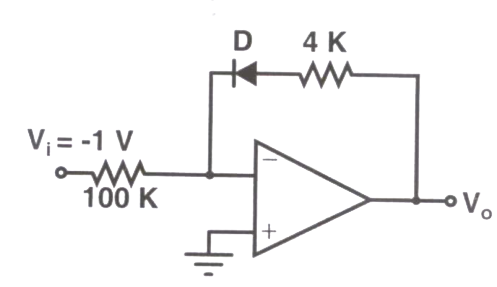
Consider the following circuit using an ideal OPAMP. The I-V characteristics of the diode is described by the relation $I = I_0 \left( e^{\frac{V}{V_T}} - 1 \right)$ where $V_T = 25$ mV, $I_0 = 1$ μA and $V$ is the voltage across the diode (taken as positive for forward bias). For an input voltage $V_I = -1$ V, the output voltage $V_o$ is

Question diagram

Open complete paper
6
2008 · Electronics & Communication Engineering · Analog Circuits · Op-amp Circuits
Electronics & Communication Engineering (EC) 2008

The OPAMP circuit shown above represents a

Question diagram

Open complete paper
7
2008 · Electronics & Communication Engineering · Analog Circuits · Op-amp Circuits
Electronics & Communication Engineering (EC) 2008
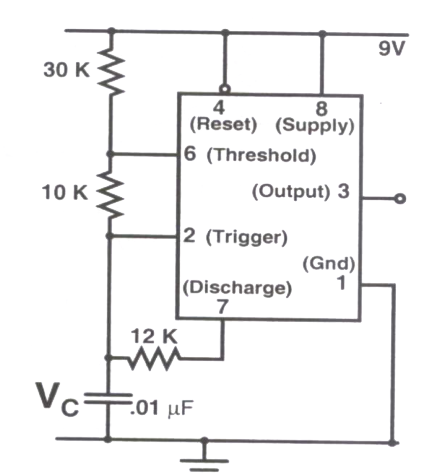
An astable multivibrator circuit using IC 555 timer is shown below. Assume that the circuit is oscillating steadily. The voltage $V_C$ across the capacitor varies between

Question diagram

Open complete paper
8
2008 · Electronics & Communication Engineering · Analog Circuits · Op-amp Circuits
Electronics & Communication Engineering (EC) 2008
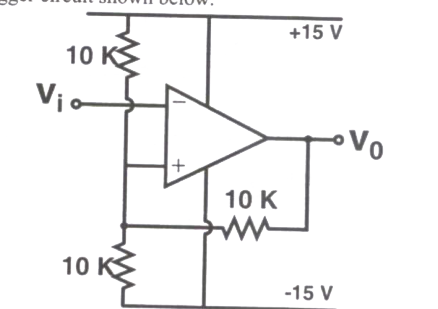
Consider the Schmidt trigger circuit shown below. A triangular wave which goes from -12 V to 12 V is applied to the inverting input of the OPAMP. Assume that the output of the OPAMP swings from +15 V to -15 V. The voltage at the non-inverting input switches between

Question diagram

Open complete paper
9
2008 · Electronics & Communication Engineering · Analog Circuits · Op-amp Circuits
Electronics & Communication Engineering (EC) 2008
The magnitude of the error between V_DAC and V_in at steady state in volts is
Open complete paper
10
2009 · Electronics & Communication Engineering · Analog Circuits · Op-amp Circuits
Electronics & Communication Engineering (EC) 2009
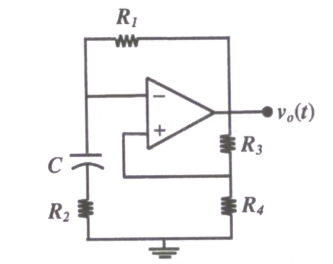
In the following astable multivibrator circuit, which properties of \(v_o(t)\) depend on \(R_2\) ?

Question diagram

Open complete paper
11
2009 · Electronics & Communication Engineering · Analog Circuits · Op-amp Circuits
Electronics & Communication Engineering (EC) 2009
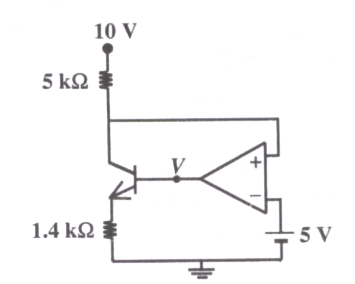
In the circuit shown below, the op-amp is ideal, the transistor has \(V_{BE} = 0.6\) V and \(\beta = 150\). Decide whether the feedback in the circuit is positive or negative and determine the voltage \(V\) at the output of the op-amp.

Question diagram

Open complete paper
12
2010 · Electronics & Communication Engineering · Analog Circuits · Op-amp Circuits
Electronics & Communication Engineering (EC) 2010

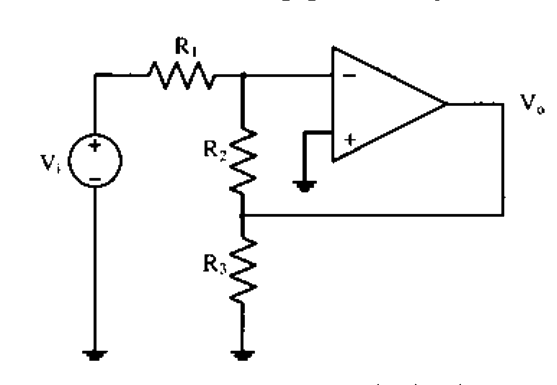
Assuming the OP-AMP to be ideal, the voltage gain of the amplifier shown below is

Question diagram

Open complete paper
13
2010 · Electronics & Communication Engineering · Analog Circuits · Op-amp Circuits
Electronics & Communication Engineering (EC) 2010

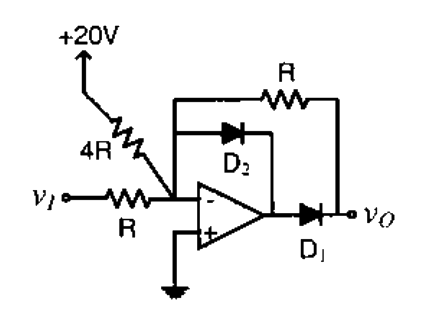
The transfer characteristic for the precision rectifier circuit shown below is (assume ideal OP-AMP and practical diodes)

Question diagram

Open complete paper
14
2010 · Electronics & Communication Engineering · Analog Circuits · Op-amp Circuits
Electronics & Communication Engineering (EC) 2010
The resistance seen by the source vs is
Open complete paper
15
2011 · Electronics & Communication Engineering · Analog Circuits · Op-amp Circuits
Electronics & Communication Engineering (EC) 2011

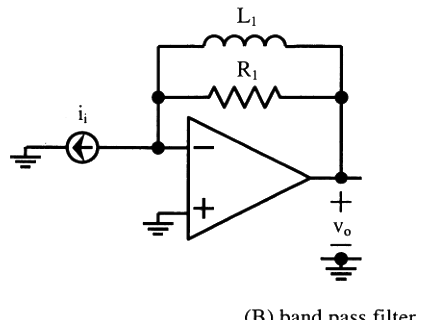
The circuit below implements a filter between the input current \(i_i\) and the output voltage \(v_o\). Assume that the opamp is ideal. The filter implemented is a

Question diagram

Open complete paper
16
2011 · Electronics & Communication Engineering · Analog Circuits · Op-amp Circuits
Electronics & Communication Engineering (EC) 2011
The circuit shown below is driven by a sinusoidal input \(v_i = V_p \cos(t/RC)\). The steady state output \(v_o\) is
Open complete paper
17
2012 · Electronics & Communication Engineering · Analog Circuits · Op-amp Circuits
Electronics & Communication Engineering (EC) 2012

The circuit shown is a

Question diagram

Open complete paper
18
2013 · Electronics & Communication Engineering · Analog Circuits · Op-amp Circuits
Electronics & Communication Engineering (EC) 2013 [Session 1]
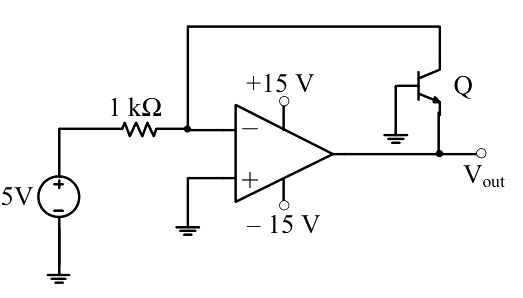
In the circuit shown below what is the output voltage (\( V_{out} \)) if a silicon transistor Q and an ideal op-amp are used?

Question diagram

Open complete paper
19
2013 · Electronics & Communication Engineering · Analog Circuits · Op-amp Circuits
Electronics & Communication Engineering (EC) 2013 [Session 1]
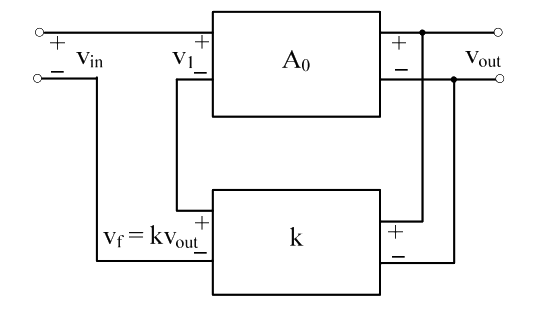
In a voltage-voltage feedback as shown below, which one of the following statements is TRUE if the gain \( k \) is increased?

Question diagram

Open complete paper
20
2013 · Electronics & Communication Engineering · Analog Circuits · Op-amp Circuits
Electronics & Communication Engineering (EC) 2013 [Session 2]
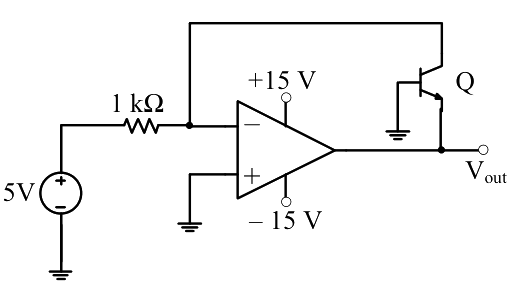
In the circuit shown below what is the output voltage ($V_{out}$) if a silicon transistor Q and an ideal op-amp are used?

Question diagram

Open complete paper

Showing 20 of 75 questions