Difficulty distribution
How the classified questions are distributed by difficulty.
44questions
Not classified
44
100%
Your cart is empty.
Practice Ray Optics - Optics - Physics previous year questions organised from real papers, with year-wise coverage and clear topic navigation.
Every graph below is calculated only from this selection.
Year-wise coverage for Ray Optics. Each bar uses a separate theme-derived color.
How the classified questions are distributed by difficulty.
MCQ, numerical, multiple-select and other formats found in these papers.
Top subjects by unique question coverage.
Top topics across the included previous year papers.
Top subtopics inside this exact selection.
Question coverage for the most populated papers. Every active PYP paper remains listed below.
Newest papers appear first. Sort by year, question coverage or name.
| Paper | Year / session | Questions in this view | Open |
|---|---|---|---|
| COMEDK 2026 Afternoon Shift | 2026 | 4 | View paper |
| COMEDK 2026 Morning Shift | 2026 | 4 | View paper |
| COMEDK 2025 AFTERNOON SHIFT | 2025 | 5 | View paper |
| COMEDK 2025 EVENING SHIFT | 2025 | 4 | View paper |
| COMEDK 2025 Morning Shift | 2025 | 2 | View paper |
| COMEDK 2024 AFTERNOON SHIFT | 2024 | 4 | View paper |
| COMEDK 2024 EVENING SHIFT | 2024 | 4 | View paper |
| COMEDK 2024 MORNING SHIFT | 2024 | 4 | View paper |
| COMEDK 2023 EVENING SHIFT | 2023 | 5 | View paper |
| COMEDK 2023 Morning Shift | 2023 | 2 | View paper |
| COMEDK 2022 | 2022 | 2 | View paper |
| COMEDK 2021 | 2021 | 2 | View paper |
| COMEDK 2020 | 2020 | 2 | View paper |
Practice every matching question in batches of 20, with every available option.
A convex lens is made of 3 layers of glass of 3 different materials as in the figure.

A point object is placed on its axis. The number of images of the object are
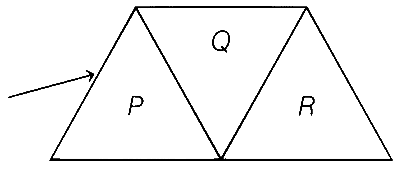
A ray of light suffers minimum deviation in equilateral prism P. Additional prisms Q and R of identical shape and of same material as that of P are now combined as shown in figure. The ray will now suffer
The magnifying power of a telescope is 9. When it is adjusted for parallel rays, the distance between the objective and eyepiece is 20 cm. The focal length of lenses are
Two converging lenses of focal length 20 cm and 40 cm are placed in contact. The effective power of the combination is
A plane glass mirror of thickness 3 cm of material of \(\mu=\frac{3}{2}\) is silvered on the black surface. When a point object is placed 9 cm from the front surface of the mirror, then the position of the brightest image from the front surface is
A point object is placed on the optic axis of a convex lens of focal length \(f\) at a distance of \(2f\) to the left of it. The diameter of the lens is \(d\). An eye is placed at a distance of \(3f\) to the right of the lens and a distance \(h\) below the optic axis. The maximum value of \(h\) to see the image is
A person has a normal near point \(25 \mathrm{~cm}\). What is the magnifying power of the simple microscope he used, if the focal length of the convex lens used is \(10 \mathrm{~cm}\) and the final image is formed at the least distance of distinct vision?
The critical angle of a medium having the refractive index \(\sqrt2\) is :
When angle of incidence on one face of the equilateral glass prism is \(3 / 4^{\text {th }}\) of the angle of prism, the ray of light undergoes minimum deviation. If the velocity of light in vacuum is '\(c\)' then the velocity of light in the glass is :
A lens of power \(+1 \mathrm{D}\) is made in contact with another lens of power \(-2 \mathrm{D}\) the combination will then act as a:
What will be change in wave length, if a light of wave length \(600 \mathrm{~nm}\) travels from air enters a medium of refractive index 1.5 and continues its journey through that medium?
To a fish under water, viewing obliquely, a fisherman standing on the bank of a lake looks
An object is placed at a distance of \(12 \mathrm{~cm}\) from a convex lens on its principal axis and a virtual image of certain size is formed. If the object is moved \(4 \mathrm{~cm}\) away from the lens, a real image of the same size as that of the virtual image is formed. The focal length of the lens in \(\mathrm{cm}\) is
In a container of height \(21 \mathrm{~cm}\), certain transparent liquid is taken to a height of \(12 \mathrm{~cm}\). When seen from above, it appears half filled. The refractive index of the liquid is
Light enters at an angle of incidence in a transparent rod of refractive index '\(n\)'. The least value of '\(n\)' for which the light once entered into it will not leave it through its lateral face whatsoever be the value of the angle of incidence is
Figure below shows a lens of refractive index, \(\mu=1.4\). \(C_1\) and \(C_2\) are the centres of curvature of the two faces of the lens of radii of curvature \(4 \mathrm{~cm}\) and \(8 \mathrm{~cm}\) respectively.
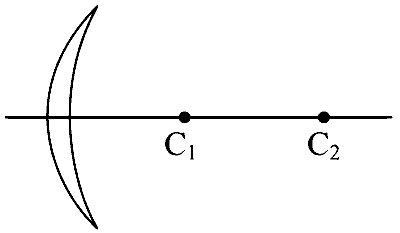
The lens behaves as a
A telescope has an objective of focal length \(60 \mathrm{~cm}\) and eyepiece of focal length \(5 \mathrm{~cm}\). The telescope is focussed for least distance of distinct vision \(300 \mathrm{~cm}\) away from the object. The magnification produced by the telescope at least distance of distinct vision is
A hollow prism is filled with water and placed in air. It will deviate the incident rays
When a biconvex lens of glass of refractive index 1.5 is dipped in a liquid, it acts like a plane sheet of paper. This means the refractive index of the liquid is
A ray of light travelling through a medium of refractive index \(\frac{5}{4}\) is incident on a glass of refractive index \(\frac{3}{2}\). Find the angle of refraction in the glass, if the angle of incidence at the given medium - glass interface is \(30^{\circ}\).
Showing 20 of 44 questions