Exam Details
COMEDK 2025 Morning Shift
Review the key details, then start the test when you are ready. You can also open the full package to see related papers.
Questions
180
Duration
60 mins
Package
COMEDK- Previous Year Papers
Paper pattern & analysis
Filter this paper by subject, topic or subtopic. Every graph updates from the selected questions.
Topic distribution
Subtopic distribution
Difficulty distribution
180questions
Not classified
180
100%
Question type distribution
180questions
MCQ
180
100%
Practise paper questions
Choose your answer to check it. Log in to view the explanation. For a timed attempt and result, start the exam.
PYP
COMEDK 2025 Morning Shift
Choose the pair of elements $[(\mathrm{A})$ to $(\mathrm{F})]$ which:
(i) belong to the Chalcogen family
(ii) form monovalent oxides which give alkalies in aqueous solution
(iii) form stable monovalent anions
(A) $1 s^2 2 s^2 2 p^6 3 s^2 3 p^6 4 s^1$
(B) $1 s^2 2 s^2 2 p^5$
(C) $1 s^2 2 s^2 2 p^6 3 s^1$
(D) $1 s^2 2 s^2 2 p^6 3 s^2 3 p^5$
(E) $1 s^2 2 s^2 2 p^6 3 s^2 3 p^4$
(F) $1 s^2 2 s^2 2 p^4$
PYP
COMEDK 2025 Morning Shift
A symmetric double convex lens is cut into two equal parts by a plane perpendicular to the principal axis. If the power of the original lens is 4D, the difference between the powers of the original lens and the cut lens is
PYP
COMEDK 2025 Morning Shift
Two light rays A and B travel from a medium into air at angles of incidence 15 degrees and 42 degrees respectively. In the medium, light travels 3 cm in 0.2 ns . Will there be total internal reflection? If so, which ray?
PYP
COMEDK 2025 Morning Shift
An electric field $E=3 x^2 i N C^{-1}$ exists in a certain region of space. The potential difference between the origin and at $x=4 m, V_0-V_4$ is
PYP
COMEDK 2025 Morning Shift
The nuclear forces
a. are central forces, independent of the spin of the nucleons.
b. have a short-range dominant over a distance of about a few fermi
c. are stronger being hundred times stronger than that of electromagnetic forces.
d. are independent of the nuclear charge.
Which of the above is not true?
PYP
COMEDK 2025 Morning Shift
A wooden block floats with $\frac{3}{5}$ of its volume submerged in a tank of water. If a denser liquid is poured into the tank, the wooden block floats with half its volume in the liquid and the remaining half in water. The relative density of the liquid is:
PYP
COMEDK 2025 Morning Shift
Three identical conducting balls $\mathrm{A}, \mathrm{B}$ and C , each of mass m , are thrown upward at an angle $\Theta$ to the horizontal with an initial speed $v$ in a region of space that has a uniform electric field $E$ downward along with the gravitational field $g . A$ is positively charged, B is uncharged and C is negatively charged. Rank the ranges R of these three balls in increasing order.
PYP
COMEDK 2025 Morning Shift
Two simple harmonic motions are represented by equations $y_1=0.5 \sin \left[200 \pi \mathrm{t}+\frac{\pi}{3}\right]$ and $y_1=0.5 \cos \pi \mathrm{t}$. The phase difference of the velocity of particle 1 with respect to the velocity of particle 2 is :
PYP
COMEDK 2025 Morning Shift
A sonometer string vibrates with a frequency of 400 Hz . When the length of the string is halved and the tension is altered, it begins to vibrate with a frequency of 200 Hz . The ratio of the new tension to the original tension in the string is:
PYP
COMEDK 2025 Morning Shift
A particle starts from rest and moves along the x -axis with a velocity that varies as $\mathrm{v}=\sqrt{100+4 x} \mathrm{~ms}^{-1}$. The acceleration of the particle is:
PYP
COMEDK 2025 Morning Shift
A vertical spring of spring constant $24 \mathrm{Nm}^{-1}$ is fixed on a table. A ball of mass 0.5 kg at a height 2 m above the free upper end of the spring falls vertically on the spring so that the spring is compressed by a distance of 50 cm . The net work done in the process is:
PYP
COMEDK 2025 Morning Shift
If E is the amplitude of the electric field of the waves starting from the slits in a double slit experiment and $\theta$ is the phase difference between the waves reaching a point on the screen, the ratio of the amplitude of the resultant electric field at that point on the screen to the amplitude at one of the slits is
PYP
COMEDK 2025 Morning Shift
In an experiment to measure the density of the material of a sphere, an error of $2 \%$ occurred while measuring the radius of a sphere and an error of $3 \%$ occurred while measuring the mass of the sphere. What is the maximum percentage error in the measurement of density?
PYP
COMEDK 2025 Morning Shift
A stone is dropped from a height $h$. It hits the ground with a certain momentum ' $p$ '. If the same stone is dropped from a different height h ' such that percentage change in momentum is $41.4 \%$, then the height from which the stone is dropped is $\mathrm{h}^{\prime}=x \mathrm{~h}$, where $x$ is:
PYP
COMEDK 2025 Morning Shift
If the binding energy per nucleon in $3 \mathrm{Li}^7$ and ${ }_2 \mathrm{He}^4$ nuclei are respectively 5.60 MeV and 7.06 MeV , then energy of $p$ in the reaction $p+{ }_3 \mathrm{Li}^7 \rightarrow 2{ }_2 \mathrm{He}^4$ is
PYP
COMEDK 2025 Morning Shift
Which of the following is not true for a perfect conductor?
PYP
COMEDK 2025 Morning Shift
Young's modulus of the material of wires X and Y are in the ratio 4:1 and the areas of cross sections of the wires X and Y are in the ratio $2: 1$. If the same amount of load is applied to both the wires, the ratio of elongation produced in the wires X and Y will be: (Assume length of the wires X and Y initially are the same)
PYP
COMEDK 2025 Morning Shift
A long solenoid has 400 turns. When a current of 100 A is passed through it, the resulting magnetic flux linked with each turn of the solenoid is 4 mWb . The self-inductance of the solenoid is
PYP
COMEDK 2025 Morning Shift
A particle moves towards west with a velocity of $10 \mathrm{~ms}^{-1}$. After 10s its direction changes towards south and it moves with the same velocity. The average acceleration of the particle is:
PYP
COMEDK 2025 Morning Shift
A bomb of mass 20 kg at rest explodes into two pieces of masses 12 kg and 8 kg . If the velocity of 8 kg mass is $6 \mathrm{~ms}^{-1}$, then the kinetic energy of the other mass is:
PYP
COMEDK 2025 Morning Shift
A block of metal A is connected in series with another block of metal B such that the two metal blocks have the same area of cross sections. The thermal conductivity of metal A is K and the free end of metal A is at $80^{\circ} \mathrm{C}$. The temperature of the interface is $60^{\circ} \mathrm{C}$ and the free end of metal B is at $20^{\circ} \mathrm{C}$. Assuming the two metals have the same thickness, the conductivity of metal B is:
PYP
COMEDK 2025 Morning Shift
From a circular disc of radius 2 R , a smaller circular disc is cut with radius of the larger disc as its diameter. The centre of the hole is at a distance of $R$ from the centre of the original disc. The distance of the centre of mass of the remaining portion from the centre is:
PYP
COMEDK 2025 Morning Shift
A force of $-\mathrm{F} \hat{\mathbf{i}}$ acts at the origin of the coordinate system. The torque about the point $(0,1,-1)$ is:
PYP
COMEDK 2025 Morning Shift
The ratio of specific heat capacities at constant pressure to that at constant volume for a given mass of a gas is $\frac{5}{2}$. If the percentage increase in volume of the gas while undergoing an adiabatic change is $\frac{3}{2}$, then the percentage decrease in pressure will be:
PYP
COMEDK 2025 Morning Shift
A cylindrical tank 0.5 m in radius, rests on a platform 1.5 m high. Initially the tank is filled with water to a height of 2.5 m . A small plug whose area is $10^{-4} \mathrm{~m}^2$ is removed from an orifice located on the side of the tank at the bottom. The speed with which the water strikes the ground is: [Assume $g=10 \mathrm{~ms}^{-2}$ ]
PYP
COMEDK 2025 Morning Shift
The mean energy per molecule for a diatomic gas is:
PYP
COMEDK 2025 Morning Shift
One surface of a lens is convex and the other is concave. If the radii of curvatures are $R$ and $r$ respectively, the lens will be convex if
PYP
COMEDK 2025 Morning Shift
The radius of earth is $R$ and acceleration due to gravity on its surface is $g$. The height at which the acceleration due to gravity becomes $\frac{g}{8}$ is:
PYP
COMEDK 2025 Morning Shift
Two coherent waves of intensities $I_1$ and $I_2$ pass through a region at the same time in the same direction. The sum of maximum to minimum intensities is
PYP
COMEDK 2025 Morning Shift
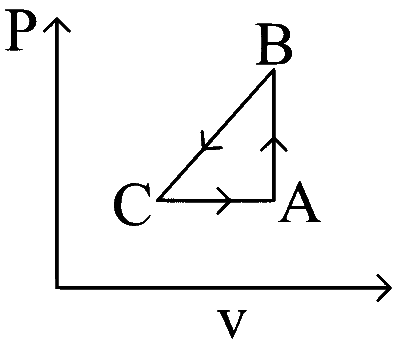
A sample of an ideal gas is taken through the cyclic process ABCA as shown in figure below. It absorbs 60 J of heat during the part AB and rejects 80 J of heat during CA . There is no heat exchanged during the process $\mathrm{BC} . \mathrm{A}$ work of 40 J is done on the gas during the part BC . If the internal energy of the gas at A is 1450 J , then the work done by the gas during the part CA is:
PYP
COMEDK 2025 Morning Shift
In a single slit Fraunhofer diffraction pattern obtained at normal incidence, at the angular position of the second diffraction minimum the phase difference (in radian) between the waves from the opposite edges of the slit is
PYP
COMEDK 2025 Morning Shift
A planet is 121 times heavier than moon and has a diameter 9 times that of moon. If the escape velocity on the planet is $v$, then the escape velocity on the moon will be:
PYP
COMEDK 2025 Morning Shift
A galvanometer of resistance $50 \Omega$ is connected to a battery of 4 V along with a resistance of $3950 \Omega$ in series. A full-scale deflection of 30 divisions is obtained in the galvanometer. In order to reduce this deflection to 10 divisions, the resistance in series should be equal to:
PYP
COMEDK 2025 Morning Shift
A convex lens forms a real image of an object with magnification $m_1$. The lens is moved towards the object to obtain another real image of magnification $m_2$. The image distance is increased by $x$. The focal length of the lens is
PYP
COMEDK 2025 Morning Shift
Two identical conducting balls having positive charges $q_1$ and $q_2$ are separated by a distance $r$. If they are made to touch each other and then separated to the same distance, the force between them will be
PYP
COMEDK 2025 Morning Shift
A student measures the terminal potential difference $V$ of a cell (emf $\varepsilon$ and internal resistance $r$ ) as a function of current I flowing through it, and draws V versus I graph. The slope and intercept of the graph respectively are
PYP
COMEDK 2025 Morning Shift
Point charges $-3 Q,-q, 2 q$ and $2 Q$ are placed, one at each corner of a square. The relation between Q and q for which the potential at the centre of the square is zero is
PYP
COMEDK 2025 Morning Shift
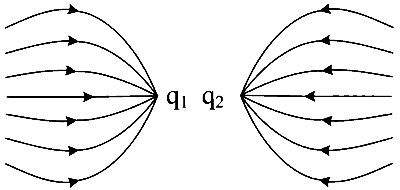
For the charge configuration shown here, which of the following is not true?
PYP
COMEDK 2025 Morning Shift
If voltage across a bulb rated $220 \mathrm{~V}, 50 \mathrm{~W}$ drops by $5 \%$ of its rated value, the percentage of the rated value by which the power would decrease is
PYP
COMEDK 2025 Morning Shift
Two identical conductors of lengths 1 and 31 respectively are maintained at the same temperature. They are given potential differences in the ratio $1: 3$. The ratio of their drift velocities is
PYP
COMEDK 2025 Morning Shift
Two very long, straight, parallel wires carry steady currents I and 21 respectively. The distance between the wires is d . At a certain instant of time, a point charge $q$ is at a point equidistant from the two wires, in the plane of the wires. Its instantaneous velocity is v perpendicular to this plane. The magnitude of the force due to the magnetic field acting on the charge at this instant is
PYP
COMEDK 2025 Morning Shift
A current loop consists of two identical semicircular parts each of radius $2 R$, one lying in the $x-y$ plane and the other in $x-z$ plane. If the current in the loop is I, the resultant magnetic field due to two semicircular parts at their common centre is
PYP
COMEDK 2025 Morning Shift
The resistance of a wire is 5 ohm at $25^{\circ} \mathrm{C}$ and 7 ohm at $100^{\circ} \mathrm{C}$. The resistance of the wire at $0^{\circ} \mathrm{C}$ is
PYP
COMEDK 2025 Morning Shift
Two capacitors $\mathrm{C}_1$ and $\mathrm{C}_2$ are charged to 100 V and 120 V respectively. It is found that upon connecting them together in parallel, the potential on each one of them is zero. Therefore
PYP
COMEDK 2025 Morning Shift
A bar magnet is oscillating in the earth's magnetic field with a period $T$. When the length of the bar magnet is doubled and its mass is quadrupled, the time period is $T_1$. The ratio of $T_1$ to $T$ is
PYP
COMEDK 2025 Morning Shift
A charged particle is released from rest in a region of space in which steady and uniform electric and magnetic fields are parallel to each other. The particle will move in a
PYP
COMEDK 2025 Morning Shift
The magnetic flux $\phi$ through a stationary loop of wire having a resistance R varies with time as $\phi=4 t^2+3 t$. The average emf and total charge flowing in the loop in the time interval $t=0$ to $t=\tau$ respectively are
PYP
COMEDK 2025 Morning Shift
If $R$ and $L$ denote resistance and inductance of a material, then the dimension of $L R$ will be:
PYP
COMEDK 2025 Morning Shift
Which of the following is not a characteristic of diamagnetism?
PYP
COMEDK 2025 Morning Shift
An ideal inductor is connected across a capacitor. Oscillations of energy $K$ are set up in the circuit. The capacitor plates are slowly drawn apart such that the frequency of oscillations is quadrupled. The work done in the process is
PYP
COMEDK 2025 Morning Shift
An LCR series ac circuit is at resonance with 10 V each across $\mathrm{L}, \mathrm{C}$ and R . If the resistance is halved, the respective voltage across $R, C$ and $L$ are
PYP
COMEDK 2025 Morning Shift
A bulb of resistance 280 Ohm is supplied with a voltage $\mathrm{V}=400 \sin \pi \mathrm{t}$. The peak current is
PYP
COMEDK 2025 Morning Shift
A Si and a Ge diode has identical physical dimensions. The band gap in Si is larger than that in Ge. On applying identical reverse bias across these diodes,
PYP
COMEDK 2025 Morning Shift
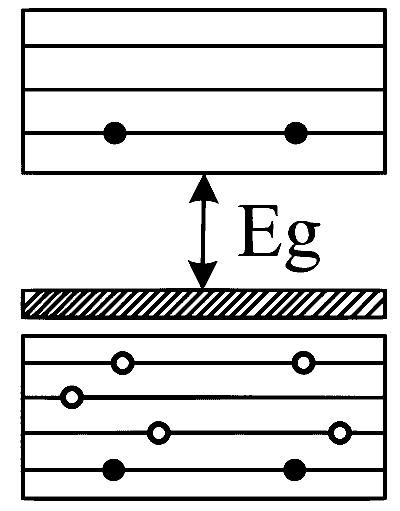
In the energy band diagram of a material shown below, open circles and filled circles denote holes and electrons respectively. The material is a
PYP
COMEDK 2025 Morning Shift
The electric and magnetic fields associated with an electromagnetic wave propagating along +z axis, can be represented by
PYP
COMEDK 2025 Morning Shift
The electrical conductivity of a semiconductor increases when electromagnetic radiation of wavelength shorter than $1.24 \mu \mathrm{~m}$ is incident on it. The band gap (in eV ) for the semiconductor is
PYP
COMEDK 2025 Morning Shift
In a nuclear fusion reaction, two nuclei, $A$ and $B$ fuse to produce a nucleus $C$, releasing an amount of energy $\Delta \mathrm{E}$ in the process. If the mass defects of the three nuclei are $\Delta M_A, \Delta M_B$ and $\Delta M_C$ respectively, then which of the following relations is true? ( $c$ is the speed of light).
PYP
COMEDK 2025 Morning Shift
Which, of the following is true of the Balmer series of the hydrogen spectrum?
a. The series is in the visible region.
b. The entire series falls in the ultraviolet region
c. The entire series falls in the infrared region
d. The series is partly in the visible region and partly in the infrared region
PYP
COMEDK 2025 Morning Shift
If X is a haloalkane with a single Chlorine atom per molecule and the percentage of Cl is 55 , what would be the number of Cl atoms present in 0.1 g of the haloalkane?
Atomic mass of $\mathrm{Cl}=35.5 \mathrm{~g} / \mathrm{mol}$
PYP
COMEDK 2025 Morning Shift
Emission of electrons from a metal plate illuminated with monochromatic electromagnetic radiation will always take place provided
PYP
COMEDK 2025 Morning Shift
According to Bohr's theory of hydrogen atom, the speed of the electron, its energy and radius of its orbit vary with the principal quantum number $n$, respectively as
PYP
COMEDK 2025 Morning Shift
A particle of mass $M$ at rest decays into masses $m_1$ and $m_2$ with non-zero velocities. The ratio of de Broglie wavelengths $\lambda_1$ and $\lambda_2$ of the particles is
PYP
COMEDK 2025 Morning Shift
For a reaction $\mathrm{X}_2(\mathrm{l})+\mathrm{Y}_2(\mathrm{~g}) \leftrightharpoons 2 \mathrm{XY}(\mathrm{g})$, the $\Delta \mathrm{H}^0$ and $\Delta \mathrm{S}^0$ are $+29.3 \mathrm{~kJ} / \mathrm{mol}$ and $104.1 \mathrm{~J} \mathrm{~K}^{-1} \mathrm{~mol}^{-1}$ respectively at 298 K . Find the free energy change in $\mathrm{kJ} / \mathrm{mol}$.
PYP
COMEDK 2025 Morning Shift
A certain orbital having 2 angular nodes and no radial nodes is:
PYP
COMEDK 2025 Morning Shift
0.4 g of Propane burns completely at 300 K in a bomb calorimeter. The temperature of the calorimeter and surrounding water rises by $0.4^0 \mathrm{C}$. If the heat capacity of the calorimeter and contents is $24 \mathrm{~kJ} \mathrm{~K}^{-1}$ what is the Enthalpy for the reaction?
(Assume that propane gas shows ideal behaviour).
PYP
COMEDK 2025 Morning Shift
A certain gas absorbs photon of wavelength $4.0 \times 10^{-7} \mathrm{~m}$ and emits radiation at two wavelengths. If one of the emissions occurs at $7.5 \times 10^{-7} \mathrm{~m}$, what is the wavelength at which the second emission occurs?
PYP
COMEDK 2025 Morning Shift
What volume of $0.2 \mathrm{M} \mathrm{CH}_3 \mathrm{COOH}$ needs to be added to 100 ml of $0.4 \mathrm{M} \mathrm{CH}_3 \mathrm{COONa}$ solution to prepare a buffer of pH equal to 4.91 ? ( $\mathrm{pK}_{\mathrm{a}}$ of $\mathrm{CH}_3 \mathrm{COOH}$ is 4.76 )
PYP
COMEDK 2025 Morning Shift
Given that the standard enthalpy of combustion of $\mathrm{C}_{(\mathrm{S})}$ and $\mathrm{CS}_2(\mathrm{l})$ are -393.3 and $-1108.76 \mathrm{~kJ} / \mathrm{mol}$ respectively and the standard enthalpy of formation of $\mathrm{CS}_2$ is $128.02 \mathrm{~kJ} / \mathrm{mol}$. What is $\Delta H_f^0$ of $\mathrm{SO}_2$ ?
PYP
COMEDK 2025 Morning Shift
When $9.2 \times 10^{-3} \mathrm{~kg}$ of formic acid is added to 600 ml of water the freezing point of water is depressed. If $30 \%$ of Formic acid undergoes dissociation what would be the freezing point of the solution? ( $\mathrm{K}_{\mathrm{f}}$ of $\mathrm{H}_2 \mathrm{O}$ is 1.86 K kg mol ; MM of formic acid: 46 amu )
PYP
COMEDK 2025 Morning Shift
For a 1.0 molal solution containing the non-volatile solute Urea, the elevation in boiling point is 2.0 K while the depression in freezing point in a 3.0 molal solution having the same solvent is $4.0 K$. If the ratio $\frac{K_b}{K_f}=\frac{1}{X}$, what is the value of $X$ ?
PYP
COMEDK 2025 Morning Shift
A non-volatile solute A weighing 60 g when dissolved in 212 g of the solvent Xylene reduces its vapour pressure to $60 \%$. What is the Molar mass of A in $\mathrm{g} / \mathrm{mol}$ ? [MM of xylene $=106 \mathrm{~g} / \mathrm{mol}$ ]
PYP
COMEDK 2025 Morning Shift
The conductivity of 0.01 M solution of $\mathrm{CH}_3 \mathrm{COOH}$ at 298 K is $1.65 \times 10^{-4} \mathrm{Scm}^{-1}$ What is the $\mathrm{pK}_{\mathrm{a}}$ value of the acid if $\lambda^0\left(\mathrm{H}^{+}\right)$and $\lambda^0\left(\mathrm{CH}_3 \mathrm{COO}\right)^{-1}$ are $349.1 \mathrm{Scm}^2 \mathrm{~mol}^{-1}$ and $40.9 \mathrm{Scm}^2 \mathrm{~mol}^{-1}$ respectively?
PYP
COMEDK 2025 Morning Shift
Solubility product of the sparingly soluble salt $\mathrm{AgBrO}_3$ in aqueous medium is $9.3 \times 10^{-10}$ Calculate the mass in gram of $\mathrm{AgBrO}_3$ present in 100 ml of its saturated solution. (Molar mass of $\mathrm{AgBrO}_3$ is $236 \mathrm{~g} / \mathrm{mol}$ )
PYP
COMEDK 2025 Morning Shift
Two volatile liquids X and Y form an ideal solution at 298 K and have vapour pressures equal to 100 mm and 200 mm of Hg respectively in their pure state. The mole fraction of X in the solution is 0.4 and the mole fraction of Y in the vapour phase is $a / 20$. Calculate the value of a.
PYP
COMEDK 2025 Morning Shift
Choose the correct statement.
PYP
COMEDK 2025 Morning Shift
Which one of the following options represents the decreasing order of oxidation number of the central atom in:
$$\mathrm{Cr}_2 \mathrm{O}_7^{2-}, \mathrm{Cr} \mathrm{O}_2^{-}, \mathrm{MnO}_4^{-}, \mathrm{BrO}_3^{-}$$
PYP
COMEDK 2025 Morning Shift
What is the reduction potential of a half-cell consisting of a Pt electrode dipped in $2.2 \mathrm{M} \mathrm{Fe}^{2+}$ and $0.04 \mathrm{M} \mathrm{Fe}^{3+}$ solution where the reaction taking place is conversion of $\mathrm{Fe}^{3+}$ ions to $\mathrm{Fe}^{2+}$ ?
$$\mathrm{E}^0\left(\mathrm{Fe}^{3+} / \mathrm{Fe}^{2+}\right)=0.771 \mathrm{~V}$$
PYP
COMEDK 2025 Morning Shift
Choose the correct statement.
PYP
COMEDK 2025 Morning Shift
The concentration and percentage purity of Oxalic acid can be determined by titration with $\mathrm{KMnO}_4$ in presence of dil. $\mathrm{H}_2 \mathrm{SO}_4$. Instead of dil. $\mathrm{H}_2 \mathrm{SO}_4$, dil HCl cannot be used because
PYP
COMEDK 2025 Morning Shift
A current of 2.5 amperes is passed through 800 ml of 0.48 M solution of $\mathrm{CuSO}_4$ for 1.0 hour with a current efficiency of $80 \%$. If the volume of the solution remains unchanged, what is the final molarity of the solution?
PYP
COMEDK 2025 Morning Shift
The EMF of the cell $\mathrm{Al} / \mathrm{Al}^{3+}(0.01 \mathrm{M}) \| \mathrm{Fe}^{2+}(0.02 \mathrm{M}) / \mathrm{Fe}$ is 1.209 V . The EMF of the cell can be increased by
PYP
COMEDK 2025 Morning Shift
Two chemical reactions of the same order have equal Frequency factor value. Their Activation energies differ by $26.8 \mathrm{~kJ} / \mathrm{mol}$. At 300 K if $k_2=x k_1$ find the value of $x$.
PYP
COMEDK 2025 Morning Shift
For a given reaction of the type $\frac{3}{5} X(a q) \rightarrow \frac{1}{2} Y(a q)+Z(g)$, the correct expression for the rate of disappearance of $X$ with reference to $Y$ is ___________
PYP
COMEDK 2025 Morning Shift
Two statements, One Assertion (A) and the other Reason (R) are given. Choose the right option.
Assertion: The rate constant $(\mathrm{k})$ for a chemical reaction gets nearly doubled for a $10^0$ rise in temperature.
Reason: The number of bimolecular collisions between reactant molecules increase with increase in temperature
PYP
COMEDK 2025 Morning Shift
$\mathrm{X} \rightarrow 2 \mathrm{Y}$ is a first order reaction where $1.0 \mathrm{~mol} / \mathrm{L}$ of the reactant yields $0.4 \mathrm{~mol} / \mathrm{L}$ of Y in 200 minutes. Calculate the half-life period of the reaction in minutes.
PYP
COMEDK 2025 Morning Shift
From the given covalent compounds (A to F) identify the pair of molecules which have:
(i) Two lone pairs of electrons on the central atom.
(ii) One lone pair of electrons on the central atom.
A. $\mathrm{SO}_2$
B. $\mathrm{ClF}_3$
C. $\mathrm{BF}_3$
D. $\mathrm{BrF}_5$
E. XeF 4
F. $\mathrm{SF}_6$
PYP
COMEDK 2025 Morning Shift
The following results were obtained during study of the reaction $2 \mathrm{NO}(\mathrm{g})+\mathrm{Cl}_2(\mathrm{~g}) \rightarrow 2 \mathrm{NOCl}(\mathrm{g})$. Determine the value of $[\mathrm{X}]$ in $\mathrm{mol} / \mathrm{L}$
| Experiment | [NO] mol / L |
[Cl$_2$] mol / L |
Initial rate of formation. [NOCl] mol / L / min |
|---|---|---|---|
| I | 0.2 | 0.2 | $6.0 \times 10^{-3}$ |
| II | 0.2 | 0.4 | $2.4 \times 10^{-2}$ |
| III | 0.4 | 0.2 | $1.2 \times 10^{-2}$ |
| IV | X | 0.6 | $1.35 \times 10^{-1}$ |
PYP
COMEDK 2025 Morning Shift

What is the spin only magnetic moment of the metal ion in $\mathbf{P}$ and the oxidation number of Sulphur in the oxidised product Z ?
PYP
COMEDK 2025 Morning Shift
Identify the correct statement.
PYP
COMEDK 2025 Morning Shift
Choose the correct statement.
PYP
COMEDK 2025 Morning Shift
In which one of the following pairs does the stability of the monovalent ion increase with respect to the molecule, while the magnetic character remains the same for both?
PYP
COMEDK 2025 Morning Shift
Match the metals in Column II with their characteristic properties given in Column I.
| Properties | Metals | ||
|---|---|---|---|
| A. | Lanthanoid with low value of $3^{\text {rd }}$ ionisation enthalpy. | P | V |
| B. | f-Block element with electronic configuration $[R n] 6 d^2 7 s^2$ | Q | Gd |
| C. | 3 d -series metal whose $\mathrm{M}^{3+}{ }_{(\mathrm{aq})}$ is colourless. | R | Th |
| D. | 3d-series metal with highest $\Delta \mathrm{H}_{\text {(atomisation) }}$ | S | Sc |
PYP
COMEDK 2025 Morning Shift
An aqueous solution of $\mathrm{CrCl}_3 .6 \mathrm{H}_2 \mathrm{O}$ (Molar mass $=266.5 \mathrm{~g} / \mathrm{mol}$ ) containing 2.665 g of the solute after processing, when treated with excess of $\mathrm{AgNO}_3$ gave 2.87 g of AgCl (Molar mass of $\mathrm{AgCl}=143.5 \mathrm{~g} / \mathrm{mol}$ ) Choose the correct formula of the compound which give these results.
PYP
COMEDK 2025 Morning Shift
Match the coordination compounds in Column I having the given type of hybridisation of $\mathrm{M}^{\mathrm{n}+}$ ion and magnetic moment as given in Column II.
| Coordination compounds | Hybridisation & Magnetic nature | ||
|---|---|---|---|
| A. | $\mathrm{Ni}(\mathrm{CO})_4$ | P. | $\mathrm{sp}^3, \quad \mu=5.92 \mathrm{BM}$ |
| B. | $\left[\mathrm{Ni}(\mathrm{CN})_4\right]^{2-}$ | Q. | $\mathrm{sp}^3, \quad \mu=2.84 \mathrm{BM}$ |
| C. | $\left[\mathrm{Ni}(\mathrm{Cl})_4\right]^{2-}$ | R. | $\mathrm{sp}^3, \quad \mu=0$ |
| D. | $\left[\mathrm{MnBr}_4\right]^{2-}$ | S. | $\mathrm{dsp}^2, \quad \mu=0$ |
PYP
COMEDK 2025 Morning Shift
Arrange the following compounds in the decreasing order of the molar conductivities of their aqueous solutions.
| A | B | C | D |
|---|---|---|---|
| $\left[\mathrm{Co}\left(\mathrm{NH}_3\right)_5 \mathrm{Cl}\right] \mathrm{Cl}_2$ | $\left[\mathrm{Co}\left(\mathrm{NH}_3\right)_3 \mathrm{Cl}_3\right]$ | $\left[\mathrm{Co}\left(\mathrm{NH}_3\right)_4 \mathrm{Cl}_2\right] \mathrm{Cl}$ | $\left[\mathrm{Co}\left(\mathrm{NH}_3\right)_6\right] \mathrm{Cl}_3$ |
PYP
COMEDK 2025 Morning Shift
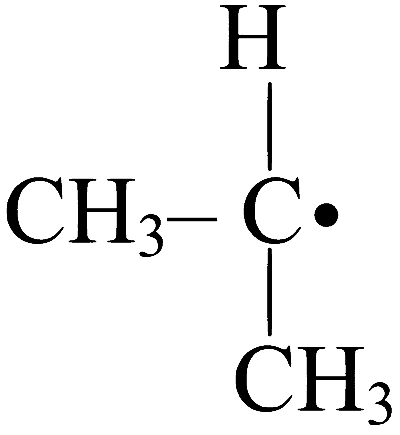
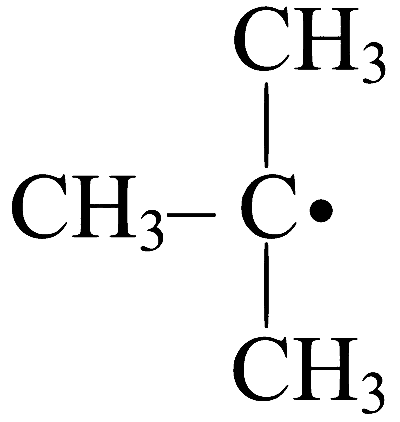
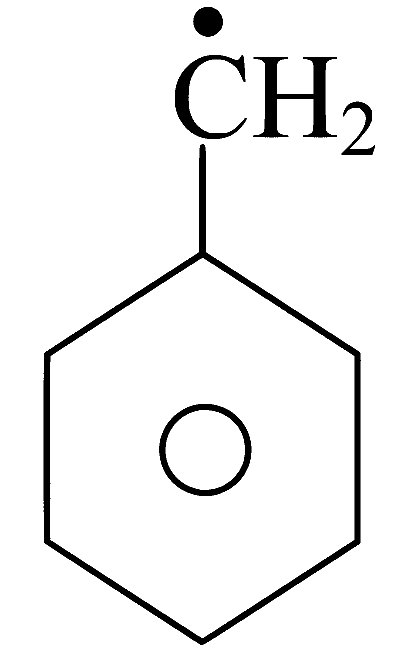
Arrange the following free radicals in the increasing order of their stability:
| A | B | C | D |
|---|---|---|---|
 |
 |
 |
 |
PYP
COMEDK 2025 Morning Shift
Which one of the following coordination compounds will exhibit both geometrical and optical isomerism?
PYP
COMEDK 2025 Morning Shift
Match the structures in Column I with their correct IUPAC names given in Column II.
| Column I | Column II | ||
|---|---|---|---|
| A. | 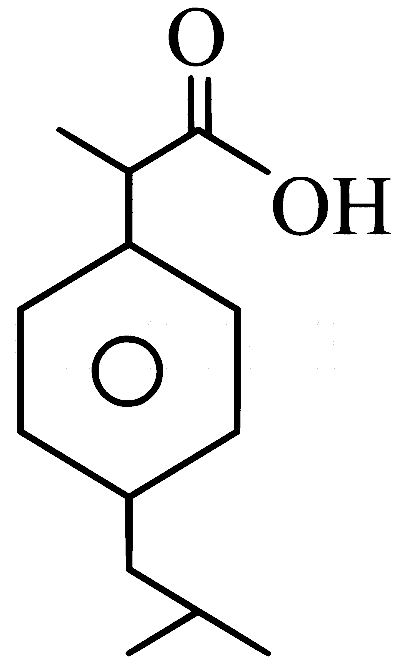 |
P. | 2,3-Dibromo-1-phenylpentane. |
| B. | 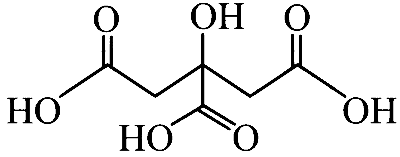 |
Q. | 2,3- Dibromohexanedial. |
| C. | 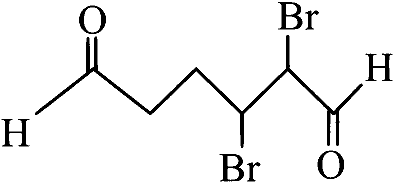 |
R. | 2- ( 4- isobutylphenyl) propanoic acid |
| D. | 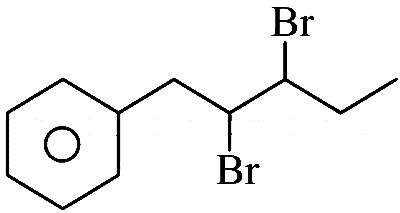 |
S. | 2- Hydroxy-1,2,3- propanetricarboxylic acid. |
PYP
COMEDK 2025 Morning Shift
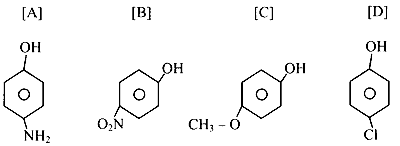
Arrange the following in the decreasing order of their $\mathrm{pK}_{\mathrm{a}}$ values.
PYP
COMEDK 2025 Morning Shift
Which one of the following statements is correct?.
PYP
COMEDK 2025 Morning Shift
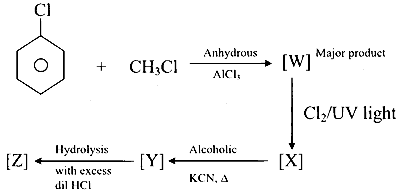
Identify the final product $[Z]$ formed when Chlorobenzene undergoes the given series of reactions:
PYP
COMEDK 2025 Morning Shift
Which one of the following is a true statement with reference to reaction between 2- Bromo-2-methylpropane and aqueous KOH ?
PYP
COMEDK 2025 Morning Shift
Which of the following haloalkanes will give more than one isomeric product, on being heated with alc. KOH ?
PYP
COMEDK 2025 Morning Shift
An unsaturated hydrocarbon $[\mathrm{A}]$ undergoes the following series of reactions. Identify $[\mathrm{A}]$.
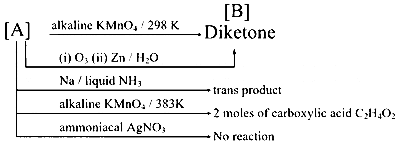
PYP
COMEDK 2025 Morning Shift
Both reactions (i) and (ii) give the same compound X as the major product. Identify X
(i). 3-Methylbut-1-ene $+\mathrm{HCl} \rightarrow \mathrm{X}$
(ii). Neopentyl alcohol $+\mathrm{HCl}\left(\right.$ anh. $\left.\mathrm{ZnCl}_2\right) \rightarrow \mathrm{X}$
PYP
COMEDK 2025 Morning Shift
Convert Benzene $\rightarrow 3$-Bromophenol by choosing appropriate reagents [(i) to (v)] in the correct sequence.
(i) $\mathrm{NaNO}_2 / \mathrm{HCl}\left(0^{\circ} \mathrm{C}\right)$
(ii) Conc. $\mathrm{HNO}_3 / \mathrm{H}_2 \mathrm{SO}_4$
(iii) $\mathrm{H}_2 \mathrm{O} / 283 \mathrm{~K}$
(iv) $\mathrm{Fe} / \mathrm{HCl}$
(v) $\mathrm{Br} 2 / \mathrm{Fe}$
PYP
COMEDK 2025 Morning Shift
Identify the compound which gives an optically active haloalkane on reaction with $\mathrm{H}_2$ / Ni on heating.
| A | B | C | D |
|---|---|---|---|
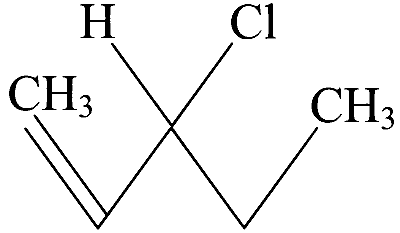 |
 |
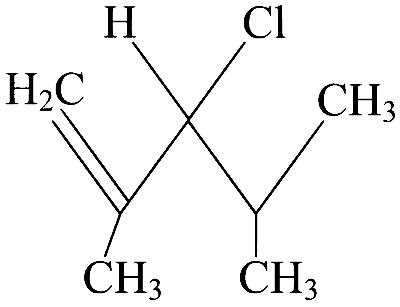 |
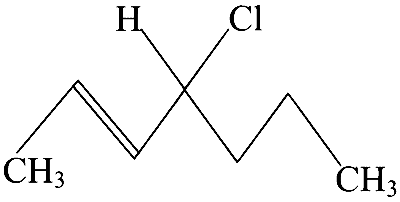 |
PYP
COMEDK 2025 Morning Shift
What is the final product $[\mathrm{Z}]$ formed when the given reactions take place?

PYP
COMEDK 2025 Morning Shift
Benzene diazonium chloride when warmed with water gives a compound, whose Sodium salt when reacted with Allyl bromide gives compound $[\mathrm{X}]$. Identify $[\mathrm{X}]$.
PYP
COMEDK 2025 Morning Shift
Two statements, one Assertion (A) and the other Reason (R) are given. Choose the correct option.
Assertion: Compound $[\mathrm{X}]$ reacts with Hydrazine in presence of $\mathrm{KOH} /$ Glycol to form the product $[\mathrm{Y}]$.
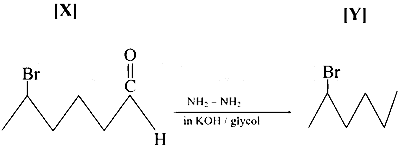
Reason: Reduction reaction occurs and Carbonyl group is reduced to Methylene group.
PYP
COMEDK 2025 Morning Shift
Cyclohexanol undergoes a series of reactions as given. Identify compound (iv).
$\mathrm{C}_6 \mathrm{H}_{11} \mathrm{OH}+\mathrm{CrO}_3 \rightarrow(\mathrm{i})+\mathrm{C}_6 \mathrm{H}_5 \mathrm{MgI} \rightarrow(\mathrm{ii})+$ dil. $\mathrm{HCl} \rightarrow(\mathrm{iii})+$ Conc. $\mathrm{H}_3 \mathrm{PO}_4 \rightarrow(\mathrm{iv})$
PYP
COMEDK 2025 Morning Shift
An organic compound $[\mathrm{X}]$ reacts with $\mathrm{H}_2 / \mathrm{Pd}-\mathrm{BaSO}_4$ to give compound $[\mathrm{Y}]$ which reduces Tollen's reagent and undergoes Cannizzaro's reaction. On rigorous oxidation of $[\mathrm{Y}]$ in presence of $\mathrm{KMnO}_4 / \mathrm{H}^{+}$Phthalic acid is the product obtained. What is $[\mathrm{X}]$ ?
PYP
COMEDK 2025 Morning Shift
An organic compound $[\mathrm{X}]$ (molecular formula- $\mathrm{C}_5 \mathrm{H}_{11} \mathrm{NO}$ when reacted with $\mathrm{Br}_2$ / aq. NaOH yielded $[\mathrm{Y}]$ which reacts with $\mathrm{CHCl}_3$ and Ethanolic KOH to produce a foul smelling compound.
Compound $[\mathrm{Y}]$ also reacts with HONO to produce Butan-1-ol with liberation of $\mathrm{N}_2(\mathrm{~g})$.
Identify [X].
PYP
COMEDK 2025 Morning Shift
Which one of the following reactions does not give the correct combination of reactants and the major products formed in the reaction?
PYP
COMEDK 2025 Morning Shift
Two statements, One Assertion [ A ] and the other Reason [ R ] are given. Identify the correct option
Assertion $[A]$ : The decreasing order of the acidic character of the following is $B>D>A>C$
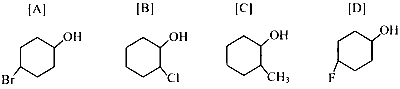
Reason $[\mathbf{R}]$ : Fluorine has larger -I effect than Cl and Br .
PYP
COMEDK 2025 Morning Shift
Two statements, one Assertion (A) and the other Reason (R) are given. Choose the correct option.
Assertion: 2-aminoethanoic acid and p-aminobenzene sulphonic acid can exist as Zwitter ions while p-aminobenzoic acid cannot.
Reason: When the acid group is a relatively strong proton donor and the $-\mathrm{NH}_2$ group is sufficiently basic it can accept a $\mathrm{H}^{+}$ion from the acid group to form the dipolar ion.
PYP
COMEDK 2025 Morning Shift
Identify $[\mathrm{X}]$, the final product formed when 2 moles of Ethanal undergoes the following series of reactions with reagents [(i) to (iv)]

PYP
COMEDK 2025 Morning Shift
Choose the incorrect statement.
PYP
COMEDK 2025 Morning Shift
Match the reactions of Glucose given in Column I with the major product formed in the reaction as in Column II.
| Column I - Reactions | Column II - Major product | ||
|---|---|---|---|
| A. | $\mathrm{C}_6 \mathrm{H}_{12} \mathrm{O}_6+\mathrm{HI}$ (Heat) | P. | $\mathrm{HOOC}-(\mathrm{CHOH})_4-\mathrm{COOH}$ |
| B. | $\mathrm{C}_6 \mathrm{H}_{12} \mathrm{O}_6+\mathrm{Br}_2(\mathrm{aq})$ | Q. | $\mathrm{CH}_3-\left(\mathrm{CH}_2\right)_4-\mathrm{CH}_3$ |
| C. | $\mathrm{C}_6 \mathrm{H}_{12} \mathrm{O}_6+$ Conc. $\mathrm{HNO}_3$ | R. | $\mathrm{NH}_4 \mathrm{O}-\mathrm{OC}-(\mathrm{CHOH})_4-\mathrm{CH}_2 \mathrm{OH}$ |
| D. | $\mathrm{C}_6 \mathrm{H}_{12} \mathrm{O}_6+2\left[\mathrm{Ag}\left(\mathrm{NH}_3\right)_2\right] \mathrm{OH}$ | S. | $\mathrm{HOOC}-(\mathrm{CHOH})_4-\mathrm{CH}_2 \mathrm{OH}$ |
PYP
COMEDK 2025 Morning Shift
Let R be a relation on natural numbers defined by $x+2 y=8, x, y \in N$. The domain of R is
PYP
COMEDK 2025 Morning Shift
Identify the correct statement
PYP
COMEDK 2025 Morning Shift
Two statements, one Assertion (A) and the other Reason (R) are given. Choose the correct option.
Assertion: Maltose, a disaccharide, is a reducing sugar and is obtained by the partial hydrolysis of starch in presence of the enzyme diastase.
Reason: Hydrolysis of one mole of Maltose gives one mole each of $\alpha-D-$ Glucose and $\beta-D-$ Fructose.
PYP
COMEDK 2025 Morning Shift
If $n(A)=3$ and $n(B)=7$ and $A \subseteq B$ then the number of elements in $A \cap B$ is equal to
PYP
COMEDK 2025 Morning Shift
The solution set of the system of inequalities $5-4 x \leq-7$ or $5-4 x \geq 7, x \in R$ is
PYP
COMEDK 2025 Morning Shift
$0.2+0.22+0.022+\ldots \ldots \ldots$. up to $n$ terms is equal to
PYP
COMEDK 2025 Morning Shift
A shopkeeper sells three varieties of fruit juice. He has a large number of bottles of same size of each variety. The number of different ways of displaying all the three varieties on the shelf with 5 places in a row and each display must have at least one bottle of each variety is
PYP
COMEDK 2025 Morning Shift
Codes used for vehicle identification consists of two distinct English alphabets followed by two distinct digits from 1 to 9 . How many of them end with an even number.
PYP
COMEDK 2025 Morning Shift
The digits of a three-digit number taken in an order are in geometric progression. If one is added to the middle digit, they form an arithmetic progression. If 594 is subtracted from the number, then a new number with the same digits in reverse order is formed. The original number is divisible by
PYP
COMEDK 2025 Morning Shift
If $\frac{x-1}{3+i}+\frac{y-1}{3-i}=i$ then $(y, x)=$
PYP
COMEDK 2025 Morning Shift
In an entrance test, there are multiple choice questions. There are four possible answers to each question of which only one is correct. The probability that a student knows the answer to a question is $90 \%$. If he gets the correct answer to a question, then the probability that he was guessing is
PYP
COMEDK 2025 Morning Shift
A person writes four letters and address four envelopes. If the letters are placed in the envelopes at random, then the probability that not all letters are placed in the right envelope is
PYP
COMEDK 2025 Morning Shift
If the third and fourth terms in the expansion $\left(2 x+\frac{1}{8}\right)^{10}$ are equal, then the value of $x$ is __________
PYP
COMEDK 2025 Morning Shift
Let $A$ and $B$ be two events such that one of the two events must occur. Given that the chance of occurrence of $A$ is $\frac{2}{3}$ the chance of occurrence of $B$, then odds in favour of $B$ is
PYP
COMEDK 2025 Morning Shift
Vasant and Jothi play a game with a coin. Vasant stakes ₹ 1 and throw the coins four times.
If he throws four heads, he gets his stake and ₹3 from Jothi.
If he throws only three heads and they are consecutive, he gets his stake and ₹2 from Jothi.
If he throws only two heads and they are consecutive, he gets his stake and ₹1 from Jothi.
In all other cases Jothi takes the stake money.
Find the expectation of Vasant's gain.
PYP
COMEDK 2025 Morning Shift
Three fair dice are thrown. What is the probability of getting a total of 15 given that they exhibit three different numbers that are in arithmetic progression?
PYP
COMEDK 2025 Morning Shift
A line $L_1$ passing through the point A with position vector $\vec{a}=4 \hat{i}+2 \hat{j}+2 \hat{k}$ is parallel to the vector $\vec{b}=2 \hat{i}+3 \hat{j}+6 \hat{k}$. The length of the perpendicular drawn from a point P with position vector $\vec{p}=\hat{i}+2 \hat{j}+3 \hat{k}$ to $L_1$ is
PYP
COMEDK 2025 Morning Shift
If $\vec{a}, \vec{b}, \vec{c}$ are three vectors such that $a \neq 0$ and $\vec{a} \times \vec{b}=2(\vec{a} \times \vec{c}),|\vec{a}|=|\vec{c}|=1,|\vec{b}|=4$ and $|\vec{b} \times \vec{c}|=\sqrt{15}$ if $\vec{b}-2 \vec{c}=\lambda \vec{a}$ then $\lambda^2$ equals :
PYP
COMEDK 2025 Morning Shift
The magnitude of the projection of the vector $-\hat{\imath}+2 \hat{\jmath}-\hat{k}$ on the z -axis is
PYP
COMEDK 2025 Morning Shift
P is a point on the line joining the points $(3,5,-1)$ and $(6,3,-2)$. If $y$ coordinate of point P is 2 , then $x$ coordinate will be
PYP
COMEDK 2025 Morning Shift
The sum of three numbers is 6 .
Twice the third number, when added to the first number gives 7 ,
On adding the sum of the second and third numbers to thrice the first number, we get 12 .
The above situation can be represented in matrix form as $A X=B$.
Then the $|\operatorname{adj} A|$ is equal to
PYP
COMEDK 2025 Morning Shift
Let $M$ be the set of all $2 \times 2$ matrices with entries from the set R of real numbers. Then the function $f: M \rightarrow R$ defined by $f(A)=|A|$ for every $A \in M$ is
PYP
COMEDK 2025 Morning Shift
The value of $\lambda$ for which the angle between lines $\vec{r}=\hat{\imath}+\hat{\jmath}+\hat{k}+p(2 \hat{\imath}+\hat{\jmath}+2 \hat{k})$ and $\vec{r}=(1+q) \hat{\imath}+(1+q \lambda) \hat{\jmath}+(1+q) \hat{k}$ is $\frac{\pi}{2}$
PYP
COMEDK 2025 Morning Shift
If $A=\left[\begin{array}{ccc}0 & 1 & -2 \\ -1 & 0 & 3 \\ 2 & -3 & 0\end{array}\right]$ then $A^{-1}$
PYP
COMEDK 2025 Morning Shift
The variance of 25 observations is 8 . If each observation is multiplied by 3 , then the new variance of the resulting observations is
PYP
COMEDK 2025 Morning Shift
For a given Linear Programming problem, the objective function is
$$z=3 x+2 y$$
Subject to constraints are
$$\begin{aligned} & 4 x+3 y \leq 60 \\ & x \geq 3 \\ & y \leq 2 x \\ & y \geq 0 \end{aligned}$$
P is one of the corner points of the feasible region for the given Linear Programming problem. Then the coordinate of P is
PYP
COMEDK 2025 Morning Shift
For two matrices $A$ and $B$, given that $A^{-1}=\frac{1}{8} B$ then inverse of $(8 A)$ is
PYP
COMEDK 2025 Morning Shift
The value of $\frac{1}{2 \sin 10^{\circ}}-2 \sin 70^{\circ}$ is
PYP
COMEDK 2025 Morning Shift
If $A(t)=\left[\begin{array}{cc}\cos t & \sin t \\ -\sin t & \cos t\end{array}\right]$ then the product of $A(t)$ and $A(-t)$ is
PYP
COMEDK 2025 Morning Shift
$-\frac{2 \pi}{5}$ is the principal value of
PYP
COMEDK 2025 Morning Shift
If the distance between the foci is equal to the length of the latus rectum, then the eccentricity of the ellipse is
PYP
COMEDK 2025 Morning Shift
If $\tan x^{\circ} \tan 2^{\circ} \tan 3^{\circ} \ldots \ldots \ldots \ldots . . \tan 88^{\circ} \tan y^{\circ}=1$ then $\cot (x+y)=$
PYP
COMEDK 2025 Morning Shift
A line $L_1$ passes through the points $(h, k),(1,2)$ and $(-3,4)$. The points $(4,3)$ and $(h, k)$ lie on the line $L_2$. Given $L_1 \perp L_2$ then $(k-h)$ equals to
PYP
COMEDK 2025 Morning Shift
The range of $x$ for which the equation $\sin ^{-1}\left(\frac{2 x}{1+x^2}\right)=2 \tan ^{-1} x$ holds true
PYP
COMEDK 2025 Morning Shift
If $\sin A+\sin B=-\frac{21}{65}, \cos A+\cos B=-\frac{27}{65}$ and $\pi
PYP
COMEDK 2025 Morning Shift
The value of $\lim _\limits{x \rightarrow 0} \frac{(1-x)^n-1}{x}=$
PYP
COMEDK 2025 Morning Shift
Find the value of $\lim\limits_{h \rightarrow 0} \frac{(a+h)^2 \sin (a+h)-a^2 \sin a}{h}$
PYP
COMEDK 2025 Morning Shift
Distance of the point $(-2,3)$ from the line $12 x-5 y-2=0$ is $\frac{41}{k}$. Then the value of $k$ is
PYP
COMEDK 2025 Morning Shift
If $f(x)=\left\{\begin{array}{ll}\frac{1-x^m}{1-x} & \text { if } x \neq 1 \\ 2 m-1 & \text { if } x=1\end{array}\right.$ and the function is discontinuous at $x=1$, then
PYP
COMEDK 2025 Morning Shift
If two vertices of a triangle are $(3,-2)$ and $(-2,3)$ and its orthocentre is $(-6,1)$.
Then the difference between ordinate and abscissa of the third vertex of the triangle is
PYP
COMEDK 2025 Morning Shift
Equation of a circle whose area is 154 sq units and having $2 x-3 y+12=0$ and $x+4 y-5=0$ as diameters is
PYP
COMEDK 2025 Morning Shift
If $f(x)=\left(\frac{3+x}{1+x}\right)^{2+3 x}$, then $f^{\prime}(0)=$
PYP
COMEDK 2025 Morning Shift
If $y=\sin ^{-1}\left(\frac{1}{\sqrt{x+1}}\right)$ then $\frac{d y}{d x}=$
PYP
COMEDK 2025 Morning Shift
A spherical snowball is melting such that its volume is decreasing at the rate of $1 \mathrm{~cm}^3 / \mathrm{min}$. The rate at which the diameter is decreasing when the diameter is 10 cm is
PYP
COMEDK 2025 Morning Shift
If $y=\sqrt{\frac{x}{a}}+\sqrt{\frac{a}{x}}, \quad$ then $2 x y \frac{d y}{d x}$ is equal to
PYP
COMEDK 2025 Morning Shift
The least value of ' $a$ ' such that the function $x^2+a x+1$ is increasing on $[1,2]$ is
PYP
COMEDK 2025 Morning Shift
A solid S is made from a cylinder surmounted by a hemisphere on top with both its circular faces sharing a common centre. The radius of cylinder and radius of hemisphere are $x \mathrm{~cm}$. The height of the cylinder is $(20-4 x) \mathrm{cm}$ and the volume of S is $V=\frac{1}{3} \pi y$. Find the maximum value of $y$.
PYP
COMEDK 2025 Morning Shift
Oil from a conical funnel is dripping at the rate of $5 \mathrm{~cm}^3 / \mathrm{s}$. If the radius and height of the funnel are 10 cm and 20 cm respectively, then the rate at which the oil level drops when it is 5 cm from the top is
PYP
COMEDK 2025 Morning Shift
The curve $a x^3+b x^2+c x+d$ has a point of minima at $x=1$, then
PYP
COMEDK 2025 Morning Shift
$\int \frac{d x}{(x+2)\left(x^2+1\right)}=p \log |x+2|+q \log \left|x^2+1\right|+r \tan ^{-1} x+c$ then $p+q+r=$
PYP
COMEDK 2025 Morning Shift
$\int \frac{1}{\sqrt{9+8 x-x^2}} d x=\varphi(x)+c$ then $\varphi(x)=$
PYP
COMEDK 2025 Morning Shift
$\int \log x^2 d x=$
PYP
COMEDK 2025 Morning Shift
$\int \tan ^2\left(5-\frac{x}{2}\right) d x=$
PYP
COMEDK 2025 Morning Shift
Area of the region bounded by the curve $y=\sin \left(\frac{x}{2}\right)$ between $-4 \pi$ and 0 is
PYP
COMEDK 2025 Morning Shift
The solution of $(x+\log y) d y+y d x=0$ when $y(0)=1$ is
PYP
COMEDK 2025 Morning Shift
The general solution of the differential equation $(x-y) d y=(x+y) d x$ is
PYP
COMEDK 2025 Morning Shift
The order of the differential equation $\frac{d}{d x}\left[\left(\frac{d y}{d x}\right)^3\right]=0$ is
PYP
COMEDK 2025 Morning Shift
$\int_0^\pi \frac{e^{\cos x}}{e^{\cos x}+e^{-\cos x}} d x$ is equal to
PYP
COMEDK 2025 Morning Shift
The area bounded by the parabola $y^2=36 x$ and its latus rectum is
PYP
COMEDK 2025 Morning Shift
The solution of the differential equation $\frac{d y}{d x}+y \log y \cot x=0$ is
PYP
COMEDK 2025 Morning Shift
If $A=\left[\begin{array}{cc}1 & -2 \\ 4 & 5\end{array}\right] ; f(t)=t^2-3 t+7$ then $f(A)+\left[\begin{array}{cc}3 & 6 \\ -12 & -9\end{array}\right]=$
Showing 5 of 180 questions