Exam Details
COMEDK 2024 AFTERNOON SHIFT
Review the key details, then start the test when you are ready. You can also open the full package to see related papers.
Questions
180
Duration
180 mins
Package
COMEDK- Previous Year Papers
Paper pattern & analysis
Filter this paper by subject, topic or subtopic. Every graph updates from the selected questions.
Topic distribution
Subtopic distribution
Difficulty distribution
180questions
Not classified
180
100%
Question type distribution
180questions
MCQ
180
100%
Syllabus
Full Syllabus
Practise paper questions
Choose your answer to check it. Log in to view the explanation. For a timed attempt and result, start the exam.
PYP
COMEDK 2024 AFTERNOON SHIFT
In Young's double slit experiment, the intensity of light at a point on the screen where the path difference is $$\lambda$$ is $$\mathrm{K}$$ units ($$\lambda$$ is the wavelength of light used). The percentage change in intensity at a point where the path difference is $$\frac{\lambda}{6}$$ and the above point is
PYP
COMEDK 2024 AFTERNOON SHIFT
A transformer has 400 turns in its primary winding and 800 turns in its secondary winding. The primary voltage is $$20 \mathrm{~V}$$ and the load in the secondary is 4 ohm. The current in the primary, assuming it to be an ideal transformer, is
PYP
COMEDK 2024 AFTERNOON SHIFT
A solution of $$\mathrm{KCl}(\mathrm{M}=74.5 \mathrm{~g} \mathrm{~mol}^{-1})$$ containing $$1.9 \mathrm{~g}$$ per $$100 \mathrm{~mL}$$ of $$\mathrm{KCl}$$ is isotonic with a solution of urea $$(\mathrm{M}=60.0 \mathrm{~g} \mathrm{~mol}^{-1}$$) containing $$3 \mathrm{~g}$$ per $$100 \mathrm{~mL}$$ of urea. The degree of dissociation of $$\mathrm{KCl}$$ is: [Assume both the solutions are kept at same temperature]
PYP
COMEDK 2024 AFTERNOON SHIFT
The limiting molar conductivity of $$\mathrm{NH}_4 \mathrm{OH}$$ is $$238 \mathrm{~S} \mathrm{~cm}^2 \mathrm{~mol}^{-1}$$. At $$25^{\circ} \mathrm{C}$$, molar conductance of $$0.1 \mathrm{M}$$ aqueous solution of ammonium hydroxide is $$9.54 \mathrm{~S} \mathrm{~cm}^2 \mathrm{~mol}^{-1}$$. The degree of ionisation of $$\mathrm{NH}_4 \mathrm{OH}$$ at the same concentration and temperature is:
PYP
COMEDK 2024 AFTERNOON SHIFT
If $$\alpha, \beta$$ and $$\gamma$$ are the angles between the vectors $$\overrightarrow{\mathrm{P}}, \overrightarrow{\mathrm{Q}}$$, and $$\overrightarrow{\mathrm{R}}$$ and $$\alpha=90^{\circ}$$ as shown in figure. the product of $$(\vec{Q} \times \vec{R}) \cdot \vec{Q}$$ is equal to

PYP
COMEDK 2024 AFTERNOON SHIFT
If units of mass, length and gravitational constant are chosen to fundamental units, the dimensions of time would be
PYP
COMEDK 2024 AFTERNOON SHIFT
On the basis of crystal field theory, electronic configuration of a low spin $$\mathrm{d}^4$$ complex is:
PYP
COMEDK 2024 AFTERNOON SHIFT
The graph of an object moving with speed v for a time t is shown below.

The graph that shows the distance s travelled by the same object for a time t is
PYP
COMEDK 2024 AFTERNOON SHIFT
An object of mass $$3 \mathrm{~kg}$$ moves due to an applied constant force such that its position along $$\mathrm{X}$$ axis is given by $$x=\frac{t^3}{3}$$ where $$x$$ is in meters and $t$ in seconds. The work done in 1 second is
PYP
COMEDK 2024 AFTERNOON SHIFT
A cube bar slides thrice the time with friction than that without friction when it slides on an inclined plane of inclination $$45^{\circ}$$. The coefficient of friction between the block and the surface is
PYP
COMEDK 2024 AFTERNOON SHIFT
Two balls are thrown horizontally, one from the window of first floor which is $$3 \mathrm{~m}$$ high from the ground and second from the second floor which is $$6 \mathrm{~m}$$ high from the ground, of a multi storey building, with the same speed of $$6 \mathrm{~ms}^{-1}$$. Calculate the distance that will separate the two balls when they hit the ground.
PYP
COMEDK 2024 AFTERNOON SHIFT
A man standing in a truck moving with constant velocity throws a ball vertically into air, ball falls
PYP
COMEDK 2024 AFTERNOON SHIFT
An electric motor raises a mass of $$1.5 \mathrm{~kg}$$, a distance of $$1.128 \mathrm{~m}$$ in time of $$4.79 \mathrm{~s}$$. Calculate the power to an appropriate significant figures. (take $$g=9.81 \mathrm{~ms}^{-2}$$)
PYP
COMEDK 2024 AFTERNOON SHIFT
An object of mass $$1 \mathrm{~kg}$$ is allowed to hang tangentially from the rim of the wheel of radius R. When released from the rest, the block falls vertically through $$4 \mathrm{~m}$$ height in 2 seconds. The moment of inertia is $$1 \mathrm{~kg} \mathrm{~m}^2$$. The radius of the wheel $$\mathrm{R}$$ is

PYP
COMEDK 2024 AFTERNOON SHIFT
An iron piece of mass $$200 \mathrm{~g}$$ is kept inside a furnace for some time and then put in a calorimeter of water equivalent $$20 \mathrm{~g}$$ containing $$230 \mathrm{~g}$$ of water at $$20 \mathrm{C}$$. The steady state temperature attained by the mixture is $$60^{\circ}$$. The temperature of the furnace is (Specific heat capacity of iron is $$470 \mathrm{~J~kg}^{-1} \mathrm{C}^{-1}$$ )
PYP
COMEDK 2024 AFTERNOON SHIFT
A record player is spinning at an angular velocity of $$45 \mathrm{~rpm}$$ just before it is turned off. It then decelerates at a constant rate of $$0.8 \mathrm{~rad} \mathrm{~s}^{-1}$$. The angular displacement is
PYP
COMEDK 2024 AFTERNOON SHIFT
Water flows from a tap with steady flow, through a cross sectional area of $$10^{-3} \mathrm{~m}^2$$ with a speed of $$0.5 \mathrm{~ms}^{-1}$$. Assume the pressure is constant throughout the stream of water. The cross sectional area of the stream $$0.19 \mathrm{~m}$$ below the tap is
PYP
COMEDK 2024 AFTERNOON SHIFT
An ideal gas changes its state from $$\mathrm{A}$$ to $$\mathrm{C}$$ in two different paths $$\mathrm{ABC}$$ and $$\mathrm{AC}$$. The internal energy of the gas at state $$\mathrm{C}$$ is $$20 \mathrm{~J}$$ and at state $$\mathrm{B}$$ is $$10 \mathrm{~J}$$. Heat supplied to the gas to go from $$\mathrm{B} \rightarrow \mathrm{C}$$ is

PYP
COMEDK 2024 AFTERNOON SHIFT
Modulus of rigidity of an incompressible liquid is
PYP
COMEDK 2024 AFTERNOON SHIFT
If pressure of an ideal gas is increased by keeping temperature constant the kinetic energy will
PYP
COMEDK 2024 AFTERNOON SHIFT
A planet has double the mass of the earth and double the radius. The gravitational potential at the surface of the Earth is $$\mathrm{V}$$ and the magnitude of the gravitational field strength is $$\mathrm{g}$$. The gravitational potential and gravitational field strength on the surface of the planet are
| Potential | Field | |
|---|---|---|
| A | V | $$\frac{g}{4}$$ |
| B | 2V | $$\frac{g}{2}$$ |
| C | V | $$\frac{g}{2}$$ |
| D | 2V | $$\frac{g}{4}$$ |
PYP
COMEDK 2024 AFTERNOON SHIFT
A cubical box of side $$2 \mathrm{~m}$$ contains helium gas. It was observed that in a time of 1 second, an atom travelling with the root-mean-square speed parallel to one of the edges of the cube, made 250 hits with one of the walls, without any collision with other atoms. The average kinetic energy of the helium gas is Take $$R=\frac{25}{3} \mathrm{~J} / \mathrm{mol}-\mathrm{K}$$ and $$\mathrm{kB}=1.38 \times 10^{-23} \mathrm{JK}{ }^{-1}$$
PYP
COMEDK 2024 AFTERNOON SHIFT
A circular disc of mass $$20 \mathrm{~kg}$$, having radius $$10 \mathrm{~cm}$$ is suspended by a wire attached to its centre. The wire is twisted by rotating the disc and released. The time period of torsional oscillations is found to be $$1 \mathrm{~s}$$. The torsional spring constant of the wire is
PYP
COMEDK 2024 AFTERNOON SHIFT
A slit of width $$10 \times 10^{-7} \mathrm{~m}$$ is illuminated by light of wavelength $$500 \mathrm{~nm}$$. Angular position of the first minimum is
PYP
COMEDK 2024 AFTERNOON SHIFT
Energy required for moving a body of mass $$\mathrm{m}$$ from a circular orbit of radius 3R to a higher orbit of radius 4R around the earth is.
PYP
COMEDK 2024 AFTERNOON SHIFT
A tuning fork of unknown frequency produces 4 beats with tuning fork of frequency $$310 \mathrm{~Hz}$$. It gives the same number of beats on filing. The initial frequency of a tuning fork is
PYP
COMEDK 2024 AFTERNOON SHIFT
In Young's double slit experiment, the ratio of intensities of light from one slit to the other is $$9: 1$$. If Im is the maximum intensity, what is the resultant intensity when they interfere at phase difference $$\phi$$ ?
PYP
COMEDK 2024 AFTERNOON SHIFT
In a container of height $$21 \mathrm{~cm}$$, certain transparent liquid is taken to a height of $$12 \mathrm{~cm}$$. When seen from above, it appears half filled. The refractive index of the liquid is
PYP
COMEDK 2024 AFTERNOON SHIFT
Light enters at an angle of incidence in a transparent rod of refractive index '$$n$$'. The least value of '$$n$$' for which the light once entered into it will not leave it through its lateral face whatsoever be the value of the angle of incidence is
PYP
COMEDK 2024 AFTERNOON SHIFT
In Young's double slit experiment the ratio of phase difference between light waves reaching the third bright fringe and third dark fringe is
PYP
COMEDK 2024 AFTERNOON SHIFT
An object is placed at a distance of $$12 \mathrm{~cm}$$ from a convex lens on its principal axis and a virtual image of certain size is formed. If the object is moved $$4 \mathrm{~cm}$$ away from the lens, a real image of the same size as that of the virtual image is formed. The focal length of the lens in $$\mathrm{cm}$$ is
PYP
COMEDK 2024 AFTERNOON SHIFT
To a fish under water, viewing obliquely, a fisherman standing on the bank of a lake looks
PYP
COMEDK 2024 AFTERNOON SHIFT
A uniformly charged solid sphere of radius $$\mathrm{R}$$ has potential $$\mathrm{V}_0$$ (measured with respect to infinity) on its surface. For this sphere the equipotential surfaces with potentials $$\frac{3 \mathrm{~V}_0}{2}, \frac{\mathrm{V}_0}{1}, \frac{3 \mathrm{~V}_0}{4}$$ and $$\frac{\mathrm{V}_0}{4}$$ have radius $$\mathrm{R}_1, \mathrm{R}_2, \mathrm{R}_3$$ and $$\mathrm{R}_4$$ and respectively, then
PYP
COMEDK 2024 AFTERNOON SHIFT
A tiny ball of mass $$\mathrm{m}$$ and charge $$\mathrm{q}$$ is suspended from the fixed support using an insulating string of length $$1 \mathrm{~m}$$. The horizontal uniform electric field $$\mathrm{E}$$ is switched on. The angle made by the string with vertical when the ball is in equilibrium is $$45^{\circ}$$. The magnitude of uniform electric field is
PYP
COMEDK 2024 AFTERNOON SHIFT
The resistance of a wire at room temperature $$20^{\circ} \mathrm{C}$$ is found to be $$10 \Omega$$. If resistance of the wire increases by $$10 \%$$, then the temperature of the wire will be (The temperature coefficient of the material of the wire is $$0.002 /{ }^{\circ} \mathrm{C}$$)
PYP
COMEDK 2024 AFTERNOON SHIFT
3 point charges each of $$-\mathrm{q}$$ are placed on the circumference of a circle of diameter $$2 \mathrm{a}$$ at $$\mathrm{A}, \mathrm{B}$$ and $$\mathrm{C}$$ respectively as shown in figure. The electric field at $$\mathrm{O}$$ is

PYP
COMEDK 2024 AFTERNOON SHIFT
The potential difference between the points $$\mathrm{P}$$ and $$\mathrm{Q}$$ of the arrangement shown in figure is

PYP
COMEDK 2024 AFTERNOON SHIFT
Figure shows three arrangements of electric field lines. In each arrangement, a proton is released from rest at point $$\mathrm{P}$$ and then accelerated through point $$\mathrm{Q}$$ by the electric field. Points $$\mathrm{P}$$ and $$\mathrm{Q}$$ have equal separations in the three arrangements. If $$p_1 p_2$$ and $$p_3$$ are linear momentum of the proton at point $$\mathrm{Q}$$ in the three arrangement respectively, then
PYP
COMEDK 2024 AFTERNOON SHIFT
Two identical moving coil galvanometers have $$10 \Omega$$ resistance and full-scale deflection at $$2 \mu \mathrm{A}$$ current. One of them is converted into a voltmeter of range $$10 \mathrm{~mV}$$ and the other into an ammeter of range $$1 \mathrm{~mA}$$ using appropriate resistors. The ratio of resistance of the converted voltmeter to that of the ammeter is
PYP
COMEDK 2024 AFTERNOON SHIFT
A wire of uniform cross section and resistance 4 ohms is bent in the shape of square ABCD. Point A is connected to a point $$\mathrm{P}$$ on DC by a wire AP of resistance $$1 \mathrm{ohm}$$. When a potential difference is applied between $$\mathrm{A}$$ and $$\mathrm{C}$$, the points $$\mathrm{B}$$ and $$\mathrm{P}$$ are seen to be in same potential. What is the resistance of part $$\mathrm{DP}$$ ?

PYP
COMEDK 2024 AFTERNOON SHIFT
A storage battery of emf $$28.0 \mathrm{~V}$$ and internal resistance $$0.5 \Omega$$ is being charged by a $$140 \mathrm{~V}$$ dc supply using a series resistor of $$27.5 \Omega$$. The terminal voltage of the battery during charging is
PYP
COMEDK 2024 AFTERNOON SHIFT
A long horizontal wire $$\mathrm{P}$$ carries current of $$50 \mathrm{~A}$$ from left to right. It is rigidly fixed. Another fine wire $$\mathrm{Q}$$ is placed directly above and parallel to $$\mathrm{P}$$. The mass of the wire is '$$\mathrm{m}$$' $$\mathrm{kg}$$ and carries a current of '$$\mathrm{I}$$' A. The direction of current in $$\mathrm{Q}$$ and position of wire $$\mathrm{Q}$$ from $$\mathrm{P}$$ so that the wire $$\mathrm{Q}$$ remains suspended are
PYP
COMEDK 2024 AFTERNOON SHIFT
A charge of $$+1 \mathrm{C}$$ is moving with velocity $$\vec{V}=(2 \mathrm{i}+2 \mathrm{j}-\mathrm{k}) \mathrm{ms}^{-1}$$ through a region in which electric field $$\vec{E}=(\mathrm{i}+\mathrm{j}-3 \mathrm{k}) \quad \mathrm{NC}^{-1}$$ and magnetic field $$\vec{B}=(\mathrm{i}-2 \mathrm{j}+3 \mathrm{k}) \mathrm{T}$$ are present. The force experienced by the charge is
PYP
COMEDK 2024 AFTERNOON SHIFT
An electron starting from rest and moving with the velocity $$\mathrm{v}$$ through a potential difference $$\mathrm{V}$$ is shown by the graphs below. Identify the correct graph.
PYP
COMEDK 2024 AFTERNOON SHIFT
The percentage increase in magnetic field $$\mathrm{B}$$ when the space within a current carrying solenoid is filled with a medium of susceptibility 0.004 is
PYP
COMEDK 2024 AFTERNOON SHIFT
A metallic rod of length '$$a$$' is rotated with an angular frequency of $$0.2 \mathrm{~rads}^{-1}$$ about an axis normal to the rod passing through its one end. A constant and uniform magnetic field of '$$\mathrm{B}$$' T parallel to the axis exists everywhere. The emf developed across the ends of the rod is
PYP
COMEDK 2024 AFTERNOON SHIFT
In an inductor of self-inductance $$2 \mathrm{~mH}$$, current changes with time (in sec) according to the relation, $$I=(3 t^2-3 t+8) A$$. The emf becomes zero at
PYP
COMEDK 2024 AFTERNOON SHIFT
The magnetic susceptibility of an ideal diamagnetic substance is
PYP
COMEDK 2024 AFTERNOON SHIFT
To increase the current sensitivity of a moving coil galvanometer by $$25 \%$$, its resistance is increased so that the new resistance becomes twice its initial resistance. By what factor does the voltage sensitivity change?
PYP
COMEDK 2024 AFTERNOON SHIFT
A wire ' 1 ' $$\mathrm{cm}$$ long bent into a circular loop is placed perpendicular to the magnetic field of flux density '$$B^{\prime} W b \mathrm{~m}^{-2}$$. Within $$0.1 \mathrm{sec}$$, the loop is changed into a square of side '$$a$$' $$\mathrm{cm}$$ and flux density is doubled. The value of e.m.f. induced is
PYP
COMEDK 2024 AFTERNOON SHIFT
An electromagnetic wave of frequency $$3 \mathrm{~MHz}$$ passes from vacuum into a dielectric medium $$(\mu_r=1)$$ of relative permittivity 4.0. Then,
PYP
COMEDK 2024 AFTERNOON SHIFT
The mobility of the charge carriers increases with
PYP
COMEDK 2024 AFTERNOON SHIFT
A group of devices having a total power rating of 500 watt is supplied by an $$\mathrm{AC}$$ voltage $$E=200 \sin \left(3.14 t+\frac{\pi}{4}\right)$$. Then the r.m.s. value of the circuit current is
PYP
COMEDK 2024 AFTERNOON SHIFT
In intrinsic semiconductors at room temperature, number of electrons and holes are
PYP
COMEDK 2024 AFTERNOON SHIFT
$$ \text { In a p-n junction, the depletion layer of thickness } 1 \mu \mathrm{m} \text { has } 0.05 \mathrm{~V} \text { potential across it. The electric field in } N C^{-1} \text { is } $$
PYP
COMEDK 2024 AFTERNOON SHIFT
An AC voltage source of variable angular frequency $$\omega$$ and fixed amplitude $$\mathrm{V}_0$$ is connected in series with a capacitance $$\mathrm{C}$$ and an electric bulb of resistance $$\mathrm{R}$$ (inductance zero). When $$\omega$$ is decreased
PYP
COMEDK 2024 AFTERNOON SHIFT
A nucleus with mass number 190 initially at rest emits an alpha particle. If the $$\mathrm{Q}$$ value of the reaction is $$4.5 \mathrm{~MeV}$$, the kinetic energy of the alpha particle is
PYP
COMEDK 2024 AFTERNOON SHIFT
The radius of a nucleus as measured by electron scattering is $$4.8 \mathrm{~fm}$$. The mass number of nucleus is most likely to be
PYP
COMEDK 2024 AFTERNOON SHIFT
In a hydrogen atom, if electron is replaced by a particle which is 40 times heavier but has the same charge, then, the ratio of the radius of the first excited state of a normal hydrogen atom to the ground state of the above atom is
PYP
COMEDK 2024 AFTERNOON SHIFT
The shortest wavelengths of Paschen, Lymen and Balmer series are in the ratio
PYP
COMEDK 2024 AFTERNOON SHIFT
$$\mathrm{K}_1$$ and $$\mathrm{K}_2$$ are maximum kinetic energies of photoelectrons emitted when lights of wavelength $$\lambda_1$$ and $$\lambda_2$$ respectively are incident on a metallic surface. If $$\lambda_1=3 \lambda_2$$, then
PYP
COMEDK 2024 AFTERNOON SHIFT
A semiconductor $$\mathrm{X}$$ is made by doping silicon with phosphorous. A second semiconductor $$\mathrm{Y}$$ is made by doping silicon with aluminium. The two are joined by a suitable technique to form a $$\mathrm{p}$$-$$\mathrm{n}$$ junction and is connected to a battery such that $$\mathrm{Y}$$ is joined to negative of the battery and $$\mathrm{X}$$ to the positive of the battery. Which of the following statements is correct?
PYP
COMEDK 2024 AFTERNOON SHIFT
The velocity of an electron so that its momentum is equal to that of a photon of wavelength $$660 \mathrm{~nm}$$ is
PYP
COMEDK 2024 AFTERNOON SHIFT
The correct sequence of filling of electrons in $$n=6$$ is:
PYP
COMEDK 2024 AFTERNOON SHIFT
The ratio of the first three radii of Bohr's atom is:
PYP
COMEDK 2024 AFTERNOON SHIFT
When 1 mole of $$\mathrm{O}_2$$ and 1 mole of ammonia are made to react in the reaction,
$$4 \mathrm{NH}_3(\mathrm{~g})+5 \mathrm{O}_2(\mathrm{~g}) \rightarrow 4 \mathrm{NO}(\mathrm{g})+6 \mathrm{H}_2 \mathrm{O}(\mathrm{g})$$
PYP
COMEDK 2024 AFTERNOON SHIFT
The correct option for free expansion of an ideal gas under adiabatic condition is:
PYP
COMEDK 2024 AFTERNOON SHIFT
At Constant volume, the heat required to raise the temperature of $$4.48 \mathrm{~L}$$ of an ideal gas at STP by $$15^{\circ} \mathrm{C}$$ is 12.0 calories. The $$\mathrm{C_p}$$ of the gas is _____________ $$(\mathrm{R}=2 \mathrm{~Cal} \mathrm{~kg}^{-1} \mathrm{~mol}^{-1})$$
PYP
COMEDK 2024 AFTERNOON SHIFT
The $$\Delta \mathrm{H}_{(\mathrm{f})}^{\mathrm{o}}$$ of $$\mathrm{NO}_2(\mathrm{~g})$$ and $$\mathrm{N}_2 \mathrm{O}_4(\mathrm{~g})$$ are 16.0 and $$4.0 \mathrm{k} \mathrm{cal} \mathrm{mol}^{-1}$$ respectively. The heat of dimerisation of $$\mathrm{NO}_2$$ in $$\mathrm{k}$$ cal is :
PYP
COMEDK 2024 AFTERNOON SHIFT
$$ 1 \mathrm{~cm}^3 \text { of } 0.01 \mathrm{~M} \mathrm{~HCl} \text { is added to } 1 \mathrm{~L} \text { of } \mathrm{NaCl} \text { solution. The } \mathrm{pH} \text { of the resulting solution is: } $$
PYP
COMEDK 2024 AFTERNOON SHIFT
Which among the following compounds has the highest freezing point of its 1 molal aqueous solution?
PYP
COMEDK 2024 AFTERNOON SHIFT
An aqueous solution of glucose boils at $$100.01^{\circ} \mathrm{C}$$. The number of glucose molecules in a solution containing $$100 \mathrm{~g}$$ of water is _________ [$$\mathrm{K}_{\mathrm{b}}$$ for water is $$0.5 \mathrm{~K} \mathrm{~kg} \mathrm{~mol}^{-1}$$]
PYP
COMEDK 2024 AFTERNOON SHIFT
$$\mathrm{S}_8$$ on heating at a temperature above $$1000 \mathrm{~K}$$, changes to $$\mathrm{S}_2$$. When 1 mole of $$\mathrm{S}_8$$ is heated above $$1000 \mathrm{~K}$$, the pressure falls by $$32 \%$$ at equilibrium. The equilibrium constant for the conversion is:
PYP
COMEDK 2024 AFTERNOON SHIFT
The system that forms minimum boiling azeotrope is :
PYP
COMEDK 2024 AFTERNOON SHIFT
In the following question a statement of Assertion (A) followed by a statement of Reason (R) is given. Choose the correct option out of the choices given below.
Assertion (A): van't Hoff factor for a solution of benzoic acid in benzene is less than one.
Reason(R): Benzoic acid undergoes dissociation in benzene and its calculated molecular mass using colligative properties is lower than its actual molecular mass.
PYP
COMEDK 2024 AFTERNOON SHIFT
In the reaction,
$$2 \mathrm{~S}_2 \mathrm{O}_3^{2-}+\mathrm{I}_2 \rightarrow \mathrm{S}_4 \mathrm{O}_6^{2-}+2 \mathrm{I}^{-}$$
PYP
COMEDK 2024 AFTERNOON SHIFT
Identify the incorrect statement among the following.
PYP
COMEDK 2024 AFTERNOON SHIFT
When $$3.92 \mathrm{~g}$$ of Mohr salt is dissolved in $$100 \mathrm{~mL}$$ of water, and titrated against $$\mathrm{KMnO}_4$$ solution, $$20 \mathrm{~mL}$$ of this solution required $$18 \mathrm{~mL}$$ of $$\mathrm{KMnO}_4$$ for complete oxidation. The strength of $$\mathrm{KMnO}_4$$ is: [Molar mass of Mohr salt is $$392 \mathrm{~g} \mathrm{~mol}^{-1}$$ and $$\mathrm{KMnO}_4$$ is $$158 \mathrm{~g} \mathrm{~mol}^{-1}$$]
PYP
COMEDK 2024 AFTERNOON SHIFT
Identify the oxidation reaction in which acidified $$\mathrm{KMnO}_4$$ is required
PYP
COMEDK 2024 AFTERNOON SHIFT
The $$\mathrm{E}^{\circ}$$ values of $$\mathrm{A} . \mathrm{B}$$ and $$\mathrm{C}$$ are given. Which element/(s) is/(are) good for coating the surface of iron to prevent corrosion? Given: $$[\mathrm{E}_{\mathrm{Fe}^{2+} / \mathrm{Fe}}^0=-0.44 \mathrm{~V} ; \quad \mathrm{E}_{\mathrm{A}^{2+} / \mathrm{A}}^0=-2.37 \mathrm{~V} ; \quad \mathrm{E}_{\mathrm{B}^{2+} / \mathrm{B}}^0=-0.15 \mathrm{~V} ; \quad \mathrm{E}_{\mathrm{C}^{2+} / \mathrm{C}}^0=+0.34 \mathrm{~V}]$$
PYP
COMEDK 2024 AFTERNOON SHIFT
When 0.1 mole of $$\mathrm{MnO}_4{ }^{2-}$$ is oxidised, the quantity of electricity required to completely oxidise $$\mathrm{MnO}_4{ }^{2-}$$ to $$\mathrm{MnO}_4^{-}$$ is
PYP
COMEDK 2024 AFTERNOON SHIFT
Given below a first order reaction in the gas phase
$$\mathrm{A}(\mathrm{g}) \rightarrow \mathrm{B}(\mathrm{g})+\mathrm{C}(\mathrm{g})$$
If the initial pressure of the system is $$\mathrm{P}_{\mathrm{i}}$$ and the total pressure at $$\mathrm{t}$$ seconds is $$\mathrm{P}_{\mathrm{t}}$$, the rate constant $$\mathrm{k}$$ for the reaction is:
PYP
COMEDK 2024 AFTERNOON SHIFT
The rate of appearance of bromine is related to the disappearance of bromide ion in the equation given below is:
$$\mathrm{BrO}_3^{-} \text {(aq) }+5 \mathrm{Br}^{-} \text {(aq) }+6 \mathrm{H}^{+} \rightarrow 3 \mathrm{Br}_2(\mathrm{l})+3 \mathrm{H}_2 \mathrm{O}(\mathrm{l})$$
PYP
COMEDK 2024 AFTERNOON SHIFT
The temperature $$(\mathrm{T})$$ and rate constant $$(\mathrm{k})$$ for a first order reaction $$\mathrm{R} \rightarrow \mathrm{P}$$, was found to follow the equation $$\log \mathrm{k}=-(2000) \frac{1}{\mathrm{~T}}+8.0$$. The pre-exponential factor '$$\mathrm{A}$$' and activation energy $$\mathrm{E}_{\mathrm{a}}$$, respectively are: [Given: $$\mathrm{R}=8.314 \mathrm{~J} \mathrm{~K}^{-1} \mathrm{~mol}^{-1}$$]
PYP
COMEDK 2024 AFTERNOON SHIFT
The half-life for a zero order reaction is
PYP
COMEDK 2024 AFTERNOON SHIFT
For the reaction, $$\mathrm{A}+3 \mathrm{~B} \rightarrow 2 \mathrm{C}+\mathrm{D}$$, the concentration of $$\mathrm{A}$$ changes from 0.0150 to 0.0125 in 1 minute. The rate of formation of $$\mathrm{C}$$ in $$\mathrm{mol} \mathrm{~L}^{-1} \mathrm{~s}^{-1}$$ is:
PYP
COMEDK 2024 AFTERNOON SHIFT
$$\mathrm{Cu}^{+}$$ undergoes disproportionation, according to the equation,
$$ 2 \mathrm{Cu}^{+} \rightleftharpoons \mathrm{Cu}^{2+}+\mathrm{Cu} $$
The $$\mathrm{E}^{\circ}$$ value for the reaction is:
$$[\mathrm{E}_{\mathrm{Cu}^{2+} / \mathrm{Cu}}^{\mathrm{o}}=0.34 \mathrm{~V} \text { and } \mathrm{E}_{\mathrm{Cu}^{2+} / \mathrm{Cu}^{+}}^{\mathrm{O}}=0.15 \mathrm{~V}]$$
PYP
COMEDK 2024 AFTERNOON SHIFT
$$ \text { From the following pair of compounds, identify the incorrect pair in terms of the covalent character. } $$
PYP
COMEDK 2024 AFTERNOON SHIFT
The metallic ions that have almost same spin only magnetic moment are :
(i) $$\mathrm{Co}^{2+}$$
(ii) $$\mathrm{Mn}^{2+}$$
(iii) $$\mathrm{Cr}^{2+}$$
(iv) $$\mathrm{Cr}^{3+}$$
PYP
COMEDK 2024 AFTERNOON SHIFT
The correct order of increasing melting point is
PYP
COMEDK 2024 AFTERNOON SHIFT
Consider the following statements in respect of lanthanides, which of the statements are incorrect?
(i) $$\mathrm{La}(\mathrm{OH})_3$$ is least basic among the hydroxides of lanthanides
(ii) The lanthanide ions $$\mathrm{Yb}^{2+}, \mathrm{Lu}^{3+}$$ and $$\mathrm{Ce}^{4+}$$ are diamagnetic in nature.
(iii) $$\mathrm{Ce}^{4+}$$ can act as an oxidising agent
(iv) $$\operatorname{Ln}$$ (III) compounds are generally colourless
(v) Ionic radii of $$\mathrm{Ce}^{3+}$$ is greater than $$\mathrm{Yb}^{3+}$$
PYP
COMEDK 2024 AFTERNOON SHIFT
In the following question a statement of Assertion (A) followed by a statement of Reason (R) is given. Choose the correct option out of the choices given below.
Assertion (A): A molecule of $$\mathrm{SF}_4$$ is see-saw shaped, while that of $$\mathrm{CIF}_3$$ is T-shaped.
Reason(R): SF$$_4$$ has two lone pair of electrons. But CIF$$_3$$ has one pair of electrons.
PYP
COMEDK 2024 AFTERNOON SHIFT
The bond dissociation enthalpy of the species in their correct order is:
PYP
COMEDK 2024 AFTERNOON SHIFT
Which of the following is not aromatic?
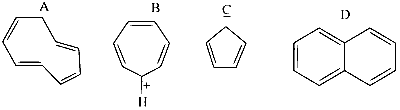
PYP
COMEDK 2024 AFTERNOON SHIFT
The molar conductivity of the complex $$\mathrm{CoCl}_3 \cdot 4 \mathrm{NH}_3 \cdot 2 \mathrm{H}_2 \mathrm{O}$$ is found to be the same as that of a $$1: 3$$ electrolyte. The structural formula of the compound is :
PYP
COMEDK 2024 AFTERNOON SHIFT
Among the following, which is not according to the property indicated against it?
PYP
COMEDK 2024 AFTERNOON SHIFT
Which of the following carbanions is the least stable?
PYP
COMEDK 2024 AFTERNOON SHIFT
The type of hybridisation and the spin only magnetic moment for the complex $$[\mathrm{Ni}(\mathrm{CO})_4]$$ are respectively:
PYP
COMEDK 2024 AFTERNOON SHIFT
Names of some organic compounds are given. Which one is not in IUPAC system?
PYP
COMEDK 2024 AFTERNOON SHIFT
Choose the incorrect statement from the following.
PYP
COMEDK 2024 AFTERNOON SHIFT
Which of the following compounds will show geometrical isomerism?
PYP
COMEDK 2024 AFTERNOON SHIFT
The major product obtained in the following reaction is :
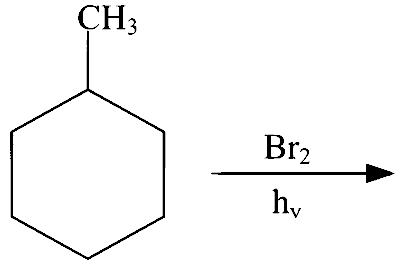
PYP
COMEDK 2024 AFTERNOON SHIFT
Arrange the following in the order of increasing reactivity towards $$\mathrm{SN}_{\mathrm{2}}$$ reactions.
$$\begin{array}{ll} \left(\mathrm{CH}_3\right)_3 \mathrm{CCH}_2 \mathrm{Br}(\mathrm{P}) ; & \\\mathrm{CH}_3\left(\mathrm{CH}_2\right)_3 \mathrm{Br}(\mathrm{Q}) ; &\\ \mathrm{CH}_3 \mathrm{CH}_2-\mathrm{CH}\left(\mathrm{CH}_3\right)-\mathrm{CH}_2 \mathrm{Br}(\mathrm{R}) ; & \\\left(\mathrm{CH}_3\right)_2 \mathrm{CHCH}_2 \mathrm{CH}_2 \mathrm{Br}(\mathrm{S}) \end{array}$$
PYP
COMEDK 2024 AFTERNOON SHIFT
Arrange the following compounds in the decreasing order of reactivity towards electrophilic substitution reaction.
(I) Chlorobenzene
(II) Nitrobenzene
(III) Benzene
(IV) Isopropylbenzene
PYP
COMEDK 2024 AFTERNOON SHIFT
Consider the following reaction
$$(\mathrm{CH}_3)_2 \mathrm{CHCH}_2 \mathrm{Br}+(\mathrm{CH}_3)_3 \mathrm{CCH}_2 \mathrm{Br} \xrightarrow[\Delta]{\mathrm{Na} \text { /dry ether }} \mathrm{X}+\mathrm{Y}+\mathrm{Z}$$
Identify the product which is not formed?
PYP
COMEDK 2024 AFTERNOON SHIFT
The major product '$$\mathrm{X}$$' of the following reaction is

PYP
COMEDK 2024 AFTERNOON SHIFT
Arrange the following compounds in the decreasing order of their acidic strength.
(I) m-cresol
(II) Phenol
(III) m-aminophenol
(IV) m-methoxyphenol
PYP
COMEDK 2024 AFTERNOON SHIFT
Which of the following tests may be used to distinguish between phenol and cyclohexanol?
PYP
COMEDK 2024 AFTERNOON SHIFT
Which of the following compound cannot be prepared by Williamson's synthesis?
PYP
COMEDK 2024 AFTERNOON SHIFT
Which of the following compounds undergo Aldol condensation followed by dehydration to give 3-phenylprop-2-en-1-al?
PYP
COMEDK 2024 AFTERNOON SHIFT
Predict the final major product 'S' of the following reaction
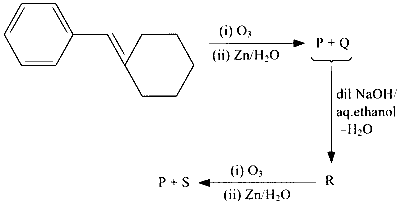
PYP
COMEDK 2024 AFTERNOON SHIFT
In a set of reactions, bromoethane yielded a final product 'S'.

The compound 'S' should be
PYP
COMEDK 2024 AFTERNOON SHIFT
An organic compound with molecular formula $$\mathrm{C}_3 \mathrm{H}_5 \mathrm{N}$$ on hydrolysis gives compound '$$\mathrm{X}$$' which on treatment with $$\mathrm{Cl}_2 / \mathrm{P}$$ gives compound '$$\mathrm{Y}$$'. Compound '$$\mathrm{Y}$$' on reaction with $$\mathrm{NH}_3$$ gives '$$\mathrm{Z}$$'. The compound '$$\mathrm{Z}$$' is :
PYP
COMEDK 2024 AFTERNOON SHIFT
With reference to vitamins and its deficiency diseases, the correct statements are:
(i) Cheilosis is due to the deficiency of Riboflavin
(ii) The deficiency of Vitamin B6 causes pernicious anaemia
(iii) Osteomalacia is due to the deficiency of Vitamin E
(iv) The deficiency of ascorbic acid causes scurvy
(v) The deficiency of Vitamin A causes xerophthalmia
PYP
COMEDK 2024 AFTERNOON SHIFT
Arrange the following amines in the decreasing order of their solubilities in water.

PYP
COMEDK 2024 AFTERNOON SHIFT
Among the following compounds, the most acidic is :
PYP
COMEDK 2024 AFTERNOON SHIFT
4-methyl benzamide (A) on reaction with ethanolic solution of $$\mathrm{KOH}$$ and bromine gives another compound (B). The compound (B) on treatment with benzoyl chloride gives compound (C). Identify the correct structure of compound (C) from the following.
PYP
COMEDK 2024 AFTERNOON SHIFT
A relation $$R$$ is defined from $$\{2,3,4\}$$ to $$\{3,6,7,10\}$$. If $$x R y \Leftrightarrow x$$ and $$y$$ are co prime numbers. Then range of $$R$$ is
PYP
COMEDK 2024 AFTERNOON SHIFT
$$ \text { Let } \mathrm{A} \text { and } \mathrm{B} \text { be two sets then } A-(A \cap B) \text { is equal to } $$
PYP
COMEDK 2024 AFTERNOON SHIFT
Among the following peptides, identify the pair where the name and its structure are correctly matched.
PYP
COMEDK 2024 AFTERNOON SHIFT
Which of the following statement is not true about glucose?
PYP
COMEDK 2024 AFTERNOON SHIFT
$$ \text { If } a \mathcal{N}=\{a x: x \in \mathcal{N}\} \text {, then } 3 \mathcal{N} \cap 7 \mathcal{N} \text { is } $$
PYP
COMEDK 2024 AFTERNOON SHIFT
$$ \text { The value of } \frac{i^{1004}+i^{1006}+i^{1008}+i^{1010}+i^{1012}}{i^{510}+i^{508}+i^{506}+i^{504}+i^{502}} \text { is } $$
PYP
COMEDK 2024 AFTERNOON SHIFT
The sum of four numbers in a geometric progression is 60 , and the arithmetic mean of the first and the last number is 18 . Then the numbers are
PYP
COMEDK 2024 AFTERNOON SHIFT
$$ \text { If } 6^{\text {th }} \text { term of a geometric progression is }-\frac{1}{32} \text { and } 9^{\text {th }} \text { term is } \frac{1}{256} \text { then } r \text { is } $$
PYP
COMEDK 2024 AFTERNOON SHIFT
The inequality $$4 x-3 \geq \frac{10 x-1}{3}$$ represents which of the following interval when $$x \in R$$
PYP
COMEDK 2024 AFTERNOON SHIFT
The sum of first three terms of a geometric progression is 16 and the sum of next three terms is 128 . The sum to $$\mathrm{n}$$ terms of the geometric progression is
PYP
COMEDK 2024 AFTERNOON SHIFT
A student has 3 library cards and 8 books of his interest in the library. Out of these 8 books he does not want to borrow Chemistry part 2 unless he can borrow Chemistry part 1 also. In how many ways can he choose the three books to be borrowed?
PYP
COMEDK 2024 AFTERNOON SHIFT
The number of four digit numbers strictly greater than 4321 formed using the digits $$0,1,2,3,4,5$$ with repetition of digit is
PYP
COMEDK 2024 AFTERNOON SHIFT
$$ \text { The angle between } \hat{\imath}-\hat{\jmath} ~\&~ \hat{\jmath}-\hat{k} \text { is } $$
PYP
COMEDK 2024 AFTERNOON SHIFT
A determinant of the second order is made with elements 0 and 1 . What is the probability that the determinant made is non-negative?
PYP
COMEDK 2024 AFTERNOON SHIFT
If the sum of the coefficients of the first three terms in the expansion of $$\left(x-\frac{a}{x^2}\right)^{12}, x \neq 0$$ is 559. Find the value of '$$a$$' if '$$a$$' belongs to positive integers
PYP
COMEDK 2024 AFTERNOON SHIFT
There are some baskets. The chances of picking a loaded basket and choosing a red coloured one is 0.2 . For every 100 tries to pick one basket, 60 times a basket is either loaded or red in colour. What is the probability of choosing an empty basket plus choosing not a red coloured one.
PYP
COMEDK 2024 AFTERNOON SHIFT
P and Q are considering to apply for a job. The probability that P applies for the job is $$\frac{1}{4}$$. The probability that $$\mathrm{P}$$ applies for the job given that $$\mathrm{Q}$$ applies for the job is $$\frac{1}{2}$$, and the probability that Q applies for the job given that P applies for the job is $$\frac{1}{3}$$. Then the probability that $$\mathrm{P}$$ does not apply for the job given that $$\mathrm{Q}$$ does not apply for the job is
PYP
COMEDK 2024 AFTERNOON SHIFT
The probability of inviting three friends on 5 consecutive days, exactly one friend a day and no friend is invited on more than two days is
PYP
COMEDK 2024 AFTERNOON SHIFT
The lines $$\vec{r}=(2 \hat{\jmath}-3 \hat{k})+\lambda(\hat{\imath}+2 \hat{\jmath}+3 \hat{k})$$ and $$\vec{r}=(2 \hat{\imath}+6 \hat{\jmath}+3 \hat{k})+\mu(2 \hat{\imath}+3 \hat{\jmath}+4 \hat{k})$$ are
PYP
COMEDK 2024 AFTERNOON SHIFT
Let a, b, c be three vector such that $$a \neq 0$$ and $$\vec{a} \times \vec{b}=2 \vec{a} \times \vec{c},|a|=|c|=1,|b|=4$$ and $$|\vec{b} \times \vec{c}|=\sqrt{15}$$. If $$\vec{b}-2 \vec{c}=\lambda \vec{a}$$ then $$\lambda$$ equals to
PYP
COMEDK 2024 AFTERNOON SHIFT
A line makes the same angle $$\theta$$ with each of the $$x$$ and $$z$$-axes. If the angle $$\beta$$, which it makes with the $$y$$-axis is such that $$\sin ^2 \beta=3 \sin ^2 \theta$$, then $$\cos ^2 \theta$$ equals
PYP
COMEDK 2024 AFTERNOON SHIFT
If the line $$\frac{1-x}{-3}=y=\frac{z+2}{2}$$ is perpendicular to the line $$\frac{3 x-1}{2 b}=3-y=\frac{z-1}{a}$$, then find the value of $$3 a+3 b$$
PYP
COMEDK 2024 AFTERNOON SHIFT
$$ \left|\begin{array}{ccc} \cos (\alpha+\beta) & -\sin (\alpha+\beta) & \cos 2 \beta \\ \sin \alpha & \cos \alpha & \sin \beta \\ -\cos \alpha & \sin \alpha & \cos \beta \end{array}\right| $$ is independent of
PYP
COMEDK 2024 AFTERNOON SHIFT
$$ \text { If } A=\left[\begin{array}{cc} 1 & -2 \\ 4 & 5 \end{array}\right] \text { and } f(t)=t^2-3 t+7 \text { then } f(A)+\left[\begin{array}{cc} 3 & 6 \\ -12 & -9 \end{array}\right] \text { is } $$
PYP
COMEDK 2024 AFTERNOON SHIFT
Let 'P' be the mean deviation of the first five odd natural numbers about their mean and 'Q' be the mean deviation of the first five prime numbers about their mean. The $$Q-P=$$
PYP
COMEDK 2024 AFTERNOON SHIFT
$$ \text { A square matrix } P \text { satisfies } P^2=I-P \text { where } I \text { is identity matrix. If } P^n=5 I-8 P \text {, then } n \text { is equal to } $$
PYP
COMEDK 2024 AFTERNOON SHIFT
$$ \text { If A }(\operatorname{adj} A)=5 I \text {, where I is the identity matrix of order } 3 \text {, then }|\operatorname{adj} A|= $$
PYP
COMEDK 2024 AFTERNOON SHIFT
If $$A=\left[\begin{array}{lll}5 & 0 & 4 \\ 2 & 3 & 2 \\ 1 & 2 & 1\end{array}\right] \quad B^{-1}=\left[\begin{array}{lll}1 & 3 & 3 \\ 1 & 4 & 3 \\ 1 & 3 & 4\end{array}\right]$$ then $$(A B)^{-1}$$ is equal to
PYP
COMEDK 2024 AFTERNOON SHIFT
$$ \text { The maximum value of } Z=3 x+4 y \text { for the given constraints } x+2 y \leq 76,2 x+y \leq 104, x \geq 0, y \geq 0 \text { is } $$
PYP
COMEDK 2024 AFTERNOON SHIFT
$$ \text { If } \frac{x}{\cos \theta}=\frac{y}{\cos \left(\theta+\frac{2 \pi}{3}\right)}=\frac{z}{\cos \left(\theta-\frac{2 \pi}{3}\right)} \text { then } x+y+z \text { is equal to } $$
PYP
COMEDK 2024 AFTERNOON SHIFT
$$ \text { If } \alpha=\tan ^{-1}\left(\tan \frac{5 \pi}{4}\right) \text { and } \beta=\tan ^{-1}\left(-\tan \frac{2 \pi}{3}\right) \text { then } $$
PYP
COMEDK 2024 AFTERNOON SHIFT
Evaluate :
$$ \operatorname{cosec}^{-1}\left(-\frac{2 \sqrt{3}}{3}\right)+\tan ^{-1}\left(-\frac{\sqrt{3}}{3}\right)+\sec ^{-1} 2+\cos ^{-1}\left(-\frac{1}{2}\right)-\sin ^{-1}\left(\frac{\sqrt{2}}{2}\right)$$
PYP
COMEDK 2024 AFTERNOON SHIFT
If the distance between the foci and the distance between the two directrixes are in the ratio $$3: 2$$ for a hyperbola $$\frac{x^2}{a^2}-\frac{y^2}{b^2}=1$$, then a : b is
PYP
COMEDK 2024 AFTERNOON SHIFT
$$ \left(\cos \frac{\pi}{12}-\sin \frac{\pi}{12}\right)\left(\tan \frac{\pi}{12}+\cot \frac{\pi}{12}\right)= $$
PYP
COMEDK 2024 AFTERNOON SHIFT
$$ \frac{\cos 9^{\circ}+\sin 9^{\circ}}{\cos 9^{\circ}-\sin 9^{\circ}}= $$
PYP
COMEDK 2024 AFTERNOON SHIFT
$$ \text { If } y=\sin ^{-1}(\sqrt{\sin x}) \text {, then } \frac{d y}{d x} \text { equals } $$
PYP
COMEDK 2024 AFTERNOON SHIFT
$$\text { Which of the following function is injective? }$$
PYP
COMEDK 2024 AFTERNOON SHIFT
For what value of $$\mathrm{a}$$ and $$\mathrm{b}$$ the intercepts cut off on the co-ordinate axes by the line $$a x-b y+8=0$$ are equal in length but opposite in signs to those cut off by the line $$2 x-3 y+6=0$$ on the axes
PYP
COMEDK 2024 AFTERNOON SHIFT
The points on the ellipse $$16 x^2+9 y^2=400$$ at which the ordinate decreases at the same rate at which the abscissa increases are
PYP
COMEDK 2024 AFTERNOON SHIFT
If an ellipse has an equation in the standard form and it passes through the points $$\left(\frac{5}{2}, \frac{\sqrt{6}}{4}\right)$$ and $$\left(-2, \frac{\sqrt{15}}{5}\right)$$ then the length of its latus rectum is
PYP
COMEDK 2024 AFTERNOON SHIFT
$$ \lim _\limits{x \rightarrow 0} \frac{a^x-b^x}{c^x-d^x}= $$
PYP
COMEDK 2024 AFTERNOON SHIFT
Let $$\mathrm{ABC}$$ be a triangle with equations of its sides $$\mathrm{AB}, \mathrm{BC}$$. $$\mathrm{CA}$$ respectively are $$x-2=0, y-5=0$$ and $$5 x+2 y-10=0$$. Then the orthocentre of triangle lies on the line
PYP
COMEDK 2024 AFTERNOON SHIFT
$$ \text { The function } y=\tan x-x \text { is } $$
PYP
COMEDK 2024 AFTERNOON SHIFT
$$ \text { The value of } \lim _\limits{x \rightarrow 0} \frac{\sin (a+x)-\sin (a-x)}{x} \text { is } $$
PYP
COMEDK 2024 AFTERNOON SHIFT
$$ \text { If } f(x)=\frac{a \sin x+b \cos x}{c \sin x+d \cos x} \text { is decreasing for all } x \text {, then } $$
PYP
COMEDK 2024 AFTERNOON SHIFT
$$ \text { If } x^2+y^2=t+\frac{1}{t} \text { and } x^4+y^4=t^2+\frac{1}{t^2} \text { then } \frac{d y}{d x}= $$
PYP
COMEDK 2024 AFTERNOON SHIFT
The dimensions of the largest rectangle of side $$x$$ and $$y$$ that can be inscribed in the right angled triangle of sides $$\mathrm{a}$$ and $$\mathrm{b}$$ is

PYP
COMEDK 2024 AFTERNOON SHIFT
$$ \text { The number of points of discontinuity of the rational function } f(x)=\frac{x^2-3 x+2}{4 x-x^3} $$
PYP
COMEDK 2024 AFTERNOON SHIFT
$$ \int \frac{f^{\prime}(x)}{f(x) \log (f(x))} d x \text { is equal to } $$
PYP
COMEDK 2024 AFTERNOON SHIFT
If $$(x-a)^2+(y-b)^2=c^2$$, where $$\mathrm{a}, \mathrm{b}, \mathrm{c}$$ are some constants, $$c>0$$ then $$\frac{\left[1+\left(\frac{d y}{d x}\right)^2\right]^{\frac{3}{2}}}{\frac{d^2 y}{d x^2}}$$ is independent of
PYP
COMEDK 2024 AFTERNOON SHIFT
If $$f(x)=\log x+b x^2+a x, x \neq 0$$ has extreme values (or turning points) at $$x=-1$$ and $$x=2$$ then the values of $$\mathrm{a}$$ and $$\mathrm{b}$$ are
PYP
COMEDK 2024 AFTERNOON SHIFT
$$ \int \frac{1+x+\sqrt{x+x^2}}{\sqrt{x}+\sqrt{1+x}} d x \text { is equal to } $$
PYP
COMEDK 2024 AFTERNOON SHIFT
$$ \int \log x(\log x+2) d x \text { equals to } $$
PYP
COMEDK 2024 AFTERNOON SHIFT
$$ \int_\limits{-\frac{\pi}{2}}^{\frac{\pi}{2}} \sqrt{\cos x-\cos ^3 x} d x \text { is equal to } $$
PYP
COMEDK 2024 AFTERNOON SHIFT
$$ \text { The area of the region (in square units) bounded by the line } y+3=x ; x=1 \text { and } x=5 \text { is } $$
PYP
COMEDK 2024 AFTERNOON SHIFT
$$ \text { The general solution of the differential equation } \frac{d y}{d x}=\frac{x y}{x^2+y^2} \text { is } $$
PYP
COMEDK 2024 AFTERNOON SHIFT
The area of the region (in sq units) bounded by the curve $$ y=\sqrt{16-x^2} \text { and } x \text {-axis is } $$
PYP
COMEDK 2024 AFTERNOON SHIFT
$$ \int_\limits0^{\frac{\pi}{2}} \frac{\cos x}{1+\cos x+\sin x} d x= $$
PYP
COMEDK 2024 AFTERNOON SHIFT
$$ \text { Integrating factor of the differential equation } \frac{d y}{d x}+y=\frac{x^3+y}{x} \text { is } $$
PYP
COMEDK 2024 AFTERNOON SHIFT
$$ \text { The general solution of } \frac{d y}{d x}=\sin ^{-1} x \text { is } $$
PYP
COMEDK 2024 AFTERNOON SHIFT
Which of the following reactions is an example for incomplete combustion?
PYP
COMEDK 2024 AFTERNOON SHIFT
Degree of the differential equation $$\log \left(\frac{d y}{d x}\right)^{\frac{1}{2}}=5 x+4 y$$ is
PYP
COMEDK 2024 AFTERNOON SHIFT
A and B are two independent events. The probability of their simultaneous occurrence is $$\frac{1}{8}$$ and the probability that neither of them occurs is $$\frac{3}{8}$$. Then their individual probabilities are
Showing 5 of 180 questions