Exam Details
COMEDK 2024 EVENING SHIFT
Review the key details, then start the test when you are ready. You can also open the full package to see related papers.
Questions
180
Duration
180 mins
Package
COMEDK- Previous Year Papers
Paper pattern & analysis
Filter this paper by subject, topic or subtopic. Every graph updates from the selected questions.
Topic distribution
Subtopic distribution
Difficulty distribution
180questions
Not classified
180
100%
Question type distribution
180questions
MCQ
180
100%
Syllabus
Full Syllabus
Practise paper questions
Choose your answer to check it. Log in to view the explanation. For a timed attempt and result, start the exam.
PYP
COMEDK 2024 EVENING SHIFT
Arrange the following redox couples in the increasing order of their reducing strength:
$$\begin{array}{ll} {[\mathrm{A}]=\mathrm{Cu} / \mathrm{Cu}^{2+}} & \mathrm{E}^0=-0.34 \mathrm{~V} \\ {[\mathrm{~B}]=\mathrm{Ag} / \mathrm{Ag}^{+}} & \mathrm{E}^0=-0.8 \mathrm{~V} \\ {[\mathrm{C}]=\mathrm{Ca} / \mathrm{Ca}^{2+}} & \mathrm{E}^0=+2.87 \mathrm{~V} \\ {[\mathrm{D}]=\mathrm{Cr} / \mathrm{Cr}^{3+}} & \mathrm{E}^0=+0.74 \mathrm{~V} \end{array}$$
PYP
COMEDK 2024 EVENING SHIFT
What mass of Silver chloride, in grams, gets precipitated when $$150 \mathrm{~ml}$$ of $$32 \%$$ solution of Silver nitrate is reacted with $$150 \mathrm{ml}$$ of $$11 \%$$ Sodium chloride solution? Atomic mass in $$\mathrm{g} / \mathrm{mol}: \mathrm{Ag}=108, \mathrm{Na}=23, \mathrm{Cl}=35.5, \mathrm{~N}=14, \mathrm{O}=16$$
PYP
COMEDK 2024 EVENING SHIFT
What is the quantity of charge, in Faraday units, required for the reduction of 3.5 moles of $$\mathrm{Cr}_2 \mathrm{O} 7^{2-}$$ in acid medium?
PYP
COMEDK 2024 EVENING SHIFT
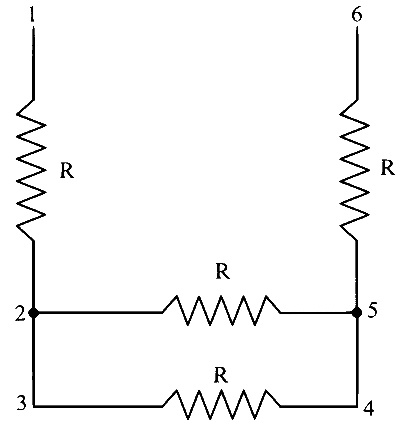
Four resistors, each of resistance R, are connected as shown in the figure below.
PYP
COMEDK 2024 EVENING SHIFT
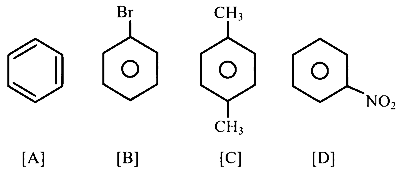
Arrange the following compounds in the increasing order of their reactivity when each of them is reacted with chloroethane / anhydrous AlCl$$_3$$.
PYP
COMEDK 2024 EVENING SHIFT
Two finite sets have '$$m$$' and '$$n$$' number of elements respectively. The total number of subsets of the first set is 112 more than the total number of subsets of the second set. Then the values of $$\mathrm{m}$$ and $$\mathrm{n}$$ are respectively.
PYP
COMEDK 2024 EVENING SHIFT
A cricketer of height $$2.5 \mathrm{~m}$$ throws a ball at an angle of $$30^{\circ}$$ with the horizontal such that it is received by another cricketer of same height standing at a distance of $$50 \mathrm{~m}$$ from the first one. The maximum height attained by the ball is ($$\tan 30^{\circ}=0.577$$)
PYP
COMEDK 2024 EVENING SHIFT
The dimension $$[\mathrm{ML}^{-1} \mathrm{~T}^{-2}]$$ is the physical quantity of
PYP
COMEDK 2024 EVENING SHIFT
The mean of five observations is 4 and their variance is 5.2 . If three of these observations are 1, 2 and 6, then the other two observations are
PYP
COMEDK 2024 EVENING SHIFT
A body initially at rest undergoes rectilinear motion. The forcetime (F-t) graph for the motion of the body is given below. Find the linear momentum gained by the body in $$2 \mathrm{~s}$$.

PYP
COMEDK 2024 EVENING SHIFT
A solid cylinder of mass $$2 \mathrm{~kg}$$ and radius $$0.2 \mathrm{~m}$$ is rotating about its own axis without friction with angular velocity $$5 \mathrm{~rad} \mathrm{s}^{-1}$$. A particle of mass $$1 \mathrm{~kg}$$ moving with a velocity of $$5 \mathrm{~ms}^{-1}$$ strikes the cylinder and sticks to it as shown in figure.
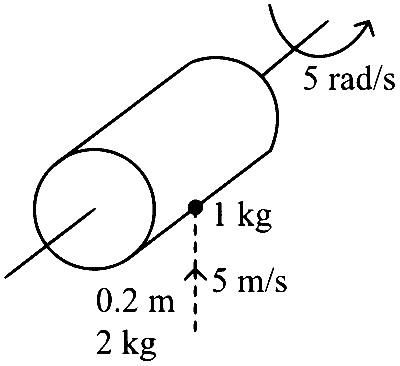
The angular velocity of the system after the particle sticks to it will be
PYP
COMEDK 2024 EVENING SHIFT
A scooter moves with a speed of $$7 \mathrm{~ms}^{-1}$$, on a straight road and is stopped by applying the brakes. Before stopping, the scooter travels $$10 \mathrm{~m}$$. If the weight of the scooter is $$\mathrm{W}$$, then the total resistance to the motion of the scooter will be
PYP
COMEDK 2024 EVENING SHIFT
A ball is moving in a circular path of radius $$5 \mathrm{~m}$$. If tangential acceleration at any instant is $$10 \mathrm{~ms}^{-2}$$ and the net acceleration makes an angle of $$30^{\circ}$$ with the centripetal acceleration, then, the instantaneous speed is
PYP
COMEDK 2024 EVENING SHIFT
Joule second is the unit of
PYP
COMEDK 2024 EVENING SHIFT
When water falls from a height of $$80 \mathrm{~m}$$ at the rate of $$20 \mathrm{~kg} \mathrm{~s}^{-1}$$ to operate a turbine the losses due to frictional force are $$20 \%$$ of input energy. How much power is generated by the turbine?
PYP
COMEDK 2024 EVENING SHIFT
Action and reaction can never balance out because
PYP
COMEDK 2024 EVENING SHIFT
The temperature of a wire is doubled. The Young's modulus of elasticity
PYP
COMEDK 2024 EVENING SHIFT
The coefficient of volume expansion of glycerine is $$49 \times 10^{-5} \mathrm{~K}^{-1}$$. The percentage change in its density for a $$50^{\circ} \mathrm{C}$$ rise in temperature is
PYP
COMEDK 2024 EVENING SHIFT
What is the relation obeyed by the angles of contact $$\theta_1, \theta_2$$ and $$\theta_3$$ of 3 liquids of different densities $$P_1, P_2$$ and $$P_3$$ respectively $$(\mathrm{P}_1 < \mathrm{P}_2 < \mathrm{P}_3$$) when they rise to the same capillary height in 3 identical capillaries and having nearly same surface tension $$\mathrm{T}$$ ?
PYP
COMEDK 2024 EVENING SHIFT
Internal energy of $$\mathrm{n}_1$$ moles of hydrogen at temperature T is equal to internal energy of $$\mathrm{m}_2$$ moles of helium at temperature 2T. The ratio $$\frac{n_1}{n_2}$$ is
PYP
COMEDK 2024 EVENING SHIFT
A cylinder of fixed capacity 44.81 contains hydrogen gas at STP. What is the amount of heat needed to raise the temperature of the gas in the cylinder by $$20^{\circ} \mathrm{C}$$ ? ($$R=8.31 \mathrm{~J} \mathrm{~mol}^{-1} \mathrm{~K}^{-1}$$)
PYP
COMEDK 2024 EVENING SHIFT
The latent heat of vaporisation of water is $$2240 \mathrm{~J}$$. If the work done in the process of vaporisation of $$1 \mathrm{~g}$$ is $$168 \mathrm{~J}$$, the increase in internal energy is
PYP
COMEDK 2024 EVENING SHIFT
A monochromatic light of wavelength $$800 \mathrm{~nm}$$ is incident normally on a single slit of width $$0.020 \mathrm{~mm}$$ to produce a diffraction pattern on a screen placed $$1 \mathrm{~m}$$ away. Estimate the number of fringes obtained in Young's double slit experiment with slit separation $$0.20 \mathrm{~mm}$$, which can be accommodated within the range of total angular spread of the central maximum due to single slit.
PYP
COMEDK 2024 EVENING SHIFT
The number of possible natural oscillations of air column in a pipe closed at one end of length $$85 \mathrm{~cm}$$ whose frequencies lie below $$1250 \mathrm{~Hz}$$ are (velocity of sound $$=340 \mathrm{~ms}^{-1}$$)
PYP
COMEDK 2024 EVENING SHIFT
A satellite is revolving around the earth in a circular orbit with kinetic energy of $$1.69 \times 10^{10} \mathrm{~J}$$. The additional kinetic energy required for just escaping into the outer space is
PYP
COMEDK 2024 EVENING SHIFT
The acceleration due to gravity at pole and equator can be related as
PYP
COMEDK 2024 EVENING SHIFT
A body is executing SHM. When its displacements from the mean position are $$4 \mathrm{~cm}$$ and $$5 \mathrm{~cm}$$ it has velocity $$10 \mathrm{~cms}^{-1}$$ and $$8 \mathrm{~cms}^{-1}$$ respectively. Its periodic time $$\mathrm{t}$$ is
PYP
COMEDK 2024 EVENING SHIFT
Two narrow parallel slits illuminated by a coherent monochromatic light produces an interference pattern on a screen placed at a distance $$\mathrm{D}$$ from the slits. The separation between the dark lines of the interference pattern can be increased by
PYP
COMEDK 2024 EVENING SHIFT
A telescope has an objective of focal length $$60 \mathrm{~cm}$$ and eyepiece of focal length $$5 \mathrm{~cm}$$. The telescope is focussed for least distance of distinct vision $$300 \mathrm{~cm}$$ away from the object. The magnification produced by the telescope at least distance of distinct vision is
PYP
COMEDK 2024 EVENING SHIFT
When a biconvex lens of glass of refractive index 1.5 is dipped in a liquid, it acts like a plane sheet of paper. This means the refractive index of the liquid is
PYP
COMEDK 2024 EVENING SHIFT
In Young's double slit experiment light of wavelength $$500 \mathrm{~nm}$$ is used to form interference pattern. A uniform glass plate of refractive index 1.5 and thickness $$0.1 \mathrm{~mm}$$ is introduced in the path of one of the interfering beams. The number of fringes that will shift due to this is
PYP
COMEDK 2024 EVENING SHIFT
Figure below shows a lens of refractive index, $$\mu=1.4$$. $$C_1$$ and $$C_2$$ are the centres of curvature of the two faces of the lens of radii of curvature $$4 \mathrm{~cm}$$ and $$8 \mathrm{~cm}$$ respectively.
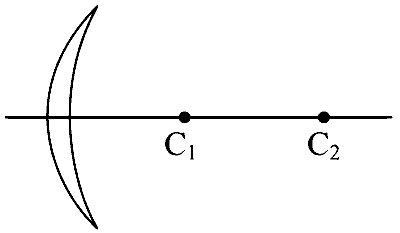
The lens behaves as a
PYP
COMEDK 2024 EVENING SHIFT
Incident light of wavelength $$\lambda=800 \mathrm{~nm}$$ produces a diffraction pattern on a screen $$1.5 \mathrm{~m}$$ away when it passes through a single slit of width $$0.5 \mathrm{~mm}$$. The distance between the first dark fringes on either side of the central bright fringe is
PYP
COMEDK 2024 EVENING SHIFT
A hollow prism is filled with water and placed in air. It will deviate the incident rays
PYP
COMEDK 2024 EVENING SHIFT
A neutral water molecule is placed in an electric field $$E=2.5 \times 10^4 \mathrm{NC}^{-1}$$. The work done to rotate it by $$180^{\circ}$$ is $$5 \times 10^{-25} \mathrm{~J}$$. Find the approximate separation of centre of charges.
PYP
COMEDK 2024 EVENING SHIFT
The resistance of a $$10 \mathrm{~m}$$ long wire is $$10 \Omega$$. Its length is increased by $$25 \%$$ by stretching the wire uniformly. The new resistance is
PYP
COMEDK 2024 EVENING SHIFT
Two point charges $$\mathrm{M}$$ and $$\mathrm{N}$$ having charges $$+q$$ and $$-q$$ respectively are placed at a distance apart. Force acting between them is $$\mathrm{F}$$. If $$30 \%$$ of charge of $$\mathrm{N}$$ is transferred to $$\mathrm{M}$$, then the force between the charges becomes:
PYP
COMEDK 2024 EVENING SHIFT
Three bulbs of $$40 \mathrm{~W}, 60 \mathrm{~W}$$, and $$100 \mathrm{~W}$$ are arranged in series with a $$220 \mathrm{~V}$$ source. The maximum light is obtained from
PYP
COMEDK 2024 EVENING SHIFT
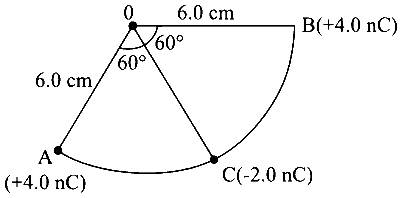
Three point charges are located on a circular arc at $$\mathrm{A}, \mathrm{B}$$ and $$\mathrm{C}$$ as shown in the figure below. The total electric field at the centre of the $$\operatorname{arc}(\mathrm{C})$$ is
PYP
COMEDK 2024 EVENING SHIFT
If 216 drops of the same size are charged at $$200 \mathrm{~V}$$ each and they combine to form a bigger drop, the potential of the bigger drop will be
PYP
COMEDK 2024 EVENING SHIFT
A voltmeter of resistance $$1000 \Omega .0 .5 \mathrm{~V} /$$ div is to be converted into a voltmeter to make it to read $$=1 \mathrm{~V} / \mathrm{div}$$. The value of high resistance to be connected in series with it is
PYP
COMEDK 2024 EVENING SHIFT
A parallel plate capacitor having a dielectric constant 5 and dielectric strength $$10^6 \mathrm{~V} \mathrm{~m}^{-1}$$ is to be designed with voltage rating of $$2 \mathrm{~kV}$$. The field should never exceed $$10 \%$$ of its dielectric strength. To have the capacitance of $$60 \mathrm{~pF}$$ the minimum area of the plates should be
PYP
COMEDK 2024 EVENING SHIFT
A wire of length $$2 \mathrm{~m}$$ carries a current of $$1 \mathrm{~A}$$ along the $$\mathrm{x}$$ axis. A magnetic field $$B=B_0(i+j+k)$$ tesla exists in space. The magnitude of magnetic force on the wire is
PYP
COMEDK 2024 EVENING SHIFT
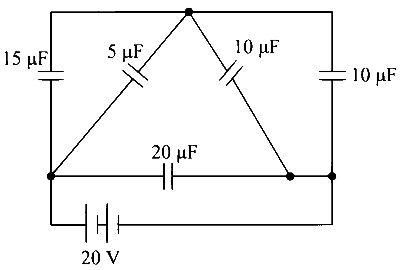
The figure shows a network of five capacitors connected to a 20 V battery. Calculate the charge acquired by each 10 $$\mu$$F capacitor.
PYP
COMEDK 2024 EVENING SHIFT
Figure below shows a network of resistors, cells, and a capacitor at steady state.
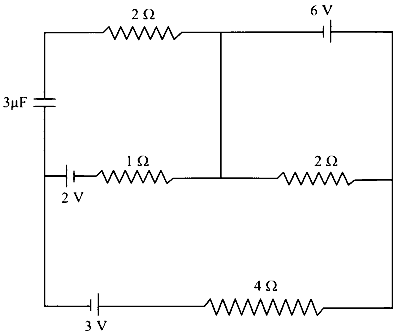
What is the current through the resistance 4 $$\Omega$$ ?
PYP
COMEDK 2024 EVENING SHIFT
A negative charge particle is moving upward in a magnetic field which is towards north. The particle is deflected towards
PYP
COMEDK 2024 EVENING SHIFT
For a paramagnetic material, the dependence of the magnetic susceptibility $$\chi$$ on the absolute temperature is given as
PYP
COMEDK 2024 EVENING SHIFT
A bar magnet is held perpendicular to a uniform field. If the couple acting on the magnet is to be halved, by rotating it, the angle by which it is to be rotated is
PYP
COMEDK 2024 EVENING SHIFT
A current I flows in an infinitely long wire with cross section in the form of semi-circular ring of radius $$1 \mathrm{~m}$$. The magnitude of the magnetic induction along its axis is
PYP
COMEDK 2024 EVENING SHIFT
A transformer of $$100 \%$$ efficiency has 200 turns in the primary and 40000 turns in the secondary. It is connected to a $$220 \mathrm{~V}$$ main supply and secondary feeds to a $$100 \mathrm{~K} \Omega$$ resistance. The potential difference per turn is
PYP
COMEDK 2024 EVENING SHIFT
A conducting circular loop is placed in a uniform magnetic field $$\mathrm{B}=0.125 \mathrm{~T}$$ with its plane perpendicular to the loop. If the radius of the loop is made to shrink at a constant rate of $$2 \mathrm{~mm} \mathrm{~s}^{-1}$$, then the induced emf when the radius is $$4 \mathrm{~cm}$$ is
PYP
COMEDK 2024 EVENING SHIFT
The current in a coil changes steadily from $$3 \mathrm{~A}$$ to $$5 \mathrm{~A}$$ in $$0.2 \mathrm{~s}$$ when an emf of $$2 \mu \mathrm{V}$$ is induced in it. The self-inductance of the coil is
PYP
COMEDK 2024 EVENING SHIFT
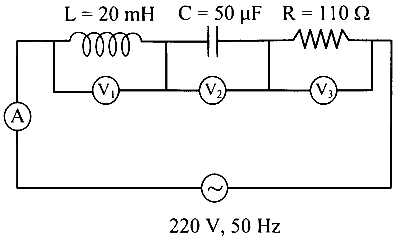
In the $$\mathrm{A} . \mathrm{C}$$. circuit given below, voltmeters $$\mathrm{V}_1$$ and $$\mathrm{V}_2$$ read $$100 \mathrm{~V}$$ each. Find the reading of the voltmeter $$\mathrm{V}_3$$ and the ammeter $$\mathrm{A}$$.
PYP
COMEDK 2024 EVENING SHIFT
The magnetic flux linked with a coil is given by the equation: $$\phi=8 t^2+t+10$$. The e.m.f. induced in the coil in the $$3^{\text {rd }}$$ second will be
PYP
COMEDK 2024 EVENING SHIFT
Column - I lists the waves of the electromagnetic spectrum. Column - II gives approximate frequency range of these waves. Match Column - I and Column - II and choose the correct match from the given choices.
| Column I | Column II | ||
|---|---|---|---|
| (A) | Radiowaves | (P) | $$ 10^{18} \text { to } 10^{20} \mathrm{~Hz} $$ |
| (B) | Microwaves | (P) | $$ 10^{11} \text { to } 5 \times 10^{14} \mathrm{~Hz} $$ |
| (C) | Infrared | (R) | $$ 10^4 \text { to } 10^8 \mathrm{~Hz} $$ |
| (D) | X-rays | (S) | $$ 10^9 \text { to } 10^{12} \mathrm{~Hz} $$ |
PYP
COMEDK 2024 EVENING SHIFT
The conductivity of a semiconductor increases with increase in temperature because
A) number density of free current carriers increases
B) relaxation time increases
C) both number density of carriers and relaxation time increase
D) number density of current carriers increases, relaxation time decreases but effect of decrease in relaxation time is much less than increase in number density
PYP
COMEDK 2024 EVENING SHIFT
When an A.C. source is connected to a inductive circuit,
PYP
COMEDK 2024 EVENING SHIFT
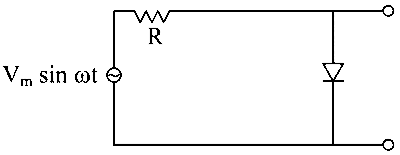
The output of the given circuit is
A. Negatively rectified half wave
B. Positively rectified half wave
C. Negatively rectified full wave
D. Zero all times
PYP
COMEDK 2024 EVENING SHIFT
The binding energy per nucleon for $$\mathrm{C}^{12}$$ is $$7.68 \mathrm{~MeV}$$ and that for $$\mathrm{C}^{13}$$ is $$7.47 \mathrm{~MeV}$$. The energy required to remove a neutron from $$\mathrm{C}^{13}$$ is
PYP
COMEDK 2024 EVENING SHIFT
An electron has a mass of $$9.1 \times 10^{-31} \mathrm{~kg}$$. It revolves round the nucleus in a circular orbit of radius $$0.529 \times 10^{-10} \mathrm{~m}$$ at a speed of $$2.2 \times 10^6 \mathrm{~ms}^{-1}$$. The magnitude of its angular momentum is
PYP
COMEDK 2024 EVENING SHIFT
If an electron in a hydrogen atom jumps from the third orbit to the second orbit, it emits a photon of wavelength $$\lambda$$. When it jumps from the second to the first orbit, the corresponding wavelength of the photon will be
PYP
COMEDK 2024 EVENING SHIFT
The distance of closest approach when an alpha particle of kinetic energy $$6.5 \mathrm{~MeV}$$ strikes a nucleus of atomic number 50 is
PYP
COMEDK 2024 EVENING SHIFT
The following are the graphs of potential barrier versus width of the depletion region for a p-n junction diode.
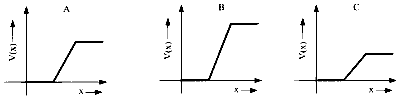
Which of the following is correct?
| I | II | III | IV` |
|---|---|---|---|
| A - unbiased diode | A - Forward biased diode | A - unbiased diode | A - unbiased diode |
| B - Reverse biased | B - Reverse biased | B - Forward biased | B - unused diode |
| C - Forward biased | C - unbiased | C - Reverse biased | C - Forward biased |
PYP
COMEDK 2024 EVENING SHIFT
$$ \text { If the nuclear radius of }{ }^{27} \mathrm{Al} \text { is } 3.6 \text { fermi, the nuclear radius of }{ }^{125} \mathrm{Fe} \text { is } $$
PYP
COMEDK 2024 EVENING SHIFT
What is the wave number (Units $$\mathrm{cm}^{-1}$$) of the longest wave length transition in the Balmer series of Hydrogen spectrum? $$Z=1 \text { for } H$$
PYP
COMEDK 2024 EVENING SHIFT
Sulphuric acid used in Lead Storage battery has a concentration of $$4.5 \mathrm{~M}$$ and a density of $$1.28 \mathrm{~g} / \mathrm{~ml}$$. The molality of the acid is __________.
PYP
COMEDK 2024 EVENING SHIFT
A photon emitted during the de-excitation of electron from a state $$\mathrm{n}$$ to the second excited state in a hydrogen atom, irradiates a metallic electrode of work function $$0.5 \mathrm{~eV}$$, in a photocell, with a stopping voltage of $$0.47 \mathrm{~V}$$. Obtain the value of quantum number of the state '$$n$$'.
PYP
COMEDK 2024 EVENING SHIFT
The Enthalpy of combustion of $$\mathrm{C}_6 \mathrm{H}_5 \mathrm{COOH}(\mathrm{s})$$ at $$25^{\circ} \mathrm{c}$$ and 1.0 atm pressure is $$-2546 \mathrm{~kJ} / \mathrm{mol}$$. What is the Internal energy change for this reaction?
PYP
COMEDK 2024 EVENING SHIFT
What are the Principal & Azimuthal quantum number values of the valence electrons in tripositive Lutetium?
PYP
COMEDK 2024 EVENING SHIFT
A particle of mass $$2 \mathrm{mg}$$ has the same wavelength as a neutron moving with a velocity of $$3 \times 10^5 \mathrm{~ms}^{-1}$$. The velocity of the particle is (mass of neutron is $$1.67 \times 10^{-27} \mathrm{Kg}$$)
PYP
COMEDK 2024 EVENING SHIFT
A solute $$\mathrm{X}$$ is found to exist as a dimer in water. A 4 molal solution of $$\mathrm{X}$$ shows a boiling point of $$101.04^{\circ} \mathrm{C}$$. What is the percentage association of $$\mathrm{X}$$ ? ($$\mathrm{K}_{\mathrm{b}}$$ for water $$=0.52 \mathrm{~K} / \mathrm{m}$$).
PYP
COMEDK 2024 EVENING SHIFT
At $$700 \mathrm{~K}$$, the Equilibrium constant value for the formation of $$\mathrm{HI}$$ from $$\mathrm{H}_2$$ and $$\mathrm{I}_2$$ is 49.0 . 0.7 mole of $$\mathrm{HI}(\mathrm{g})$$ is present at equilibrium. What will be the concentrations of $$\mathrm{H}_2$$ and $$\mathrm{I}_2$$ gases if we initially started with $$\mathrm{HI}(\mathrm{g})$$ and allowed the reaction to reach equilibrium at the same temperature?
PYP
COMEDK 2024 EVENING SHIFT
Given :
$$ \begin{gathered} \Delta \mathrm{H}^0 \mathrm{f}_{\text {of }} \mathrm{CO}_2(\mathrm{~g})=-393.5 \mathrm{~kJ} / \mathrm{mol} \\ \Delta \mathrm{H}^0{ }_{\mathrm{f}} \text { of } \mathrm{H}_2 \mathrm{O}(\mathrm{l})=-286 \mathrm{~kJ} / \mathrm{mol} \\ \Delta \mathrm{H}^0{ }_{\mathrm{f}} \text { of } \mathrm{C}_3 \mathrm{H}_6(\mathrm{~g})=+20.6 \mathrm{~kJ} / \mathrm{mol} \end{gathered} $$
$$\Delta \mathrm{H}^0$$ isomerisation of Cyclopropane to Propene $$=-33 \mathrm{~kJ} / \mathrm{mol}$$
What is the standard enthalpy of combustion of Cyclopropane?
PYP
COMEDK 2024 EVENING SHIFT
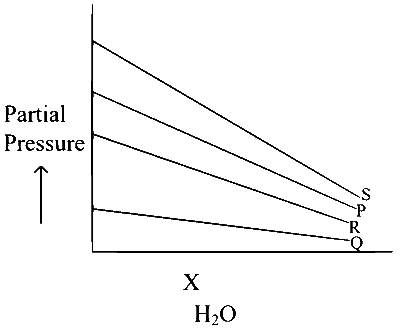
Study the graph between partial pressure and mole fraction of some gases and arrange the gases P, Q, R and S dissolved in H$$_2$$O, in the decreasing order of their KH values.
PYP
COMEDK 2024 EVENING SHIFT
5.0 moles of an Ideal gas at 3.0 atm pressure and $$27^{\circ} \mathrm{C}$$ is compressed isothermally to half its volume by application of an external pressure of $$3.5 \mathrm{~atm}$$. What is the amount of work done (in joules) on the gas? Given: $$1 \mathrm{~L} \mathrm{~atm}=101.3 \mathrm{~J}: \mathrm{R}=0.082 \mathrm{~L} \mathrm{~atm} \mathrm{~K}{ }^{-1} \mathrm{~mol}^{-1}$$
PYP
COMEDK 2024 EVENING SHIFT
What volume of $$0.2 \mathrm{~M}$$ Acetic acid is to be added to $$100 \mathrm{ml}$$ of $$0.4 \mathrm{M}$$ Sodium acetate so that a Buffer solution of $$\mathrm{pH}$$ equal to 4.94 is obtained? $$(\mathrm{pK}_{\mathrm{a}}$$ of $$\mathrm{CH}_3 \mathrm{COOH}=4.76)$$
PYP
COMEDK 2024 EVENING SHIFT
Given that the freezing point of benzene is $$5.48^{\circ} \mathrm{C}$$ and its $$\mathrm{K}_{\mathrm{f}}$$ value is $$5.12{ }^{\circ} \mathrm{C} / \mathrm{m}$$. What would be the freezing point of a solution of $$20 \mathrm{~g}$$ of propane in $$400 \mathrm{~g}$$ of benzene?
PYP
COMEDK 2024 EVENING SHIFT
$$200 \mathrm{ml}$$ of an aqueous solution contains $$3.6 \mathrm{~g}$$ of Glucose and $$1.2 \mathrm{~g}$$ of Urea maintained at a temperature equal to $$27^{\circ} \mathrm{C}$$. What is the Osmotic pressure of the solution in atmosphere units?
$$\mathrm{R}=0.082 \mathrm{~L} \mathrm{~atm} \mathrm{~K}{ }^{-1} \mathrm{~mol}^{-1}$$ : Molecular Formula: Glucose is $$\mathrm{C}_6 \mathrm{H}_{12} \mathrm{O}_6$$ and of Urea is $$\mathrm{NH}_2 \mathrm{CONH}_2$$
PYP
COMEDK 2024 EVENING SHIFT
In the redox reaction between $$\mathrm{Cr}_2 \mathrm{O}_7^{2-} / \mathrm{H}^{+}$$ and sulphite ion, what is the number of moles of electrons involved in producing 3.0 moles of the oxidised product?
PYP
COMEDK 2024 EVENING SHIFT
Identify the correct statement regarding corrosion of iron rod left exposed to atmosphere.
PYP
COMEDK 2024 EVENING SHIFT
A current of 3.0A is passed through 750 ml of 0.45 M solution of CuSO$$_4$$ for 2 hours with a current efficiency of 90%. If the volume of the solution is assumed to remain constant, what would be the final molarity of CuSO$$_4$$ solution?
PYP
COMEDK 2024 EVENING SHIFT
Given below are 2 statements: Assertion and Reason. Choose the correct option.
Assertion: When Molar conductivity for a strong electrolyte is plotted versus $$\sqrt{C}(\mathrm{~mol} / \mathrm{L})^{1 / 2}$$, a straight line is obtained with intercept equal to Molar conductivity at infinite dilution for the electrolyte and Slope equal to $$-\mathrm{A}$$. All electrolytes of a given type have the same $$\mathrm{A}$$ value.
Reason: At infinite dilution, strong electrolytes of the same type will have different number of ions due to incomplete dissociation.
PYP
COMEDK 2024 EVENING SHIFT
For a given reaction, ,$$\mathrm{X}(\mathrm{g})+\mathrm{Y}(\mathrm{g} \rightarrow \mathrm{Z}(\mathrm{g})$$, the order of reaction with respect to $$\mathrm{X}$$ and $$\mathrm{Y}$$ are $$\mathrm{m}$$ and $$\mathrm{n}$$ respectively. If the concentration of $$\mathrm{X}$$ is tripled and that of $$\mathrm{Y}$$ is decreased to one third, what is the ratio between the new rate to the original rate of the reaction?
PYP
COMEDK 2024 EVENING SHIFT
In the presence of a catalyst at a given temperature of $$27^{\circ} \mathrm{C}$$, the Activation energy of a specific reaction is reduced by $$100 \mathrm{~J} / \mathrm{mol}$$. What is the ratio between the rate constants for the catalysed $$(\mathrm{k}_2)$$ and uncatalysed $$(\mathrm{k}_1)$$ reactions?
PYP
COMEDK 2024 EVENING SHIFT
For a reaction $$5 X+Y \rightarrow 3 Z$$, the rate of formation of $$Z$$ is $$2.4 \times 10^{-5} \mathrm{~mol} \mathrm{~L}^{-1} \mathrm{~s}^{-1}$$ Calculate the average rate of disappearance of $$\mathrm{X}$$.
PYP
COMEDK 2024 EVENING SHIFT
The Activation energy for the reaction $$A \rightarrow B+C$$, at a temperature $$\mathrm{TK}$$ was $$0.04606 \mathrm{~RT} \mathrm{~J} / \mathrm{mol}$$. What is the ratio of Arrhenius factor to the Rate constant for this reaction?
PYP
COMEDK 2024 EVENING SHIFT
Identify the pair of molecules in which one of them is a molecule with an odd electron and the other has an expanded octet.
PYP
COMEDK 2024 EVENING SHIFT
The following data was recorded for the decomposition of XY compound at 750K
| [XY] mol / L | Rate of decomposition of XY mol / L s |
|---|---|
| 0.4 | $$5.5\times10^{-7}$$ |
| 0.8 | $$22.0\times10^{-7}$$ |
| 1.2 | $$49.5\times10^{-7}$$ |
What is the order of reaction with respect to decomposition of XY?
PYP
COMEDK 2024 EVENING SHIFT
An inorganic compound $$\mathrm{W}$$ undergoes the following reactions:
$$ \begin{gathered} W+\frac{\mathrm{Na}_2 \mathrm{CO}_3}{\mathrm{O}_2 / \text { heat }} \rightarrow X+\frac{\mathrm{H}^{+}}{} \rightarrow Y_{(s)} \\ Y(a q)+\mathrm{KCl}(\mathrm{aq}) \rightarrow Z_{(S)} \end{gathered} $$
Z appears in the form of orange crystals and is used as an oxidising agent in acid medium. Identify the compound W.
PYP
COMEDK 2024 EVENING SHIFT
Which of the following two molecular species are Diamagnetic in nature?
$$[\mathrm{A}]=\mathrm{O}_2^{-} \quad[\mathrm{B}] .=\mathrm{N}_2^{+} \quad[\mathrm{C}]=\mathrm{C}_2 \quad[\mathrm{D}]=\mathrm{O}_2{ }^{2-}$$
PYP
COMEDK 2024 EVENING SHIFT
Identify the correct statement from the following.
PYP
COMEDK 2024 EVENING SHIFT
Choose the incorrect statement from the following:
A. Isoelectronic molecules/ions have the same bond order.
B. Dipole moment of $$\mathrm{NH}_3$$ is greater than that of $$\mathrm{NF}_3$$.
C. The Carbon in Methyl Carbocation is $$\mathrm{sp}^3$$ hybridised.
D. The stability of an ionic compound is measured in terms of its lattice enthalpy and not simply based on attaining Octet configuration.
PYP
COMEDK 2024 EVENING SHIFT
With reference to Pauling's Electronegativity scale, which one of the following options shows the correct order of electronegativity values of elements?
PYP
COMEDK 2024 EVENING SHIFT
The Lanthanoid ion which would form coloured compounds is -------------.
Atomic numbers: $$\mathrm{Yb}=70, \quad \mathrm{Lu}=71, \mathrm{Pr}=59, \quad \mathrm{La}=57$$
PYP
COMEDK 2024 EVENING SHIFT
Which of the following 2 compounds exhibit both Geometrical and Structural isomerism?
$$\begin{aligned} & \mathrm{A}=\left[\mathrm{Co}\left(\mathrm{NH}_3\right)_4 \mathrm{Cl}_2\right] \mathrm{NO}_2 \\ & \mathrm{~B}=\left[\mathrm{Co}\left(\mathrm{NH}_3\right) \mathrm{Br}\right] \mathrm{SO}_4 \\ & \mathrm{C}=\left[\mathrm{Co}\left(\mathrm{NH}_3\right)_3\left(\mathrm{NO}_2\right)_3\right] \\ & \mathrm{D}=\left[\mathrm{Cr}\left(\mathrm{H}_2 \mathrm{O}\right)_6\right] \mathrm{Cl}_3 \end{aligned}$$
PYP
COMEDK 2024 EVENING SHIFT
Identify the product $$[\mathrm{C}]$$ formed at the end of the reaction below
1,1,2,2- Tetrabromopropane + 2 $$\mathrm{Zn}_{(\mathrm{S})}$$ / Ethanol $$\rightarrow$$ [B]
$$[\mathrm{B}]$$ + 2 moles of $$\mathrm{HBr} \rightarrow[\mathrm{C}]$$
PYP
COMEDK 2024 EVENING SHIFT
Given below are 4 statements. Two of these are correct statements. Identify them.
A. $$\mathrm{Co}^{2+}$$ is easily oxidised to $$\mathrm{Co}^{3+}$$ in the presence of a strong ligand like $$\mathrm{CN}^{-}$$
B. $$[\mathrm{Fe}(\mathrm{CN})_6]^{4-}$$ is an octahedral complex ion which is paramagnetic in nature.
C. Removal of $$\mathrm{H}_2 \mathrm{O}$$ molecules from $$[\mathrm{Ti}(\mathrm{H}_2 \mathrm{O})_6] \mathrm{Cl}_3$$ on strong heating converts it to a colourless compound.
D. Crystal Field splitting in Octahedral and Tetrahedral complexes is given by the equation $$\Delta_0=4 / 9 \Delta_t$$
PYP
COMEDK 2024 EVENING SHIFT
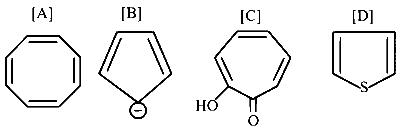
Identify the compound which is non-aromatic in nature.
PYP
COMEDK 2024 EVENING SHIFT
Based on Valence Bond Theory, match the complexes listed in Column I with the number of unpaired electrons on the central metal ion, given in Column II
| No. | Complex ions | No. | Number of unpaired electrons |
|---|---|---|---|
| (A) | $$ \left[\mathrm{Fe} \mathrm{F}_6\right]^{3-} $$ |
(P) | 0 |
| (B) | $$ \left[\mathrm{Fe}(\mathrm{CN})_6\right]^{4-} $$ |
(P) | 1 |
| (C) | $$ \left[\mathrm{Fe}\left(\mathrm{H}_2 \mathrm{O}\right)_6\right]^{2+} $$ |
(R) | 5 |
| (D) | $$ \left[\mathrm{Fe}(\mathrm{CN})_6\right]^{3-} $$ |
(S) | 4 |
PYP
COMEDK 2024 EVENING SHIFT
Based on Crystal Field theory, match the Complex ions listed in Column I with the electronic configuration in the d orbitals of the central metal ion listed in Column II.
| No. | Complexion | No. | d orbital configuration of central metal ion. |
|---|---|---|---|
| (A) | $$ \left[M n(C N)_6\right]^{4-} $$ |
(P) | $$ e_g^2 t_{2 g}^3 $$ |
| (B) | $$ \left[\mathrm{Co}\left(\mathrm{H}_2 \mathrm{O}\right)_6\right]^{2+} $$ |
(Q) | $$ t_{2 g}^4 e_g^2 $$ |
| (C) | $$ \left[\mathrm{Fe}\left(\mathrm{H}_2 \mathrm{O}\right)_6\right]^{2+} $$ |
(R) | $$ t_{2 g}^5 $$ |
| (D) | $$ \left[\mathrm{MnCl}_4\right]^{2-} $$ |
(S) | $$ t_{2 g}^5 e_g^2 $$ |
PYP
COMEDK 2024 EVENING SHIFT
Two statements, Assertion and Reason are given below. Choose the correct option.
Assertion: n-propyl tert-butyl ether can be readily prepared in the laboratory by Williamson's synthesis.
Reason: The reaction occurs by $$\mathrm{S}_{\mathrm{N}} 1$$ attack of Primary alkoxide on Tert-alkyl halide to give good yield of the product, n-propyl tert-butyl ether.
PYP
COMEDK 2024 EVENING SHIFT
Match the names of reactions given in Column I with the appropriate reactions given in Column II.
| No. | Name of reaction | No. | Equations representing reactions |
|---|---|---|---|
| (A) | Sandmeyer | (P) | $$ 2 \mathrm{C}_6 \mathrm{H}_5 \mathrm{Cl}+\mathrm{Na} \text { (dry ether) } \rightarrow \text { Diphenyl. } $$ |
| (B) | Fittig | (Q) | $$ \mathrm{CH}_3-\mathrm{CHBr}-\mathrm{CH}_3+\mathrm{AgF} \rightarrow \mathrm{CH}_3-\mathrm{CHF}-\mathrm{CH}_3+\mathrm{AgBr} $$ |
| (C) | Swarts | (R) | $$ \mathrm{CH}_3-\mathrm{CH}_2-\mathrm{Br}+\mathrm{Nal} \text { ( Acetone) } \rightarrow \mathrm{CH}_3-\mathrm{CH}_2-\mathrm{I}+\mathrm{NaBr} $$ |
| (D) | Finkelstein | (S) | $$ \mathrm{C}_6 \mathrm{H}_5 \mathrm{~N}_2+\mathrm{Cl}-+\mathrm{Cu}_2 \mathrm{Br}_2 / \mathrm{HBr} \rightarrow \mathrm{C}_6 \mathrm{H}_5 \mathrm{Br}+\mathrm{N}_2 $$ |
PYP
COMEDK 2024 EVENING SHIFT
Arrange the compounds $$\mathrm{A}, \mathrm{B}, \mathrm{C}$$ and $$\mathrm{D}$$ in the increasing order of their reactivity towards $$\mathrm{S_N}1$$ reaction.
$$ \begin{aligned} & \mathrm{A}=\mathrm{C}_6 \mathrm{H}_5 \mathrm{CH}_2 \mathrm{Cl} \\ & \mathrm{B}=\mathrm{C}_6 \mathrm{H}_5 \mathrm{Cl} \\ & \mathrm{C}=\mathrm{CH}_2=\mathrm{CH}-\mathrm{Cl} \\ & \mathrm{D}=\mathrm{CH}_3-\mathrm{CH}_2-\mathrm{Cl} \end{aligned}$$
PYP
COMEDK 2024 EVENING SHIFT
Identify the products C, D and F formed in the following sets of reactions.
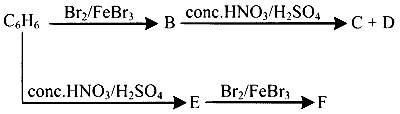
PYP
COMEDK 2024 EVENING SHIFT
4 statements are given below. Identify the incorrect statement
A. Phenol has lower $$\mathrm{pK}_{\mathrm{a}}$$ value than $$\mathrm{p}$$-cresol
B. 2-Chlorophenol is more acidic than phenol
C. Ortho and para nitrophenols can be separated by steam distillation since $$\mathrm{p}$$-Nitrophenol is more steam volatile than o-Nitrophenol
D. Phenol on reaction with $$\frac{\mathrm{Cr}_2 \mathrm{O}_7^{2-}}{\mathrm{H}^{+}}$$ yields a conjugated diketone
PYP
COMEDK 2024 EVENING SHIFT
Identify the final product formed when Toluene undergoes a series of reactions with reagents given in the order:
(i) $$\mathrm{Cl}_2$$ / Sunlight
(ii) $$\mathrm{H}_2 \mathrm{O} / 373 \mathrm{~K}$$
(iii) Acetophenone / $$\mathrm{OH^-}$$ at $$293 \mathrm{~K}$$
PYP
COMEDK 2024 EVENING SHIFT
Identify the end-product [D] formed when solution salicylate undergoes the following series of reactions
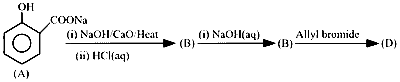
PYP
COMEDK 2024 EVENING SHIFT
Given are the names of 4 compounds. Two of these compounds will not undergo Cannizzaro's reaction. Identify the two.
A. 2-Chlorobutanal
B. 2,2-Dimethylpropanal
C. Benzaldehyde
D. 2-Phenyl ethanol
PYP
COMEDK 2024 EVENING SHIFT
Compounds $$\mathrm{A}$$ and $$\mathrm{B}$$, having the same molecular formula $$(\mathrm{C}_4 \mathrm{H}_8 \mathrm{O})$$, react separately with $$\mathrm{CH}_3 \mathrm{MgBr}$$, followed by reaction with dil. $$\mathrm{HCl}$$ to form compounds $$\mathrm{X}$$ and $$\mathrm{Y}$$ respectively. Compound $$\mathrm{Y}$$ undergoes acidic dehydration in presence of Conc. $$\mathrm{H}_2 \mathrm{SO}_4$$ much more readily than $$\mathrm{X}$$. Compound $$\mathrm{Y}$$ also reacts with Lucas reagent, much more readily than $$\mathrm{X}$$, with appearance of turbidity. Identify $$\mathrm{X}$$ and $$\mathrm{Y}$$.
PYP
COMEDK 2024 EVENING SHIFT
Which one of the following is the correct order of reagents to be used to convent [A] to [X] ?
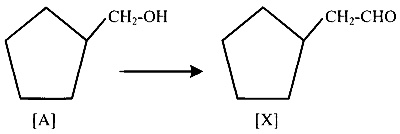
$$ \text { Reagents: } \mathrm{PCC}, \mathrm{PCl}_5, \mathrm{LiAlH}_4, \frac{\mathrm{KCN}}{\mathrm{H}_3 \mathrm{O}^{+}} $$
PYP
COMEDK 2024 EVENING SHIFT
Identify the final product formed when Benzamide undergoes the following reactions:
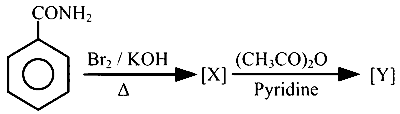
PYP
COMEDK 2024 EVENING SHIFT
What is/are the product/s formed when Benzaldehyde and Ethanal react in presence of dil. $$\mathrm{NaOH}$$ followed by heating the intermediate product formed?
PYP
COMEDK 2024 EVENING SHIFT
Identify the final product $$[\mathrm{D}]$$ formed when Benzyl alcohol undergoes the following series of reactions
$$\mathrm{C}_6 \mathrm{H}_5 \mathrm{CH}_2 \mathrm{OH}+\mathrm{SOCl}_2 \rightarrow[\mathrm{A}]+\mathrm{KCN} \rightarrow[\mathrm{B}]+\mathrm{H}_3 \mathrm{O}^{+} \text {(partial hydrolysis) } \rightarrow[\mathrm{C}]+\mathrm{H}_3 \mathrm{O}^{+} \text {(complete hydrolysis) } \rightarrow[\mathrm{D}]$$
PYP
COMEDK 2024 EVENING SHIFT
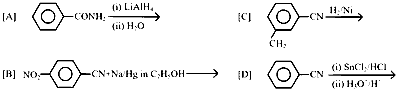
One of the reactions A, B, C, D given below yields a product which will not answer Hinsberg's test when reacted with Benzene sulphonyl chloride. Identify the reaction.
PYP
COMEDK 2024 EVENING SHIFT
A compound having molecular formula $$\mathrm{C}_4 \mathrm{H}_{11} \mathrm{N}$$, reacts with $$\mathrm{CHCl}_3$$ in alcoholic $$\mathrm{KOH}$$, on heating, to form a compound with a foul smell. Identify the optically active isomer of the compound which also shows the above reaction.
PYP
COMEDK 2024 EVENING SHIFT
Match the Vitamins given in Column I with the diseases caused by their deficiency as given in Column II.
| Vitamin | Deficiency | ||
|---|---|---|---|
| (A) | K | (P) | Cheilosis |
| (B) | B$$_12$$ | (Q) | Osteomalacia |
| (C) | B$$_2$$ | (R) | Permicious Anaemia |
| (D) | D | (S) | Haemophilia |
PYP
COMEDK 2024 EVENING SHIFT
Given are 4 statements related to the chemical properties of Glucose.
Identify the two incorrect statements from the following.
A. It reacts with $$\mathrm{Br}_2$$ (aq) to form Saccharic acid.
B. Reacts with Acetic anhydride to form Glucose tetraacetate.
C. Reacts with Hydroxylamine to give Glucose oxime.
D. It reacts with ammoniacal $$\mathrm{AgNO}_3$$ to form ammonium salt of Gluconic acid with deposition of silver.
PYP
COMEDK 2024 EVENING SHIFT
Two statements, Assertion and Reason are given. Choose the correct option from the following.
Assertion: In the secondary structure of RNA, double helix structure is formed.
Reason: In the double structure of RNA, two nucleic acid chains are wound about each other and held together by hydrogen bonds between pairs of bases
PYP
COMEDK 2024 EVENING SHIFT
In the estimation of element $$\mathrm{X}$$ in an organic compound, $$0.8 \mathrm{~g}$$ of the compound containing $$\mathrm{X}$$ was heated with fuming $$\mathrm{HNO}_3$$ and the cooled product was treated with barium chloride. The mass of barium sulphate precipitated was $$1.2 \mathrm{~g}$$. What is the percentage of element $$\mathrm{X}$$ and what is the formula of the violet-coloured compound formed when Lassaigne's extract of the organic compound is treated with sodium nitroprusside?
PYP
COMEDK 2024 EVENING SHIFT
$$ \text { If }(1-4 i)^3=a+i b \text { then the value of } \mathrm{a} \text { and } \mathrm{b} \text { is } $$
PYP
COMEDK 2024 EVENING SHIFT
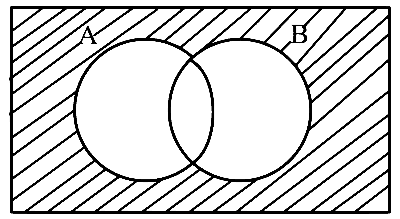
The shaded region in the Venn diagram represents
PYP
COMEDK 2024 EVENING SHIFT
If two positive numbers are in the ratio $$3+2 \sqrt{2}: 3-2 \sqrt{2}$$, then the ratio between their A.M (arithmetic mean) and G.M (geometric mean) is
PYP
COMEDK 2024 EVENING SHIFT
Which of the following relations on the set of real numbers $$\mathrm{R}$$ is an equivalence relation?
PYP
COMEDK 2024 EVENING SHIFT
$$ \text { The solution set for the inequality } 13 x-5<15 x+4<7 x+12 ; x \in W \text { is } $$
PYP
COMEDK 2024 EVENING SHIFT
Consider an infinite geometric series with first term '$$a$$' and common ratio '$$r$$'. If the sum of infinite geometric series is 4 and the second term is $$\frac{3}{4}$$ then
PYP
COMEDK 2024 EVENING SHIFT
Suppose we have three cards identical in form except that both sides of the first card are coloured red, both sides of the second are coloured black, and one side of the third card is coloured red and the other side is coloured black. The three cards are mixed and a card is picked randomly. If the upper side of the chosen card is coloured red, what is the probability that the other side is coloured black.
PYP
COMEDK 2024 EVENING SHIFT
While shuffling a pack of cards, 3 cards were accidently dropped, then find the probability that the missing cards belong to different suits?
PYP
COMEDK 2024 EVENING SHIFT
The letters of the word "COCHIN" are permuted and all the permutations are arranged in alphabetical order as in an English dictionary. The number of words that appear before the word "COCHIN" is
PYP
COMEDK 2024 EVENING SHIFT
For an examination a candidate has to select 7 questions from three different groups $$\mathrm{A}, \mathrm{B}$$ and C. The three groups contain 4, 5 and 6 questions respectively. In how many different ways can a candidate make his selection if he has to select atleast 2 questions from each group?
PYP
COMEDK 2024 EVENING SHIFT
A number consists of three digits in geometric progression. The sum of the right hand and left hand digits exceeds twice the middle digit by 1 and the sum of left hand and middle digits is two third of the sum of the middle and right hand digits. Then the sum of digits of number is
PYP
COMEDK 2024 EVENING SHIFT
A coin is tossed until a head appears or until the coin has been tossed three times. Given that 'head' does not appear on the first toss, what is the probability that the coin is tossed thrice?
PYP
COMEDK 2024 EVENING SHIFT
In the expansion $$\left(\frac{1}{x}+x \sin x\right)^{10}, \quad$$ the co - efficient of $$6^{\text {th }}$$ term is equal to $$7 \frac{7}{8}$$, then the principal value of $$x$$ is
PYP
COMEDK 2024 EVENING SHIFT
What is the probability of a randomly chosen 2 digit number being divisible by 3 ?
PYP
COMEDK 2024 EVENING SHIFT
$$ \text { If } \hat{\imath}+\hat{\jmath}-\hat{k} \quad \&~ 2 \hat{\imath}-3 \hat{\jmath}+\hat{k} \text { are adjacent sides of a parallelogram, then length of its diagonals are } $$
PYP
COMEDK 2024 EVENING SHIFT
Let $$\mathrm{A}$$ and $${B}$$ be two events such that $$P(A / B)=\frac{1}{2}$$ and $$P(B / A)=\frac{1}{3}$$ and $$P(A \cap B)=\frac{1}{6}$$ then, which one of the following is not true?
PYP
COMEDK 2024 EVENING SHIFT
Find the value of '$$b$$' such that the scalar product of the vector $$\hat{\imath}+\hat{\jmath}+\hat{k}$$ with the unit vector parallel to the sum of the vectors $$2 \hat{\imath}+4 \hat{\jmath}-5 \hat{k}$$ and $$b \hat{\imath}+2 \hat{\jmath}+3 \hat{k}$$ is unity
PYP
COMEDK 2024 EVENING SHIFT
The measure of the angle between the lines $$x=k+1, \quad y=2 k-1, \quad z=2 k+3, \quad k \in R \quad$$ and $$\quad \frac{x-1}{2}=\frac{y+1}{1}=\frac{z-1}{-2}$$ is
PYP
COMEDK 2024 EVENING SHIFT
The co-ordinate of the foot of the perpendicular from $$P(1,8,4)$$ on the line joining $$R(0,-1,3)$$ and $$Q(2,-3,-1)$$ is
PYP
COMEDK 2024 EVENING SHIFT
If the straight lines $$\frac{x-2}{1}=\frac{y-3}{1}=\frac{z-4}{-t}$$ and $$\frac{x-1}{t}=\frac{y-4}{2}=\frac{z-5}{1}$$ are intersecting then $$t$$ can have
PYP
COMEDK 2024 EVENING SHIFT
If $$A=\left[\begin{array}{ccc}0 & x & 16 \\ x & 5 & 7 \\ 0 & 9 & x\end{array}\right]$$ is a singular matrix then $$x$$ is equal to
PYP
COMEDK 2024 EVENING SHIFT
$$ \text { If } 3 A+4 B^t=\left(\begin{array}{ccc} 7 & -10 & 17 \\ 0 & 6 & 31 \end{array}\right) \text { and } 2 B-3 A^t=\left(\begin{array}{cc} -1 & 18 \\ 4 & -6 \\ -5 & -7 \end{array}\right) \text { then }(5 B)^t= $$
PYP
COMEDK 2024 EVENING SHIFT
$$ \text { If } A=\left[\begin{array}{cc} 5 a & -b \\ 3 & 2 \end{array}\right] \text { and } A \operatorname{adj} A=A A^t \text {, then } 5 a+b \text { is equal to } $$
PYP
COMEDK 2024 EVENING SHIFT
If the matrix $A$ is such that $$A\left(\begin{array}{cc}-1 & 2 \\ 3 & 1\end{array}\right)=\left(\begin{array}{cc}-4 & 1 \\ 7 & 7\end{array}\right)$$ then $$A$$ is equal to
PYP
COMEDK 2024 EVENING SHIFT
$$ \text { If } \frac{\cos x}{\cos (x-2 y)}=\lambda \text { then } \tan (x-y) \tan y= $$
PYP
COMEDK 2024 EVENING SHIFT
$$ \sqrt{2+\sqrt{2+\sqrt{2+2 \cos 8 \theta}}} \text { where } \theta \in\left[-\frac{\pi}{8}, \frac{\pi}{8}\right] \text { is equal to } $$
PYP
COMEDK 2024 EVENING SHIFT
$$ \text { Value of } \cos 105^{\circ} \text { is } $$
PYP
COMEDK 2024 EVENING SHIFT
The maximum value of $$P=500 x+400 y$$ for the given constraints $$x+y \leq 200, \quad x \geq 20, \quad y \geq 4 x, \quad y \geq 0$$ is
PYP
COMEDK 2024 EVENING SHIFT
$$ \text { Evaluate: } \cot ^{-1}\left(-\frac{3}{\sqrt{3}}\right)-\sec ^{-1}\left(-\frac{2}{\sqrt{2}}\right)-\operatorname{cosec}^{-1}(-1)-\tan ^{-1}(1) $$
PYP
COMEDK 2024 EVENING SHIFT
$$ \text { Evaluate: } \cos ^{-1}\left(\cos \frac{35 \pi}{18}\right)-\sin ^{-1}\left(\sin \frac{35 \pi}{18}\right) $$
PYP
COMEDK 2024 EVENING SHIFT
$$ \text { The function } f(x)=\tan ^{-1}(\sin x+\cos x) \text { is an increasing function in } $$
PYP
COMEDK 2024 EVENING SHIFT
The line joining two points $$A(2,0) B(3,1)$$ is rotated about $$A$$ in anticlockwise direction through an angle of $$15^{\circ}$$. If $$B$$ goes to $$C$$ in the new position, then the coordinates of $$C$$ is
PYP
COMEDK 2024 EVENING SHIFT
$$ \text { The area of the region enclosed by the curve }\left\{(x, y): 4 x^2+25 y^2=100\right\} \text { is } $$
PYP
COMEDK 2024 EVENING SHIFT
The area of the triangle whose vertices are $$(-2, a)(2,-6)$$ and $$(5,4)$$ is 35 sq units then the value of '$$\mathrm{a}$$' is
PYP
COMEDK 2024 EVENING SHIFT
The points on the $$x$$-axis whose perpendicular distance from the line $$\frac{x}{3}+\frac{y}{4}=1$$ is 4 units are
PYP
COMEDK 2024 EVENING SHIFT
The domain of the function $$y=\frac{1}{\log _{10}(3-x)}+\sqrt{x+7}$$ is
PYP
COMEDK 2024 EVENING SHIFT
$$ \text { If } f(x)=\left\{\begin{array}{cc} x & , \quad 0 \leq x \leq 1 \\ 2 x-1 & , \quad x>1 \end{array}\right. \text { then } $$
PYP
COMEDK 2024 EVENING SHIFT
In the parabola $$y^2=4 a x$$ the length of the latus rectum is 6 units and there is a chord passing through its vertex and the negative end of the latus rectum. Then the equation of the chord is
PYP
COMEDK 2024 EVENING SHIFT
Let $$\alpha$$ and $$\beta$$ be the distinct roots of $$a x^2+b x+c=0$$, then $$\lim _\limits{x \rightarrow \alpha} \frac{1-\cos \left(a x^2+b x+c\right)}{(x-\alpha)^2}$$ is equal to
PYP
COMEDK 2024 EVENING SHIFT
$$ \text { The value of } \lim _\limits{x \rightarrow 1} \frac{x^{15}-1}{x^{10}-1}= $$
PYP
COMEDK 2024 EVENING SHIFT
The equation of the circle which touches the $$x$$-axis, passes through the point $$(1,1)$$ and whose centre lies on the line $$x+y=3$$ in the first quadrant is
PYP
COMEDK 2024 EVENING SHIFT
$$ \text { If } y=\sin ^{-1}\left(\frac{5 x+12 \sqrt{1-x^2}}{13}\right) \text { then } \frac{d y}{d x} \text { equals } $$
PYP
COMEDK 2024 EVENING SHIFT
What is the nature of the function $$f(x)=x^3-3 x^2+4 x$$ on real numbers?
PYP
COMEDK 2024 EVENING SHIFT
$$ \text { If } y=\sqrt{\sin x+y} \text { then find } \frac{d y}{d x} \text { at } x=0, \quad y=1 $$
PYP
COMEDK 2024 EVENING SHIFT
$$ \text { If } y=f(x), \quad p=\frac{d y}{d x} ; q=\frac{d^2 y}{d x^2} \text { then } \frac{d^2 x}{d y^2} \text { is equal to } $$
PYP
COMEDK 2024 EVENING SHIFT
The turning point of the function $$y=\frac{a x-b}{(x-1)(x-4)}$$ at the point $$P(2,-1)$$ is
PYP
COMEDK 2024 EVENING SHIFT
The side of a cube is equal to the diameter of a sphere. If the side and radius increase at the same rate then the ratio of the increase of their surface area is
PYP
COMEDK 2024 EVENING SHIFT
$$ \text { The rate of change of the volume of a sphere with respect to its surface area } \mathrm{S} \text { is } $$
PYP
COMEDK 2024 EVENING SHIFT
$$ \text { The value of } \int \frac{d x}{\sqrt{2 x-x^2}} \text { is } $$
PYP
COMEDK 2024 EVENING SHIFT
$$ \int e^x\left[\frac{x^2+1}{(x+1)^2}\right] d x \quad \text { is equal to } $$
PYP
COMEDK 2024 EVENING SHIFT
$$ \text { If } I_n=\int_\limits0^{\frac{\pi}{4}} \tan ^n x d x \text {, for } n \geq 2 \text {, then } I_n+I_{n-2}= $$
PYP
COMEDK 2024 EVENING SHIFT
If $$a$$ is a real number such that $$\int_\limits0^a x d x \leq a+4$$ then
PYP
COMEDK 2024 EVENING SHIFT
$$ \text { The value of the integral } \int_\limits{\frac{1}{3}}^1 \frac{\left(x-x^3\right)^{\frac{1}{3}}}{x^4} d x \text { is } $$
PYP
COMEDK 2024 EVENING SHIFT
Given below are 4 reactions. Two of these reactions will give product which is an equimolar mixture of the d and 1 forms. Identify these 2 reactions.
[A] 2- Methylpropene + $$\mathrm{HI} \rightarrow$$ ---------
[B] But-1-ene + $$\mathrm{HBr} \rightarrow$$ -----------
[C] 3-Methylbut-1-ene + $$\mathrm{HI} \rightarrow$$ -----------
[D] 3- Phenylpropene + $$\mathrm{HBr}$$ (Peroxide) $$\rightarrow$$ -----------
PYP
COMEDK 2024 EVENING SHIFT
$$ \text { If } \frac{d y}{d x}=y+3>0 \text { and } y(0)=2 \text { then } y(\log 2) \text { is equal to } $$
PYP
COMEDK 2024 EVENING SHIFT
The sum of the order and degree of the differential equation $$\left(\frac{d^2 y}{d x^2}\right)^5+\frac{4\left(\frac{d^2 y}{d x^2}\right)^3}{\left(\frac{d^3 y}{d x^3}\right)}+\frac{d^3 y}{d x^3}=x^2-1$$ is
PYP
COMEDK 2024 EVENING SHIFT
$$ \text { The general solution of the differential equation }(1+\tan y)(d x-d y)+2 x d y=0 \text { is } $$
PYP
COMEDK 2024 EVENING SHIFT
The general solution of the differential equation $$x \frac{d y}{d x}=y+x \tan \left(\frac{y}{x}\right)$$ is
PYP
COMEDK 2024 EVENING SHIFT
The area bounded by the curve $$y=\cos x, x=0$$ and $$x=\pi$$ is
PYP
COMEDK 2024 EVENING SHIFT
A dry cell consists of a moist paste of $$\mathrm{NH}_4 \mathrm{Cl}$$ and $$\mathrm{ZnCl}_2$$ contained in a $$\mathrm{Zn}$$ casing which encloses a Carbon rod surrounded by black $$\mathrm{MnO}_2$$ paste. What is the role of $$\mathrm{ZnCl}_2$$ in it?
PYP
COMEDK 2024 EVENING SHIFT
A Hydrocarbon [A] (molecular formula $$\mathrm{C}_3 \mathrm{H}_6$$) on reaction with $$\mathrm{Br}_2 / \mathrm{CCl}_4$$ gave [B]. When [B] is heated with 2 moles of alcoholic $$\mathrm{KOH}$$, it gave compound [C]. 3 moles of Compound [C] when passed through red hot Iron tube forms [D]. Identify [D].
Showing 5 of 180 questions