Difficulty distribution
How the classified questions are distributed by difficulty.
18questions
Not classified
18
100%
Your cart is empty.
Practice Rotational Motion - Mechanics - Physics previous year questions organised from real papers, with year-wise coverage and clear topic navigation.
Every graph below is calculated only from this selection.
Year-wise coverage for Rotational Motion. Each bar uses a separate theme-derived color.
How the classified questions are distributed by difficulty.
MCQ, numerical, multiple-select and other formats found in these papers.
Top subjects by unique question coverage.
Top topics across the included previous year papers.
Top subtopics inside this exact selection.
Question coverage for the most populated papers. Every active PYP paper remains listed below.
Newest papers appear first. Sort by year, question coverage or name.
| Paper | Year / session | Questions in this view | Open |
|---|---|---|---|
| COMEDK 2026 Afternoon Shift | 2026 | 2 | View paper |
| COMEDK 2026 Morning Shift | 2026 | 2 | View paper |
| COMEDK 2025 AFTERNOON SHIFT | 2025 | 1 | View paper |
| COMEDK 2025 EVENING SHIFT | 2025 | 1 | View paper |
| COMEDK 2025 Morning Shift | 2025 | 1 | View paper |
| COMEDK 2024 AFTERNOON SHIFT | 2024 | 2 | View paper |
| COMEDK 2024 EVENING SHIFT | 2024 | 2 | View paper |
| COMEDK 2024 MORNING SHIFT | 2024 | 1 | View paper |
| COMEDK 2023 EVENING SHIFT | 2023 | 1 | View paper |
| COMEDK 2023 Morning Shift | 2023 | 1 | View paper |
| COMEDK 2022 | 2022 | 1 | View paper |
| COMEDK 2021 | 2021 | 1 | View paper |
| COMEDK 2020 | 2020 | 2 | View paper |
Practice every matching question in batches of 20, with every available option.
Four particles each of the mass m are placed at the corners of a square of side length \(l\). The radius of gyration of the system about an axis perpendicular to the square and passing through its centre is
The masses of 200 g and 300 g are attached to the 20 cm and 70 cm marks of a light meter rod, respectively. The moment of inertia of the system about an axis passing through 50 cm mark is
Newton's second law of rotational motion of a system particles having angular momentum L is given by
A disc of moment of inertia 4 kg - m\(^2\) revolving with 16 rad/s is placed on another disc of moment of inertia 8 kg - m\(^2\) revolving 4 rad/s. The angular frequency of composite disc
A wheel is free to rotate about a horizontal axis through O. A force of \(200 \mathrm{~N}\) is applied at a point \(\mathrm{P} 2 \mathrm{~cm}\) from the center \(\mathrm{O}\). OP makes an angle of \(55^{\circ}\) with \(\mathrm{x}\) axis and the force is in the plane of the wheel making an angle of \(25^{\circ}\) with the horizontal axis. What is the torque?
An object of mass \(1 \mathrm{~kg}\) is allowed to hang tangentially from the rim of the wheel of radius R. When released from the rest, the block falls vertically through \(4 \mathrm{~m}\) height in 2 seconds. The moment of inertia is \(1 \mathrm{~kg} \mathrm{~m}^2\). The radius of the wheel \(\mathrm{R}\) is

A record player is spinning at an angular velocity of \(45 \mathrm{~rpm}\) just before it is turned off. It then decelerates at a constant rate of \(0.8 \mathrm{~rad} \mathrm{~s}^{-1}\). The angular displacement is
A solid cylinder of mass \(2 \mathrm{~kg}\) and radius \(0.2 \mathrm{~m}\) is rotating about its own axis without friction with angular velocity \(5 \mathrm{~rad} \mathrm{s}^{-1}\). A particle of mass \(1 \mathrm{~kg}\) moving with a velocity of \(5 \mathrm{~ms}^{-1}\) strikes the cylinder and sticks to it as shown in figure.
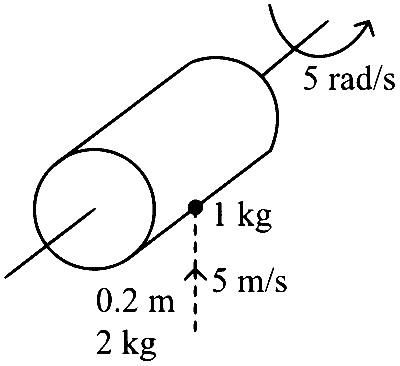
The angular velocity of the system after the particle sticks to it will be
Joule second is the unit of
A body of mass \(5 \mathrm{~kg}\) at rest is rotated for \(25 \mathrm{~s}\) with a constant moment of force \(10 \mathrm{~Nm}\). Find the work done if the moment of inertia of the body is \(5 \mathrm{~kg} \mathrm{~m}^2\).
A thin circular ring of mass ,\(M\) and radius \(R\) rotates about an axis through its centre and perpendicular to its plane, with a constant angular velocity \(\omega\). Four small spheres each of mass \(m\) (negligible radius) are kept gently to the opposite ends of two mutually perpendicular diameters of the ring. The new angular velocity of the ring will be
A particle starts rotating from rest. The instantaneous angular displacement is $\theta=3 t^3-t^2$, where $\theta$ is in radian and $t$ in s; The angular velocity at $t=1 \mathrm{~s}$ is
Four masses each 2 kg are placed at the corners A, B, C, D of a mass less square frame. 40 kg mass is at the centre O of a square frame of side 0.2 m . It is to be rotated about an axis passing through the centre O and perpendicular to the plane of the frame. Calculate the torque in $\mathrm{N}-\mathrm{m}$ required to produce an angular acceleration of $\frac{\pi}{2} \mathrm{rads}^{-2}$.
A singer, during his performance, stands on the edge of a circular turntable, and begins to walk along its edge with a speed of $1.5 \mathrm{~ms}^{-1}$ relative to the ground. The turn table is mounted on a frictionless vertical axle. Its radius R =3m and its moment of inertia about the axle is $150 \mathrm{~kg} \mathrm{~m}^2$. It is initially at rest. If the mass of the singer is 75 kg , the time taken by the man to complete one revolution is:
A bullet, fired into a door gets embedded exactly at it's centre, causing the door to rotate about it's vertical axis, practically without friction, with an angular velocity of $0.625 \mathrm{rads}^{-1}$. The door is 1.0 m wide and weighs 12 kg . If the mass of the bullet is 10 g , find the speed with which it was fired. (Hint: The moment of inertia of the door about the vertical axis at one end is $\frac{M L^2}{3}$.