Difficulty distribution
How the classified questions are distributed by difficulty.
17questions
Not classified
17
100%
Your cart is empty.
Practice Laws Of Motion - Mechanics - Physics previous year questions organised from real papers, with year-wise coverage and clear topic navigation.
Every graph below is calculated only from this selection.
Year-wise coverage for Laws Of Motion. Each bar uses a separate theme-derived color.
How the classified questions are distributed by difficulty.
MCQ, numerical, multiple-select and other formats found in these papers.
Top subjects by unique question coverage.
Top topics across the included previous year papers.
Top subtopics inside this exact selection.
Question coverage for the most populated papers. Every active PYP paper remains listed below.
Newest papers appear first. Sort by year, question coverage or name.
| Paper | Year / session | Questions in this view | Open |
|---|---|---|---|
| COMEDK 2026 Afternoon Shift | 2026 | 1 | View paper |
| COMEDK 2026 Morning Shift | 2026 | 1 | View paper |
| COMEDK 2025 AFTERNOON SHIFT | 2025 | 1 | View paper |
| COMEDK 2025 EVENING SHIFT | 2025 | 1 | View paper |
| COMEDK 2025 Morning Shift | 2025 | 1 | View paper |
| COMEDK 2024 AFTERNOON SHIFT | 2024 | 2 | View paper |
| COMEDK 2024 EVENING SHIFT | 2024 | 2 | View paper |
| COMEDK 2024 MORNING SHIFT | 2024 | 1 | View paper |
| COMEDK 2023 EVENING SHIFT | 2023 | 3 | View paper |
| COMEDK 2022 | 2022 | 1 | View paper |
| COMEDK 2021 | 2021 | 1 | View paper |
| COMEDK 2020 | 2020 | 2 | View paper |
Practice every matching question in batches of 20, with every available option.
Which of the following laws of Physics is valid across all domains of nature?
A body under the action of a force \(F = 6\widehat i - 8\widehat j + 10\widehat k\), acquires an acceleration of 1 m/s2. The mass of this body must be
The motion of a particle of mass \(m\) is described by \(y = ut + g{t^2}\). The force acting on the particle will be
With what minimum acceleration can a fireman slide down a rope while breaking strength of the rope is \(\frac{2}{3}\) of the weight?
If the resultant of all external forces acting on a system of particles is zero, then from an inertial frame one can surely say that
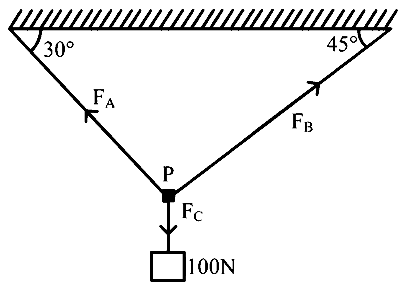
\(\mathrm{F}_{\mathrm{A}}, \mathrm{F}_{\mathrm{B}}\) and \(\mathrm{F}_{\mathrm{C}}\) are three forces acting at point \(\mathrm{P}\) as shown in figure. The whole system is in equilibrium state. The magnitude of \(\mathrm{F}_{\mathrm{A}}\) is
A hockey player hits the ball at an angle of \(37^{\circ}\) from the horizontal with an initial speed of \(40 \mathrm{~m} / \mathrm{s}\) (a right angled triangle with one of the angle is \(37^{\circ}\) and their sides in the ratio of \(6: 8: 10\)). Assume that the ball is in a vertical plane. The time at which the ball reaches the highest point of its path is
A man standing in a truck moving with constant velocity throws a ball vertically into air, ball falls
A cube bar slides thrice the time with friction than that without friction when it slides on an inclined plane of inclination \(45^{\circ}\). The coefficient of friction between the block and the surface is
A body initially at rest undergoes rectilinear motion. The forcetime (F-t) graph for the motion of the body is given below. Find the linear momentum gained by the body in \(2 \mathrm{~s}\).

Action and reaction can never balance out because
A stone of mass \(2 \mathrm{~kg}\) is hung from the ceiling of the room using two strings. If the strings make an angle \(60^{\circ}\) and \(30^{\circ}\) respectively with the horizontal surface of the roof then the tension on the longer string is : \(g=10 \mathrm{~ms}^{-2}\)
A machine gun fires a bullet of mass m with a velocity of $1000 \mathrm{~m} / \mathrm{min}$. The man holding the gun can exert a force of 200 N on the gun. The product of mass of each bullet and the number of bullets fired in one sec is
A block of metal, of 25 g mass moves down without acceleration when the plane is inclined at an angle of $30^{\circ}$. When the inclination is increased by $30^{\circ}$, find the downward acceleration of the block.