Difficulty distribution
How the classified questions are distributed by difficulty.
29questions
Not classified
29
100%
Your cart is empty.
Practice Gravitation - Mechanics - Physics previous year questions organised from real papers, with year-wise coverage and clear topic navigation.
Every graph below is calculated only from this selection.
Year-wise coverage for Gravitation. Each bar uses a separate theme-derived color.
How the classified questions are distributed by difficulty.
MCQ, numerical, multiple-select and other formats found in these papers.
Top subjects by unique question coverage.
Top topics across the included previous year papers.
Top subtopics inside this exact selection.
Question coverage for the most populated papers. Every active PYP paper remains listed below.
Newest papers appear first. Sort by year, question coverage or name.
| Paper | Year / session | Questions in this view | Open |
|---|---|---|---|
| COMEDK 2026 Afternoon Shift | 2026 | 2 | View paper |
| COMEDK 2026 Morning Shift | 2026 | 2 | View paper |
| COMEDK 2025 AFTERNOON SHIFT | 2025 | 3 | View paper |
| COMEDK 2025 EVENING SHIFT | 2025 | 2 | View paper |
| COMEDK 2025 Morning Shift | 2025 | 2 | View paper |
| COMEDK 2024 AFTERNOON SHIFT | 2024 | 2 | View paper |
| COMEDK 2024 EVENING SHIFT | 2024 | 2 | View paper |
| COMEDK 2024 MORNING SHIFT | 2024 | 2 | View paper |
| COMEDK 2023 EVENING SHIFT | 2023 | 2 | View paper |
| COMEDK 2023 Morning Shift | 2023 | 3 | View paper |
| COMEDK 2022 | 2022 | 3 | View paper |
| COMEDK 2021 | 2021 | 2 | View paper |
| COMEDK 2020 | 2020 | 2 | View paper |
Practice every matching question in batches of 20, with every available option.
Two spherical bodies of masses M and 5M and radii R and 2R are released in free space with initial separation between their centres equal to 12 R. If they attract each other due to gravitational force only, then the distance covered by the smaller body before collision is
A satellite can be in a geostationary orbit around a planet if it is at a distance R from the centre of the planet. If the planet starts rotating about its axis with double the angular velocity, then to make the satellite geostationary, its orbital radius should be
A constant potential energy of a satellite is given as
$$\mathrm{PE}=r(\mathrm{KE})$$
whee, PE = potential energy
and KE = kinetic energy.
The value of \(r\) will be
Kepler's second law of planetary motion corresponds to
If the earth were to spin faster, acceleration due to gravity at the poles
The escape velocity of a projectile on the earth's surface is 11.2 km/s. A body is projected out with thrice this speed. The speed of the body far away from the earth will be
The height at which the acceleration due to gravity becomes \(\frac{g}{16}\) (where, g = acceleration due to gravity on the surface of the earth) in terms of R is, if R is the radius of earth.
An uniform sphere of mass \(M\) and radius \(R\) exerts a force of \(F\) on a small mass \(m\) placed at a distance of 3R from the centre of the sphere. A spherical portion of diameter \(R\) is cut from the sphere as shown in the fig. The force of attraction between the remaining part of the disc and the mass \(\mathrm{m}\) is
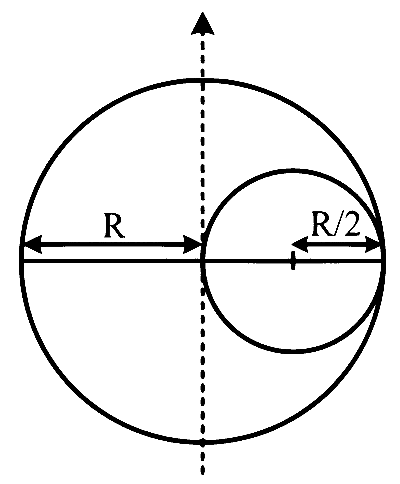
The acceleration due to gravity at a height of \(7 \mathrm{~km}\) above the earth is the same as at a depth d below the surface of the earth. Then d is
Energy required for moving a body of mass \(\mathrm{m}\) from a circular orbit of radius 3R to a higher orbit of radius 4R around the earth is.
A planet has double the mass of the earth and double the radius. The gravitational potential at the surface of the Earth is \(\mathrm{V}\) and the magnitude of the gravitational field strength is \(\mathrm{g}\). The gravitational potential and gravitational field strength on the surface of the planet are
| Potential | Field | |
|---|---|---|
| A | V | $$\frac{g}{4}$$ |
| B | 2V | $$\frac{g}{2}$$ |
| C | V | $$\frac{g}{2}$$ |
| D | 2V | $$\frac{g}{4}$$ |
The acceleration due to gravity at pole and equator can be related as
A satellite is revolving around the earth in a circular orbit with kinetic energy of \(1.69 \times 10^{10} \mathrm{~J}\). The additional kinetic energy required for just escaping into the outer space is
If \(\mathrm{A}\) is the areal velocity of a planet of mass \(\mathrm{M}\), then its angular momentum is
If the earth has a mass nine times and radius four times that of planet X, the ratio of the maximum speed required by a rocket to pull out of the gravitational force of planet \(\mathrm{X}\) to that of the earth is
If the distance between the Sun and Earth is doubled, then the duration of the year on earth will be :
[Given actual duration of the year $=\mathbf{T}$ ]
Showing 20 of 29 questions