Difficulty distribution
How the classified questions are distributed by difficulty.
31questions
Not classified
31
100%
Your cart is empty.
Practice Sets And Relations - Algebra - Mathematics previous year questions organised from real papers, with year-wise coverage and clear topic navigation.
Every graph below is calculated only from this selection.
Year-wise coverage for Sets And Relations. Each bar uses a separate theme-derived color.
How the classified questions are distributed by difficulty.
MCQ, numerical, multiple-select and other formats found in these papers.
Top subjects by unique question coverage.
Top topics across the included previous year papers.
Top subtopics inside this exact selection.
Question coverage for the most populated papers. Every active PYP paper remains listed below.
Newest papers appear first. Sort by year, question coverage or name.
| Paper | Year / session | Questions in this view | Open |
|---|---|---|---|
| COMEDK 2025 AFTERNOON SHIFT | 2025 | 4 | View paper |
| COMEDK 2025 EVENING SHIFT | 2025 | 3 | View paper |
| COMEDK 2025 Morning Shift | 2025 | 3 | View paper |
| COMEDK 2024 AFTERNOON SHIFT | 2024 | 3 | View paper |
| COMEDK 2024 EVENING SHIFT | 2024 | 3 | View paper |
| COMEDK 2024 MORNING SHIFT | 2024 | 3 | View paper |
| COMEDK 2023 EVENING SHIFT | 2023 | 3 | View paper |
| COMEDK 2023 Morning Shift | 2023 | 2 | View paper |
| COMEDK 2022 | 2022 | 1 | View paper |
| COMEDK 2021 | 2021 | 2 | View paper |
| COMEDK 2020 | 2020 | 4 | View paper |
Practice every matching question in batches of 20, with every available option.
A group (G *) has 10 elements. The minimum number of elements of G, which are their own inverses is
In the group \((G\,{ \otimes _{15}})\), where \(G = \{ 3,6,9,12\}\), \({ \otimes _{15}}\) is multiplication modulo 15, the identity element is
Which of the following is not a group with respect to the given operation?
A graph G has m vertices of odd degree and ‘n’ vertices of even degree. Then which of the following statements is necessarily true?
If A = {1, 2, 5, 6} and B = {1, 2, 3}, then (A \(\times\) B) \(\cap\) (B \(\times\) A) is equal to
Total number of elements in the power set of A containing 15 elements is
If \(A=\{3,5,7\}\) and \(B=\{1,2,3,5\}\), then \(A \times B \cap B \times A\) is equal to
In the set \(\mathrm{W}\) of whole numbers an equivalence relation \(\mathrm{R}\) is defined as follows \(\mathrm{aRb}\) iff both \(\mathrm{a}\) & \(\mathrm{~b}\) leave the same reminder when divided by 5. The equivalence class of 1 is given by.
Let \(X\) and \(Y\) be the set of all positive divisors of 400 and 1000 respectively (including 1 and the number). Then \(n(X \cap Y)\) is equal to
Which of the following is a singleton set?
$$\text { Let } \mathrm{A} \text { and } \mathrm{B} \text { be two sets then } A-(A \cap B) \text { is equal to }$$
A relation \(R\) is defined from \(\{2,3,4\}\) to \(\{3,6,7,10\}\). If \(x R y \Leftrightarrow x\) and \(y\) are co prime numbers. Then range of \(R\) is
$$\text { If } a \mathcal{N}=\{a x: x \in \mathcal{N}\} \text {, then } 3 \mathcal{N} \cap 7 \mathcal{N} \text { is }$$
Two finite sets have '\(m\)' and '\(n\)' number of elements respectively. The total number of subsets of the first set is 112 more than the total number of subsets of the second set. Then the values of \(\mathrm{m}\) and \(\mathrm{n}\) are respectively.
Which of the following relations on the set of real numbers \(\mathrm{R}\) is an equivalence relation?
The shaded region in the Venn diagram represents
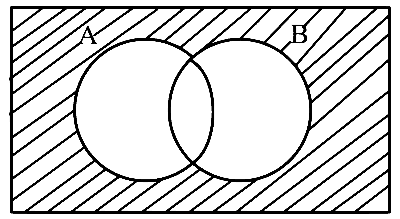
Express the set \(A=\{1,7,17,31,49\}\) in set builder form
$$\begin{aligned} &\begin{aligned} & \text { A, B, C are subsets of the Universal set U } \\ & \text { If } \mathrm{A}=\{x: x \text { is even number, } x \leq 20\} \\ & \mathrm{B}=\{x: x \text { is multiple of } 3, x \leq 15\} \\ & \mathrm{C}=\{x: x \text { is multiple of } 5, x \leq 20\} \\ & \mathrm{U}=\text { Set of whole numbers } \end{aligned}\\ &\text { then the Venn diagram representing } \mathrm{U}, \mathrm{A}, \mathrm{B} \text { and } \mathrm{C} \text { is } \end{aligned}$$


$$\text { If } A=\{1,2,3,4,5\} \text { and } B=\{2,3,6,7\} \text { then number of elements in the set }(A \times B) \cap(B \times A) \text { is equal to }$$
Showing 20 of 31 questions