Difficulty distribution
How the classified questions are distributed by difficulty.
51questions
Not classified
51
100%
Your cart is empty.
Practice Probability - Algebra - Mathematics previous year questions organised from real papers, with year-wise coverage and clear topic navigation.
Every graph below is calculated only from this selection.
Year-wise coverage for Probability. Each bar uses a separate theme-derived color.
How the classified questions are distributed by difficulty.
MCQ, numerical, multiple-select and other formats found in these papers.
Top subjects by unique question coverage.
Top topics across the included previous year papers.
Top subtopics inside this exact selection.
Question coverage for the most populated papers. Every active PYP paper remains listed below.
Newest papers appear first. Sort by year, question coverage or name.
| Paper | Year / session | Questions in this view | Open |
|---|---|---|---|
| COMEDK 2025 AFTERNOON SHIFT | 2025 | 5 | View paper |
| COMEDK 2025 EVENING SHIFT | 2025 | 5 | View paper |
| COMEDK 2025 Morning Shift | 2025 | 5 | View paper |
| COMEDK 2024 AFTERNOON SHIFT | 2024 | 4 | View paper |
| COMEDK 2024 EVENING SHIFT | 2024 | 5 | View paper |
| COMEDK 2024 MORNING SHIFT | 2024 | 5 | View paper |
| COMEDK 2023 EVENING SHIFT | 2023 | 5 | View paper |
| COMEDK 2023 Morning Shift | 2023 | 6 | View paper |
| COMEDK 2022 | 2022 | 6 | View paper |
| COMEDK 2021 | 2021 | 5 | View paper |
Practice every matching question in batches of 20, with every available option.
Three of the six vertices of a regular hexagon are chosen at random. The probability that the triangle with three vertices is equilateral equals
The coefficients a, b and c of the quadratic equation, \(ax^2+bx+c=0\) are obtained by throwing a dice three times. The probability that this equation has equal roots is
A student answers a multiple choice question with 5 alternatives, of which exactly one is correct. The probability that he knows the correct answer is \(p,0 < p < 1\). If he does not know the correct answer, he randomly ticks one answer. Given that he has answered the question correctly, the probability that he did not tick the answer randomly, is
If A, B and C are mutually exclusive and exhaustive events of a random experiment such that \(P(B) = {3 \over 2}P(A)\) and \(P(C) = {1 \over 2}P(B)\), then \(P(A \cup C)\) equals
Five persons A, B, C, D and E are in queue of a shop. The probability that A and E are always together, is
If the probability for A to fail in an examination is 0.2 and that for B is 0.3, then the probability that either A or B fail is
Three vertices are chosen randomly from the seven vertices of a regular 7-sided polygon. The probability that they form the vertices of an isosceles triangle is
The probability of choosing randomly a number c from the set {1, 2, 3, ... 9} such that the quadratic equation \(x^2+4x+c=0\) has real roots, is
Five persons A, B, C, D and E are in queue of a shop. The probability that A and B are always together is
If A, B and C are three mutually exclusive and exhaustive events such that P(A) = 2P(B) = 3P(C). What is P(B)?
A multiple choice examination has 5 questions. Each question has three alternative answers of which exactly one is correct. The probability that a student will get 4 or more correct answer just by guessing, is
A die is thrown twice and the sum of numbers appearing is observed to be 8 . What is the conditional probability that the number 5 has appeared atleast once?
Bag A contains 3 white and 2 red balls. Bag B contains only 1 white ball. A fair coin is tossed. If head appears then 1 ball is drawn at random from bag A and put into bag B. However if tail appears then 2 balls are drawn at random from bag A and put into bag B. Now one ball is drawn at random from bag B. Given that the drawn ball from B is white, the probability that head appeared on the coin is
The probability distribution of a discrete random variable X is given as
| $$\mathrm{X}$$ | 1 | 2 | 4 | 2A | 3A | 5A |
|---|---|---|---|---|---|---|
| $$\mathrm{P(X)}$$ | $$\frac{1}{2}$$ | $$\frac{1}{5}$$ | $$\frac{3}{25}$$ | K | $$\frac{1}{25}$$ | $$\frac{1}{25}$$ |
$$\text { Then the value of } A \text { if } E(X)=2.94 \text { is }$$
$$\text { If } P(B)=\frac{3}{5} \quad P(A / B)=\frac{1}{2} \text { and } P(A \cup B)=\frac{4}{5} \text { then } P(A \cup B)^{\prime}+P\left(A^{\prime} \cup B\right)=$$
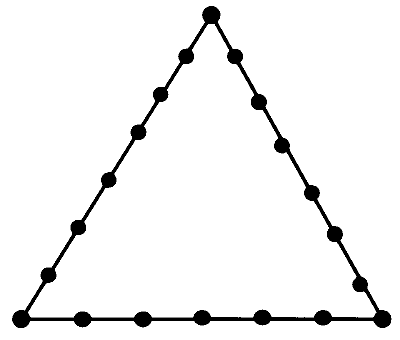
18 Points are indicated on the perimeter of a triangle \(\mathrm{ABC}\) as shown below. If three points are chosen then probability that it will from a triangle is
There are some baskets. The chances of picking a loaded basket and choosing a red coloured one is 0.2 . For every 100 tries to pick one basket, 60 times a basket is either loaded or red in colour. What is the probability of choosing an empty basket plus choosing not a red coloured one.
The probability of inviting three friends on 5 consecutive days, exactly one friend a day and no friend is invited on more than two days is
P and Q are considering to apply for a job. The probability that P applies for the job is \(\frac{1}{4}\). The probability that \(\mathrm{P}\) applies for the job given that \(\mathrm{Q}\) applies for the job is \(\frac{1}{2}\), and the probability that Q applies for the job given that P applies for the job is \(\frac{1}{3}\). Then the probability that \(\mathrm{P}\) does not apply for the job given that \(\mathrm{Q}\) does not apply for the job is
A determinant of the second order is made with elements 0 and 1 . What is the probability that the determinant made is non-negative?
Showing 20 of 51 questions