Difficulty distribution
How the classified questions are distributed by difficulty.
45questions
Not classified
45
100%
Your cart is empty.
Practice Chemical Kinetics - Physical Chemistry - Chemistry previous year questions organised from real papers, with year-wise coverage and clear topic navigation.
Every graph below is calculated only from this selection.
Year-wise coverage for Chemical Kinetics. Each bar uses a separate theme-derived color.
How the classified questions are distributed by difficulty.
MCQ, numerical, multiple-select and other formats found in these papers.
Top subjects by unique question coverage.
Top topics across the included previous year papers.
Top subtopics inside this exact selection.
Question coverage for the most populated papers. Every active PYP paper remains listed below.
Newest papers appear first. Sort by year, question coverage or name.
| Paper | Year / session | Questions in this view | Open |
|---|---|---|---|
| COMEDK 2025 AFTERNOON SHIFT | 2025 | 5 | View paper |
| COMEDK 2025 EVENING SHIFT | 2025 | 5 | View paper |
| COMEDK 2025 Morning Shift | 2025 | 5 | View paper |
| COMEDK 2024 AFTERNOON SHIFT | 2024 | 5 | View paper |
| COMEDK 2024 EVENING SHIFT | 2024 | 5 | View paper |
| COMEDK 2024 MORNING SHIFT | 2024 | 5 | View paper |
| COMEDK 2023 EVENING SHIFT | 2023 | 5 | View paper |
| COMEDK 2023 Morning Shift | 2023 | 3 | View paper |
| COMEDK 2022 | 2022 | 3 | View paper |
| COMEDK 2021 | 2021 | 3 | View paper |
| COMEDK 2020 | 2020 | 1 | View paper |
Practice every matching question in batches of 20, with every available option.
Which one of the following is a second order reaction?
Determine the specific rate constant of the reaction. If the half-life period of a first order reaction is 1402 s.
Rate constant (K) of a reaction has least value at
For the reaction 2N\(_2\)O\(_5\) \(\to\) 4NO\(_2\) + O\(_2\), rate constant \(k\) is 4.48 \(\times\) 10\(^{-5}\) s\(^{-1}\) and the initial pressure is 600 atm. After 10 min, determine the final pressure of N\(_2\)O\(_5\).
For the reaction 2N\(_2\)O\(_5\) \(\to\) 4NO\(_2\) + O\(_2\).
If initial pressure is 100 atm and rate constant \(k\) is 3.38 \(\times\) 10\(^{-5}\) s\(^{-1}\). after 20 min the final pressure of N\(_2\)O\(_5\) will be
Which of the following statement is incorrect about activation energy?
A newly prepared radioactive nuclide has a decay constant of 6.93 s\(^{-1}\). What is the half-life of the nuclide?
The rate constant for a First order reaction at \(560 \mathrm{~K}\) is \(1.5 \times 10^{-6}\) per second. If the reaction is allowed to take place for 20 hours, what percentage of the initial concentration would have converted to products?
A first order reaction proceeds to \(90 \%\) completion. What will be the approximate time taken for \(90 \%\) completion in relation to \(t_{1 / 2}\) of the reaction?
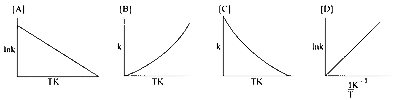
Given below are graphs showing the variation in velocity constant with temperature on Kelvin scale. Identify the graph which represents Arrhenius equation.
Match the details given in Column I with those given in Column II
| S.No. | Column I | S.No. | Column II |
|---|---|---|---|
| A | For complex reactions order is determined by | P | Rate of reaction. |
| B | For Zero order reaction unit of $\mathrm{k}$ is same as that of | Q | Slope \(=k/2.303\) |
| C | Mathematical expression which gives relationship between rate of reaction and concentrations of reactants is called | R | Slowest rate determining step. |
| D | For a first order reaction plot of \(\mathrm{\log \left[R_0\right] /[R]}\) vs time gives | S | Rate law. |
For a reaction of the type, \(2 \mathrm{X}+\mathrm{Y} \rightarrow \mathrm{A}+\mathrm{B}\), the following is the data collected:
| Experiment | $$\mathrm{[X]}$$ | $$\mathrm{[Y]}$$ | Initial rate of formation of A |
|---|---|---|---|
| 1 | 0.2 | 0.2 | $$12.0\times10^{-3}$$ |
| 2 | 0.6 | 0.4 | $$\mathrm{14.4\times10^{-2}}$$ |
| 3 | 0.6 | 0.8 | $$5.76\times10^{-1}$$ |
| 4. | 0.8 | 0.2 | $$\mathrm{4.8\times10^{-2}}$$ |
What is the overall order of the reaction?
For the reaction, \(\mathrm{A}+3 \mathrm{~B} \rightarrow 2 \mathrm{C}+\mathrm{D}\), the concentration of \(\mathrm{A}\) changes from 0.0150 to 0.0125 in 1 minute. The rate of formation of \(\mathrm{C}\) in \(\mathrm{mol} \mathrm{~L}^{-1} \mathrm{~s}^{-1}\) is:
The half-life for a zero order reaction is
Given below a first order reaction in the gas phase
$$\mathrm{A}(\mathrm{g}) \rightarrow \mathrm{B}(\mathrm{g})+\mathrm{C}(\mathrm{g})$$
If the initial pressure of the system is \(\mathrm{P}_{\mathrm{i}}\) and the total pressure at \(\mathrm{t}\) seconds is \(\mathrm{P}_{\mathrm{t}}\), the rate constant \(\mathrm{k}\) for the reaction is:
The rate of appearance of bromine is related to the disappearance of bromide ion in the equation given below is:
$$\mathrm{BrO}_3^{-} \text {(aq) }+5 \mathrm{Br}^{-} \text {(aq) }+6 \mathrm{H}^{+} \rightarrow 3 \mathrm{Br}_2(\mathrm{l})+3 \mathrm{H}_2 \mathrm{O}(\mathrm{l})$$
The temperature \((\mathrm{T})\) and rate constant \((\mathrm{k})\) for a first order reaction \(\mathrm{R} \rightarrow \mathrm{P}\), was found to follow the equation \(\log \mathrm{k}=-(2000) \frac{1}{\mathrm{~T}}+8.0\). The pre-exponential factor '\(\mathrm{A}\)' and activation energy \(\mathrm{E}_{\mathrm{a}}\), respectively are: [Given: \(\mathrm{R}=8.314 \mathrm{~J} \mathrm{~K}^{-1} \mathrm{~mol}^{-1}\)]
In the presence of a catalyst at a given temperature of \(27^{\circ} \mathrm{C}\), the Activation energy of a specific reaction is reduced by \(100 \mathrm{~J} / \mathrm{mol}\). What is the ratio between the rate constants for the catalysed \((\mathrm{k}_2)\) and uncatalysed \((\mathrm{k}_1)\) reactions?
The following data was recorded for the decomposition of XY compound at 750K
| [XY] mol / L | Rate of decomposition of XY mol / L s |
|---|---|
| 0.4 | $$5.5\times10^{-7}$$ |
| 0.8 | $$22.0\times10^{-7}$$ |
| 1.2 | $$49.5\times10^{-7}$$ |
What is the order of reaction with respect to decomposition of XY?
The Activation energy for the reaction \(A \rightarrow B+C\), at a temperature \(\mathrm{TK}\) was \(0.04606 \mathrm{~RT} \mathrm{~J} / \mathrm{mol}\). What is the ratio of Arrhenius factor to the Rate constant for this reaction?
Showing 20 of 45 questions