Difficulty distribution
How the classified questions are distributed by difficulty.
28questions
Not classified
28
100%
Your cart is empty.
Practice Hydrocarbons - Organic Chemistry - Chemistry previous year questions organised from real papers, with year-wise coverage and clear topic navigation.
Every graph below is calculated only from this selection.
Year-wise coverage for Hydrocarbons. Each bar uses a separate theme-derived color.
How the classified questions are distributed by difficulty.
MCQ, numerical, multiple-select and other formats found in these papers.
Top subjects by unique question coverage.
Top topics across the included previous year papers.
Top subtopics inside this exact selection.
Question coverage for the most populated papers. Every active PYP paper remains listed below.
Newest papers appear first. Sort by year, question coverage or name.
| Paper | Year / session | Questions in this view | Open |
|---|---|---|---|
| COMEDK 2025 AFTERNOON SHIFT | 2025 | 3 | View paper |
| COMEDK 2025 EVENING SHIFT | 2025 | 7 | View paper |
| COMEDK 2025 Morning Shift | 2025 | 2 | View paper |
| COMEDK 2024 AFTERNOON SHIFT | 2024 | 1 | View paper |
| COMEDK 2024 EVENING SHIFT | 2024 | 3 | View paper |
| COMEDK 2024 MORNING SHIFT | 2024 | 2 | View paper |
| COMEDK 2023 EVENING SHIFT | 2023 | 2 | View paper |
| COMEDK 2023 Morning Shift | 2023 | 1 | View paper |
| COMEDK 2022 | 2022 | 2 | View paper |
| COMEDK 2021 | 2021 | 3 | View paper |
| COMEDK 2020 | 2020 | 2 | View paper |
Practice every matching question in batches of 20, with every available option.
The general formula of a cycloalkene is
According to Baeyer's strain theory which is highly stable?
What is the product formed when benzene react with CO and HCl in presence of anhydrous AlCl\(_3\)?


Coupling reaction is an example of
Which of the product is not possible in Wurtz reaction?
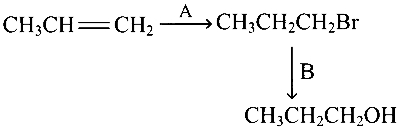
What can be A and B in the following reaction?
The conversion of Propyne to Benzene can be brought out in 4 steps.
Choose the reagents to be used, in the proper sequential order, to bring out the conversion.
Reagents provided: alc. \(\mathrm{KOH}, \mathrm{H}_2 / \mathrm{Pd}, \mathrm{Na} /\) dry ether, \(\mathrm{HBr}, \mathrm{HBr} /\left(\mathrm{C}_6 \mathrm{H}_5 \mathrm{CO}\right)_2 \mathrm{O}_2\), Soda-lime, \(\mathrm{Cr}_2 \mathrm{O}_3\) (high T and P), Conc. \(\mathrm{H}_2 \mathrm{SO}_4\)
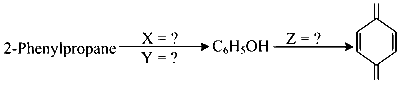
Identify the reagents \(\mathrm{X}, \mathrm{Y}\) and \(\mathrm{Z}\) used to bring out the following reactions.
Which of the following reactions is an example for incomplete combustion?


Identify the product \([\mathrm{C}]\) formed at the end of the reaction below
1,1,2,2- Tetrabromopropane + 2 \(\mathrm{Zn}_{(\mathrm{S})}\) / Ethanol \(\rightarrow\) [B]
\([\mathrm{B}]\) + 2 moles of \(\mathrm{HBr} \rightarrow[\mathrm{C}]\)
Given below are 4 reactions. Two of these reactions will give product which is an equimolar mixture of the d and 1 forms. Identify these 2 reactions.
[A] 2- Methylpropene + \(\mathrm{HI} \rightarrow\) ---------
[B] But-1-ene + \(\mathrm{HBr} \rightarrow\) -----------
[C] 3-Methylbut-1-ene + \(\mathrm{HI} \rightarrow\) -----------
[D] 3- Phenylpropene + \(\mathrm{HBr}\) (Peroxide) \(\rightarrow\) -----------
A Hydrocarbon [A] (molecular formula \(\mathrm{C}_3 \mathrm{H}_6\)) on reaction with \(\mathrm{Br}_2 / \mathrm{CCl}_4\) gave [B]. When [B] is heated with 2 moles of alcoholic \(\mathrm{KOH}\), it gave compound [C]. 3 moles of Compound [C] when passed through red hot Iron tube forms [D]. Identify [D].
An aromatic hydrocarbon \([\mathrm{A}]\left(\mathrm{Molecular}\right.\) formula \(\left.\mathrm{C}_9 \mathrm{H}_{12}\right)\), undergoes air oxidation followed by reaction with dil. \(\mathrm{HCl}\) to give [B] as one of the products
Compound [B] forms a white precipitate on treatment with \(\mathrm{Br}_2(\mathrm{aq})\)
Sodium salt of [B] reacts with \(\mathrm{CO}_2\) at \(400 \mathrm{~K}\) under high pressure followed by acid hydrolysis to give [C]
Compound [C] reacts with acetic anhydride / conc. \(\mathrm{H}_2 \mathrm{SO}_4\) to form [D] Identify compound \([\mathrm{D}]\)


An unsaturated hydrocarbon \([\mathrm{A}]\) reacts with \(\mathrm{HBr}\) in presence of Benzoyl peroxide to yield [B] Compound [A] when reacted with cold, dilute alkaline \(\mathrm{KMnO}_4\) gave compound [C], 2-Methylbutane-2, 3-diol But when [A] is reacted with hot \(\mathrm{KMnO}_4\), it yielded \(\mathrm{CH}_3 \mathrm{COOH}\) and a compound [D] Identify compounds [A], [B] and [D]
Match the reactions in Column I with the correct products given in Column II
| S.No. | Column I | S.NO. | Column II |
|---|---|---|---|
| A. | 1- Chloropropane $+(\mathrm{Zn} / \mathrm{HCl}) \rightarrow$ | P. | Propanone + Methanal |
| B. | n- Hexane $+\left(\right.$ anh. $\left.\mathrm{AlCl}_3 / \mathrm{HCl}_{(\mathrm{g})}\right) \rightarrow$ | Q. | Propanone |
| C. | 2- Methylpropene $+\left(\mathrm{O}_3 \& \mathrm{Zn} / \mathrm{H}_2 \mathrm{O}\right) \rightarrow$ | R. | Propane |
| D. | Propyne $+\left(\mathrm{HgSO}_4 / \mathrm{H}_2 \mathrm{SO}_4\right.$ at 333 K$) \rightarrow$ | S. | 2-Methylpentane + 3-Methylpentane |
Showing 20 of 28 questions


