Difficulty distribution
How the classified questions are distributed by difficulty.
31questions
Not classified
31
100%
Your cart is empty.
Practice Haloalkanes And Haloarenes - Organic Chemistry - Chemistry previous year questions organised from real papers, with year-wise coverage and clear topic navigation.
Every graph below is calculated only from this selection.
Year-wise coverage for Haloalkanes And Haloarenes. Each bar uses a separate theme-derived color.
How the classified questions are distributed by difficulty.
MCQ, numerical, multiple-select and other formats found in these papers.
Top subjects by unique question coverage.
Top topics across the included previous year papers.
Top subtopics inside this exact selection.
Question coverage for the most populated papers. Every active PYP paper remains listed below.
Newest papers appear first. Sort by year, question coverage or name.
| Paper | Year / session | Questions in this view | Open |
|---|---|---|---|
| COMEDK 2025 AFTERNOON SHIFT | 2025 | 4 | View paper |
| COMEDK 2025 EVENING SHIFT | 2025 | 1 | View paper |
| COMEDK 2025 Morning Shift | 2025 | 5 | View paper |
| COMEDK 2024 AFTERNOON SHIFT | 2024 | 5 | View paper |
| COMEDK 2024 EVENING SHIFT | 2024 | 5 | View paper |
| COMEDK 2024 MORNING SHIFT | 2024 | 1 | View paper |
| COMEDK 2023 EVENING SHIFT | 2023 | 3 | View paper |
| COMEDK 2023 Morning Shift | 2023 | 3 | View paper |
| COMEDK 2022 | 2022 | 1 | View paper |
| COMEDK 2021 | 2021 | 1 | View paper |
| COMEDK 2020 | 2020 | 2 | View paper |
Practice every matching question in batches of 20, with every available option.
Benzene reacts with chlorine in sunlight to give a final product
An alkyl halide reacts with alcoholic ammonia in a sealed tube, the product formed will be
The reaction \(\mathrm{ArN_2^ + C{l^ - }\buildrel {Cu/HCl} \over \longrightarrow ArCl + {N_2} + CuCl}\) is called as
Alkyl halides undergoing SN2 reaction do inverse
The reactions taking place with \(\mathrm{2- Phenyl-2-bromopropane}\) as the starting material is shown below. Identify [A] and [B] formed in the reaction.
$$\mathrm{C}_6 \mathrm{H}_5-\mathrm{C}\left(\mathrm{CH}_3\right)_2^{-} \mathrm{Br} \xrightarrow[\Delta]{\text { KOH Alcoholic }}[\mathrm{A}]$$
$$[\mathrm{A}]+\mathrm{HBr} \xrightarrow{\left(\mathrm{C}_6 \mathrm{H}_5 \mathrm{CO})_2 \mathrm{O}\right.}[\mathrm{B}]$$
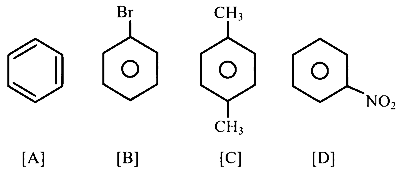
Identify the compounds A, B, C and D.
$$\text { 1,2,2,2-tetrachloroethane } \xrightarrow[\Delta]{\mathrm{Zn}}[\mathrm{A}]$$
[A] \(\xrightarrow[675 \mathrm{~K}]{\text { Fe tube }}\) [B] \(\xrightarrow[\text { Conc. } \mathrm{H}_2 \mathrm{SO}_4]{\text { Conc. } \mathrm{HNO}_3}\) [C] \(\xrightarrow[\text { Anhydrous } \mathrm{AlCl}_3]{\mathrm{Cl} /}\) [D]


Which one of the following will undergo Nucleophilic substitution, by \(\mathrm{S}_{\mathrm{N}}{ }^1\) mechanism, fastest?
Choose the incorrect statement from the following.
Arrange the following in the order of increasing reactivity towards \(\mathrm{SN}_{\mathrm{2}}\) reactions.
$$\begin{array}{ll} \[\left(\mathrm{CH}_3\right)_3 \mathrm{CCH}_2 \mathrm{Br}(\mathrm{P}) ; & \\\mathrm{CH}_3\left(\mathrm{CH}_2\right)_3 \mathrm{Br}(\mathrm{Q}) ; &\\\] \[\mathrm{CH}_3 \mathrm{CH}_2-\mathrm{CH}\left(\mathrm{CH}_3\right)-\mathrm{CH}_2 \mathrm{Br}(\mathrm{R}) ; & \\\left(\mathrm{CH}_3\right)_2 \mathrm{CHCH}_2 \mathrm{CH}_2 \mathrm{Br}(\mathrm{S})\] \end{array}$$
Consider the following reaction
$$(\mathrm{CH}_3)_2 \mathrm{CHCH}_2 \mathrm{Br}+(\mathrm{CH}_3)_3 \mathrm{CCH}_2 \mathrm{Br} \xrightarrow[\Delta]{\mathrm{Na} \text { /dry ether }} \mathrm{X}+\mathrm{Y}+\mathrm{Z}$$
Identify the product which is not formed?
Arrange the following compounds in the decreasing order of reactivity towards electrophilic substitution reaction.
(I) Chlorobenzene
(II) Nitrobenzene
(III) Benzene
(IV) Isopropylbenzene
Arrange the following compounds in the increasing order of their reactivity when each of them is reacted with chloroethane / anhydrous AlCl\(_3\).
Match the names of reactions given in Column I with the appropriate reactions given in Column II.
| No. | Name of reaction | No. | Equations representing reactions |
|---|---|---|---|
| (A) | Sandmeyer | (P) | $$ \[2 \mathrm{C}_6 \mathrm{H}_5 \mathrm{Cl}+\mathrm{Na} \text { (dry ether) } \rightarrow \text { Diphenyl. }\] $$ |
| (B) | Fittig | (Q) | $$ \[\mathrm{CH}_3-\mathrm{CHBr}-\mathrm{CH}_3+\mathrm{AgF} \rightarrow \mathrm{CH}_3-\mathrm{CHF}-\mathrm{CH}_3+\mathrm{AgBr}\] $$ |
| (C) | Swarts | (R) | $$ \[\mathrm{CH}_3-\mathrm{CH}_2-\mathrm{Br}+\mathrm{Nal} \text { ( Acetone) } \rightarrow \mathrm{CH}_3-\mathrm{CH}_2-\mathrm{I}+\mathrm{NaBr}\] $$ |
| (D) | Finkelstein | (S) | $$ \[\mathrm{C}_6 \mathrm{H}_5 \mathrm{~N}_2+\mathrm{Cl}-+\mathrm{Cu}_2 \mathrm{Br}_2 / \mathrm{HBr} \rightarrow \mathrm{C}_6 \mathrm{H}_5 \mathrm{Br}+\mathrm{N}_2\] $$ |
Arrange the compounds \(\mathrm{A}, \mathrm{B}, \mathrm{C}\) and \(\mathrm{D}\) in the increasing order of their reactivity towards \(\mathrm{S_N}1\) reaction.
$$\begin{aligned} & \mathrm{A}=\mathrm{C}_6 \mathrm{H}_5 \mathrm{CH}_2 \mathrm{Cl} \\ & \mathrm{B}=\mathrm{C}_6 \mathrm{H}_5 \mathrm{Cl} \\ & \mathrm{C}=\mathrm{CH}_2=\mathrm{CH}-\mathrm{Cl} \\ & \mathrm{D}=\mathrm{CH}_3-\mathrm{CH}_2-\mathrm{Cl} \end{aligned}$$
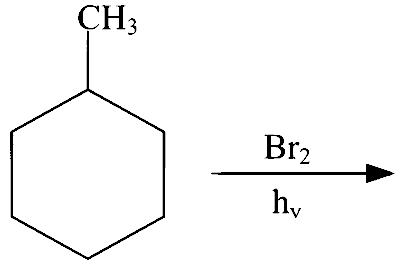
Identify the final product formed when Toluene undergoes a series of reactions with reagents given in the order:
(i) \(\mathrm{Cl}_2\) / Sunlight
(ii) \(\mathrm{H}_2 \mathrm{O} / 373 \mathrm{~K}\)
(iii) Acetophenone / \(\mathrm{OH^-}\) at \(293 \mathrm{~K}\)
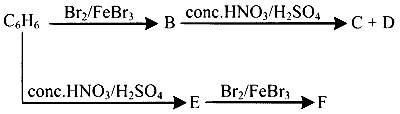
Identify the products C, D and F formed in the following sets of reactions.
Which one of the following compounds when reacted with \(\mathrm{NaOH}\) (aq) undergoes Substitution Nucleophilic Bimolecular reaction with retention of configuration?


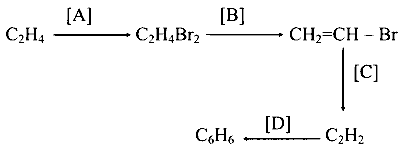
Identify the reagents to be used to complete the given reaction.
Showing 20 of 31 questions