Difficulty distribution
How the classified questions are distributed by difficulty.
15questions
Not classified
15
100%
Your cart is empty.
Practice General Organic Chemistry - Organic Chemistry - Chemistry previous year questions organised from real papers, with year-wise coverage and clear topic navigation.
Every graph below is calculated only from this selection.
Year-wise coverage for General Organic Chemistry. Each bar uses a separate theme-derived color.
How the classified questions are distributed by difficulty.
MCQ, numerical, multiple-select and other formats found in these papers.
Top subjects by unique question coverage.
Top topics across the included previous year papers.
Top subtopics inside this exact selection.
Question coverage for the most populated papers. Every active PYP paper remains listed below.
Newest papers appear first. Sort by year, question coverage or name.
| Paper | Year / session | Questions in this view | Open |
|---|---|---|---|
| COMEDK 2025 AFTERNOON SHIFT | 2025 | 1 | View paper |
| COMEDK 2025 EVENING SHIFT | 2025 | 1 | View paper |
| COMEDK 2025 Morning Shift | 2025 | 2 | View paper |
| COMEDK 2024 AFTERNOON SHIFT | 2024 | 2 | View paper |
| COMEDK 2024 EVENING SHIFT | 2024 | 1 | View paper |
| COMEDK 2024 MORNING SHIFT | 2024 | 3 | View paper |
| COMEDK 2023 EVENING SHIFT | 2023 | 2 | View paper |
| COMEDK 2023 Morning Shift | 2023 | 1 | View paper |
| COMEDK 2021 | 2021 | 1 | View paper |
| COMEDK 2020 | 2020 | 1 | View paper |
Practice every matching question in batches of 20, with every available option.
+I-effect is shown by
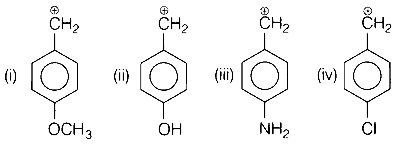
Arrange stability of the given carbon cation in decreasing order
Select the strongest base from the given compounds:
[A] p- \(\mathrm{NO}_2-\mathrm{C}_6 \mathrm{H}_4 \mathrm{NH}_2\)
[B] \(\mathrm{C}_6 \mathrm{H}_5-\mathrm{CH}_2-\mathrm{NH}_2\)
[C] \(\mathrm{m}-\mathrm{NO}_2-\mathrm{C}_6 \mathrm{H}_4 \mathrm{NH}_2\)
[D] \(\mathrm{C}_6 \mathrm{H}_5 \mathrm{NH}_2\)
Which one of the following statements is correct?
Which of the following carbanions is the least stable?
Which of the following is not aromatic?
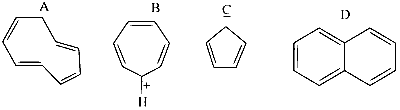
Identify the compound which is non-aromatic in nature.
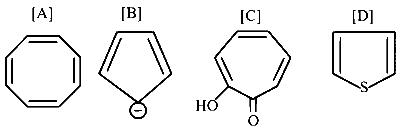
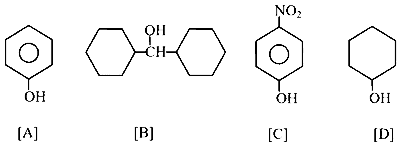
From the following compounds, identify the one which is most acidic.
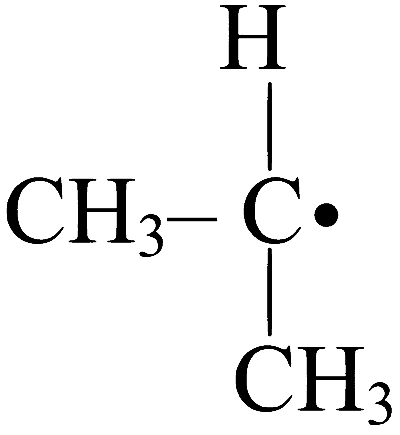
Given below are 4 species with one odd electron on the Carbon atom.
$$\begin{array}{ll}
\[\mathrm{A}=\left(\mathrm{CH}_3\right)_3 \stackrel{\bullet}{\mathrm{C}} & \mathrm{B}=\left(\mathrm{C}_6 \mathrm{H}_5\right)_3 \stackrel{\bullet}{\mathrm{C}} \\\]
\[\mathrm{C}=\left(\mathrm{C}_6 \mathrm{H}_5\right)_2 \stackrel{\bullet}{\mathrm{C}} \mathrm{H} & \mathrm{D}=\left(\mathrm{CH}_3\right)_2 \stackrel{\bullet}{\mathrm{C}} \mathrm{H}\]
\end{array}$$
Choose the correct decreasing order of stability of the species.
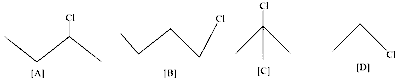
Arrange the following compounds in the decreasing order of reactivity towards \(\mathrm{S}_{\mathrm{N}} 1\) reaction.
Two statements, one Assertion and the other Reason are given. Choose the correct option.
Assertion: Heterocyclic compounds like Pyridine and Thiophene are non-aromatic compounds.
Reason: According to Huckel rule for a given compound to exhibit aromaticity, the molecule must be planar, cyclic system having delocalised $(4 n+2) \pi$ electrons.
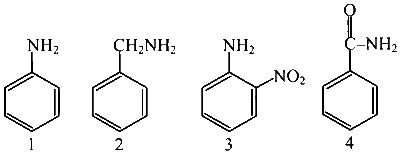
Rank the following compounds in order of increasing basicity.
Arrange the following free radicals in the increasing order of their stability:
| A | B | C | D |
|---|---|---|---|
 |
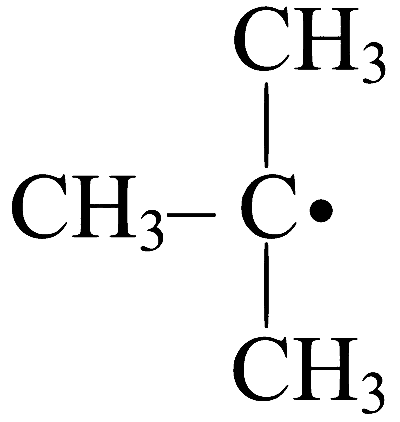 |
 |
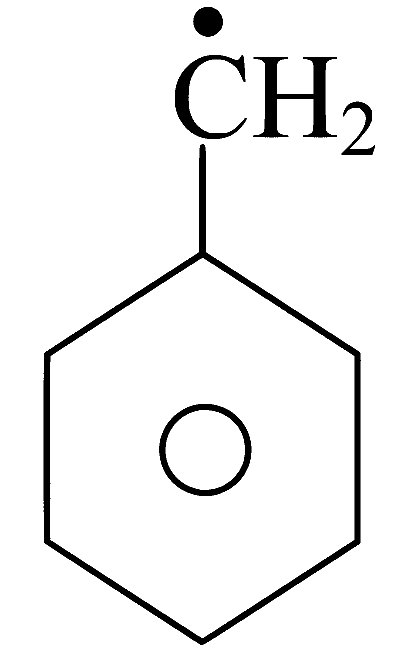 |
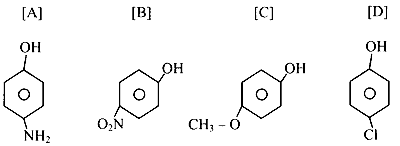
Arrange the following in the decreasing order of their $\mathrm{pK}_{\mathrm{a}}$ values.