Difficulty distribution
How the classified questions are distributed by difficulty.
30questions
Not classified
30
100%
Your cart is empty.
Practice Compounds Containing Nitrogen - Organic Chemistry - Chemistry previous year questions organised from real papers, with year-wise coverage and clear topic navigation.
Every graph below is calculated only from this selection.
Year-wise coverage for Compounds Containing Nitrogen. Each bar uses a separate theme-derived color.
How the classified questions are distributed by difficulty.
MCQ, numerical, multiple-select and other formats found in these papers.
Top subjects by unique question coverage.
Top topics across the included previous year papers.
Top subtopics inside this exact selection.
Question coverage for the most populated papers. Every active PYP paper remains listed below.
Newest papers appear first. Sort by year, question coverage or name.
| Paper | Year / session | Questions in this view | Open |
|---|---|---|---|
| COMEDK 2025 AFTERNOON SHIFT | 2025 | 3 | View paper |
| COMEDK 2025 EVENING SHIFT | 2025 | 6 | View paper |
| COMEDK 2025 Morning Shift | 2025 | 1 | View paper |
| COMEDK 2024 AFTERNOON SHIFT | 2024 | 2 | View paper |
| COMEDK 2024 EVENING SHIFT | 2024 | 2 | View paper |
| COMEDK 2024 MORNING SHIFT | 2024 | 3 | View paper |
| COMEDK 2023 EVENING SHIFT | 2023 | 2 | View paper |
| COMEDK 2023 Morning Shift | 2023 | 2 | View paper |
| COMEDK 2022 | 2022 | 3 | View paper |
| COMEDK 2021 | 2021 | 2 | View paper |
| COMEDK 2020 | 2020 | 4 | View paper |
Practice every matching question in batches of 20, with every available option.
Hofmann’s bromamide reaction is to convert
Maximum number of molecules of CH\(_3\)I that can react with a molecule of CH\(_3\)NH\(_2\) are
Decomposition of benzene diazonium chloride by using Cu\(_2\)Cl\(_2\)/HCl to form chlorobenzene is
Acidified sodium fusion extract on addition of ferric chloride solution gives blood red colouration which confirms the presence of
The chemical formula of Hinsberg's reagent is
Which of the following is most stable?
Which of the following is highly basic?
Which among the following will not liberate nitrogen on reaction with nitrous acid?
Which one of the following will give a positive result when it is warmed with Chloroform and alcoholic solution of \(\mathrm{KOH}\) ?
What would be the final product [\(\mathbf{X}\)] formed when p-Toluidine undergoes the following series of reactions?
$$\begin{aligned} & \text { P-Toluidine } \xrightarrow[\text { Pyridine }]{\left\{\mathrm{CH}_2, \mathrm{CO}_2 \mathrm{O}\right.}[\mathrm{P}] \\ & {[\mathrm{P}] \xrightarrow{\mathrm{Br}_2 / \mathrm{CH}_3 \mathrm{COOH}}[\mathrm{O}]} \\ & {[\mathrm{Q}] \xrightarrow[\Delta]{\text { dilнG }}[\mathrm{R}]} \\ & {\mathrm{[R]} \xrightarrow[0^{\circ} \mathrm{C}]{\mathrm{Nan}_2 / \mathrm{HCl}}\mathrm{[S]}} \\ & {[\mathrm{S}] \xrightarrow{\mathrm{H}_2 \mathrm{PO}_2}[\mathrm{X}]} \\ \end{aligned}$$


Arrange the following amines in the decreasing order of their solubilities in water.

An organic compound with molecular formula \(\mathrm{C}_3 \mathrm{H}_5 \mathrm{N}\) on hydrolysis gives compound '\(\mathrm{X}\)' which on treatment with \(\mathrm{Cl}_2 / \mathrm{P}\) gives compound '\(\mathrm{Y}\)'. Compound '\(\mathrm{Y}\)' on reaction with \(\mathrm{NH}_3\) gives '\(\mathrm{Z}\)'. The compound '\(\mathrm{Z}\)' is :
A compound having molecular formula \(\mathrm{C}_4 \mathrm{H}_{11} \mathrm{N}\), reacts with \(\mathrm{CHCl}_3\) in alcoholic \(\mathrm{KOH}\), on heating, to form a compound with a foul smell. Identify the optically active isomer of the compound which also shows the above reaction.
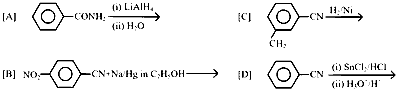
One of the reactions A, B, C, D given below yields a product which will not answer Hinsberg's test when reacted with Benzene sulphonyl chloride. Identify the reaction.
Which one of the following shows the correct increasing order of basic nature of the given compounds?
A: Phenylmethanamine
B: N-Ethylethanamine
C:N, N-Dimethylaniline
D : N, N-Dimethylmethanamine
Aniline undergoes reactions with reagents given in the order shown
(i) Aqueous \(\mathrm{Br}_2\)
(ii) \(\mathrm{NaNO}_2 / \mathrm{HCl} / 0^0 \mathrm{C}\)
(iii) Hypophosphorous acid
What is the product formed at the end of these reactions?
What is the final product formed when Toluene undergoes the following series of reactions?

Showing 20 of 30 questions