Difficulty distribution
How the classified questions are distributed by difficulty.
16questions
Not classified
16
100%
Your cart is empty.
Practice Carboxylic Acids And Its Derivatives - Organic Chemistry - Chemistry previous year questions organised from real papers, with year-wise coverage and clear topic navigation.
Every graph below is calculated only from this selection.
Year-wise coverage for Carboxylic Acids And Its Derivatives. Each bar uses a separate theme-derived color.
How the classified questions are distributed by difficulty.
MCQ, numerical, multiple-select and other formats found in these papers.
Top subjects by unique question coverage.
Top topics across the included previous year papers.
Top subtopics inside this exact selection.
Question coverage for the most populated papers. Every active PYP paper remains listed below.
Newest papers appear first. Sort by year, question coverage or name.
| Paper | Year / session | Questions in this view | Open |
|---|---|---|---|
| COMEDK 2025 AFTERNOON SHIFT | 2025 | 2 | View paper |
| COMEDK 2025 EVENING SHIFT | 2025 | 1 | View paper |
| COMEDK 2025 Morning Shift | 2025 | 3 | View paper |
| COMEDK 2024 AFTERNOON SHIFT | 2024 | 3 | View paper |
| COMEDK 2024 EVENING SHIFT | 2024 | 2 | View paper |
| COMEDK 2024 MORNING SHIFT | 2024 | 2 | View paper |
| COMEDK 2023 EVENING SHIFT | 2023 | 1 | View paper |
| COMEDK 2023 Morning Shift | 2023 | 1 | View paper |
| COMEDK 2021 | 2021 | 1 | View paper |
Practice every matching question in batches of 20, with every available option.
Why, ketones and carboxylic acids have higher boiling point as compared to aldehydes?
Which one of the following correctly represents the decreasing order of acidic nature of the given carboxylic acids:
[A] 2-Hydroxybenzoic acid
[B] Benzoic acid
[C] 3-Hydroxybenzoic acid
[D] 4- Hydroxybenzoic acid
In a set of reactions, bromoethane yielded a final product 'S'.

The compound 'S' should be
Among the following compounds, the most acidic is :
4-methyl benzamide (A) on reaction with ethanolic solution of \(\mathrm{KOH}\) and bromine gives another compound (B). The compound (B) on treatment with benzoyl chloride gives compound (C). Identify the correct structure of compound (C) from the following.


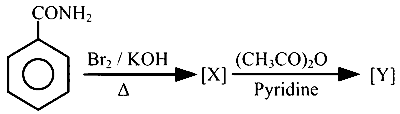
Identify the final product formed when Benzamide undergoes the following reactions:
Identify the final product \([\mathrm{D}]\) formed when Benzyl alcohol undergoes the following series of reactions
$$\mathrm{C}_6 \mathrm{H}_5 \mathrm{CH}_2 \mathrm{OH}+\mathrm{SOCl}_2 \rightarrow[\mathrm{A}]+\mathrm{KCN} \rightarrow[\mathrm{B}]+\mathrm{H}_3 \mathrm{O}^{+} \text {(partial hydrolysis) } \rightarrow[\mathrm{C}]+\mathrm{H}_3 \mathrm{O}^{+} \text {(complete hydrolysis) } \rightarrow[\mathrm{D}]$$
A sweet smelling organic compound \([\mathrm{A}]\left(\mathrm{C}_9 \mathrm{H}_{10} \mathrm{O}_2\right)\) undergoes acid hydrolysis to form an acid [B].
Compound [B] further reacts with Ammonia followed by heating to yield [C].
Compound \([\mathrm{C}]\) when reacted with \(\mathrm{Br}_2\) in caustic potash gave compound \([\mathrm{D}]\left(\mathrm{C}_6 \mathrm{H} 7 \mathrm{~N}\right)\) which gives a white precipitate with aqueous \(\mathrm{Br}_2\).
Identify compounds \([\mathrm{A}]\) & \([\mathrm{D}]\)
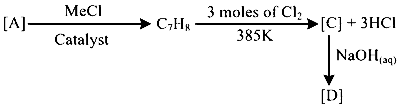
Identify the product [D] formed when Reactant [A] \((M M 78 \mathrm{~g} / \mathrm{mol})\) undergoes the series of reactions shown
Identify X and Y formed in the following two reactions.
(i) Decan-1-ol $\xrightarrow{\text { Jones reagent }} \mathrm{X}$
(ii). Sodium salt of $\mathrm{X} \xrightarrow{\mathrm{NaOH} / \mathrm{CaO}, \Delta} \mathrm{Y}$
Which of the following compounds would not be expected to decarboxylate when heated?


Two statements, One Assertion [ A ] and the other Reason [ R ] are given. Identify the correct option
Assertion $[A]$ : The decreasing order of the acidic character of the following is $B>D>A>C$
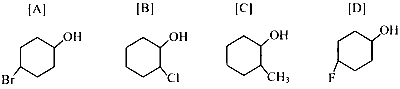
Reason $[\mathbf{R}]$ : Fluorine has larger -I effect than Cl and Br .
Two statements, one Assertion (A) and the other Reason (R) are given. Choose the correct option.
Assertion: 2-aminoethanoic acid and p-aminobenzene sulphonic acid can exist as Zwitter ions while p-aminobenzoic acid cannot.
Reason: When the acid group is a relatively strong proton donor and the $-\mathrm{NH}_2$ group is sufficiently basic it can accept a $\mathrm{H}^{+}$ion from the acid group to form the dipolar ion.