My Cart
Your Cart 0

    Your cart is empty.

  • Total (Amount) ₹0.00
NCERT Exemplar · Class 8 · Maths

Chapter 8: Exponents and Powers

Practice each question, then open the answer or worked solution.

Exercise

180 questions
Q131Written answer

This table shows the mass of one atom for five chemical elements. Use it to answer the question given.

Element

Mass of atom (kg)

Titanium

7.95 × 10⁻²⁶

Lead

3.44 × 10⁻²⁵

Silver

1.79 × 10⁻²⁵

Lithium

1.15 × 10⁻²⁶

Hydrogen

1.674 × 10⁻²⁷


(a) Which is the heaviest element?

(b) Which element is lighter, Silver or Titanium?

(c) List all five elements in order from lightest to heaviest.

Show solutionHide solution
Worked solution

Ans: The heaviest element is Lead = 34.4 × 10⁻²⁶ 


Ans: Silver = 17.9 × 10⁻²⁶ and Titanium= 7.95 × 10⁻²⁶, therefore,

Titanium is lighter.


Ans: Arrangement of elements from lightest to heaviest-

Hydrogen < Lithium < Titanium < Silver < Lead

Q132Written answer

The planet Uranus is approximately 2,896,819,200,000 metres away from the Sun. What is this distance in standard form?

Show solutionHide solution
Worked solution

Ans: Distance between the planet Uranus and the Sun is 2896819200000 m.
Standard form of 2896819200000 = 28968192 x 10 x 10 x 10 x 10 x 10
= 28968192 x 105 = 2.8968192 x 10¹² m


Q133Written answer

An inch is approximately equal to 0.02543 metres. Write this distancein standard form.

Show solutionHide solution
Worked solution

Ans: Standard form of 0.02543 m = 0.2543 x 10-1 m = 2.543 x 10⁻² m Hence,’ standard form of 0.02543 is 2.543 x 10⁻² m.


Q134Written answer

The volume of the Earth is approximately 7.67 × 10⁻⁷ times the volume of the Sun. Express this figure in usual form.

Show solutionHide solution
Worked solution

Ans: Given, volume of the Earth = 7.67 × 10⁻⁷ times the volume of the Sun.

Usual form of 7.67 × 10–7 = 0.000000767

We have placed decimal 7 places towards the left of the original position.


Q135Written answer

An electron’s mass is approximately 9.1093826 × 10⁻³¹ kilograms. What is this mass in grams?

Show solutionHide solution
Worked solution

Ans: Mass of electron = 9.1093826 × 10–31

= 9.1093826 × 10–31 x 1000 g

(Use, am × an = (a)m+n)

= 9.1093826 × 10–31 x 103 = 9.1093826 × 10⁻²⁸ g.


Q136Written answer

At the end of the 20th century, the world population was approximately 6.1 × 10⁹ people. Express this population in usual form. How would you say this number in words?

Show solutionHide solution
Worked solution

Ans: Given, at the end of the 20th century, the world population was 6.1 x 10⁹ (approx). People population in usual form = 6.1 x 109 = 6100000000 

Hence, the population in its usual form was six thousand one hundred million.


Q137Written answer

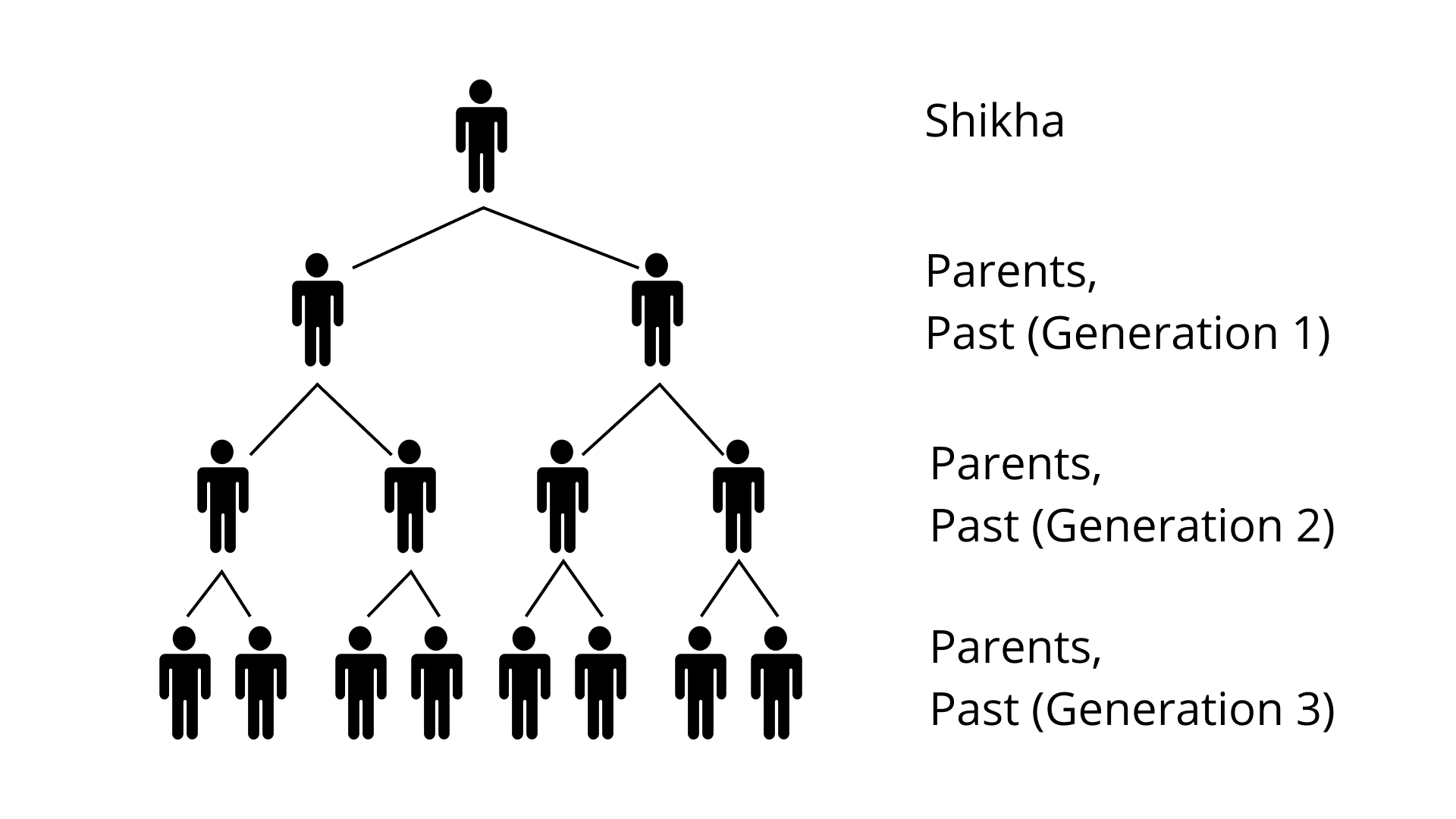
While studying her family’s history. Shikha discovers records of ancestors 12 generations back. She wonders how many ancestors she has had in the past 12 generations. She starts to make a diagram to help her figure this out. The diagram soon becomes very complex.


seo images


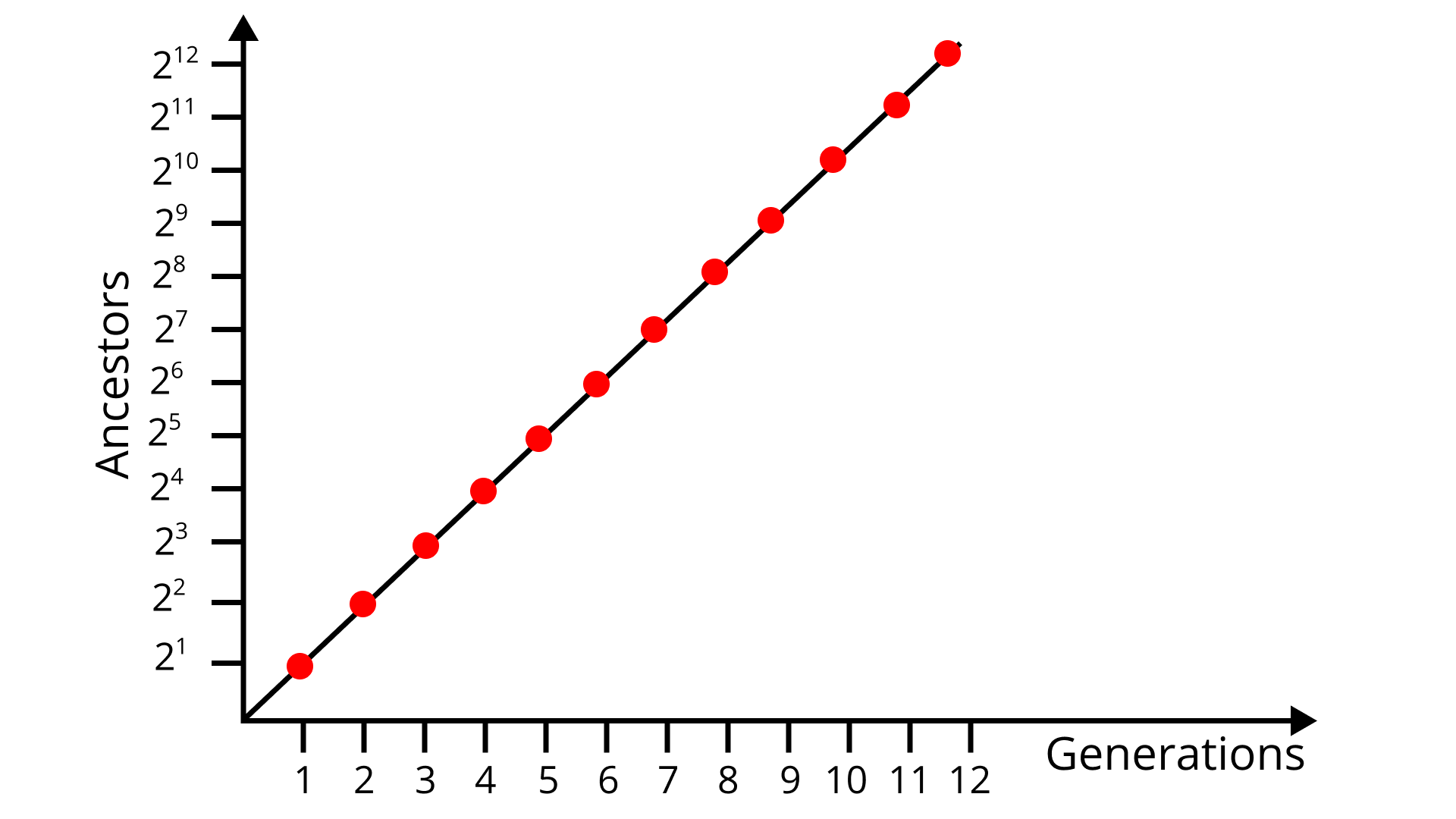
(a) Make a table and a graph showing the number of ancestors in each of the 12 generations.

(b) Write an equation for the number of ancestors in a given generation n.

Show solutionHide solution
Worked solution

Ans: On the basis of the given diagram, we can make a table that shows the number of ancestors in each of the 12 generations.

Generation

Ancestors

1st

2

2nd

22

3rd

23

:

:

4th

24


Hence, we can also make a graph that shows the relation between generation and ancestor.


seo images


Ans: On the basis of the generation-ancestor graph, the numbers of ancestors in n generations will be 2n.


Q138Written answer

About 230 billion litres of water flows through a river each day. How many litres of water flows through that river in a week? How many litres of water flows through the river in an year? Write your answer in standard notation.

Show solutionHide solution
Worked solution

Ans: Water flows through a river in each day = 230000000000 = 230 billion

Water flows through the river in a week = 7 x 230000000000

= 1610000000000 = 1610 billion = 1.61 x 10¹² L

Water flows through the river in a year= 230000000000 x 365

= 8395000000000000 = 8.395 x 10¹³ L.


Q139Written answer

A half-life is the amount of time that it takes for a radioactive substance to decay to one half of its original quantity. 

Suppose radioactive decay causes 300 grams of a substance to decrease to 300 × 2–3 grams after 3 half-lives. Evaluate 300 × 2–3 to determine how many grams of the substance are left. 

Explain why the expression 300 × 2–n can be used to find the amount of the substance that remains after n half-lives.

Show solutionHide solution
Worked solution

Ans: Since, 300 g of a substance decreases to 300 x 2-3 g

after 3 half-lives.

So, we have to evaluate 300 x 2-3 = $\dfrac{{300}}{8}$ = 37.5 g


Q140Written answer

Consider a quantity of a radioactive substance. The fraction of this quantity that remains after t half-lives can be found by using the expression 3–t. 

(a) What fraction of substance remains after 7 half-lives?

(b) After how many half-lives will the fraction be $\dfrac{1}{{243}}$ of the original?

Show solutionHide solution
Worked solution

Ans: Since, 3-t expression is used for finding the fraction of the quality that remains after t half-lives.

Hence, the fraction of substance remains after 7 half-lives will be equal to 3-7 i.e., $\dfrac{1}{{{3^7}}}.$


Ans: Given, t half-lives = 3-t

So, $\dfrac{1}{{{3^5}}} = \dfrac{1}{{{3^t}}}$

And t = 5.

On comparing both sides, we get t = 5 half-lives.