My Cart
Your Cart 0

    Your cart is empty.

  • Total (Amount) ₹0.00
NCERT Exemplar · Class 8 · Maths

Chapter 8: Exponents and Powers

Practice each question, then open the answer or worked solution.

Exercise

180 questions
Q121Written answer

$\dfrac{{16 \times {{10}^2} \times 64}}{{{2^4} \times {4^2}}}$

Show solutionHide solution
Worked solution

Ans: Use ${a^m} \times {a^n} = {\left( a \right)^{m + n}}$, ${a^m} \div {a^n} = {\left( a \right)^{m - n}}$ and ${a^{ - m}} = \dfrac{1}{{{a^m}}}$.

$\dfrac{{16 \times {{10}^2} \times 64}}{{{2^4} \times {4^2}}} = {\left( 4 \right)^2} \times {10^2} \times {2^{ - 4}} \times {4^3} \times {4^{ - 2}}$

= ${\left( {{2^2}} \right)^2} \times {10^2} \times {\left( {{2^2}} \right)^{ - 2}} \times {4^3} \times {4^{ - 2}}$

= ${4^2} \times {10^2} \times {4^{ - 2}} \times {4^3} \times {4^{ - 2}}$

= ${4^{2 - 2 + 3 - 2}} \times {10^2}$

= ${4^1} \times {10^2} = 400$

Q122Written answer

If $\dfrac{{{5^m} \times {5^3} \times {5^{ - 2}}}}{{{5^{ - 5}}}} = {5^{12}}$, find m.

Show solutionHide solution
Worked solution

Ans: Use ${a^m} \times {a^n} = {\left( a \right)^{m + n}}$, ${a^m} \div {a^n} = {\left( a \right)^{m - n}}$ and ${a^{ - m}} = \dfrac{1}{{{a^m}}}$.

$\Rightarrow {5^{m + 3 + \left( { - 2} \right) - \left( { - 5} \right)}} = {5^{12}}$

$\Rightarrow {5^{m + 3 - 2 + 5}} = {5^{12}}$

$\Rightarrow {5^{m + 6}} = {5^{12}}$

On comparing both sides,

⇒m + 6 = 12

⇒n = 6


Q123Written answer

A new born bear weighs 4 kg. How many kilograms might a five-year-old bear weigh if its weight increases by the power of 2 in 5 years?

Show solutionHide solution
Worked solution

Ans: Weight of new born bear = 4 kg
Weight increases by the power of 2 in 5 yr.
Weight of bear in 5 yr = (4)2 = 16 kg


Q124Written answer

The cells of a bacteria double in every 30 minutes. A scientist begins with a single cell. How many cells will be there after-

(a) 12 hours 

(b) 24 hours

Show solutionHide solution
Worked solution

Ans: The bacteria cell in every 30 min= 2

So, cell of a bacterium in 1h = 22 $[$As (2+2) in 1h$]$

cell of a bacterium in 12h = 22 x 22 x 22 x 22 x22 x 22 x 22 x

22 x 22 x 22 x 22 x 22 = 224 


Ans: Similarly, bacteria in 24 h = 224 x 224 = 224+24 = 248


Q125Written answer

Planet A is at a distance of 9.35 × 10⁶ km from Earth and planet B is 6.27 × 10⁷ km from Earth. Which planet is nearer to Earth?

Show solutionHide solution
Worked solution

Ans: Distance between planet A and Earth = 9.35 x 10⁶ km Distance between planet B and Earth = 6.27 x 10⁷ km
For finding difference between above two distances, we have to change both in same exponent of 10, i.e. 9.35 x 106 = 0.935 x 10⁷, clearly 6.27 x 10⁷ is greater.
So, planet A is nearer to Earth.


Q126Written answer

The cells of a bacteria double itself every hour. How many cells will there be after 8 hours, if initially we start with 1 cell. Express the answer in powers.

Show solutionHide solution
Worked solution

Ans: The cell of a bacteria double itself every hour = 1 + 1

= 2 = 21

Since, the process started with 1 cell.

As, am × an = am+n

Therefore, total no. of cell in 8h = 21 x 21 x 21 x 21 x 21 x 21 x

21 x 21 = 28


Q127Written answer

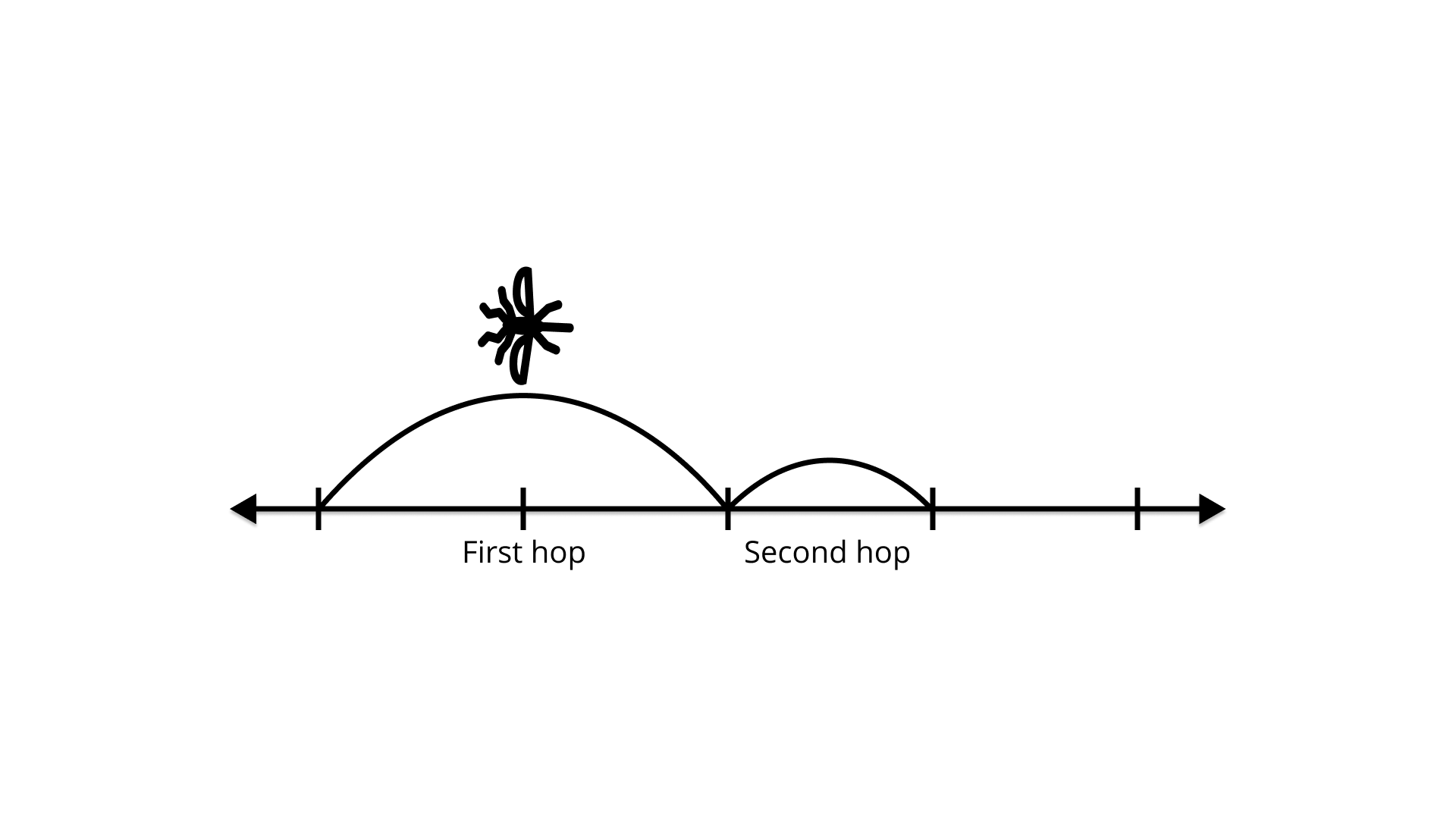
An insect is on the 0 point of a number line, hopping towards 1. She covers half the distance from her current location to 1 with each hop. So, she will be at $\dfrac{1}{2}$ after one hop, $\dfrac{3}{4}$after two hops, and so on.


seo images


(a) Make a table showing the insect’s location for the first 10 hops.

(b) Where will the insect be after n hops?

(c) Will the insect ever get to 1? Explain.

Show solutionHide solution
Worked solution

Ans: On the basis of given information in the question, we can arrange the following table which shows the insect’s location for the first 10 hops.

No. of Hops

Distance Covered

Distance Left

Distance Covered

1

$\dfrac{1}{2}$

$\dfrac{1}{2}$

$1 - \dfrac{1}{2}$

2

$\dfrac{1}{2}\left( {\dfrac{1}{2}} \right) + \dfrac{1}{2}$

$\dfrac{1}{4}$

$1 - \dfrac{1}{4}$

3

$\dfrac{1}{2}\left( {\dfrac{1}{4}} \right) + \dfrac{3}{4}$

$\dfrac{1}{8}$

$1 - \dfrac{1}{8}$

4

$\dfrac{1}{2}\left( {\dfrac{1}{8}} \right) + \dfrac{7}{8}$

$\dfrac{1}{{16}}$

$1 - \dfrac{1}{{16}}$

5

$\dfrac{1}{2}\left( {\dfrac{1}{{16}}} \right) + \dfrac{{15}}{{16}}$

$\dfrac{1}{{32}}$

$1-\dfrac{1}{{32}}$

6

$\dfrac{1}{2}\left( {\dfrac{1}{{32}}} \right) + \dfrac{{31}}{{32}}$

$\dfrac{1}{{64}}$

$1-\dfrac{1}{{64}}$

7

$\dfrac{1}{2}\left( {\dfrac{1}{{64}}} \right) + \dfrac{{63}}{{64}}$

$\dfrac{1}{{128}}$

$1-\dfrac{1}{{128}}$

8

$\dfrac{1}{2}\left( {\dfrac{1}{{128}}} \right) + \dfrac{{127}}{{128}}$

$\dfrac{1}{{256}}$

$1-\dfrac{1}{{256}}$

9

$\dfrac{1}{2}\left( {\dfrac{1}{{256}}} \right) + \dfrac{{255}}{{256}}$

$\dfrac{1}{{512}}$

$1-\dfrac{1}{{512}}$

10

$\dfrac{1}{2}\left( {\dfrac{1}{{512}}} \right) + \dfrac{{511}}{{512}}$

$\dfrac{1}{{1024}}$

$1 - \dfrac{1}{{1024}}$


Ans: If we see the distance covered in each hops

Distance covered in 1st hops = $1-\dfrac{1}{2}$

Distance covered in 2nd hops = $1-\dfrac{1}{4}$

Distance covered in 3rd hops = $1-\dfrac{1}{8}$

---------------------------------------------------------------------------

Distance covered in n hops = $1-{\left( {\dfrac{1}{2}} \right)^n}$


Ans: No, because for reaching 1, ${\left( {\dfrac{1}{2}} \right)^n}$ has to be zero for finite n

which is not possible.


Q128Written answer

Predicting the ones digit, copy and complete this table and answer the questions that follow.

x

1x

2x

3x

4x

5x

6x

7x

8x

9x

10x

1

1

2


2

1

4


3

1

8


4

1

16


5

1

32


6

1

64


7

1

128


8

1

256


Ones Digits of the

Powers

1

2,4,8,6


(a) Describe patterns you see in the ones digits of the powers.

Show solutionHide solution
Worked solution

Ans: On the basis of given pattern in 1x and 2x , we can make more patterns for 3x 4x , 5x ,6x , 7x , 8x , 9x , 10x .
Thus, we have the following table which shows all details about the patterns.

x

1x

2x

3x

4x

5x

6x

7x

8x

9x

10x

1

1

2

3

4

5

6

7

8

9

10

2

1

4

9

16

25

36

49

64

81

100

3

1

8

27

64

125

216

343

512

729

1000

4

1

16

81

256

625

1296

2401

4096

6561

10000

5

1

32

243

1024

3125

7776

16807

32768

59049

100000

6

1

64

729

4096

1565

46656

117649

262144

531441

1000000

7

1

128

2187

16384

78125

279936

823543

2097152

4782969

10000000

8

1

256

6591

65536

390625

1679616

5764801

16777216

43046721

100000000

Ones Digits of the

Powers

1

2,4,8,6

3, 9, 7, 1

4,6

5

6

7, 9, 3, 1

8, 4, 2, 6

-9.1

0


(b) Predict the ones digit in the following:

1. 412                  

Ans: Ones digit in 412 is 6.


2. 920   

Ans: Ones digit in 920 is 1.


3. 317

Ans: Ones digit in 317 is 3.


 4. 5100 

Ans: Ones digit in 5100 is 5.


 4. 10500 

Ans: Ones digit in 10500 is 0.


(c) Predict the ones digit in the following:

1. 3110                

Ans: Ones digit in 3110 is 1.


2. 1210 

Ans:  Ones digit in 1210 is 4.


3. 1721    

Ans:  Ones digit in 1721 is 7.


4. 2910

Ans:  One digit in 2910 is 1.


Q129Written answer

Astronomy The table shows the mass of the planets, the sun and the moon in our solar system.

Celestial Body

Mass (kg)

Mass (kg) Standard

Notation

Sun

1,990,000,000,000,000,000,000,000,000,000

1.99 × 1030

Mercury

330,000,000,000,000,000,000,000


Venus

4,870,000,000,000,000,000,000,000


Earth

5,970,000,000,000,000,000,000,000


Mars

642,000,000,000,000,000,000,000,000,000


Jupiter

1,900,000,000,000,000,000,000,000,000


Saturn

568,000,000,000,000,000,000,000,000


Uranus

86,800,000,000,000,000,000,000,000


Neptune

102,000,000,000,000,000,000,000,000


Pluto

12,700,000,000,000,000,000,000


Moon

73,500,000,000,000,000,000,000


(a) Write the mass of each planet and the Moon in scientific notation.

(b) Order the planets and the moon by mass, from least to greatest.

(c) Which planet has about the same mass as earth?

Show solutionHide solution
Worked solution

Ans: Using law of exponents am × an = am+n

Sun= 199 x 1028 = 1.99 x 1028 x 102 = 1.99 x 1030

Mercury= 33 x 1022 = 3.3 x 1022 x 10 = 3.3 x 10²³

Venus= 487 x 1022 = 4.87 x 1022 x 102 = 4.87 x 1024

Earth= 597 x 1022 = 5.97 x 1022 x 102 = 5.97 x 1024

Mars= 642 x 1027 = 6.42 x 1027 x 102 = 6.42 x 1029

Jupiter= 19 x 1026 = 1.9 x 1026 x 10= 1.9 x 1027

Saturn= 568 x 1024 = 5.68 x 1024 x 102 = 5.68 x 1026

Uranus= 868 x 1023 = 8.68 x 1023 x 102 = 8.68 x 1025

Neptune= 102 x 1024 = 1.02 x 1024 x 102 = 1.02 x 1026

Pluto= 127 x 1024 = 1.27 x 1020 x 102 = 1.27 x 10²²

Moon= 795 x 1020 = 7.95 x 1020 x 102 = 7.95 x 10²²


Ans: Order of mass of all planets and Moon from least to greatest.

Pluto < Moon < Mercury < Venus < Earth < Uranus < Neptune < Saturn < Jupiter < Mars


Ans: Venus has the mass similar to Earth.


Q130Written answer

Investigating the Solar System The table shows the average distance from each planet in our solar system to the sun.

Planet

Distance from Sun (km)

Distance from Sun

(km) Standard Notation

Earth

149,600,000

1.496 × 10⁸

Jupiter

778,300,000


Mars

227,900,000


Mercury

57,900,000


Neptune

4,497,000,000


Pluto

5,900,000,000


Saturn

1,427,000,000


Uranus

2,870,000,000


Venus

108,200,000


(a) Complete the table by expressing the distance from each planet

to the Sun in scientific notation.

(b) Order the planets from closest to the sun to farthest from the sun.

Show solutionHide solution
Worked solution

Ans: Scientific notation of distance from Sun to

Earth= 149600000 = 1496 x 105 = 1.496 x 10⁸

Jupiter= 778300000 = 7783 x 105 = 7.783 x 10⁸

Mars= 227900000 = 2279 x 105 = 2.279 x 10⁸

Mercury= 57900000 = 579 x 105 = 5.97 x 10⁷

Neptune= 4497000000 = 4497 x 105 = 4.497 x 10⁸

Pluto= 5900000000 = 59 x 108 = 5.9 x 10⁹

Saturn= 1427000000= 1427 x 106 = 1.427 x 10⁹

Venus= 108200000 = 1082 x 105 = 1.082 x 10⁸


Ans: Order of planet from closest to the Sun to farthest from the

sun is given by

Mercury < Venus < Earth < Mars < Jupiter < Saturn < Uranus

< Neptune < Pluto.