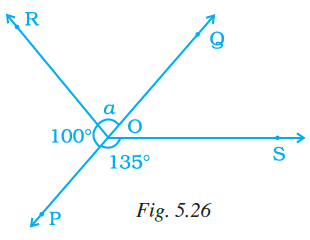
In Fig. 5.26, POQ is a line, then a is equal to
(a) 35o (b) 100o (c) 80o (d) 135o
Show solutionHide solution
Solution:-
(c) 80o
From the figure POQ is a straight line,
Then, 100 + a = 180o
a = 180o – 100
a= 80o
Your cart is empty.
Practice each question, then open the answer or worked solution.
In Fig. 5.26, POQ is a line, then a is equal to
(a) 35o (b) 100o (c) 80o (d) 135o

Solution:-
(c) 80o
From the figure POQ is a straight line,
Then, 100 + a = 180o
a = 180o – 100
a= 80o
Vertically opposite angles are always
(a) supplementary (b) complementary
(c) adjacent (d) equal
Solution:-
(d) equal
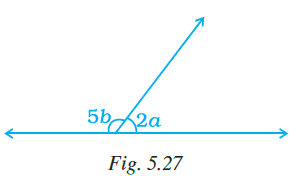
In Fig. 5.27, a = 40o. The value of b is
(a) 20o (b) 24o (c) 36o (d) 120o

Solution:-
(a) 20o
Given, a = 40o
Then, 2a = 2 × 40 = 80o
From the figure, angles formed on the straight line are equal to 180o,
Then, 5b + 2a = 180o
5b + 80o = 180o
5b= 180o – 80o
5b = 100o
b = 100/5
b = 20o
If an angle is 60o less than two times of its supplement, then the greater angle is
(a) 100o (b) 80o (c) 60o (d) 120o
Solution:-
(a) 100o
Let us assume the angle be P.
Then, its supplement is 180o – P
As per the condition in the question,
P = 2(180o – P) – 60o
P = 360o – 2P – 60o
P + 2P = 300o
3P = 300o
P = 300/3
P = 100o
So, its supplement is 180o – P = 180o – 100o = 80o
Therefore, the greater angle is 100o.
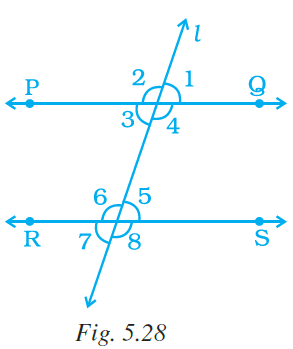
In Fig. 5.28, PQ || RS. If ∠1=(2a+b)o and ∠6=(3a–b)o, then the measure of ∠2 in terms of b is
(a) (2+b)o (b) (3–b)o (c) (108–b)o (d) (180–b)o

Solution: –
(c) (108–b)o
From the question it is given that, ∠1 = (2a + b)o and ∠6 = (3a – b)o
Since ∠5 and ∠6 form a linear pair of angles
Then,
∠5 = (180-3a + b)o … [equation 1]
∠5 = ∠1 = (180-3a + b)o [Because Corresponding angles] …equation (2)
From equation (2) we get,
2a + b = 180-3a + b
5a = 180
a = 360
Since ∠1 and ∠2 forms a linear pair so
∠2 = 1800– 2a-b
Substituting the value of a
∠2 = 1800– 720 – b
∠2 = 1080– b
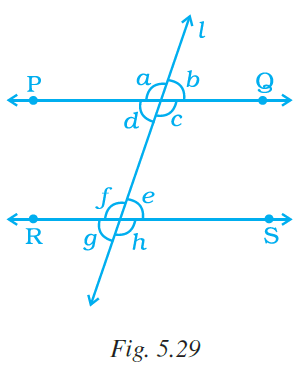
In Fig. 5.29, PQ||RS and a : b = 3 : 2. Then, f is equal to

(a) 36o (b) 108o (c) 72o (d) 144o
Solution: –
(b) 108o
From the figure, PQ||RS.
From the question it is given that, a: b = 3: 2
So, let us assume a = 3m and b = 2m
We know that, sum of angles on the straight line is equal to 180o
Then, ∠a + ∠b = 180o
3m + 2m = 180o
5m = 180o
m = 180o/5
m = 36o
So, a = 3m = 3 × 36o = 108o
b = 2m = 2 × 36o = 72
Therefore, ∠a = ∠f = 108o [because corresponding angles]
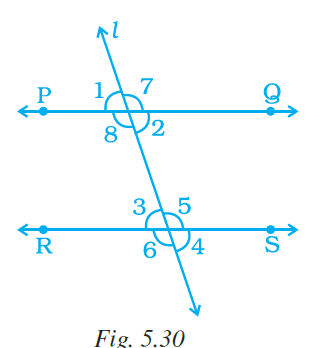
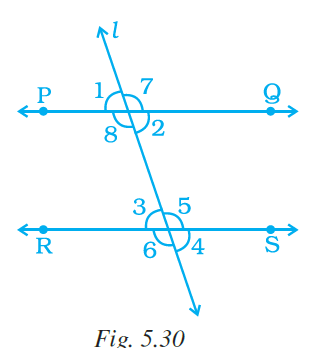
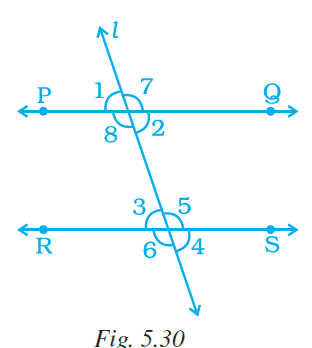
In Fig. 5.30, line l intersects two parallel lines PQ and RS. Then, which one of the following is not true?

(a) ∠1 = ∠3 (b) ∠2 = ∠4
(c) ∠6 = ∠7 (d) ∠4 = ∠8
Solution:-
(d) ∠4 = ∠8
Because, ∠4 ≠ ∠8
In Fig. 5.30, which one of the following is not true?

Solution:-
(d) ∠2 + ∠3 = 180o
We know that, interior opposite angles are equal
∠2 = ∠3
In Fig. 5.30, which of the following is true?

(a) ∠1 = ∠5 (b) ∠4 = ∠8 (c) ∠5 = ∠8 (d) ∠3 = ∠7
Solution:-
(c) ∠5 = ∠8
From the figure, PQ||RS
∠5 = ∠8 [interior alternate angles are equal]
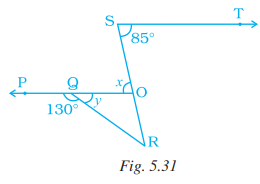
In Fig. 5.31, PQ||ST. Then, the value of x + y is
(a) 125o (b) 135o (c) 145o (d) 120o

Solution: –
(b) 135o
From the figure, PO is a straight line
We know that, sum of angles on the straight is equal to 180o.
Then,
y + ∠ PQR = 1800
y + 1300 = 1800
y = 50o
Then,
∠ QOS = ∠ TSO [Co-interior angle]
x = 850
x + y = 135