In which of the following cases, a unique triangle can be drawn
(a) ${\mathbf{AB = 4cm,}}\,\,{\mathbf{BC = 8cm}}$ and ${\mathbf{CA = 2cm}}$
(b) $BC=5.2 cm$ $\angle B = {90}^{\circ}$ and $\angle C = {110}^{\circ}$
(c) $XY=5 cm$ $\angle X = {45}^{\circ}$ and $\angle Y = {60}^{\circ}$
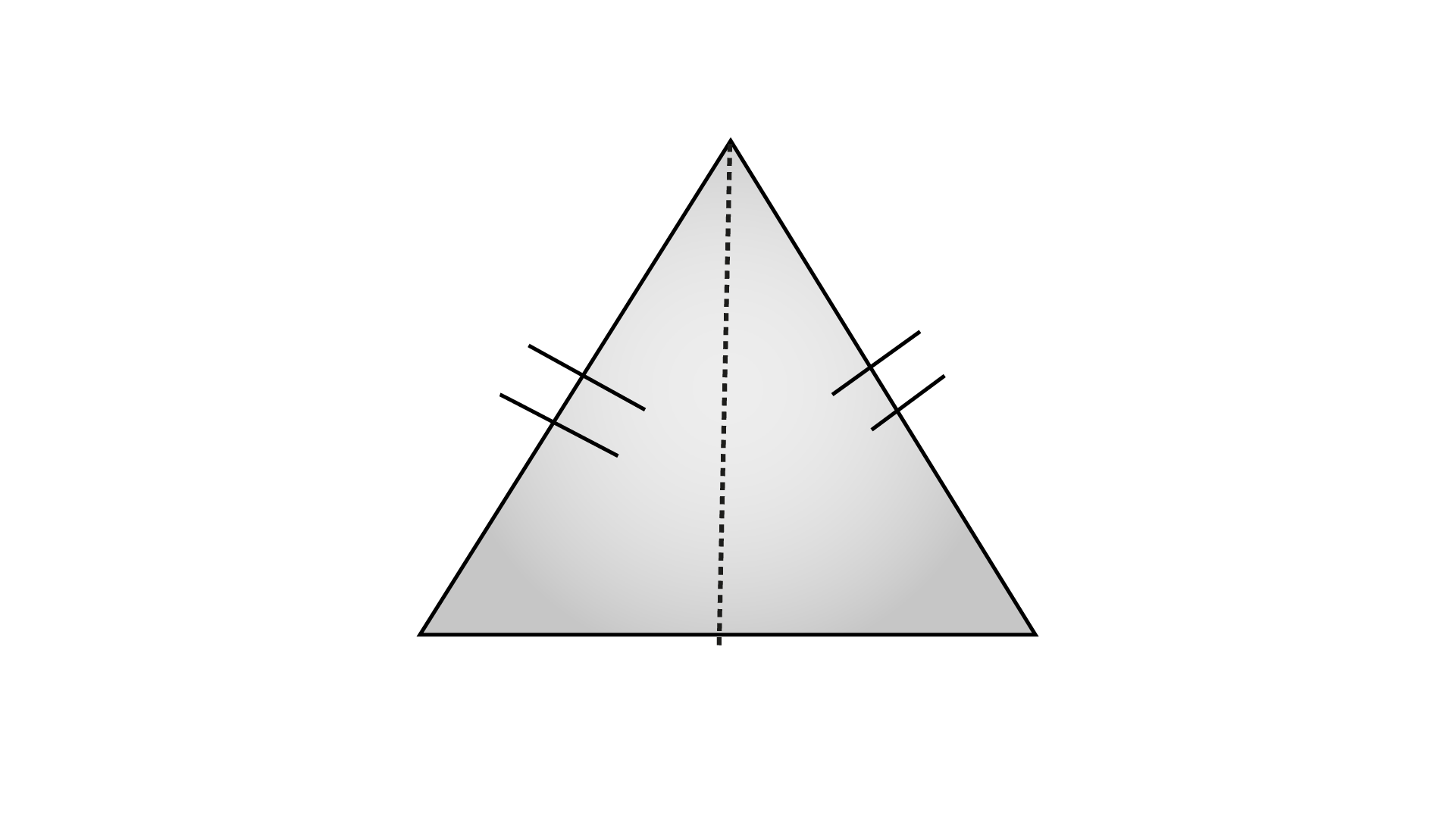
(d) An isosceles triangle with the length of each equal side ${\mathbf{6}}{\mathbf{.2cm}}$.
Show solutionHide solution
Ans: Option (c) is the correct answer.
A triangle Is possible if:
(i) Sum of any two sides must be greater than the third side of the triangle.
(ii) Sum of all angles must be equal to $180^{\circ}$.
So, options (a) and (b) triangles are not possible because of the above points (i) and (ii) respectively.
In option (d) we can draw more than one isosceles triangle with side length $6.2$ $\mathrm{cm}$. So, triangles are not unique.
Thus, a unique triangle can be drawn only in option (c).