My Cart
Your Cart 0

    Your cart is empty.

  • Total (Amount) ₹0.00
NCERT Exemplar · Class 12 · Physics

Chapter 9: Ray Optics and Optical Instruments

Practice each question, then open the answer or worked solution.

Questions

32 questions
Q9.11Written answer

There are certain materials developed in laboratories which have a negative refractive index (Fig. 9.3). A ray incident from the air (medium 1) into such a medium (medium 2) shall follow a path given by
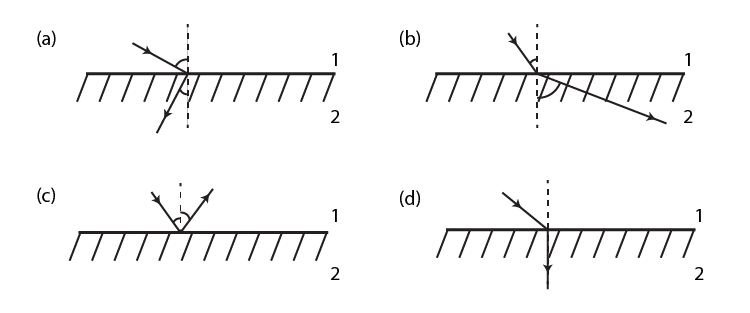
Exemplar Solutions Class 12 Physics Chapter 9 - 3

Show solutionHide solution
Worked solution

(a)  The speed of the car in the rear is 65 km h–1.

Q9.12Written answer

Consider an extended object immersed in water contained in a plane trough. When seen from close to the edge of the trough the object looks distorted because

(a) the apparent depth of the points close to the edge is nearer the surface of the water compared to the points away from the edge.

(b) the angle subtended by the image of the object at the eye is smaller than the actual angle subtended by the object in the air.

(c) some of the points of the object far away from the edge may not be visible because of total internal reflection.

(d) water in a trough acts as a lens and magnifies the object.

Show solutionHide solution
Worked solution

(a) the apparent depth of the points close to the edge is nearer the surface of the water compared to the points away from the edge.

(b) the angle subtended by the image of the object at the eye is smaller than the actual angle subtended by the object in the air.

(c) some of the points of the object far away from the edge may not be visible because of total internal reflection.

Q9.13Written answer

A rectangular block of glass ABCD has a refractive index 1.6. A pin is placed midway on the face AB. When observed from the face AD, the pin shall

A B

DC

(a) appear to be near A.

(b) appear to be near D.

(c) appear to be at the centre of AD.

(d) not be seen at all.

Show solutionHide solution
Worked solution

(a) appear to be near A.

(d) not be seen at all.

Q9.14Written answer

Between the primary and secondary rainbows, there is a dark band known as Alexandar’s dark band. This is because

(a) light scattered into this region interferes destructively.

(b) there is no light scattered into this region

(c) light is absorbed in this region.

(d) angle made at the eye by the scattered rays with respect to the incident light of the sun lies between approximately 42° and 50°.

Show solutionHide solution
Worked solution

(a) light scattered into this region interfere destructively.

(d) angle made at the eye by the scattered rays with respect to the incident light of the sun lies between approximately 42° and 50°.

Q9.15Written answer

A magnifying glass is used, as the object to be viewed can be brought closer to the eye than the normal near point. This results in

(a) a larger angle to be subtended by the object at the eye and hence viewed in greater detail.

(b) the formation of a virtual erect image.

(c) increase in the field of view.

(d) infinite magnification at the near point.

Show solutionHide solution
Worked solution

(a) a larger angle to be subtended by the object at the eye and hence viewed in greater detail.

(b) the formation of a virtual erect image.

Q9.16Written answer

An astronomical refractive telescope has an objective focal length of 20m and an eyepiece of focal length 2cm.

(a) The length of the telescope tube is 20.02m.

(b) The magnification is 1000.

(c) The image formed is inverted.

(d) An objective of a larger aperture will increase the brightness and reduce the chromatic aberration of the image.

Show solutionHide solution
Worked solution

(a) The length of the telescope tube is 20.02m.

(b) The magnification is 1000.

(c) The image formed is inverted.

Very Short Answers
Q9.17Written answer

Will the focal length of a lens for red light be more, the same or less than that for blue light?

Show solutionHide solution
Worked solution

The focal length of a lens for red light will be larger than that for blue light.

Q9.18Written answer

The near vision of an average person is 25cm. To view an object with an angular magnification of 10, what should be the power of the microscope?

Show solutionHide solution
Worked solution

D = 25 cm

u = -f

v = -25

m = v/u

f = 0.025 m

p = 1/f = 40 D

Q9.19Written answer

An unsymmetrical double convex thin lens forms the image of a point object on its axis. Will the position of the image change if the lens is reversed?

Show solutionHide solution
Worked solution

The position of the image will not change if the lens is reversed.

Q9.20Written answer

Three immiscible liquids of densities d1 > d2 > d3 and refractive indices µ1 > µ2 > µ3 are put in a beaker. The height of each liquid column is h/3. A dot is made at the bottom of the beaker. For near-normal vision, find the apparent depth of the dot.

Show solutionHide solution
Worked solution

h1 = -μ2/ μ1 h/3

h2 = – μ3/ μ2(μ2/ μ1 h/3 + h/3) = -h/3 (μ3/ μ2 + μ2/ μ1)

h3(1/ μ1 + 1/ μ2 + 1/ μ3) is the required depth.