My Cart
Your Cart 0

    Your cart is empty.

  • Total (Amount) ₹0.00
NCERT Exemplar · Class 12 · Physics

Chapter 7: Alternating Current

Practice each question, then open the answer or worked solution.

Questions

31 questions
Q7.21Written answer

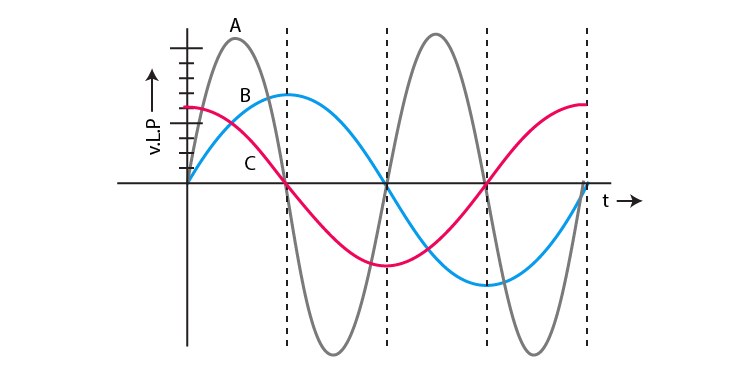
A device ‘X’ is connected to an a.c source. The variation of voltage, current and power in one complete cycle is shown in Fig 7.5.

(a) Which curve shows power consumption over a full cycle?

(b) What is the average power consumption over a cycle?

(c) Identify the device ‘X’.
Exemplar Solutions Class 12 Physics Chapter 7 - 5

Show solutionHide solution
Worked solution

a) The curve of power will have maximum amplitude and the is equal to the product of amplitudes of voltages and current. Therefore, curve A represents power.

b) The average power consumption over a cycle is zero as the full cycle in the graph consists of one positive and one negative symmetrical area.

c) X might be an inductor or capacitor or a combination of both.

Q7.22Written answer

Both alternating current and direct current are measured in amperes. But how is the ampere defined for an alternating current?

Show solutionHide solution
Worked solution

The ampere for an alternating current is defined in terms of the property known as Joule’s law of heating. According to Joule’s law of heating, AC is the current which is produced in the conductor when heat per second in the conductor is as direct current can produce in one-ohm resistance.

Q7.23Written answer

A coil of 0.01-henry inductance and 1-ohm resistance is connected to 200 volt, 50 Hz ac supply. Find the impedance of the circuit and time lag between max. alternating voltage and current.

Show solutionHide solution
Worked solution

Inductance L = 0.01 H

Resistance R = 1 ohm

Voltage = 200 V

Frequency = 50 Hz

Impedance = Z = 3.3 ohms

Phase difference = 72 × π/180 rad

Time lag in the alternating voltage and the current is 0.004 sec

Q7.24Written answer

A 60 W load is connected to the secondary of a transformer whose primary draws line voltage. If a current of 0.54 A flows in the load, what is the current in the primary coil? Comment on the type of transformer being used.

Show solutionHide solution
Worked solution

Ps = 60 W

Is = 0.54 A

Primary voltage = 220 V

Vs = 60/0.54 = 110 V

The transformer is a step-down transformer as the voltage in the secondary is less than the voltage in the primary.

The transformation ratio is r = Vs/Vp = Ip/Is

Substituting the values we get,

Ip = 0.27 A

Q7.25Written answer

Explain why the reactance provided by a capacitor to an alternating current decreases with increasing frequency.

Show solutionHide solution
Worked solution

The reactance provided by a capacitor to an alternating current decreases with increasing frequency because capacitance reactance is inversely proportional to the frequency and capacitors have the tendency to pass high-frequency current and to block low-frequency currents.

Q7.26Written answer

Explain why the reactance offered by an inductor increases with increasing frequency of an alternating voltage.

Show solutionHide solution
Worked solution

The reactance offered by an inductor increases with increasing frequency of an alternating voltage because the induced emf is proportional to the rate of change of current.

Long Answers
Q7.27Written answer

An electrical device draws 2kW power from AC mains (voltage 223V (rms) = 50,000 V). The current differs (lags) in phase by φ (tan φ = -3/4) as compared to voltage. Find (i) R, (ii) XC – XL, and (iii) IM. Another device has twice the values for R, XC and XL. How are the answers affected?

Show solutionHide solution
Worked solution

Impedance = Z = 25 ohms

635 = 25R2/16

a) Resistance = R = √25 × 16 = √400 = 20 ohms

b) Xc – Xl = -3R/4 = -15 ohms

c) Main current = Im = 12.6 A

Q7.28Written answer

1MW power is to be delivered from a power station to a town 10 km away. One uses a pair of Cu wires of radius 0.5 cm for this purpose. Calculate the fraction of ohmic losses to power transmitted if (i) power is transmitted at 220V. Comment on the feasibility of doing this. (ii) a step-up transformer is used to boost the voltage to 11000 V, power transmitted, then a step-down transformer is used to bring the voltage to 220 V.

Show solutionHide solution
Worked solution

i) The power station is 10 km away from the town

Length of the Cu wire = L = 20 km = 20000 m

Resistance of Cu wire = R = 4 ohms

Current at 220 V = 0.45 × 10⁴A

RI2 = Power loss = 4 × (0.45)2 × 10⁸ W > 106 W

The above method cannot be used as the power loss is much large.

ii) When power P = 106 W is transmitted at 11000 V

V’I’ = 106 W = 11000 I’

Current drawn = I’ = 1/1.1 × 102

Power loss = I’2R = 1/1.21 × 4 × 104 = 3.3 × 10⁴ W

Fraction of power loss = 3.3 %

Q7.29Written answer

Consider the LCR circuit such that the net current i and the phase of i. Show that i = V/Z . Find the impedance Z for this circuit.

Show solutionHide solution
Worked solution

The impedance Z for the given circuit is given as:

1/Z = [1/R2 + 1/(1/ꞷC – ꞷL)2]1/2

Q7.30Written answer

For an LCR circuit driven at frequency ω, the equation reads L di/dt + Ri + q/C = vi = vm sin ꞷ t

(i) Multiply the equation by i and simplify where possible.

(ii) Interpret each term physically.

(iii) Cast the equation in the form of a conservation of energy statement.

(iv) Integrate the equation over one cycle to find that the phase difference between v and i must be acute.

Show solutionHide solution
Worked solution

L di/dt + Ri + q/C = vi = vm sin ꞷ t

i) Multiplying the above equation with I, we get

d(1/2 Li2)/dt + 1/2C dq2/dt + i2R/2 = ½ Vm i sin ꞷt

ii) d(1/2 Li2)/dt represents the rate of change of potential energy in inductance L

d/dt q2/2C represents the energy stored in dt time in the capacitor

i2R represents the joules heating loss

½ Vm i sin ꞷt is the rate of driving force

iii) The first equation is in the form of conservation of energy

iv) Integrating the equation from o to T we get dt as positive which is possible when the phase difference is constant and the angle made is acute.