My Cart
Your Cart 0

    Your cart is empty.

  • Total (Amount) ₹0.00
NCERT Exemplar · Class 12 · Physics

Chapter 7: Alternating Current

Practice each question, then open the answer or worked solution.

Questions

31 questions
Q7.11Written answer

For an LCR circuit, the power transferred from the driving source to the driven oscillator is P = I2Z cos φ.

(a) Here, the power factor cos 0, 0. φ ≥ ≥ P

(b) The driving force can give no energy to the oscillator (P = 0) in some cases.

(c) The driving force cannot syphon out (P < 0) the energy out of oscillator.
(d) The driving force can take away energy out of the oscillator.

Show solutionHide solution
Worked solution

(a) Here, the power factor cos 0, 0. φ ≥ ≥ P

(b) The driving force can give no energy to the oscillator (P = 0) in some cases.

(c) The driving force cannot syphon out (P < 0) the energy out of oscillator.
Q7.12Written answer

When an AC voltage of 220 V is applied to the capacitor C

(a) the maximum voltage between plates is 220 V.

(b) the current is in phase with the applied voltage.

(c) the charge on the plates is in phase with the applied voltage.

(d) power delivered to the capacitor is zero.

Show solutionHide solution
Worked solution

(c) the charge on the plates is in phase with the applied voltage.

(d) power delivered to the capacitor is zero.

Q7.13Written answer

The line that draws power supply to your house from street has

(a) zero average current.

(b) 220 V average voltage.

(c) voltage and current out of phase by 90°.

(d) voltage and current possibly differing in phase φ such that |φ| < π/2.

Show solutionHide solution
Worked solution

(a) zero average current.

(d) voltage and current possibly differing in phase φ such that |φ| < π/2.

Very Short Answers
Q7.14Written answer

If an LC circuit is considered analogous to a harmonically oscillating spring block system, which energy of the LC circuit would be analogous to potential energy and which one analogous to kinetic energy?

Show solutionHide solution
Worked solution

The magnetic energy of the LC circuit would be analogous to the kinetic energy while electrostatic energy due to change in charge of a capacitor would be analogous to the potential energy.

Q7.15Written answer

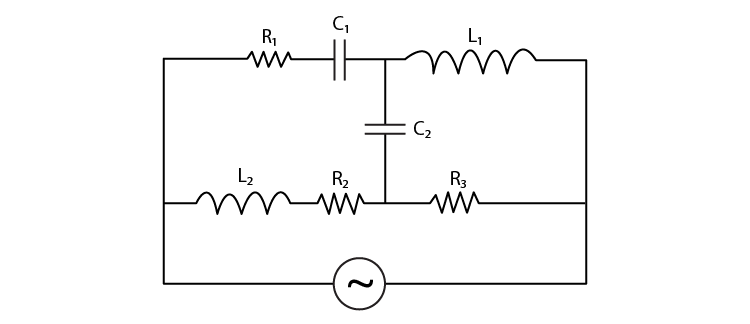
Draw the effective equivalent circuit of the circuit shown in Fig 7.1, at very high frequencies and find the effective impedance.

Exemplar Solutions Class 12 Physics Chapter 7 - 1

Show solutionHide solution
Worked solution

The effective impedance = Zeq = R1 + R3

Q7.16Written answer

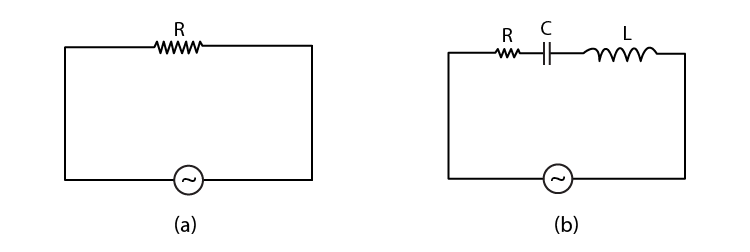
Study the circuits (a) and (b) shown in Fig 7.2 and answer the following questions.

Exemplar Solutions Class 12 Physics Chapter 7 - 2

(a) Under which conditions would the rms currents in the two circuits be the same? (b) Can the rms current in the circuit (b) be larger than that in (a)?

Show solutionHide solution
Worked solution

a) (Irms)a = (Irms)b

Xl = Xc

R = √R2 + (Xl – Xc)2

Therefore, Irms will be equal in (a) as well (b) if Xl = Xc

b) For (Irms)b > (Irms)a

√R2 + (Xl – Xc)2 < R

(Xl < Xc)2 < 0

Reactance cannot be negative.

Q7.17Written answer

Can the instantaneous power output of an ac source ever be negative? Can the average power output be negative?

Show solutionHide solution
Worked solution

a) The instantaneous power output of the AC source can be negative when P < 0

b) The average power output cannot be negative as Pav > 0.

Q7.18Written answer

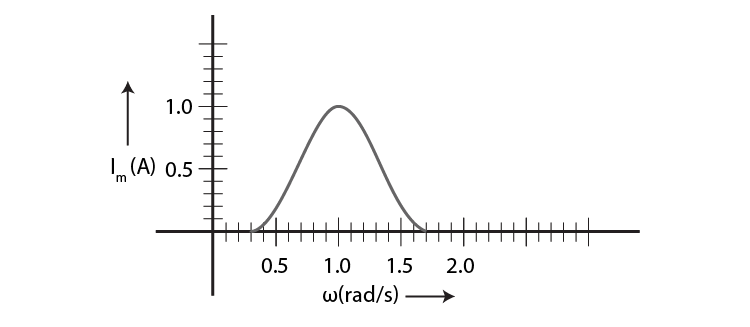
In series LCR circuit, the plot of I max vs ω is shown in Fig 7.3. Find the bandwidth and mark in the figure.

Exemplar Solutions Class 12 Physics Chapter 7 - 3

Show solutionHide solution
Worked solution

Frequency 1 = 0.8 rad/s

Frequency 2 = 1.2 rad/s

The bandwidth = 0.4 rad/s

Q7.19Written answer

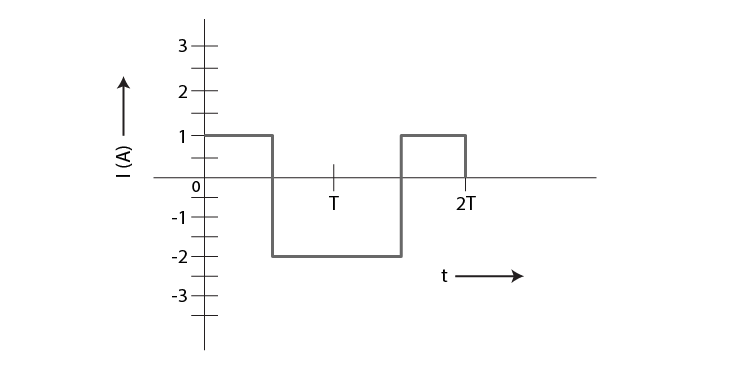
The alternating current in a circuit is described by the graph shown in Fig 7.4. Show rms current in this graph.

Exemplar Solutions Class 12 Physics Chapter 7 - 4

Show solutionHide solution
Worked solution

The Irms = 1.6 A

Q7.20Written answer

How does the sign of the phase angle φ, by which the supply voltage leads the current in an LCR series circuit, change as the supply frequency is gradually increased from very low to very high values.

Show solutionHide solution
Worked solution

tan φ = Xl – Xc/ R

Xl < Xc

At resonate frequency, Xl = Xc

tan φ = 0

Short Answers