My Cart
Your Cart 0

    Your cart is empty.

  • Total (Amount) ₹0.00
NCERT Exemplar · Class 12 · Physics

Chapter 5: Magnetism and Matter

Practice each question, then open the answer or worked solution.

Questions

25 questions
Q5.21Written answer

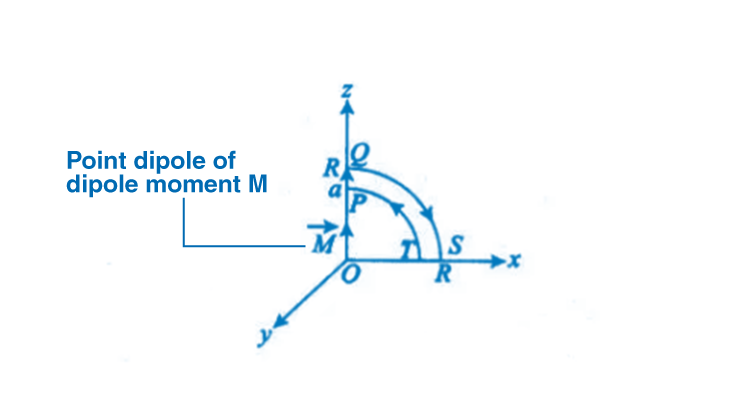
Verify the Ampere’s law for the magnetic field of a point dipole of dipole moment
Exemplar Solutions Class 12 Physics Chapter 5 - 14 Take C as the closed curve running clockwise along i) the z-axis from z = a > 0 to z = R; ii) along the quarter circle of radius R and centre at the origin, in the first quadrant of x-z plane; iii) along the x-axis from x = R to x = a and iv) along the quarter circle of radius a and centre at the origin in the first quadrant of the x-z plane.

Show solutionHide solution
Worked solution

a)
Exemplar Solutions Class 12 Physics Chapter 5 - 15

Along z-axis, magnetic field = μ0M/4π(1/a2-1/R2)

b)

The magnetic field at point A on the circular arc is = μ0m/4πR2

c)
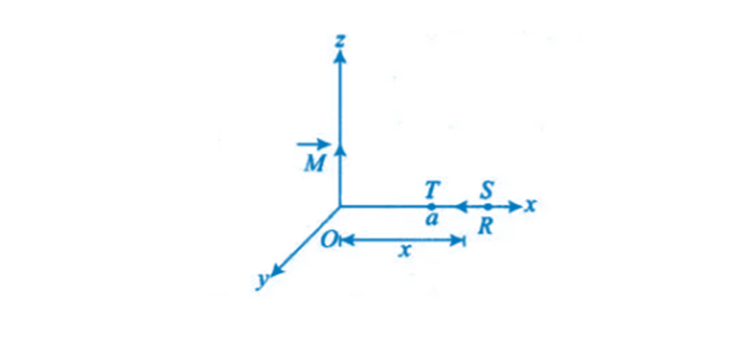
Exemplar Solutions Class 12 Physics Chapter 5 - 16

The magnetic moment is 0

d)

Exemplar Solutions Class 12 Physics Chapter 5 - 17

The magnetic moment is 0

Q5.22Written answer

What are the dimensions of χ, the magnetic susceptibility? Consider an H-atom. Guess an expression for χ, up to a constant, by constructing a quantity of dimensions of χ, out of parameters of the atom: e, m, v, R and μ0. Here, m is the electronic mass, v is electronic velocity, and R is Bohr radius. Estimate the number so obtained and compare it with the value of | χ| equivalent to 10-5 for many solid materials.

Show solutionHide solution
Worked solution

χm = I/H = intensity of magnetisation/magnetising force

χ is dimensionless as I and H have the same units

χ = 10-4

Q5.23Written answer

Assume the dipole model for earth’s magnetic field B, which is given by Bv = vertical component of magnetic field = μ0/4π 2m cos θ/r3, BH = horizontal component of magnetic field = μ0/4π 2m sin θm/r3, θ = 90o latitude as measured from magnetic equator. Find loci of points for which i) |B| is minimum, ii) dip angle is zero, and iii) dip angle is ±45o.

Show solutionHide solution
Worked solution

a) |B| is the minimum at the magnetic equator.

b) Angle of dip is zero when θ = π/2

c) When dip angle is ±45o θ = tan-1 is the locus.

Q5.24Written answer

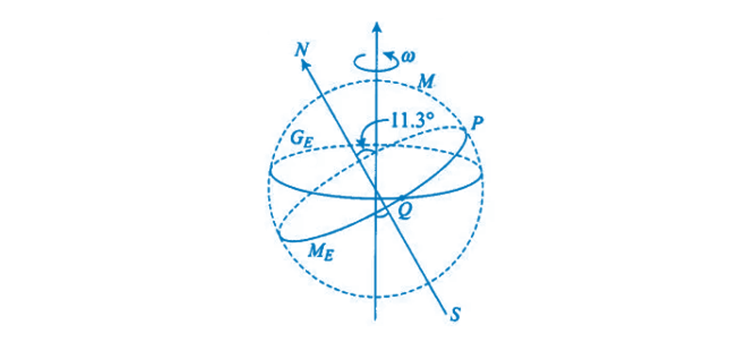
Consider the plane S formed by the dipole axis and the axis of the earth. Let P be a point on the magnetic equator and in S. Let Q be the point of intersection of the geographical and magnetic equators. Obtain the declination and dip angle at P and Q.

Show solutionHide solution
Worked solution

Exemplar Solutions Class 12 Physics Chapter 5 - 18

Point P is in the plane, S is in the north, and the declination is zero.

The declination is zero for point P as the point lies in the plane S formed by the dipole axis and the axis of the earth

The angle of dip is zero for point Q as point Q lies on the magnetic equator, and the angle of declination is 11.3o.

Q5.25Written answer

There are two current-carrying planar coils made each from identical wires of length L. C1 is circular, and C2 is square. They are so constructed that they have the same frequency of oscillation when they are placed in the same uniform B and carry the same current. Find a in terms of R.

Show solutionHide solution
Worked solution

C1 is the circular coil with radius R, length L, and no.of turns per unit length n1 = L/2πR

C2 is the square with side a, perimeter L, and no.of turns per unit length n2 = L/4a

Exemplar Solutions Class 12 Physics Chapter 5 - 19

Magnetic moment of C1 = m1 = n1iA1

Magnetic moment of C2 = m2 = n2iA2

m1 = LiR/2

m2 = Lia/4

Moment of inertia of C1 = I1 = MR2/2

Moment of inertia of C2 = Ma2/12

Solving the above, we get a = 3R

Magnetism is a property which explains the phenomenon of two interactive objects which are magnetic in nature and portray the virtue of an attractive or repulsive force. The electrons in an atom move in a certain motion, leading to the phenomenon of magnetism occurring.

Important concepts covered in Chapter 5, Magnetism and Matter, are listed below:

    1. Magnetism Introduction
    2. Bar Magnet – formula derivation and problems
      1. The magnetic field lines
      2. Bar magnet as an equivalent solenoid
      3. The dipole in a uniform magnetic field
      4. The electrostatic analogue>
    3. Magnetism and Gauss’s Law – Statement, derivation, numerical
    4. The Earth’s Magnetism
      1. Magnetic declination and dip
    5. Magnetisation and Magnetic Intensity – Net magnetic moment per unit volume derivation and calculation
    6. Magnetic Properties of Materials
      1. Diamagnetism
      2. Paramagnetism
      3. Ferromagnetism