My Cart
Your Cart 0

    Your cart is empty.

  • Total (Amount) ₹0.00
NCERT Exemplar · Class 12 · Physics

Chapter 5: Magnetism and Matter

Practice each question, then open the answer or worked solution.

Questions

25 questions
Q5.11Written answer

A proton has a spin and magnetic moment, just like an electron. Then, why is its effect neglected in the magnetism of materials?

Show solutionHide solution
Worked solution

The comparison between the spinning of a proton and an electron is done by comparing their magnetic dipole moment, which is given as

μp = eh/4πmp

μe = eh/4πme

μp/μe = me/mp = 1/1837 >> 1

μp << μe
Q5.12Written answer

A permanent magnet in the shape of a thin cylinder of length 10 cm has M = 106 A/m. Calculate the magnetisation current I m.

Show solutionHide solution
Worked solution

Intensity of magnetisation = 106 A/m

Length, l = 0.1 m

M = IM/l

IM = Ml = 105 A

Q5.13Written answer

Explain the order of magnitude difference between the diamagnetic susceptibility of N2 and Cu quantitatively.

Show solutionHide solution
Worked solution

The density of nitrogen = 28 g/ 22400 cc

The density of copper = 8 g/ 22400 cc

Ratio of densities = 16 × 10-4

Diamagnetic susceptibility = density of nitrogen/density of copper = 1.6 × 10⁻⁴

Q5.14Written answer

From a molecular viewpoint, discuss the temperature dependence of susceptibility for diamagnetism, paramagnetism, and ferromagnetism.

Show solutionHide solution
Worked solution

The temperature dependence of susceptibility for a diamagnetism is not much affected by the temperature.

The temperature dependence of susceptibility for paramagnetism and ferromagnetism is affected by the temperature that is, as the temperature rises, the magnetic moments get disturbed.

Q5.15Written answer

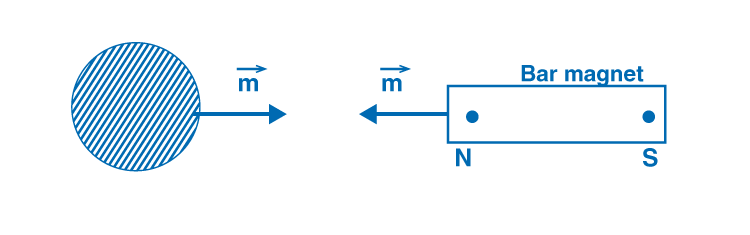
A ball of superconducting material is dipped in liquid nitrogen and placed near a bar magnet. i) In which direction will it move? ii) What will be the direction of its magnetic moment?

Show solutionHide solution
Worked solution

Exemplar Solutions Class 12 Physics Chapter 5 - 4

i) The superconducting material will move away from the bar magnet.

ii) The direction of the magnetic moment will be from left to right.

Short Answers
Q5.16Written answer

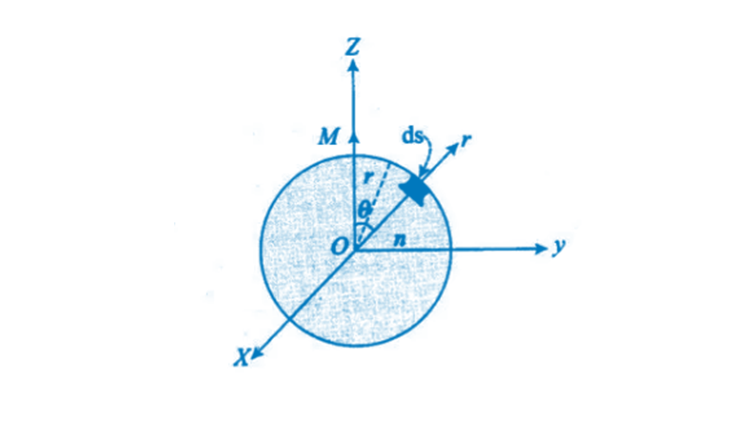
Verify Gauss’s law for the magnetic field of a point dipole of dipole moment m at the origin for the surface, which is a sphere of radius R.

Show solutionHide solution
Worked solution

Exemplar Solutions Class 12 Physics Chapter 5 - 5

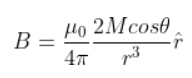
P is the point at a distance r from O and OP, then the magnetic field is given as:

Exemplar Solutions Class 12 Physics Chapter 5 - 6

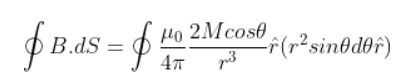
dS is the elementary area of the surface P, then

dS = r2 (r2 sin θ d θr)

Exemplar Solutions Class 12 Physics Chapter 5 - 7

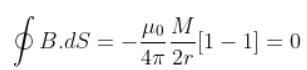
Solving the above, we get,

Exemplar Solutions Class 12 Physics Chapter 5 - 8

Q5.17Written answer

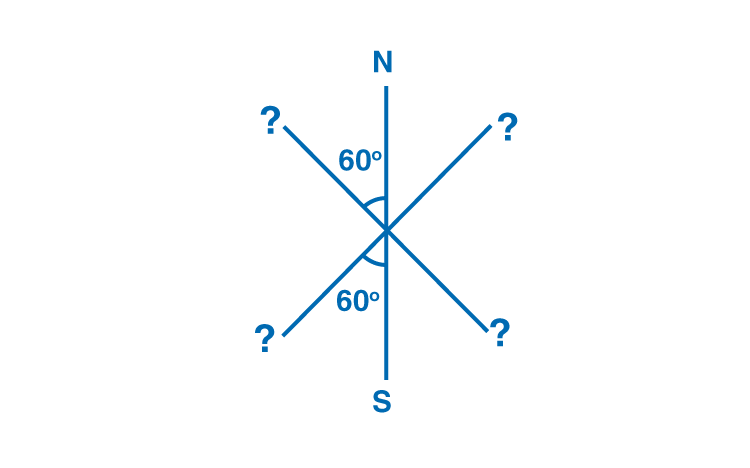
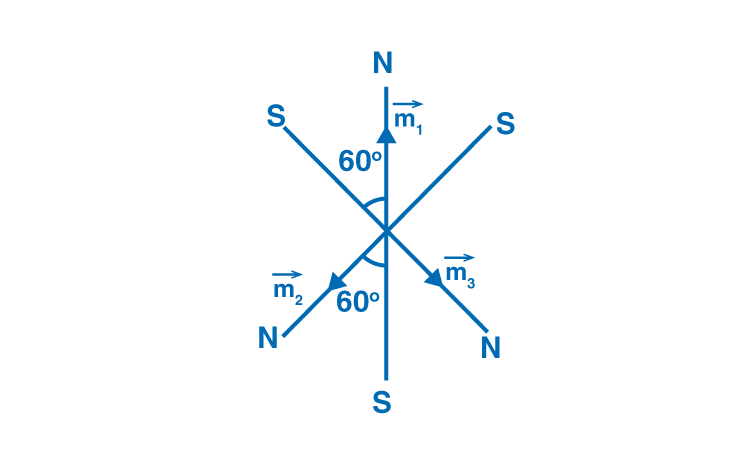
Three identical bar magnets are riveted together at the centre in the same plane, as shown in the figure. This system is placed at rest in a slowly varying magnetic field. It is found that the system of magnets does not show any motion. The north-south poles of one magnet are shown in the figure. Determine the poles of the remaining two.

Exemplar Solutions Class 12 Physics Chapter 5 - 9

Show solutionHide solution
Worked solution

Exemplar Solutions Class 12 Physics Chapter 5 - 10

The system will have a net torque and the net force equal to zero as the system is in equilibrium.

Q5.18Written answer

Suppose we want to verify the analogy between electrostatic and magnetostatic by an explicit experiment. Consider the motion of i) electric dipole p in an electrostatic field E and ii) magnetic dipole m in a magnetic field B. Write down a set of conditions on E, B, p, m so that the two movements are verified to be identical.

Show solutionHide solution
Worked solution

pE sin θ = μB sin θ

pE = μB

E = cB

pcB = μB

p = μ/c

Q5.19Written answer

A bar magnet of magnetic moment m and moment of inertia I are cut into two equal pieces, perpendicular to the length. Let T be the period of oscillations of the original magnet about an axis through the midpoint, perpendicular to the length, in a magnetic field B. What would be the similar period T’ for each piece?

Show solutionHide solution
Worked solution

T is the time period

I is the moment of inertia

m is the mass of the magnet

B is the magnetic field

T = 2π√I/MB

Magnetic dipole moment M’ = M/2

The time period is given as T’ = T/2

Q5.20Written answer

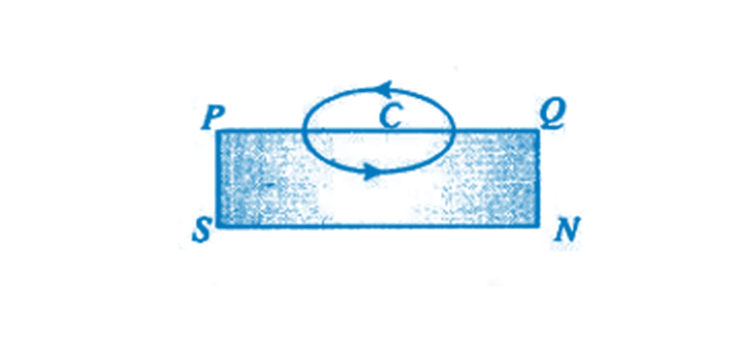
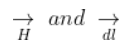
Use i) the Ampere’s law for H and ii) the continuity of lines of B to conclude that inside a bar magnet, a) lines of H run from the N pole to the S pole, while b) lines of B must run from the S pole to N pole.

Show solutionHide solution
Worked solution

Exemplar Solutions Class 12 Physics Chapter 5 - 11

C is the Amperian loop which is given as

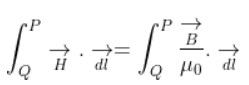
Exemplar Solutions Class 12 Physics Chapter 5 - 12

Solving the above equation, we get the angle between
Exemplar Solutions Class 12 Physics Chapter 5 - 13more than 90o so that cos θ is negative.

Long Answers