My Cart
Your Cart 0

    Your cart is empty.

  • Total (Amount) ₹0.00
NCERT Exemplar · Class 12 · Physics

Chapter 3: Current Electricity

Practice each question, then open the answer or worked solution.

Questions

31 questions
Q3.11Written answer

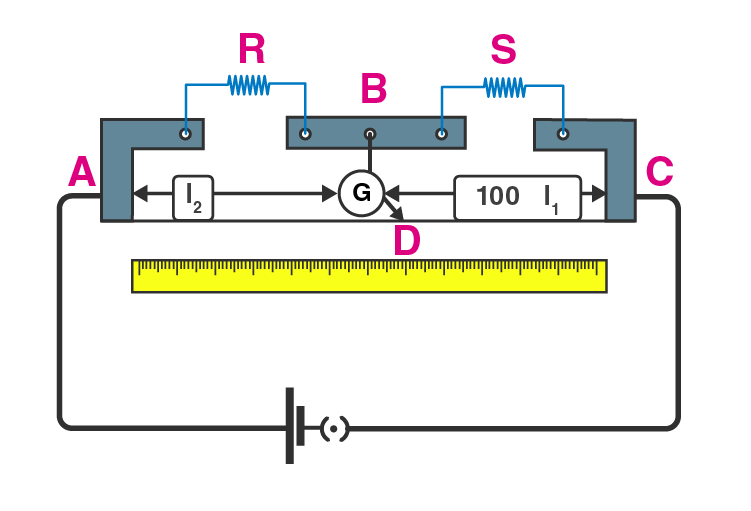
In a meter bridge, point D is a neutral point.
Exemplar Solutions Physics Class 12 Chapter 3 - 4

a) the meter bridge can have no other neutral point for this set of resistances

b) when the jockey contacts a point on meter wire left of D, current flows to B from the wire

c) when the jockey contacts a point on a meter wire to the right of D, current flows from B to the wire through the galvanometer

d) when R is increased, the neutral point shifts to left

Show solutionHide solution
Worked solution

The correct answer is

a) the meter bridge can have no other neutral point for this set of resistances

c) when the jockey contacts a point on a meter wire to the right of D, current flows from B to the wire through the galvanometer

Very Short Answers
Q3.12Written answer

Is the momentum conserved when charge crosses a junction in an electric circuit? Why or why not?

Show solutionHide solution
Worked solution

The momentum is not conserved when the charge crosses a junction in an electric circuit. This is because the drift velocity is proportional to the electric field.

Q3.13Written answer

The relaxation time τ is nearly independent of applied E field whereas it changes significantly with temperature T. First fact is responsible for Ohm’s law whereas the second fact leads to a variation of ρ with temperature. Elaborate why?

Show solutionHide solution
Worked solution

Relaxation time is the time interval between two successive collisions of the electrons.

It is defined as

τ = mean free path/rms velocity of electrons

Usually, the drift velocity of the electrons is small because there is a frequent collision between the electrons.

ρ = 1/σ = m/ne2τ

Q3.14Written answer

What are the advantages of the null-point method in a Wheatstone bridge? What additional measurements would be required to calculate R unknown by any other?

Show solutionHide solution
Worked solution

The advantage of a null-point in the Wheatstone bridge is that the resistance of the galvanometer is not affected by the balance point. The R unknown is calculated by using Kirchhoff’s rule.

Q3.15Written answer

What is the advantage of using thick metallic strips to join wires in a potentiometer?

Show solutionHide solution
Worked solution

The advantage of using thick metallic strips is that the resistance of these strips are negligible.

Q3.16Written answer

For wiring in the home, one uses Cu wires or Al wires. What considerations are involved in this?

Show solutionHide solution
Worked solution

The main considerations in the selection of the wires is the conductivity of the metal, cost of metal, and their availability.

Q3.17Written answer

Why are alloys used for making standard resistance coils?

Show solutionHide solution
Worked solution

Alloys are used in the making of the standard resistance coils because they have less temperature coefficient of resistance and the temperature sensitivity is also less.

Q3.18Written answer

Power P is to be delivered to a device via transmission cables having resistance Rc. If V is the voltage across R and I the current through it, find the power wasted and how can it be reduced.

Show solutionHide solution
Worked solution

Power consumed by the transmission lines is given as P = i2Rc

Where Rc is the resistance of connecting cables

Power is given as P = VI

The transmission of power takes place either during low voltage and high current or during high voltage and low current.

Q3.19Written answer

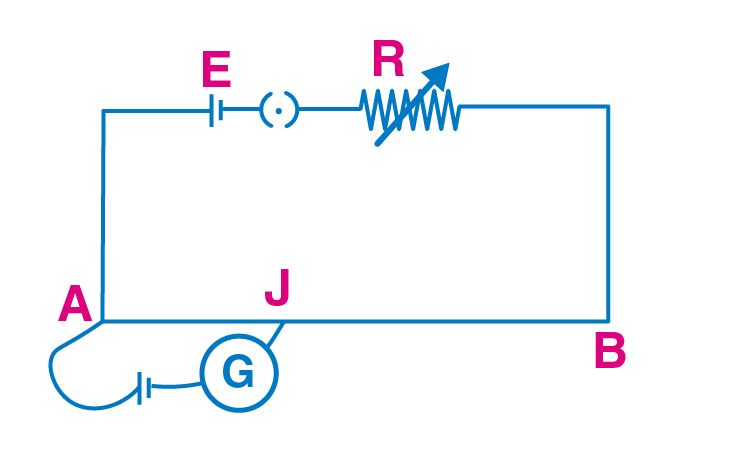
AB is a potentiometer wire. If the value of R is increased, in which direction will the balance point J shift?

Exemplar Solutions Physics Class 12 Chapter 3 - 5

Show solutionHide solution
Worked solution

When the value of R is increased, the potential difference across AB decreased and hence the potential gradient across AB decreases. This is given as E’ = kl

Jockey shifts towards B when the balance length l increases.

Q3.20Written answer

While doing an experiment with potentiometer it was found that the deflection is one-sided and i) the deflection decreased while moving from one end A of the wire to the end B; ii) the deflection increased while the jockey was moved towards end B.

i) Which terminal +ve or –ve of the cell E, is connected at X in case i) and how is E1 related to E?

ii) Which terminal of the cell E1 is connected at X in case ii)?

Show solutionHide solution
Worked solution

i) E is connected to the positive terminal of the cell E1 and it is connected to X. Also, E1 > E

ii) The negative terminal of the cell E1 is connected to X.