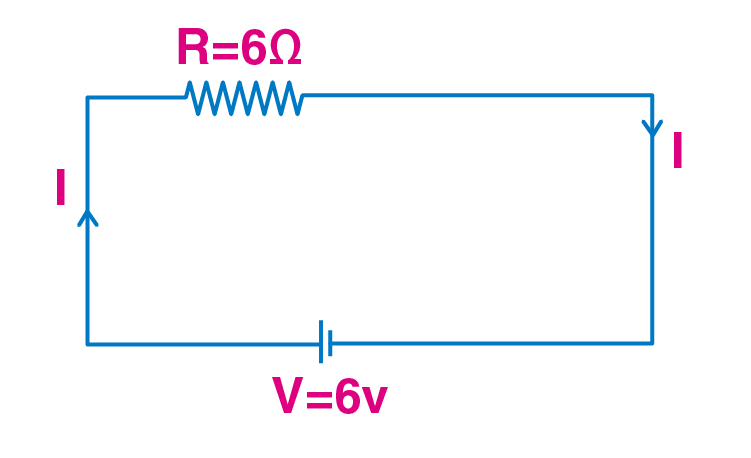
a) Consider the circuit in the figure. How much energy is absorbed by electrons from the initial state of no current to the state of drift velocity?
b) Electrons give up energy at the rate of RI2 per second to the thermal energy. What time scale would one associate with energy in problem a) n = no of electron/volume = 1029/m3, length of circuit = 10 cm, cross-section = A = 1mm2
Show solutionHide solution
a) Current is given as I = V/R from the Ohm’s law
Therefore, I = 1A
But, I = neAvd
vd = I/neA
When the values for the above parameters are substituted, vd = 1/1.6 × 10-4 m/s
The KE = (KE of one electron)(no.of electrons) = 2 × 10-17J
b) Power loss, P = I2R = 6 J/s
P = E/t
E = Pt
t = E/P = 10-17 s
Current electricity, which is also known as electric current, can simply be defined as the flow of electric charge that takes place. The charge that usually occurs takes place with the help of electrons moving through the wire. The charge present can be either ion in an electrolyte or through the ionised gas called plasma.
Concepts Covered in NCERT Exemplar Solutions for Class 12 Physics Chapter 3 Current Electricity| Section Number | Topic |
| 1 | Electric Current – formula derivation, numerical |
| 2 | Electric Currents in Conductors |
| 3 | Ohm’s Law – definition, formula, problems |
| 4 | Drift of Electrons and the Origin of Resistivity |
| 5 | Mobility- definition, formula derivation and problems |
| 6 | Limitations of Ohm’s Law |
| 7 | Resistivity of Various Materials – resistivity chart, their usage in problems |
| 8 | Temperature Dependence of Resistivity – Derivation of resistivity at a temperature formula – Derivation of finite resistance formula and numerical |
| 9 | Electrical Energy, Power – circuit diagrams, derivations, numerical |
| 10 | Combination of Resistors – Series and parallel |
| 11 | Cells, Emf, Internal Resistance – circuit diagrams, derivations, numerical |
| 12 | Cells in Series and in Parallel |
| 13 | Kirchhoff’s Rules – statements, numerical |
| 14 | Wheatstone Bridge – application of Kirchhoff’s rules |
| 15 | Meter Bridge – introduction and application |
| 16 | Potentiometer |