My Cart
Your Cart 0

    Your cart is empty.

  • Total (Amount) ₹0.00
NCERT Exemplar · Class 12 · Physics

Chapter 3: Current Electricity

Practice each question, then open the answer or worked solution.

Questions

31 questions
Q3.21Written answer

A cell of emf E and internal resistance r is connected across an external resistance R. Plot a graph showing the variation of PD across R versus R.

Show solutionHide solution
Worked solution
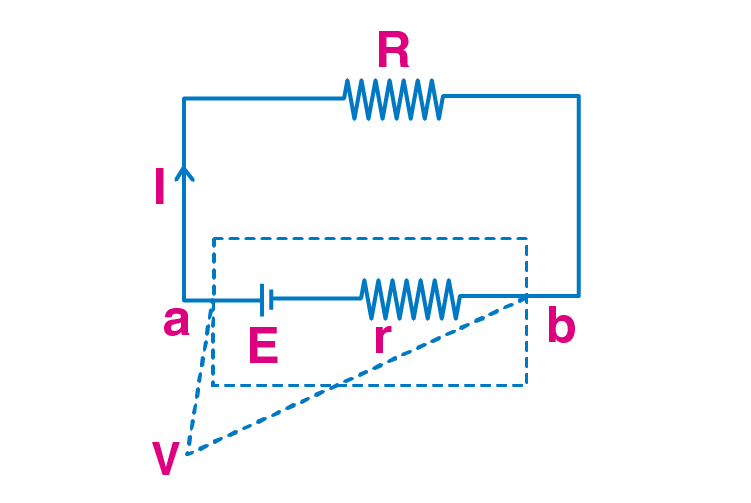
Exemplar Solutions Physics Class 12 Chapter 3 - 6

E is the emf of the cell and r is the resistance which is connected across the external resistance R. The relationship between voltage and R is

V = ER/R+r

When R increases, V approaches closer to E and when E is infinite, V is zero.

Following is the graphical representation:
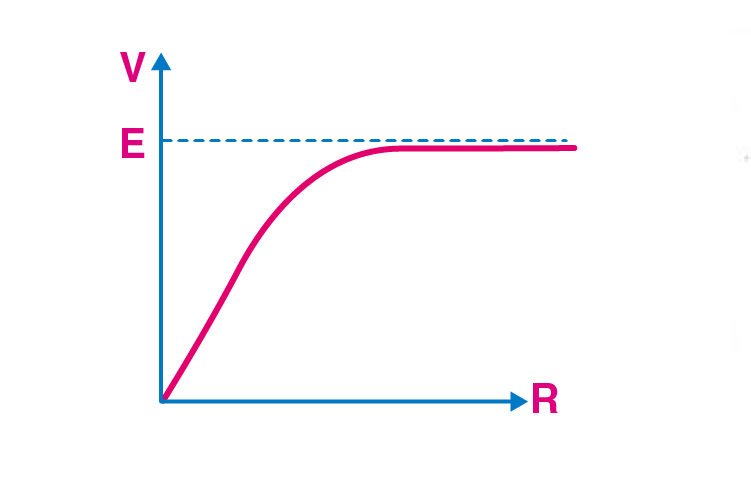
Exemplar Solutions Physics Class 12 Chapter 3 - 7

Short Answers
Q3.22Written answer

First, a set of n equal resistors of R each are connected in series to a battery of emf E and internal resistance R. A current I is observed to flow. Then the n resistors are connected in parallel to the same battery. It is observed that the current is increased 10 times. What is ‘n’?

Show solutionHide solution
Worked solution

When the resistors are in series combination, the current is given as I = E/R+nR

When the resistors are in parallel combination, current is given as 10I = E/(R+R/n)

Solving the two equations, we get

n = 10

Q3.23Written answer

Let there be n resistors R1……..Rn with Rmax = max(R1……Rn) and Rmin = min(R1…….Rn). Show that when they are connected in parallel, the resultant resistance Rp < Rmin and when they are connected in series, the resultant resistance Rs > Rmax. Interpret the result physically.

Show solutionHide solution
Worked solution

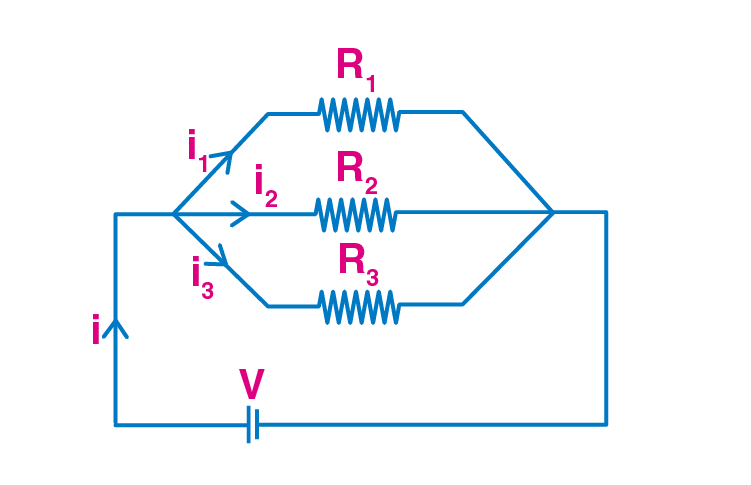
Following is the parallel grouping of the resistance:

Rp = 1/R1 + 1/R2 + …. + 1/Rn

Rmin/Rp = Rmin/R1 + Rmin/R2 + …..+Rmin/Rn

The RHS is equal to 1

Therefore, Rp < Rmin

Exemplar Solutions Physics Class 12 Chapter 3 - 8

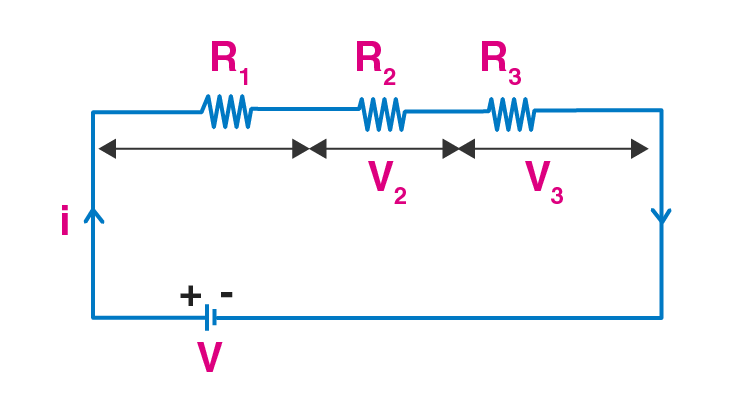
Following is the series grouping of the resistance:

Rs = R1 + R2 + …… + Rn

Rs = R1 + ….. +Rmax+…..+Rn

Rs = Rmax(R1+……..Rn)

Exemplar Solutions Physics Class 12 Chapter 3 - 9

Therefore, series combination has an equivalent resistance of resistors which is greater than the maximum resistance in parallel combination.

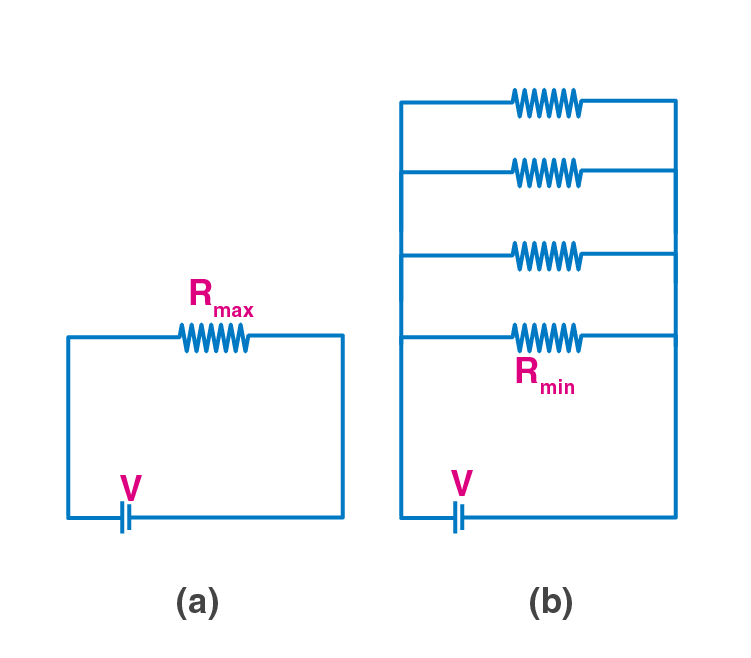
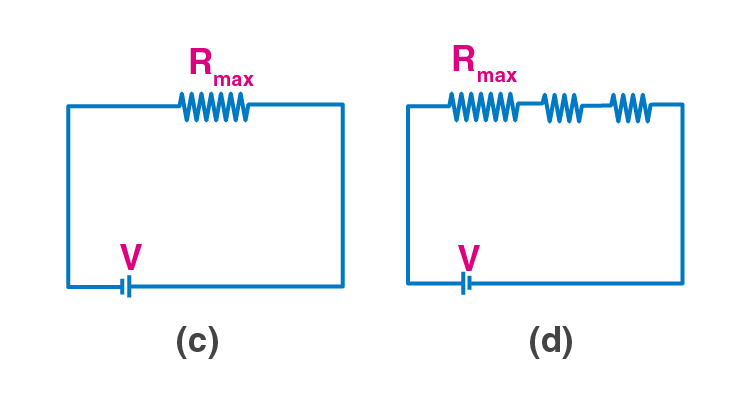
Physical interpretation is:

Exemplar Solutions Physics Class 12 Chapter 3 - 10

Exemplar Solutions Physics Class 12 Chapter 3 - 11

Q3.24Written answer

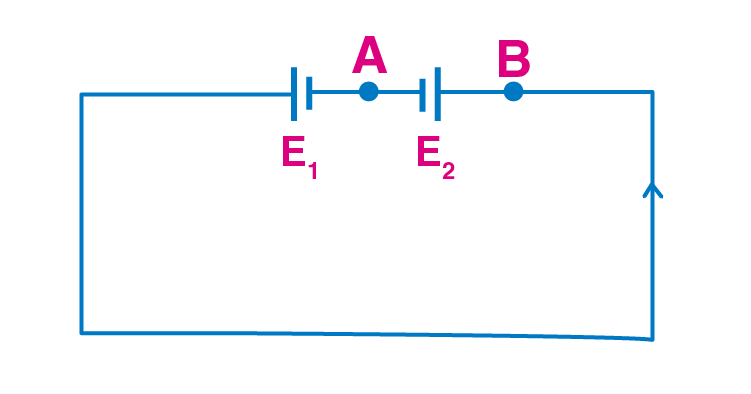
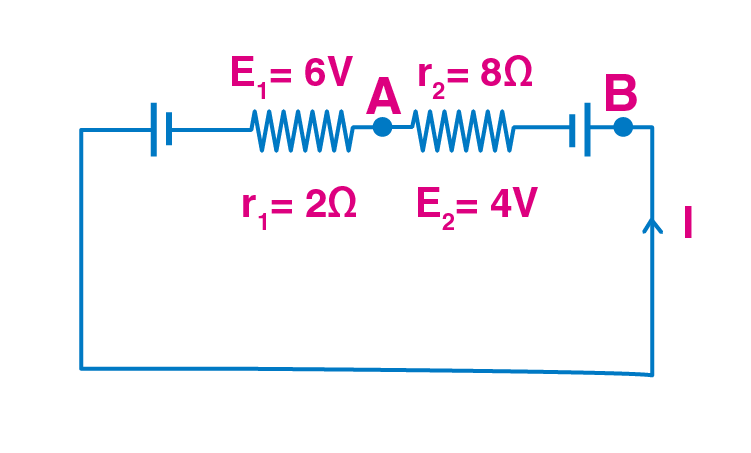
The circuit in the figure shows two cells connected in opposition to each other. Cell E1 is of emf 6V and internal resistance 2Ω; the cell E2 is of emf 4V and internal resistance 8 Ω. Find the potential difference between the points A and B.

Exemplar Solutions Physics Class 12 Chapter 3 - 12

Show solutionHide solution
Worked solution

Exemplar Solutions Physics Class 12 Chapter 3 - 13

Applying Ohm’s law, equivalent emf of the two cells = 6 – 4 = 2V

Equivalent resistance = 2 + 8 = 10 Ω

Electric current, I = 6-4/2+8 = 0.2A

When the loop is considered in the anti-clockwise direction, E1 > E2 which means VB > VA

Therefore, VB – VA = 3.6 V

Q3.25Written answer

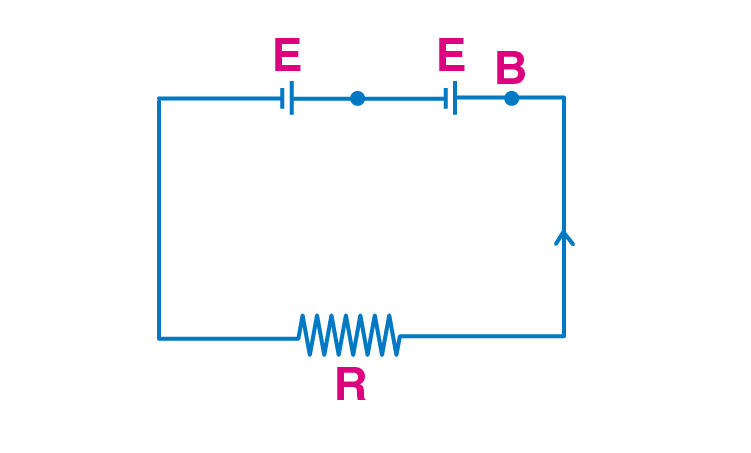
Two cells of same emf E but internal resistance r1 and r2 are connected in series to an external resistor R. What should be the value of R so that the potential difference across the terminals of the first cell becomes zero.

Exemplar Solutions Physics Class 12 Chapter 3 - 14

Show solutionHide solution
Worked solution

Effective emf of two cells = E + E = 2E

Effective resistance = R + r1 + r2

Electric current is given as

I = 2E/R+r1+r2

Potential difference is given as

V1 – E – Ir1 = 0

Which f=gives R = r1 – r2

Q3.26Written answer

Two conductors are made of the same material and have the same length. Conductor A is a solid wire of diameter 1 mm. Conductor B is a hollow tube of outer diameter 2 mm and inner diameter 1 mm. Find the ratio of resistance RA to RB.

Show solutionHide solution
Worked solution

Resistance of wire R = ρ l/A

Where A is the cross-sectional area of the conductor

L is the length of the conductor

ρ is the specific resistance

RA = ρl/π(10-3 × 0.5)2

RB = ρl/ π[10-3)2 × (0.5 × 10-3)2]

Therefore, the ratio is RA/RB = 3:1

Q3.27Written answer

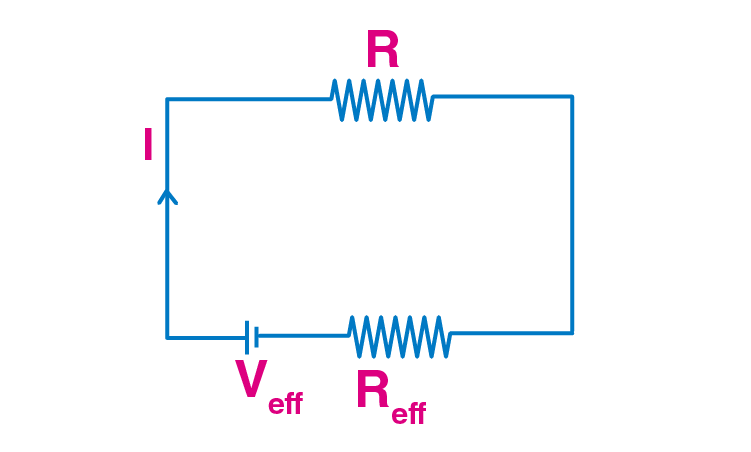
Suppose there is a circuit consisting of only resistances and batteries and we have to double all voltages and all resistances. Show that currents are unaltered.

Show solutionHide solution
Worked solution

Exemplar Solutions Physics Class 12 Chapter 3 - 15

Reff is the equivalent internal resistance of the battery

Veff is the equivalent voltage of the battery

Using Ohm’s law,

I = Veff/(Reff + R)

When the resistance and effective voltage are increased by n-times,

Veff = nVeff

Reff = n Reff

Rnew = nR

Then current is given as

I’ = bVeff/nReff + nR = Veff/Reff + R = I

Long Answers
Q3.28Written answer

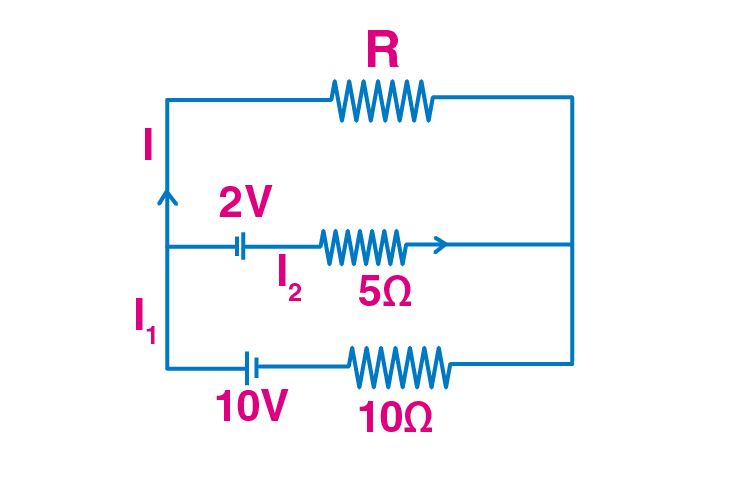
Two cells of voltage 10V and 2V and internal resistances 10Ω and 5Ω respectively are connected in parallel with the positive end of the 10V battery connected to the negative pole of 2V battery. Find the effective voltage and effective resistance of the combination.

Exemplar Solutions Physics Class 12 Chapter 3 - 16

Show solutionHide solution
Worked solution

Exemplar Solutions Physics Class 12 Chapter 3 - 17

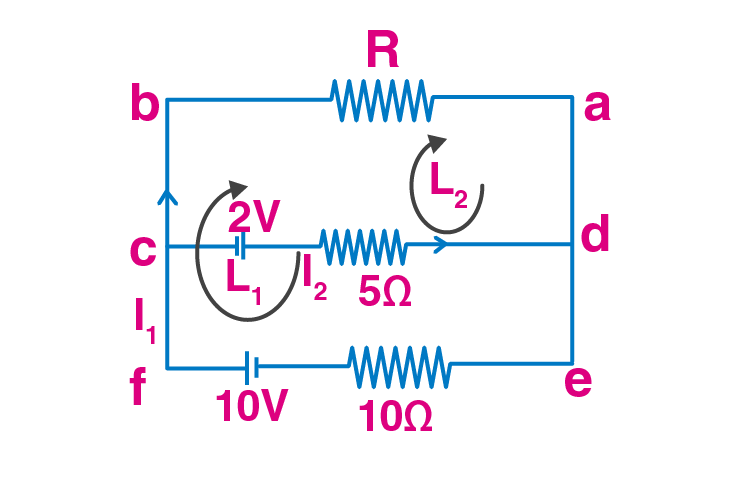
Kirchhoff’s law is applied at c, I1 = I + I2

Kirchhoff’s law is applied at efbae, 10 – IR – 10I2 = 0

10 = IR + 10I1

Kirchhoff’s law is applied at cbadc, -2-IR+5I2 = 0

2 = 5I2- RI

I2 = I1 – I

Substituting the values we get

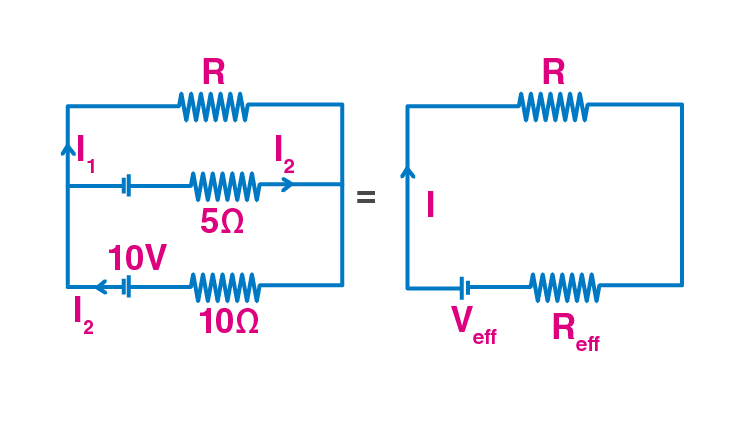
Equivalent internal resistance of the two cells as (10/3) Ohms

Following is the equivalent circuit when the combination of 5 and 10 Ohm are used

Exemplar Solutions Physics Class 12 Chapter 3 - 18

Q3.29Written answer

A room has AC run for 5 hours a day at a voltage of 220V. The wiring of the room consists of Cu of 1 mm radius and a length of 10 m. Power consumption per day is 10 commercial units. What fraction of it goes in the joule heating in wires? What would happen if the wiring is made of aluminium of the same dimensions?

Show solutionHide solution
Worked solution

Power consumption in a day = 10 units

Power consumption per hour = 2 units

Power consumption = 2 units = 2 kW = 2000 J/s

Power consumption in resistors, P = VI

Which gives I = 9A

We know that resistance, R = ρ l/A

Substituting the values we get, resistance = 4 J/s

This is used in the calculation of power loss in Al wire = 6.4 J/s

Fractional loss in the second wire due to Joule heating is = 0.32%

Q3.30Written answer

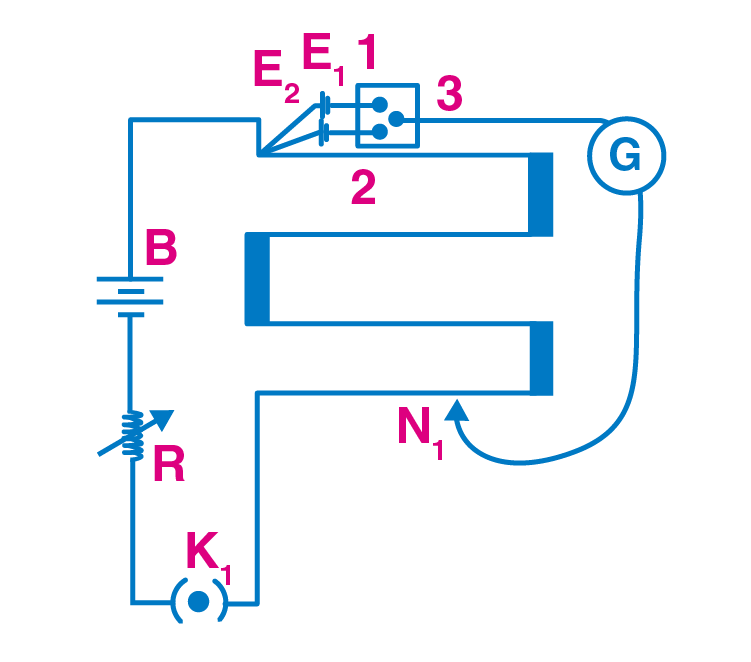
In an experiment with a potentiometer, VB = 10V. R is adjusted to be 50 Ω. A student wanting to measure voltage E1 of a battery finds no null point possible. He then diminishes R to 10 Ω and is able to locate the null point on the last segment of the potentiometer. Find the resistance of the potentiometer wire and potential drop per unit length across the wire in the second case.

Exemplar Solutions Physics Class 12 Chapter 3 - 19

Show solutionHide solution
Worked solution

Equivalent resistance of the potentiometer = 50 Ohm + R’

Equivalent voltage across the potentiometer = 10 V

Current through the main circuit I = 10/(50 Ohms +R’)

Potential difference across wire of potentiometer is:

When 50 ohms resistors is used

2R’ < 400

R’ < 200 Ohms

When 10 Ohm resistor is used

160 < R’ < 200

When the resistor is between 160 Ohms and 200 Ohms,

The potential gradient is given as

k > 2 V/m

When the potential drop across 300 cm wire is < 8 V

k < 2 2/3 V/m