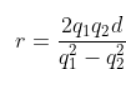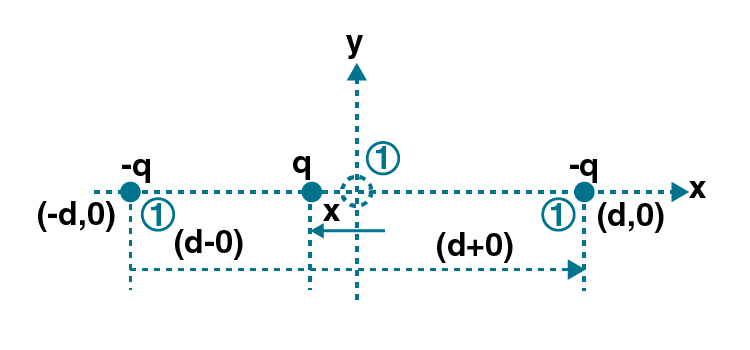
In the above figure, +q is the charge that got displaced from O towards (-d,0).
This is written as
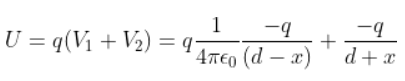
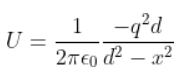
At x = 0
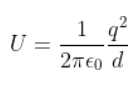
Differentiating the equation with respect to x, we get
When x < 0, dU/dx > 0
And when x > 0, dU/dx < 0
Using this, we can define the charge on the particle to be F = -dU/dx
F = -dU/dx = 0
When
d2U/dx2 = positive, equilibrium is stable
d2U/dx2 = negative, equilibrium is unstable
d2U/dx2 = 0, equilibrium is neutral
Therefore, when x = 0, d2U/dx2 = (-2dq2/4πε0)(1/d6)(2d2) < 0
Which shows that the system is in unstable equilibrium.
Electric charges which are slow or stationary is called Electrostatic Charge, and the amount of work needed to move from one initial point to another is termed Electrostatic Potential. It can be measured in volts and is a scalar quantity. Capacitance, on the other hand, can be defined as the ability of a capacitor to store energy. They are measured in farads.
Important Concepts Covered in NCERT Exemplar Electrostatic Potential and Capacitance
| Sl.No. |
Concept Name |
| 1 |
Electrostatic Potential – derivation of the electric formula |
| 2 |
Potential Due to a Point Charge – relation between electric charge and potential |
| 3 |
Potential Due to an Electric Dipole – derivation of potential access formula |
| 4 |
Potential Due to a System of Charges – derivation of the potential energy of a system of two charges |
| 5 |
Equipotential Surfaces – derivation of potential due to charge |
| 6 |
The Relation between Field and Potential:
- Potential Energy of a System of Charges
- Potential Energy in an External Field
- Potential Energy of a Single Charge
|
| 7 |
Potential Energy of a System of Two Charges in an External Field |
| 8 |
Potential Energy of a Dipole in an External Field |
| 9 |
Electrostatics of Conductors in Different Conditions, Electro-shielding |
| 10 |
Dielectrics and Polarisation – meaning dielectric constant derivation |
| 11 |
Capacitors and Capacitance – meaning, capacitance derivation and problems |
| 12 |
The Parallel-Plate Capacitor – meaning and derivation |
| 13 |
Effect of Dielectric on Capacitance – derivations and numerical problems |
| 14 |
Combination of Capacitors – capacitors in series, capacitors in parallel |
| 15 |
Energy Stored in a Capacitor – Energy density of electric field, derivation |
| 16 |
Van De Graaff Generator – introduction, applications |