My Cart
Your Cart 0

    Your cart is empty.

  • Total (Amount) ₹0.00
NCERT Exemplar · Class 12 · Physics

Chapter 2: Electrostatic Potential and Capacitance

Practice each question, then open the answer or worked solution.

Questions

33 questions
Q2.21Written answer

Prove that if an insulated, uncharged conductor is placed near a charged conductor and no other conductors are present, the uncharged body must be intermediate in potential between that of the charged body and that of infinity.

Show solutionHide solution
Worked solution

The electric potential decreasing along the direction of the electric field is given as E = dV/dr

The electric potential decreases when the path from the charged conductor is taken to the uncharged conductor along the direction of the electric field.

This continues when another uncharged conductor is considered to the infinity lowering the potential even further.

This shows that the uncharged body is at intermediate potential, and the charged body is at infinity potential.
Q2.22Written answer

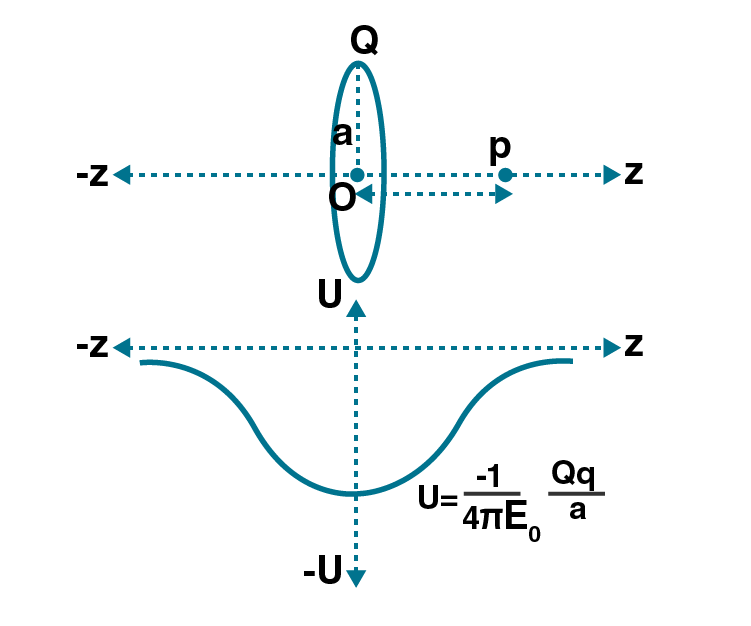
Calculate the potential energy of a point charge –q placed along the axis due to charge +Q uniformly distributed along a ring of radius R. Sketch PE as a function of axial distance z from the centre of the ring. Looking at the graph, can you see what would happen if –q is displaced slightly from the centre of the ring?

Show solutionHide solution
Worked solution

Exemplar Solutions Class 12 Physics Chapter 2 - 9

U is the potential energy of a point charge q which is placed at potential V, U = qV

A negatively charged particle is placed at the axis of the ring with charge Q

Let a be the radius of the ring

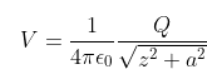
The electric potential at the axial distance is given as

Exemplar Solution Class 12 Physics Chapter 2 Img 7

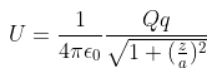
The potential energy, U is given as

Exemplar Solution Class 12 Physics Chapter 2 Img 8

When z = infinity, U = 0.

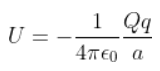
When z = 0, U is given as

Exemplar Solution Class 12 Physics Chapter 2 Img 9

Q2.23Written answer

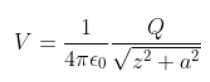
Calculate potential on the axis of a ring due to charge Q uniformly distributed along the ring of radius R.

Show solutionHide solution
Worked solution

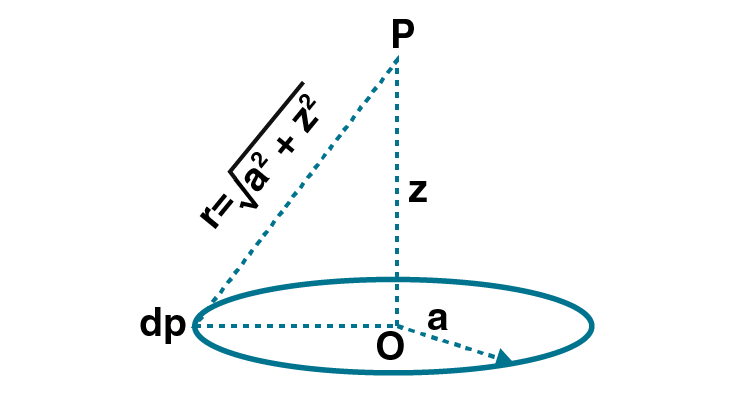
Exemplar Solutions Class 12 Physics Chapter 2 - 10

Point P is considered to be at a distance z from the centre of the ring. The charge dq is at a distance z from point P.

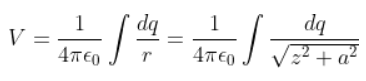
V is written as

Exemplar Solution Class 12 Physics Chapter 2 Img 10

Therefore, the net potential is given as

Exemplar Solution Class 12 Physics Chapter 2 Img 11

Long Answers
Q2.24Written answer

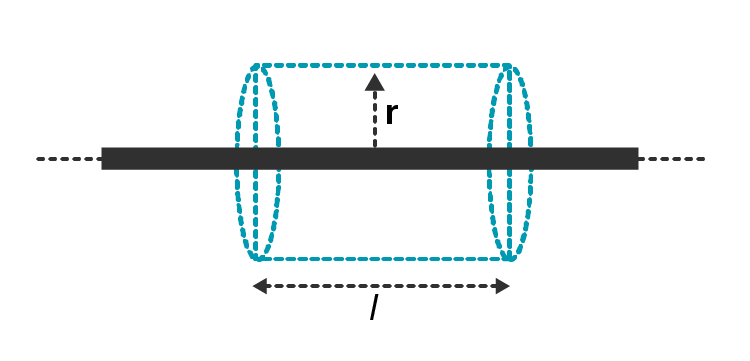
Find the equation of the equipotential for an infinite cylinder of radius r0, carrying charge of linear density λ.

Show solutionHide solution
Worked solution

Exemplar Solutions Class 12 Physics Chapter 2 - 11

The equation of the equipotential for an infinite cylinder of radius r0 with linear charge density λ is given as:

r = r0e 2πε0/ λ [V(r) – V(r0)]

Q2.25Written answer

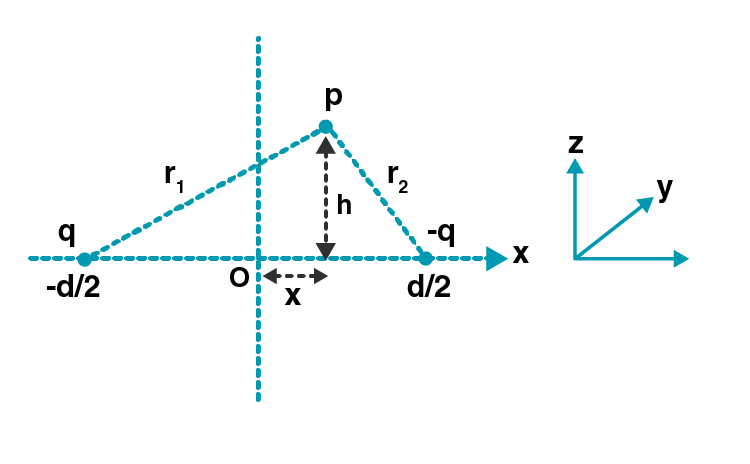
Two-point charges of magnitude +q and –q are placed at (-d/2, 0, 0) and (d/2, 0, 0), respectively. Find the equation of the equipotential surface where the potential is zero.

Show solutionHide solution
Worked solution

Exemplar Solutions Class 12 Physics Chapter 2 - 12

The potential at point P due to charges is given as

Vp = 1/4πε0 q/r1 + 1/4 πε0 (-q)/r2

The net electric potential at this point is zero,

Therefore, r1 = r2

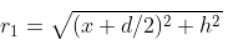
We know that

Exemplar Solution Class 12 Physics Chapter 2 Img 12

Exemplar Solution Class 12 Physics Chapter 2 Img 13

To solve the two equations, we require the equation in-plane x = 0, which is a y-z plane.

Q2.26Written answer

A parallel plate capacitor is filled by a dielectric whose relative permittivity varies with the applied voltage (U) as ε = αU where α = 2V-1. A similar capacitor with no dielectric is charged to U0 = 78 V. It is then connected to the uncharged capacitor with the dielectric. Find the final voltage on the capacitors.

Show solutionHide solution
Worked solution

Since the capacitors are connected in parallel, the potential difference across the capacitors is the same. The final voltage is assumed to be U. C is the capacitance of the capacitor without dielectric, then the charge is given as Q1 = CU

The initial charge is given as

Q0 = CU0

The conversion of charges is

Q0 = Q1 + Q2

CU0 = CU + αCU2

αU2 + U – U0 = 0

Solving the equation, we get U = 6V

Q2.27Written answer

A capacitor is made of two circular plates of radius R each, separated by a distance d < < R. The capacitor is connected to a constant voltage. A thin conducting disc of radius r < < R and thickness t < < r is placed at the centre of the bottom plate. Find the minimum voltage required to lift the disc if the mass of the disc is m.

Show solutionHide solution
Worked solution

When the conducting disc is placed at the centre of the bottom plate, the potential of the disc is equal to the potential of the plate. The electric field on the disc is given as

E = V/d

The charge q’ is transferred to the disc, which is given as

q’ = -ε0 V/d πr2

The force acting on the disc is

F = ε0 V2/d2 πr2

Therefore, V = square root of mdg/ π ε0r2

Q2.28Written answer

a) In a quark model of elementary particles, a neutron is made of one up quark and two down quarks. Assume that they have a triangle configuration with a side length of the order of 10-15 m. Calculate the electrostatic potential energy of the neutron and compare it with its mass 939 MeV.

b) Repeat the above exercise for a proton which is made of two up and one down quarks.

Show solutionHide solution
Worked solution

There are three charges in the system. The potential energy of the system is equal to the sum of the PE of each pair.

U = 1/4 π ε0 {qdqd/r – quqd/r – quqd/r}

Substituting the values we get,

U = 5.11 10-4

Q2.29Written answer

Two metal spheres, one of radius R and the other of radius 2R, both have the same surface charge density σ. They are brought in contact and separated. What will be the new surface charge densities on them?

Show solutionHide solution
Worked solution

Following are the charges on the metal sphere before contact

Q1 = σ.4πR2

Q2 = σ.4π(2R)2 = 4Q1

Q1’ and Q2’ are the charges on the metal sphere after contact

Q1’ + Q2’ = Q1 + Q2 = 5Q1

When the metal spheres are in contact, the following is the potentials acquired by them

Q1’ = Q2’/2

Solving the equations we

σ1 = 5 σ/3

σ2 = 5 σ/6

Q2.30Written answer

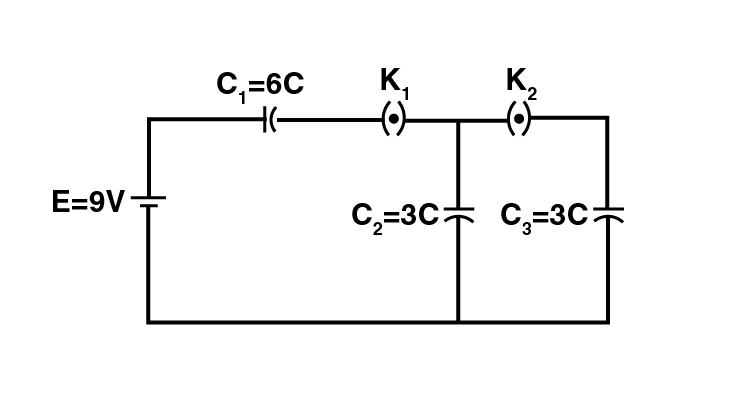
In the circuit shown in the figure, initially, K1 is closed, and K2 is open. What are the charges on each capacitor? Then K1 was opened, and K2 was closed. What will be the charge on each capacitor now?

Exemplar Solutions Class 12 Physics Chapter 2 - 13

Show solutionHide solution
Worked solution

Exemplar Solutions Class 12 Physics Chapter 2 - 17

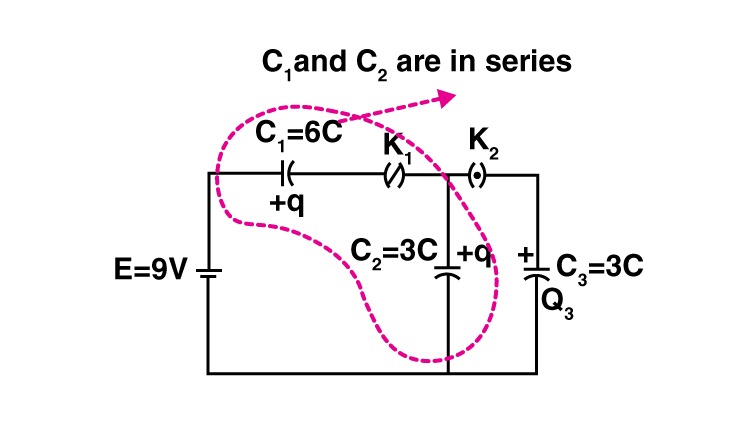
When K1 is closed, and K2 is open, the capacitors C1 and C2 are connected in series with the battery

Therefore, the charge in capacitors C1 and C2 are

Q1 = Q2 = q = (C1C2/C1+C2)E = 18μC

Exemplar Solutions Class 12 Physics Chapter 2 - 18

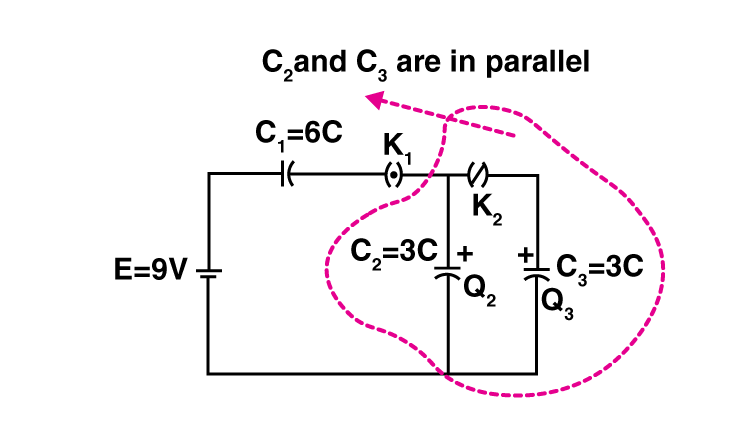
When the capacitors C2 and C3 are placed in parallel,

C2V’ + C3V’ = Q2

V’ = Q2/C2 + C3 = 3V

Therefore,

Q2’ = 3CV’ = 9 μC

Q3’ = 3CV’ = μC

Q1’ = 18 μC