My Cart
Your Cart 0

    Your cart is empty.

  • Total (Amount) ₹0.00
NCERT Exemplar · Class 12 · Physics

Chapter 15: Communication Systems

Practice each question, then open the answer or worked solution.

Questions

30 questions
Q15.21Written answer

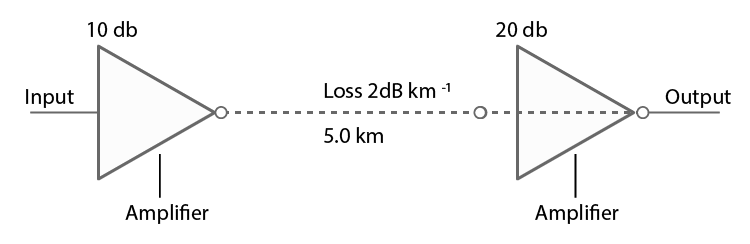
Figure 15.3 shows a communication system. What is the output power when the input signal is of 1.01mW? (gain in dB = 10 log10 (Po /Pi ).

Exemplar Solutions Class 12 Physics Chapter 15 - 3

Show solutionHide solution
Worked solution

Loss suffered in the path of transmission = 2 dB/km

Distance travelled by the signal = 5 km

Total loss suffered = -10 dB

Totla amplifier gain = 30 dB

Overall gain in signal = 20 dB

Gain in dB = 2

Input power = 1.01 mW

Po = 1.01 × 100

Output power is 101 mW.

Q15.22Written answer

A TV transmission tower antenna is at a height of 20 m. How much service area can it cover if the receiving antenna is (i) at ground level, (ii) at a height of 25 m? Calculate the percentage increase in area covered in case (ii) relative to case (i).

Show solutionHide solution
Worked solution

i) Range , it = 16 km

Area covered = 803.84 km2

ii) Height from ground level = 25 m

Range = dm = 33.9 km

Area covered = 3608.52 km2

Percentage increase in area = 348.9 %

Q15.23Written answer

If the whole earth is to be connected by LOS communication using space waves (no restriction of antenna size or tower height), what is the minimum number of antennas required? Calculate the tower height of these antennas in terms of earths radius?

Show solutionHide solution
Worked solution

Let ht be the height of the receiving antenna

Then ht = hr where r is the radius of the earth

Let dm be the line of sight distance between the transmission and receiving antennas,

Then the maximum distance is R = ht.

Q15.24Written answer

The maximum frequency for reflection of sky waves from a certain layer of the ionosphere is found to be f max = 9(Nmax) 1/2, where Nmax is the maximum electron density at that layer of the ionosphere. On a certain day, it is observed that signals of frequencies higher than 5MHz are not received by reflection from the F1 layer of the ionosphere while signals of frequencies higher than 8MHz are not received by reflection from the F2 layer of the ionosphere. Estimate the maximum electron densities of the F1 and F2 layers on that day.

Show solutionHide solution
Worked solution

Maximum frequency = fmax = 9(Nmax)1/2

fmax = 5 MHz

Nmax = 3.086 ×10¹¹ m3

fmax = 8 MHz

Nmax = 7.9 × 10¹¹/m3

Q15.25Written answer

On radiating (sending out) an AM modulated signal, the total radiated power is due to energy carried by ωc, ωc – ωm & ωc + ωm. Suggest ways to minimise the cost of radiation without compromising on information

Show solutionHide solution
Worked solution

Total radiated power due to energy carried by ωc, (ωc – ωm) and (ωc + ωm).

Sideband frequencies are generally close to the carrier frequency.

Only the sideband frequencies carry information in an amplitude modulated signal.

Long Answers
Q15.26Written answer

(i) The intensity of a light pulse travelling along a communication channel decreases exponentially with distance x according to the relation I = Ioe–αx, where I o is the intensity at x = 0 and α is the attenuation constant. Show that the intensity reduces by 75 per cent after a distance of (ln 4/α)

(ii) Attenuation of a signal can be expressed in decibel (dB) according to the relation dB =10 log10 (I/I0). What is the attenuation in dB/km for an optical fibre in which the intensity falls by 50 per cent over a distance of 50 km?

Show solutionHide solution
Worked solution

i) The decrease in the intensity is reduced by 75%.

ii) The attenuation of the given optical fibre = 0.0602 dB/km

Q15.27Written answer

A 50 MHz sky wave takes 4.04 ms to reach a receiver via re-transmission from a satellite 600 km above earth’s surface. Assuming re-transmission time by satellite negligible, find the distance between source and receiver. If communication between the two was to be done by Line of Sight (LOS) method, what should size and placement of receiving and transmitting antenna be?

Show solutionHide solution
Worked solution

Velocity of waves = 3 × 10⁸ m/s

Time to reach a receiver = 4.04 × 10⁻³ s

Height of satellite, h = 600 km

Radius of earth = 6400 km

Size of transmitting antenna = ht

Velocity of waves = 606 km

d = 85.06 km

Distance between source and receiver = 2d = 170 km

Maximum distance covered = ht

ht = 565 m

Q15.28Written answer

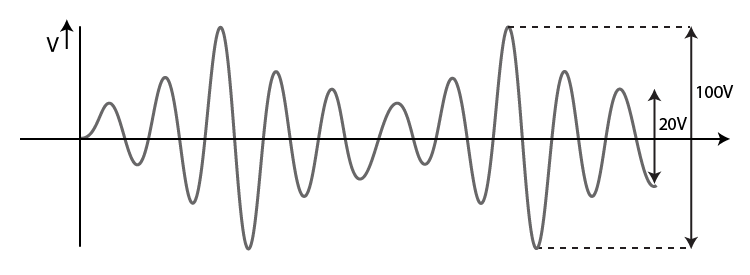
An amplitude modulated wave is as shown in the figure. Calculate

(i) the percentage modulation

(ii) peak carrier voltage and

(iii) peak value of information voltage

Exemplar Solutions Class 12 Physics Chapter 15 - 4

Show solutionHide solution
Worked solution

Maximum voltage, Vmax = 100/2 = 50 V

Minimum voltage, Vmin = 20/2 = 10 V

i) Percentage modulation = 66.67%

ii) Peak carrier voltage, Vc = 30 V

iii) Peak value of information voltage = 20 V

Q15.29Written answer

(i) Draw the plot of amplitude versus ‘ω’ for an amplitude modulated wave whose carrier wave (ωc ) is carrying two modulating signals, ω1 and ω2 (ω2 > ω1). [Hint: Follow derivation from Eq 15.6 of NCERT Textbook of XII]

(ii) Is the plot symmetrical about ωc? Comment especially about plot in region ω < ωc

(iii) Extrapolate and predict the problems one can expect if more waves are to be modulated

(iv) Suggest solutions to the above problem. In the process can one understand another advantage of modulation in terms of bandwidth?

Show solutionHide solution
Worked solution

ii) The plot is not symmetrical

iii) There are chances of mixing of signals

iv) By increasing the bandwidth and frequency of the carrier waves, more signals can be accommodated.

Q15.30Written answer

An audio signal is modulated by a carrier wave of 20MHz such that the bandwidth required for modulation is 3kHz. Could this wave be demodulated by a diode detector which has the values of R and C as

(i) R = 1 kΩ, C = 0.01µF

(ii) R = 10 kΩ, C = 0.01µF

(iii) R = 10 kΩ, C = 0.1µF

Show solutionHide solution
Worked solution

Carrier wave frequency, fc – 20 MHz = 20 × 106 Hz

Bandwidth = 2fm = 3 × 10³ Hz

fm = 1.5 × 10³ Hz

1/fc = 0.5 × 10⁻⁷

1/fm = 0.7 × 10⁻³

i) 1/fc << RC < 1/fm

Therefore, it can be demodulated

ii) 1/fc << RC << 1/fm

Therefore, it can be demodulated

iii) 1/fc < RC

Therefore, it cannot be demodulated

Communication systems are a collection of systems used for transmission, connection, communication and interconnection. These systems are categorically arranged into three different types based on uses, such as media, technology and application area. Sensors, transducers, emitters and amplifiers are all examples of modern technology which are used as components in the majority of modern devices.

Major Examples of General Communication Systems
  1. E-mail
  2. Internet
  3. Television
  4. Radio
  5. Computer
Concepts Discussed in Chapter 15 Communication System 
    1. Introduction
    2. Elements of a Communication System
    3. Basic Terminology Used in Electronic Communication Systems
    4. Bandwidth of Signals
    5. Bandwidth of Transmission Medium
    6. Propagation of Electromagnetic Waves
      1. Ground wave
      2. Skywaves
      3. Space wave
    7. Modulation and Its Necessity
    8. Size of the Antenna or Aerial
    9. Effective Power Radiated by an Antenna Ex 15.7.3 – Mixing up of Signals from Different Transmitters
    10. Amplitude Modulation
    11. Production of Amplitude Modulated Wave
    12. Detection of Amplitude Modulated Wave